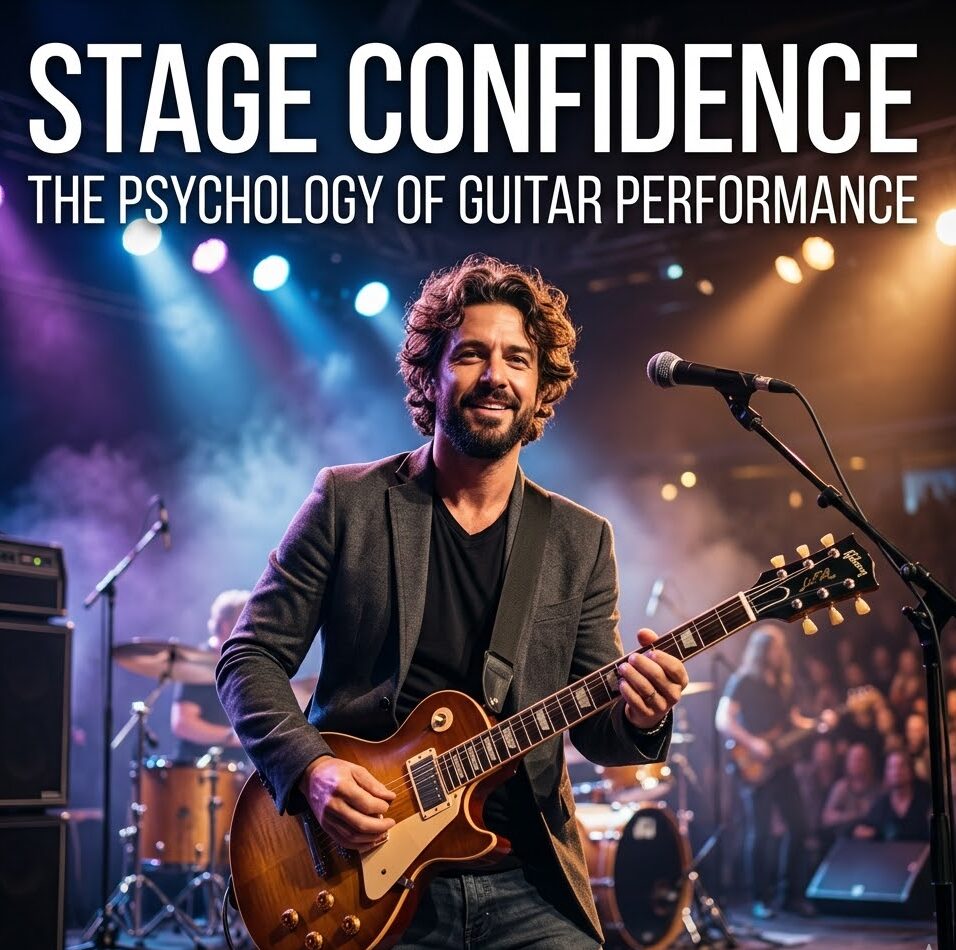
Stage Confidence | The Psychology of Guitar Performance
Stage confidence plays a crucial role in every guitarist’s performance journey. Most guitarists dream of playing effortlessly, moving smoothly across the fretboard, and earning genuine appreciation from their audience. However, many musicians face an unexpected challenge when they step from the practice room onto the stage: performance anxiety. Even after hours of preparation, they often find their confidence wavering as the stage lights come on and the audience focuses on every note they play.
Stage confidence is often misunderstood as a personality trait that some musicians naturally possess while others lack. In reality, confidence is largely a psychological skill that can be developed through understanding, preparation, and experience. The difference between a nervous performer and a confident one is rarely the absence of fear. More often, it lies in how that fear is managed and transformed into productive energy.
Understanding the psychology behind guitar performance can help musicians approach the stage with greater assurance. By recognizing what happens mentally and emotionally before and during a performance, players can develop strategies that allow their skills to shine when it matters most.

Understanding Stage Confidence and Performance Anxiety
The nervousness that appears before a performance is a completely natural human response. Long before modern concerts existed, humans evolved to be highly aware of social evaluation. Being observed by a group naturally increases alertness because the brain interprets public scrutiny as a situation requiring heightened attention.
As a result, many guitarists experience symptoms such as increased heart rate, sweaty palms, shallow breathing, or racing thoughts before stepping on stage. While these reactions may feel uncomfortable, they are not signs that something is wrong. Instead, they represent the body’s attempt to prepare for an important event.
Problems arise when musicians interpret these sensations negatively. A guitarist who notices a fast heartbeat may assume they are losing control, which increases anxiety further. Meanwhile, another performer may view the same sensation as excitement and readiness. The physical response is similar, but the psychological interpretation creates entirely different outcomes.
Recognizing this distinction is often the first step toward developing stronger stage confidence.

The Gap Between Practice and Stage Confidence
Many musicians become frustrated when they can play flawlessly during practice sessions but struggle during live performances. This difference is not necessarily caused by a lack of skill. Rather, the brain operates differently under pressure.
Practice environments are usually predictable and comfortable. Mistakes carry little consequence, and players can stop, repeat passages, and correct errors immediately. The stage, however, introduces variables that are absent during practice. Audience presence, unfamiliar surroundings, and heightened self-awareness create additional mental demands.
Consequently, performance requires more than technical proficiency. It also demands the ability to maintain focus while managing emotional and environmental distractions. Guitarists who understand this reality stop viewing stage mistakes as evidence of inadequate preparation. Instead, they recognize that performing itself is a separate skill that deserves dedicated practice.
This shift in perspective often leads to healthier expectations and greater resilience.

The Role of Self-Talk in Performance
One of the most powerful influences on stage confidence is the internal dialogue that occurs before and during a performance. Many musicians unknowingly sabotage themselves through negative self-talk.
Thoughts such as “I can’t make any mistakes,” “Everyone will notice if I mess up,” or “I’m not good enough to be here” place enormous pressure on the performer. Rather than focusing on music, attention becomes consumed by fear and self-judgment.
Confident performers are not necessarily more talented. Frequently, they have simply learned to replace destructive thoughts with supportive ones. Their internal dialogue may sound more like, “I’ve prepared for this,” “It’s okay to be nervous,” or “My goal is to share the music.”
Such statements do not eliminate anxiety entirely, but they prevent fear from dominating the performance experience. Over time, positive self-talk becomes a valuable tool for maintaining composure under pressure.

Why Perfectionism Can Hurt Stage Confidence
Many guitarists believe confidence will arrive once they can perform flawlessly. Unfortunately, perfectionism often creates the opposite effect.
When musicians set unrealistic standards, every small mistake feels significant. Attention shifts from musical expression to error avoidance, creating tension that actually increases the likelihood of mistakes. A single missed note can trigger frustration, leading to further lapses in concentration.
The audience, however, rarely evaluates performances with the same level of scrutiny as the performer. Most listeners respond to emotion, energy, and connection far more than technical perfection.
For this reason, successful performers learn to accept imperfections as part of live music. Confidence grows when musicians trust their ability to recover gracefully rather than demanding mistake-free performances. The ability to continue playing smoothly after an error is often more valuable than avoiding mistakes altogether.

Building Trust in Your Preparation
Confidence is closely connected to preparation. Not because preparation guarantees perfection, but because it creates a sense of security.
When a guitarist has consistently practiced material, the brain develops confidence in its ability to execute the required skills. Repetition strengthens neural pathways, making movements more automatic and reliable under pressure.
However, effective preparation involves more than simply playing songs repeatedly. Musicians benefit from recreating performance conditions during practice. Playing through an entire piece without stopping, recording practice sessions, or performing for friends and family can help bridge the gap between practice and the stage.
As familiarity with performance situations increases, uncertainty decreases. This process gradually builds trust, allowing musicians to focus more on expression and less on survival.

The Importance of Audience Connection
Anxiety often becomes stronger when performers focus excessively on themselves. Every movement, every note, and every potential mistake becomes magnified under self-conscious observation.
A helpful psychological shift occurs when attention moves away from self-evaluation and toward audience connection. Instead of asking, “How am I doing?” performers begin asking, “How can I communicate this music effectively?”
This change transforms the purpose of performance. The stage becomes less about proving ability and more about sharing an experience. Audiences generally respond positively to authenticity, and musicians who focus on communication often appear more confident regardless of their skill level.
Interestingly, performers who prioritize connection frequently discover that their anxiety diminishes naturally because their attention is directed outward rather than inward.

Developing a Strong Stage Confidence Mindset
Stage confidence is not something that appears suddenly on the day of a concert. It is developed gradually through consistent mental training.
Visualization can be particularly effective. Imagining a successful performance helps the brain become familiar with the experience before it occurs. Athletes have used this technique for decades, and musicians can benefit from it in similar ways.
Breathing exercises also play an important role. Slow, controlled breathing signals safety to the nervous system and helps reduce physical symptoms of anxiety. Combined with positive self-talk and realistic expectations, these techniques create a stronger mental foundation for performance.
Most importantly, confidence grows through repeated exposure. Each performance provides evidence that nervousness can be managed and that challenges can be overcome. Even imperfect performances contribute to long-term growth.
Turning Nervous Energy Into Stage Confidence
Many performers spend years trying to eliminate nervousness completely. Yet some of the most experienced musicians still feel butterflies before stepping on stage.
The key difference is that they no longer view nervousness as an enemy. Instead, they recognize it as energy that can enhance focus, engagement, and passion. The same adrenaline that causes anxiety can also create excitement and intensity in a performance.
Rather than fighting these feelings, confident musicians learn to channel them into their playing. What once felt like fear becomes a source of presence and vitality.
This perspective changes the entire performance experience. The goal shifts from avoiding nervousness to using it effectively.

Conclusion
Stage confidence does not belong only to naturally outgoing or fearless musicians. Every guitarist can develop it through preparation, the right mindset, and consistent performance experience. Throughout their musical journey, guitarists face moments of doubt, uncertainty, and nervous anticipation. Instead of treating these feelings as weaknesses, they can view them as a natural part of growth and progress.
When musicians understand their thoughts, regulate their emotions, and focus on communicating through music, they build confidence over time. They stop seeing the stage as a place of judgment and start embracing it as an opportunity to connect with listeners, express themselves, and share their passion for music. Whether they learn on their own or through Guitar Lessons Online, regular practice and performance help them strengthen their confidence with each step.
Ultimately, true stage confidence does not mean eliminating fear. It means stepping onto the stage despite it and trusting the preparation, passion, and perseverance that support every performance. At The Mystic Keys, we encourage musicians to develop this confidence so they can perform authentically and fully enjoy the experience of sharing music with an audience.
For more information and exciting resources about learning music, visit our website at The Mystic Keys. For more music content and exciting offers follow us on
Facebook, Instagram, YouTube, LinkedIn, Twitter, Pinterest, and Threads.