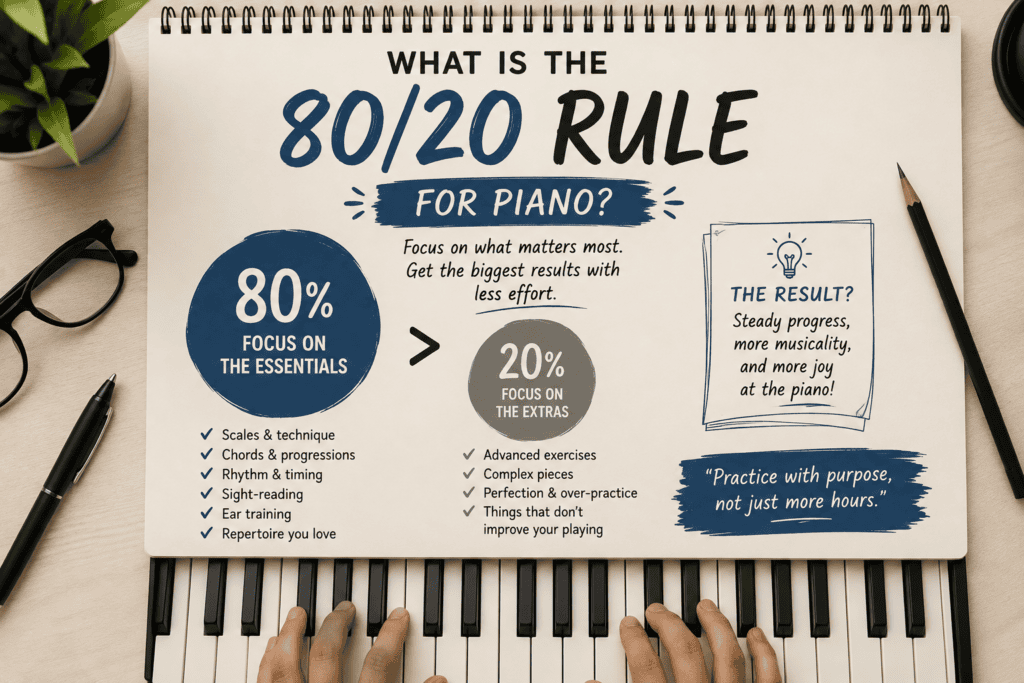
What Is the 80/20 Rule for Piano?
Learning piano does not always require spending countless hours at the instrument. What matters more is how those hours are used. The 80/20 Rule for Piano is a practical way of thinking about practice that encourages pianists to identify the small number of activities that produce the greatest improvements. Instead of trying to practice everything equally, you learn to focus your time and energy on the areas that have the biggest impact on your playing.
The idea comes from the broader Pareto Principle, which suggests that a relatively small portion of causes can produce a large portion of results. In piano practice, this does not mean that exactly 20 percent of your practice will always produce exactly 80 percent of your progress. Rather, it is a useful principle for identifying what deserves the most attention. A pianist with only thirty minutes available may achieve more by working carefully on difficult chord transitions, rhythm, sight-reading, or a specific technical weakness than by simply playing through an entire piece repeatedly.
The principle is especially useful for modern learners who have limited practice time. Students may have school, work, family responsibilities, or other commitments that make long practice sessions difficult. Learning to practice strategically allows you to make meaningful progress even when your available time is limited.
Understanding the 80/20 Rule for Piano Practice
The basic idea is simple: identify the activities that create the greatest improvement and give them priority.
For one pianist, the most valuable 20 percent may involve scales and technical exercises. For another, it may be chord progressions, rhythm, ear training, or learning difficult sections of repertoire. The important thing is to understand what your playing actually needs.
Not All Practice Produces the Same Results
Two students can practice for the same amount of time and make completely different progress.
One student may spend thirty minutes repeatedly playing a piece from beginning to end without stopping to correct mistakes. Another may spend the same thirty minutes identifying two difficult passages, practicing them slowly, improving the fingering, and then connecting them to the surrounding sections.
The second approach is more focused because it targets the specific problem.
This is where the 80/20 mindset becomes useful. Instead of measuring practice only by time, measure it by the quality and relevance of the work being done.
Identify the Skills That Matter Most
Before applying the principle, you need to understand your priorities.
Ask yourself what would make the biggest difference to your playing right now.
Perhaps your rhythm is inconsistent. Maybe your chord changes are slow. You might struggle with sight-reading, left-hand coordination, scales, memorization, or playing with both hands.
These weaknesses are more important than spending equal amounts of time on skills you already perform comfortably.
Focus on Your Biggest Musical Bottlenecks
A bottleneck is an area that prevents you from progressing efficiently.
For example, if you know all the notes of a piece but cannot maintain a steady rhythm, additional note-reading practice may not solve the real problem.
Instead, rhythm exercises and metronome practice may produce a much greater improvement.
Finding these bottlenecks is one of the most effective ways to make your practice more purposeful.
Spend More Time on Difficult Sections

One of the simplest applications of the 80/20 principle is to stop treating every measure of a piece equally.
If 90 percent of a piece is comfortable but 10 percent consistently causes mistakes, that difficult section deserves most of your attention.
Many students make the mistake of starting at the beginning and playing through the entire piece every time they practice. This can feel productive, but it may not address the actual problem.
Isolate the Problem Areas
Take the difficult measure or phrase and practice it separately.
Start slowly.
Analyze the fingering.
Repeat the movement accurately.
Then connect the difficult section to the measures before and after it.
A few focused minutes on a difficult passage can sometimes produce more improvement than several complete run-throughs.
Use the 80/20 Rule for Technical Practice
Technical exercises can be extremely useful, but they should have a purpose.
Pianists do not need to practice every exercise available simply because it appears in a method book.
Instead, choose exercises that address the skills you actually need.
If your playing requires better finger independence, select exercises that develop independence. If you struggle with scales, focus on scales that relate to your current repertoire.
Practice Technique That Transfers to Music
Technical practice becomes more valuable when you can recognize its connection to actual playing.
For example, if a scale exercise improves your finger coordination, apply that coordination to a musical passage.
If chord exercises improve your transitions, use those transitions in songs.
The objective is not to collect exercises. It is to develop skills that improve your musicianship.
Prioritize Rhythm and Timing 80/20 Rule for Piano
Rhythm is one of the highest-impact areas of piano playing.
A pianist can know every note of a piece and still struggle to sound confident if the rhythm is inconsistent.
This makes rhythm practice a particularly valuable use of limited practice time.
Use a Metronome Strategically 80/20 Rule for Piano
A metronome can help you identify rushing, hesitation, uneven subdivisions, and inconsistent tempo.
Start at a tempo where you can play accurately.
Once the rhythm is stable, increase the speed gradually.
Rather than using the metronome only to increase speed, use it to develop control.
A steady sense of rhythm improves nearly every aspect of piano playing, making it an excellent example of a high-value practice skill.
Focus on the Parts of Music You Struggle With Most
The 80/20 principle encourages honest self-assessment.
It is natural to spend more time playing the sections we already enjoy because they feel successful.
However, the areas that challenge us often contain the greatest opportunities for improvement.
Don’t Practice Only What Feels Easy
If a particular chord progression repeatedly causes hesitation, work on it.
If your left hand is weaker than your right, give it focused attention.
If you struggle with reading both clefs, include sight-reading in your practice routine.
Progress often happens fastest when practice is directed toward the areas that need improvement rather than the areas that already feel comfortable.
Use the 80/20 Rule for Repertoire
Choosing the right repertoire can also make practice more effective.
A piece should challenge you enough to develop new skills without being so difficult that progress becomes frustrating.
The most useful pieces often contain techniques that you want to improve.
Choose Music That Teaches You Something
If you are working on arpeggios, choose repertoire that uses them.
If you want better chord transitions, choose pieces with useful chord patterns.
If you want to develop musical expression, choose pieces that challenge your ability to shape phrases and dynamics.
This creates a connection between practice and performance.
Practice Fewer Things More Effectively

A common misconception about effective practice is that you need a huge checklist.
In reality, trying to practice too many things can divide your attention.
Instead of practicing ten unrelated exercises for two minutes each, you may achieve more by spending meaningful time on three or four important goals.
Quality Matters More Than Quantity 80/20 Rule for Piano
A focused practice session might include:
- Five minutes of warm-up and technique
- Ten minutes on a difficult passage
- Ten minutes of rhythm or coordination work
- Ten minutes of repertoire
- Five minutes of review
The exact structure can change depending on your goals.
The important part is that each activity has a clear purpose.
Apply the Principle to Sight-Reading
Sight-reading is another area where focused practice can produce significant results.
Instead of repeatedly reading pieces that are far above your current level, choose short examples that are slightly easier and practice reading them without stopping.
This develops fluency and confidence.
Practice Sight-Reading Consistently
A few minutes of daily sight-reading can be more effective than a long session once every few weeks.
The goal is to train your eyes, brain, and hands to respond naturally to written music.
Consistency makes this skill increasingly automatic.
Use Focused Practice Instead of Long Practice

Long practice sessions are not automatically better.
Once concentration decreases, students may begin repeating mistakes without noticing them.
Short, focused sessions can often produce better results because the mind remains engaged.
Make Every Practice Session Intentional
Before sitting at the piano, decide what you want to accomplish.
Instead of saying, “I will practice piano for one hour,” set specific goals such as:
“I will improve the transition in measures 24–28.”
“I will practice this scale at three tempos.”
“I will play this section with the correct dynamics.”
Clear goals make practice easier to evaluate.
Learn to Stop When the Goal Is Achieved
The 80/20 principle also teaches us to avoid unnecessary repetition.
If you have successfully solved a particular problem, you do not always need to spend another thirty minutes repeating it.
Move on to another priority.
This does not mean avoiding repetition altogether. Repetition is essential for building reliable technique and memory. It simply means that repetition should remain purposeful.
Practice With Awareness
Ask yourself whether each repetition is improving something.
If the answer is yes, continue.
If you are simply playing automatically without listening or thinking, change the exercise or take a short break.
The 80/20 Rule and Musical Expression
Technical progress is important, but piano playing is ultimately about making music.
The highest-value practice is not always the most technically difficult.
Sometimes the most important improvement is learning how to shape a phrase, control dynamics, create contrast, or communicate emotion.
Practice What Makes the Music Better
If your notes are already accurate but your performance sounds mechanical, spending another hour on note accuracy may not be the best use of your time.
Instead, experiment with dynamics, articulation, phrasing, tone, and pedaling.
These elements can transform technically correct playing into expressive musicianship.
Conclusion
The 80/20 Rule for Piano is ultimately about practicing with purpose. It encourages pianists to identify the relatively small number of skills, passages, habits, and musical decisions that can create the greatest improvement. Rather than simply accumulating practice hours, you learn to direct your attention toward what your playing actually needs.
This approach does not mean taking shortcuts or avoiding hard work. It means making your hard work more intelligent. Focus on difficult passages instead of repeatedly playing what you already know. Prioritize rhythm, coordination, technique, ear training, and musical expression according to your current goals. Choose repertoire that develops useful skills, practice consistently, and regularly evaluate what is actually improving.
The most effective pianist is not necessarily the person who spends the most hours at the instrument. It is often the pianist who knows what to practice, why it matters, and how to use limited time effectively.
At The Mystic Keys, our personalized Piano Lessons Online help students build effective practice habits alongside technique, musical expression, sight-reading, rhythm, and performance skills. With one-on-one guidance from experienced teachers, students can identify their individual goals and develop a structured approach that makes every practice session more meaningful.
For more information and exciting resources about learning music, visit our website at The Mystic Keys. For more music content and exciting offers follow us on
Facebook, Instagram, YouTube, LinkedIn, Twitter, Pinterest, and Threads.