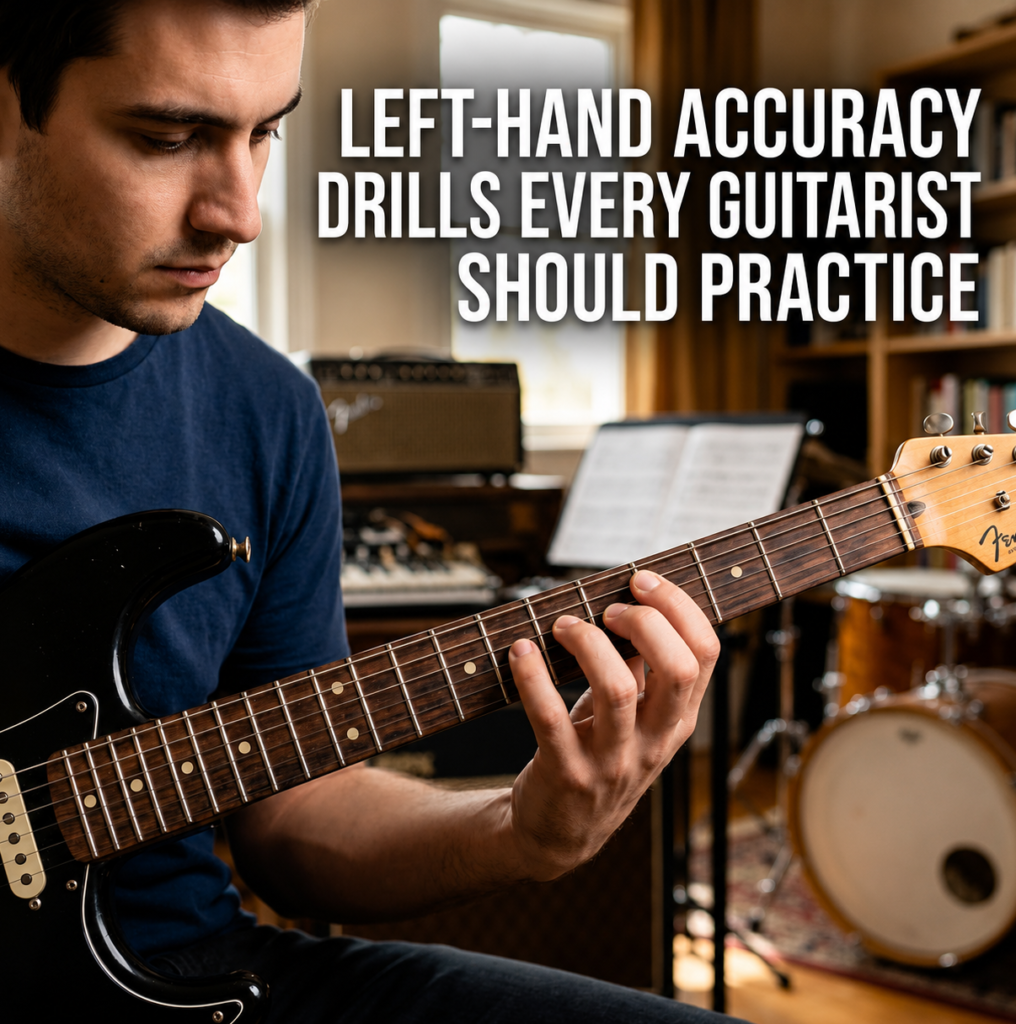
Left-Hand Accuracy Drills Every Guitarist Should Practice
Whether you are a beginner struggling with basic chord changes or an advanced guitarist working on solos and intricate techniques, improving left-hand accuracy should always remain part of your practice routine. Speed may impress listeners for a moment, but precision creates the kind of playing that feels effortless and professional.
The good news is that left-hand accuracy can be developed through focused exercises. With consistent practice, the fingers become stronger, more independent, and better coordinated with the picking hand. Let’s explore some essential drills that every guitarist should include in their practice sessions.

Understanding the Importance of Left-Hand Accuracy
Before diving into exercises, it is important to understand what left-hand accuracy actually means. It is not simply about hitting the right fret. True accuracy involves placing your fingers at the correct position, applying the right amount of pressure, moving efficiently between notes, and maintaining control at different speeds.
Many guitarists make the mistake of pressing too hard on the strings or lifting their fingers too far away from the fretboard between notes. These habits create unnecessary tension and slow down movement. A precise player uses only the amount of motion required to produce a clean sound.
Developing accuracy also improves musical expression. Clean bends, smooth vibrato, fast runs, and complicated chord shapes all depend on a reliable left hand. Once your fingers learn to move with control, technical challenges become much easier to overcome.

The Chromatic Finger Exercise | Building Finger Independence
One of the simplest yet most effective left-hand drills is the classic chromatic exercise. Although it looks basic, this exercise trains finger independence, coordination, and control across the entire fretboard.
Start by placing your index finger on the first fret, your middle finger on the second fret, your ring finger on the third fret, and your little finger on the fourth fret. Play each note slowly and clearly before moving to the next string.
The goal is not speed in the beginning. Focus on making every note sound clean while keeping your fingers close to the fretboard. Avoid allowing unused fingers to fly away from the strings, as this creates extra movement that will affect accuracy later.
As your control improves, move the exercise across different areas of the neck. Practicing in various positions helps your fingers adapt to different fret distances and prepares you for real musical situations.

The Spider Walk Drill for Left-Hand Accuracy and Coordination
The spider walk is another excellent exercise for developing finger independence. Unlike simple chromatic patterns, this drill forces your fingers to move in unusual combinations, helping them become more flexible and coordinated.
Begin with your index and ring fingers on adjacent strings while your middle and little fingers remain relaxed. Move across the strings using different finger combinations, making sure each finger lands accurately before playing the note.
This exercise may feel uncomfortable at first because it challenges the natural movement patterns your hand has developed. However, that difficulty is exactly what makes it valuable. It trains weaker fingers, especially the ring and little fingers, to work independently.
With regular practice, the spider walk improves your ability to handle complicated riffs, chord extensions, and fast melodic passages without your fingers feeling disconnected.

Practicing Scales With Left-Hand Accuracy and Control
Scale practice is often associated with speed, but it is one of the best opportunities to develop left-hand precision. Instead of rushing through scales, treat every note as a chance to improve your technique.
Play major, minor, pentatonic, and modal scales slowly while paying attention to finger placement. Each finger should land directly behind the fret, producing a clear note without unnecessary pressure.
Using a metronome can make your practice more effective. Start at a comfortable tempo and focus on playing evenly. Gradually increase the speed only when every note remains clean and controlled.
This approach builds reliable technique because your fingers learn proper movement patterns rather than simply memorizing fast motions.

The One-Finger-Per-Fret Exercise | Strengthening Control
A common challenge for guitarists is maintaining control when playing notes that are close together. The one-finger-per-fret exercise helps develop stretching ability, finger strength, and accuracy.
Place each finger on four consecutive frets and play through different patterns. For example, you can move from the first finger to the fourth finger and then reverse the pattern. The focus should remain on smooth movement and consistent tone.
Many players try to force their fingers to stretch too far too quickly. This often creates tension and discomfort. Instead, practice slowly and allow flexibility to develop naturally over time.
This drill is particularly useful for lead guitarists because many solos require quick movements across neighboring frets.

Practicing Hammer-Ons and Pull-Offs for Cleaner Technique
Hammer-ons and pull-offs rely heavily on left-hand control. When performed correctly, they create smooth, connected phrases without requiring every note to be picked.
Start with simple two-note combinations. Pick the first note and hammer onto a higher fret using a controlled finger movement. For pull-offs, make sure the second finger does not simply lift away but slightly pulls the string to create a strong sound.
Many guitarists struggle with these techniques because their fingers lack precision. Practicing slowly helps develop the strength and timing needed for clear articulation.
As your control improves, combine hammer-ons and pull-offs into longer patterns. These exercises will improve both accuracy and musical expression.

Chord Change Drills for Better Left-Hand Accuracy and Fretboard Movement
Left-hand accuracy is not only important for single notes. Chord transitions require the same level of control, especially when playing songs that involve quick changes.
Choose two or three chords that are challenging for you and practice moving between them repeatedly. Instead of focusing only on speed, observe how your fingers travel from one shape to another.
A useful approach is to lift your fingers only slightly between chord changes. Large movements waste time and make transitions feel slower. Efficient players keep their hands relaxed and minimize unnecessary motion.
Over time, these small improvements create smoother rhythm playing and make difficult chord progressions feel much easier.

Accuracy Training With a Metronome
A metronome is one of the most valuable tools for developing reliable technique. It teaches your hands to stay synchronized and helps identify uneven timing.
Begin with slow tempos and play exercises carefully. If a passage feels difficult, reduce the speed instead of forcing your fingers to move faster than they can control.
Gradually increasing tempo builds confidence because your muscles adapt step by step. This method creates lasting improvement rather than temporary bursts of speed.
Remember that accuracy always comes before speed. A perfectly played slow exercise is far more beneficial than a fast exercise filled with mistakes.

Practicing With Relaxation and Proper Technique
Even the best exercises will not produce results if your hand remains tense. Excessive pressure and unnecessary movement can limit progress and even lead to discomfort.
Keep your thumb relaxed behind the neck and allow your fingers to move naturally. Your wrist should not be forced into an uncomfortable position, and your shoulders should remain relaxed while practicing.
A relaxed hand responds faster and adapts better to challenging techniques. Many professional guitarists achieve impressive speed not because they use more force, but because they eliminate wasted movement.
Developing this awareness during practice will make every exercise more effective.

Combining Left-Hand Accuracy Drills With Real Music Practice
Technical exercises are important, but they become even more meaningful when applied to actual music. After practicing drills, spend time using those skills in songs, solos, and riffs.
Take a difficult section from a song and isolate the specific movement causing trouble. Practice it slowly until your fingers understand the pattern, then gradually return it to the original tempo.
This connection between exercises and musical application keeps practice engaging while ensuring that your technique improves in practical situations.

Creating a Consistent Left-Hand Accuracy Practice Routine
Improving left-hand accuracy does not require hours of repetitive practice every day. A focused routine of even 15–20 minutes can create noticeable progress when done consistently.
A balanced practice session might include finger exercises, scale practice, chord transitions, and a few minutes of applying techniques to music. The key is quality practice rather than simply spending more time.
Tracking progress can also keep you motivated. Notice improvements in areas such as cleaner notes, smoother transitions, and better control at higher speeds.
Small improvements repeated over time create major results.

Final Thoughts
Left-hand accuracy is the foundation behind confident and expressive guitar playing. Every great guitarist, regardless of style, depends on precise finger control to communicate musical ideas clearly. Developing this skill through structured practice, such as the lessons offered at Guitar Lessons Online, helps players build the control and coordination needed to perform with greater confidence.
Exercises like chromatic patterns, spider walks, scale practice, chord transitions, and technique drills may seem simple, but their impact is powerful when practiced consistently. The guidance and practice methods shared by platforms like The Mystic Keys can help guitarists understand the importance of technique while creating a strong foundation for musical growth.
By dedicating regular time to left-hand accuracy, you build the technical foundation needed to explore more advanced guitar techniques and perform with greater freedom. A precise left hand does not limit creativity; it unlocks it.
For more information and exciting resources about learning music, visit our website at The Mystic Keys. For more music content and exciting offers follow us on
Facebook, Instagram, YouTube, LinkedIn, Twitter, Pinterest, and Threads.