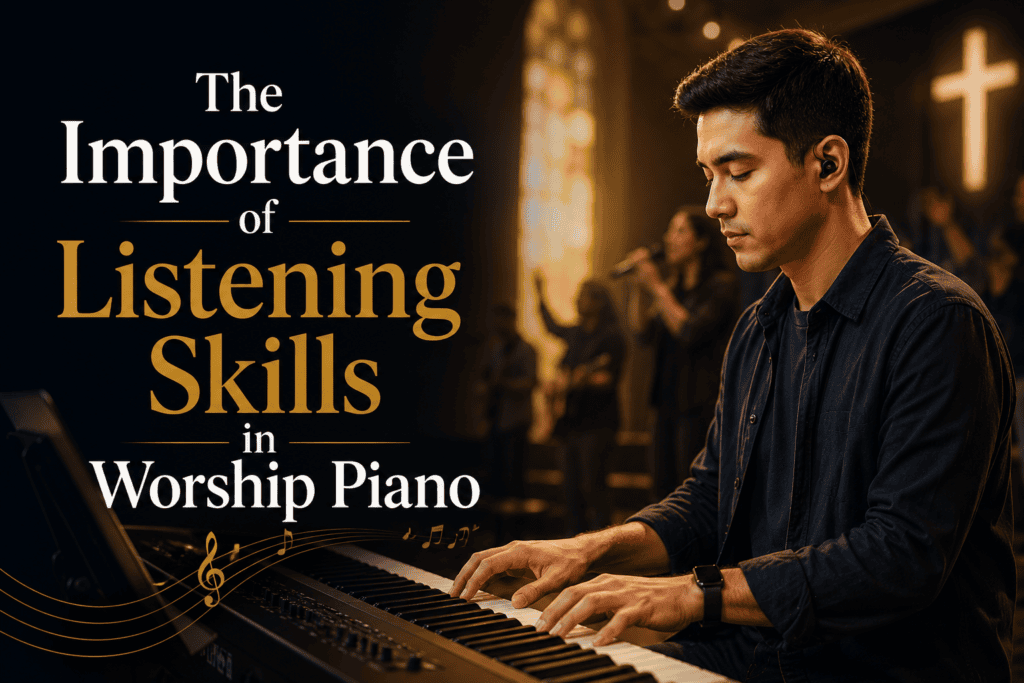
The Importance of Listening Skills in Worship Piano
Many worship pianists spend countless hours practicing chords, scales, inversions, and songs. While technical ability is important, there is another skill that often determines the quality of a worship performance—listening. Strong worship piano listening skills allow pianists to support the worship team, follow the flow of the service, and create music that encourages the congregation rather than distracting from worship.
Unlike solo piano performance, worship piano is built around collaboration. A worship pianist must constantly listen to the worship leader, vocalists, guitarists, bass players, drummers, and even the congregation. Every musical decision should support the overall worship experience rather than simply showcasing individual ability.
Developing excellent listening skills transforms a pianist from someone who simply plays chords into a musician who responds naturally to every moment. Whether you’re accompanying a small worship team or leading worship with a full band, active listening is one of the most valuable skills you can develop.
Why Worship Piano Listening Skills Matter

Playing the correct notes is only part of leading worship effectively. Worship music constantly changes based on the worship leader’s direction, the atmosphere of the service, and the interaction between musicians.
A pianist who listens carefully can adjust naturally by:
- Supporting the melody.
- Following tempo changes.
- Matching the band’s dynamics.
- Responding to spontaneous worship moments.
- Filling musical spaces appropriately.
These small adjustments help create a unified and meaningful worship experience.
Listening Creates Better Teamwork
The best worship pianists are often those who listen more than they play. Their awareness allows every musician to perform together with confidence and unity.
Listening to the Worship Leader

The worship leader provides the musical direction throughout the service.
Sometimes they extend a chorus.
Sometimes they repeat a bridge.
Sometimes they transition into spontaneous worship without prior planning.
A pianist who watches and listens carefully can follow these changes naturally without interrupting the flow of worship.
Follow Musical Cues
Listening carefully to vocal phrasing, spoken instructions, and visual cues allows smoother transitions between different sections of each song.
Listening to the Band

A worship band functions as one musical unit rather than several individual performers.
The pianist should continually listen to:
- Bass guitar
- Acoustic guitar
- Electric guitar
- Drums
- Vocal harmonies
- Other keyboard parts
Understanding how each instrument contributes helps the pianist decide when to play more and when to simplify.
Every Instrument Has a Purpose
Good listening prevents musical overcrowding and allows every instrument to contribute clearly.
Worship Piano Listening Skills Improve Timing

Timing is essential in worship music.
Even if every note is correct, poor timing can make the band sound disconnected.
Listening carefully to the drummer and bass player helps maintain consistent rhythm while keeping the entire band together.
Instead of leading with volume, great worship pianists lead with musical awareness.
Internal and External Timing
Developing both internal rhythm and careful listening creates steady performances that feel relaxed and unified.
Dynamics Depend on Listening

One of the most beautiful aspects of worship music is its dynamic range.
Songs often begin quietly, build gradually, and return to gentle moments of reflection.
These changes cannot be achieved by reading sheet music alone.
They require active listening.
A pianist must recognize when the band is building intensity and when softer accompaniment better serves the worship atmosphere.
Dynamics Support Worship
Listening helps pianists adjust volume naturally instead of playing with the same intensity throughout every song.
Worship Piano Listening Skills Help During Spontaneous Worship
Many worship services include unscripted moments where the music continues while prayers, Scripture readings, or spontaneous worship take place.
These moments require flexibility.
Rather than focusing on prepared arrangements, pianists must respond to what is happening in real time.
Listening carefully allows appropriate chord choices, smooth transitions, and supportive accompaniment.
Musical Sensitivity Matters
Responding naturally creates an atmosphere that supports worship instead of drawing attention to the instrument.
Listening Improves Chord Choices

Experienced worship pianists rarely play every chord exactly the same way.
Instead, they adjust voicings, inversions, and rhythms based on what they hear from the rest of the band.
Sometimes fewer notes create a fuller sound because other instruments are already filling the musical space.
Less Can Be More
Listening carefully often leads to simpler accompaniment that enhances the overall arrangement.
Practicing Worship Piano Listening Skills
Listening is a skill that can be practiced intentionally.
Helpful exercises include:
- Playing along with worship recordings.
- Listening only to the bass guitar.
- Following the drummer’s groove.
- Singing while playing.
- Recording your rehearsals.
- Practicing with backing tracks.
- Learning songs by ear.
These activities strengthen musical awareness while improving confidence.
Active Listening Produces Better Musicians
The more intentionally you listen during practice, the more naturally these skills appear during live worship.
Common Listening Mistakes

Many pianists unintentionally focus only on their own instrument.
Some common mistakes include:
- Playing too loudly.
- Ignoring the worship leader.
- Overplaying during quiet moments.
- Missing dynamic changes.
- Watching only the keyboard.
- Not listening to the rhythm section.
Correcting these habits greatly improves overall musicianship.
Awareness Builds Confidence
Strong listening skills allow pianists to make better musical decisions without feeling uncertain.
Listening Helps Build Confidence
Confidence does not come only from technical ability.
It also comes from knowing how to respond to the musicians around you.
When pianists trust their listening skills, they become more relaxed during rehearsals and live worship.
Instead of worrying about every note, they focus on serving the music and supporting the congregation.
Confident Worship Is Collaborative
Listening creates confidence because musicians know they are responding together rather than performing individually.
Developing Worship Piano Listening Skills Every Day

Like every musical ability, listening improves through consistent practice.
A simple daily routine may include:
- Listening to one worship song attentively.
- Identifying each instrument.
- Practicing dynamic control.
- Playing softly with recordings.
- Learning songs by ear.
- Following live worship videos.
Small daily improvements gradually produce remarkable musical awareness.
Daily Listening Creates Better Worship Musicians
The more carefully you listen each day, the more naturally you respond during rehearsals and worship services.
Conclusion
Developing strong worship piano listening skills is just as important as learning chords, scales, or advanced techniques. Active listening allows worship pianists to follow the worship leader, support the band, respond to spontaneous moments, control dynamics, and create a unified musical experience that serves both the congregation and the worship team. Great worship piano is not about playing more notes—it is about playing the right notes at the right time with sensitivity and purpose.
At The Mystic Keys, our personalized Worship Piano Lessons Online help students develop technical excellence alongside musical awareness, listening skills, improvisation, and confident accompaniment. Through one-on-one instruction and structured guidance, you’ll learn how to become a worship pianist who listens carefully, plays with sensitivity, and supports every worship experience with confidence.
For more information and exciting resources about learning music, visit our website at The Mystic Keys. For more music content and exciting offers follow us on
Facebook, Instagram, YouTube, LinkedIn, Twitter, Pinterest, and Threads.