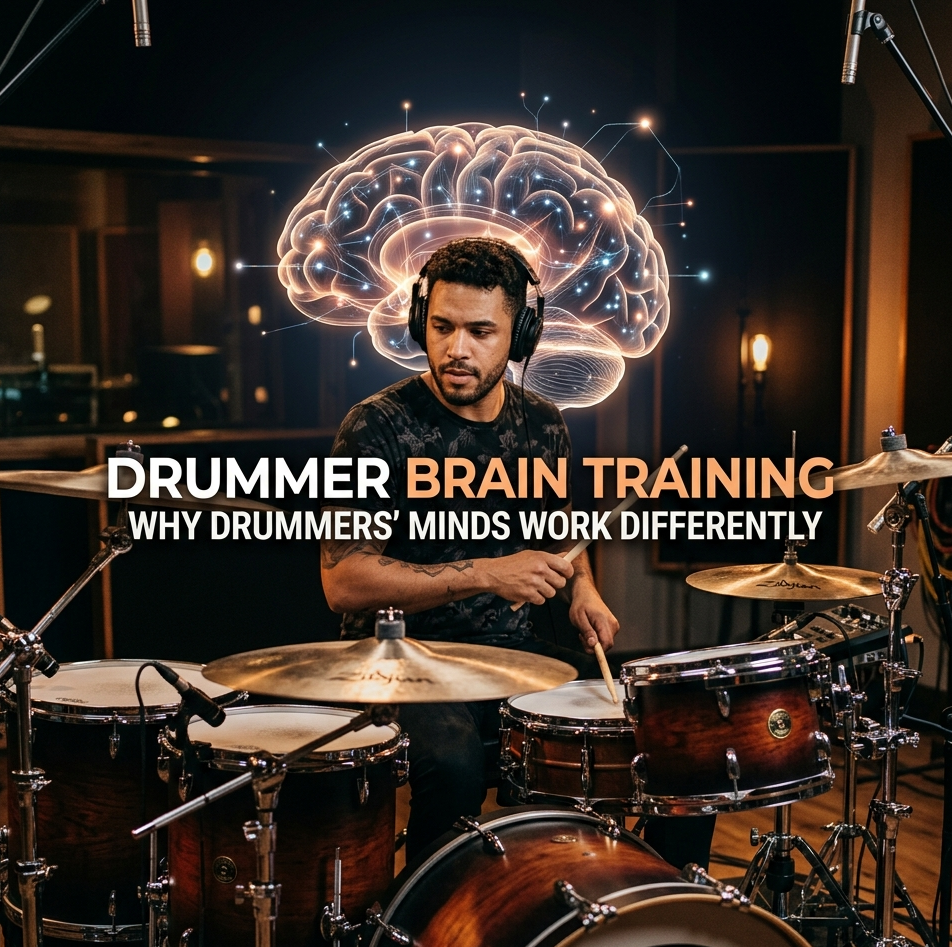
Drummer Brain Training | Why Drummers' Minds Work Differently
When people think about drumming, they often focus on speed, power, and coordination. A drummer sitting behind a kit appears to be performing a highly physical task, moving all four limbs independently while maintaining a steady groove. Yet beneath the visible movement lies something even more remarkable: an extraordinary level of brain activity. This is where Drummer Brain Training becomes truly fascinating, as the instrument challenges the mind just as intensely as it challenges the body. Every beat, transition, and coordinated movement requires the brain to process multiple streams of information simultaneously, creating a unique form of cognitive exercise that few other musical disciplines can match.
Researchers and musicians alike have long been fascinated by the cognitive abilities drummers develop over years of practice. Unlike many instrumentalists who primarily focus on melodic lines or harmonic structures, drummers must constantly manage multiple rhythms, coordinate complex physical movements, and serve as the timing foundation for an entire ensemble. As a result, the drummer’s brain undergoes unique forms of training that can shape attention, memory, coordination, and decision-making in distinctive ways.
While every musician develops valuable cognitive skills, drummers often engage their brains in a manner that resembles advanced multitasking, athletic performance, and mathematical problem-solving all at once. Understanding how this process works offers fascinating insight into why drummers frequently think, react, and process information differently from other musicians.

Drummer Brain Training Begins with a Full-Body Cognitive Challenge
Most musical instruments require precise hand movements, but drumming demands something far more complex. A drummer must simultaneously control both hands and both feet, often performing completely different rhythmic patterns with each limb.
Consider a common groove. One hand may be maintaining a steady pulse on the hi-hat, while the other hand plays accents on the snare drum. At the same time, one foot controls the bass drum and the other operates the hi-hat pedal. Each limb performs a unique task, yet everything must remain synchronized within the same rhythmic framework.
This level of independence places significant demands on the brain. Neural pathways responsible for motor control, timing, and coordination are constantly activated and strengthened during practice. Over time, the brain becomes increasingly efficient at managing multiple streams of information simultaneously.
Consequently, drummers develop a heightened ability to divide attention without losing overall focus. Instead of concentrating on a single action, they learn to oversee several independent actions while maintaining awareness of the larger musical picture.

Enhanced Communication Between Brain Hemispheres
One of the most intriguing aspects of drummer brain training involves communication between the left and right hemispheres of the brain. Because drumming requires both sides of the body to perform intricate and often unrelated movements, the brain must coordinate information across hemispheres with exceptional efficiency.
The corpus callosum, which serves as a bridge between the two hemispheres, plays a vital role in this process. Frequent drumming practice encourages constant communication between different neural regions responsible for movement, timing, auditory processing, and sensory feedback.
As these connections strengthen, drummers often become more adept at tasks involving coordination and rapid information exchange. Their brains learn to process multiple inputs simultaneously while maintaining smooth execution of complex actions.
This enhanced connectivity does not simply benefit musical performance. Many drummers report improvements in concentration, reaction time, and overall mental agility that extend beyond the practice room.

Drummer Brain Training and the Development of Exceptional Timing
Every band relies on a consistent pulse. While all musicians must understand rhythm, drummers carry the primary responsibility for maintaining it.
Developing a reliable sense of timing involves far more than counting beats. A skilled drummer learns to internalize tempo so deeply that it becomes almost instinctive. Whether playing with a metronome or performing live with a group, the drummer continuously monitors subtle timing variations and makes micro-adjustments in real time.
This process trains the brain’s internal clock. Neural systems associated with prediction, sequencing, and temporal processing become highly refined through repeated exposure to rhythmic patterns.
Moreover, drummers must anticipate what is about to happen rather than simply reacting to what has already occurred. During a performance, they constantly predict transitions, tempo changes, dynamic shifts, and cues from other musicians. Such predictive processing strengthens the brain’s ability to forecast events and respond proactively.
As a result, many drummers develop exceptional temporal awareness, which can positively influence areas ranging from athletic performance to problem-solving and communication.

Why Drummer Brain Training Creates Advanced Multitasking Skills
The term “multitasking” is often used casually, yet true simultaneous task management is remarkably difficult for the human brain. Drumming provides one of the closest practical examples of genuine multitasking training.
Imagine performing a groove while reading sheet music, listening to the bass player, anticipating an upcoming fill, adjusting dynamics, and monitoring audience energy—all at the same time. This is a routine situation for experienced drummers.
Rather than switching attention back and forth, drummers learn to process multiple layers of information concurrently. Repeated exposure to these demands strengthens cognitive flexibility and improves the brain’s ability to prioritize information efficiently.
Furthermore, drumming teaches selective attention. Not every sound or visual cue deserves equal focus. Skilled drummers learn when to concentrate intensely on one element and when to broaden their awareness to encompass the entire musical environment.
This balance between focused attention and situational awareness becomes one of the defining characteristics of advanced drumming.

Rhythm and Pattern Recognition
At its core, music is organized sound, and rhythm is one of its most fundamental organizing principles. Drummers spend years identifying, creating, modifying, and combining rhythmic patterns.
Because of this constant exposure, their brains become exceptionally skilled at recognizing patterns. They quickly detect recurring structures, subtle variations, and rhythmic relationships that others might overlook.
Pattern recognition extends far beyond music. The same cognitive ability plays a major role in language processing, mathematics, strategic thinking, and problem-solving. Every time a drummer learns a new groove or deciphers a complex rhythm, the brain strengthens its capacity to identify relationships and predict outcomes.
Over time, rhythmic analysis becomes second nature. What appears complicated to a beginner may feel completely intuitive to an experienced drummer because their brain has developed sophisticated pattern-mapping abilities through years of repetition and exposure.

Faster Decision-Making Under Pressure
Live performances can be unpredictable. Equipment may fail, musicians may miss cues, tempos may shift unexpectedly, and arrangements can change without warning.
In such situations, drummers often serve as the stabilizing force within the ensemble. They must assess problems instantly and make corrective decisions in fractions of a second.
This continuous exposure to high-pressure environments trains rapid decision-making systems within the brain. Instead of freezing when confronted with unexpected challenges, drummers learn to adapt quickly while maintaining performance quality.
Additionally, the need to keep a steady groove encourages emotional regulation. Panic can disrupt timing, so drummers develop the ability to remain calm and focused even when circumstances become chaotic.
These skills frequently transfer into everyday life, where quick thinking and composure are valuable assets in both professional and personal settings.

Drummer Brain Training and Its Impact on Memory
Memorization plays a larger role in drumming than many people realize. A drummer must remember song structures, tempo changes, fills, dynamic markings, stylistic nuances, and performance cues.
Unlike rote memorization, however, drumming often involves procedural memory—the type of memory associated with learned skills and actions. Through repetition, complex movements become automated, allowing the drummer to execute them with minimal conscious effort.
At the same time, working memory remains highly engaged during performance. Drummers must retain immediate information while processing incoming musical signals and planning upcoming actions.
This combination of long-term procedural memory and active working memory creates a powerful cognitive workout. Over years of practice, these systems become increasingly efficient, contributing to stronger overall memory performance.

Listening | The Hidden Superpower of Great Drummers
Many people assume drummers spend most of their attention creating rhythms. In reality, a significant portion of drumming involves listening.
A great drummer constantly monitors the entire musical landscape. They listen to the vocalist’s phrasing, the bassist’s groove, the guitarist’s dynamics, and the emotional direction of the song. Every decision they make is influenced by what they hear.
This level of active listening strengthens auditory processing skills. The brain becomes highly efficient at separating important information from background noise and identifying subtle changes in sound.
Moreover, drummers learn to respond musically rather than mechanically. Their performance becomes a conversation with other musicians, requiring continuous interpretation and adaptation.
Such advanced listening abilities contribute significantly to the unique cognitive profile often associated with experienced drummers.

Drummer Brain Training | Balancing Creativity Within Structure
At first glance, drumming may seem rigid because it revolves around timing and consistency. Yet creativity plays an enormous role in the art form.
Drummers must balance freedom and discipline. They are expected to maintain structure while simultaneously adding expression, energy, and originality. Every fill, accent, and dynamic choice represents a creative decision made within a specific framework.
This process encourages flexible thinking. The brain learns to generate new ideas while respecting established boundaries. Such a balance between innovation and control is valuable in many creative and professional disciplines.
Rather than viewing rules as limitations, drummers often learn to use them as foundations for experimentation and artistic growth.

What Science Suggests About Drummer Brains
Several studies examining musicians have found that extensive musical training can lead to measurable changes in brain structure and function. Drummers are particularly interesting subjects because their training combines rhythmic precision, motor coordination, sensory integration, and cognitive flexibility.
Researchers have observed that drummers often demonstrate efficient neural processing and strong synchronization between brain regions involved in movement and timing. Some studies even suggest that experienced drummers may solve certain problem-solving tasks with less overall brain activity, indicating highly optimized neural pathways developed through years of practice.
Although individual results vary, the broader conclusion remains consistent: drumming represents one of the most comprehensive forms of brain training found in music.

Conclusion
Drumming is far more than hitting drums in time with a song. Every practice session challenges the brain to coordinate independent movements, process multiple streams of information, maintain precise timing, recognize patterns, make rapid decisions, and communicate effectively with other musicians.
Through years of repetition and refinement, drummers develop a unique cognitive skill set that sets them apart from many other instrumentalists. Their minds become exceptionally adept at balancing structure and creativity, focus and awareness, precision and adaptability.
Perhaps that is why great drummers often seem to possess an almost effortless ability to stay calm amid complexity. Behind every groove lies a brain that has been trained to manage extraordinary levels of coordination and information processing. The result is not merely better musicianship but a fascinating example of how specialized practice can reshape the way the human mind works.
For aspiring drummers, this means that every practice session contributes to more than just musical growth. Whether learning independently or through structured programs such as Drums Lessons Online at The Mystic Keys, students are continually developing cognitive abilities that support coordination, concentration, creativity, and confidence both on and off the drum kit.
For more information and exciting resources about learning music, visit our website at The Mystic Keys. For more music content and exciting offers follow us on
Facebook, Instagram, YouTube, LinkedIn, Twitter, Pinterest, and Threads.