Trinity Grade 3 Piano Syllabus | Exam, Pieces & Online Preparation
Moving from the early stages of piano learning into Trinity Grade 3 is an important step in a student’s musical development. At this level, piano study becomes more than simply learning notes and playing a piece from beginning to end. Students begin to work more consciously on musical expression, technical control, rhythm, interpretation, and confident performance.
The Trinity College London Grade 3 Piano exam offers considerable flexibility in repertoire selection, allowing students to choose music that matches their interests while continuing to develop the skills expected at this stage. Trinity’s current piano repertoire includes classical works alongside music from popular culture, contemporary composers, film, stage, and other styles. Trinity College London
For students preparing through online lessons, this flexibility can be especially useful. With structured one-to-one guidance, regular practice, performance feedback, and careful exam planning, Grade 3 preparation can be both effective and enjoyable.
What Is Trinity Grade 3 Piano?
Trinity Grade 3 Piano sits at an intermediate stage of the graded piano pathway. By this point, students are expected to demonstrate greater independence than they would at the earlier grades.
The focus is not simply on whether a student can play the correct notes. Instead, preparation develops a combination of technical ability, musical understanding, interpretation, rhythm, coordination, and performance confidence.
That makes Grade 3 a useful stage for strengthening the fundamentals before students move towards more demanding repertoire. It also encourages learners to become more aware of how a piece should sound rather than treating the score as a collection of notes.
Trinity’s piano syllabus is designed around a broad choice of repertoire. The current repertoire system also continues to make earlier valid repertoire available, giving teachers and students greater flexibility when selecting suitable music.
Trinity Grade 3 Piano Exam | What Does It Include?
For a face-to-face Trinity Classical & Jazz graded exam, candidates normally perform three pieces, complete technical work, and undertake two supporting tests. The complete assessment is marked out of 100. Trinity College London
The three performance pieces form the largest part of the assessment, carrying 66 marks. Technical work accounts for 14 marks, while the supporting tests contribute the remaining 20 marks.
This structure is important because it shows why preparation should not focus entirely on the three selected pieces. A student may play the repertoire confidently but still need to strengthen technical skills, musical understanding, or the supporting-test requirements.
At Grade 3, therefore, a balanced preparation plan is much more valuable than simply practising the exam pieces repeatedly.
Choosing the Three Grade 3 Piano Pieces
One of the appealing features of Trinity’s piano exams is the freedom students have when selecting repertoire.
For Initial to Grade 3, candidates choose three pieces from a single repertoire list. One of the three may be a duet, and a candidate may also perform their own composition in place of one listed piece, subject to the syllabus requirements.
This gives teachers an opportunity to create a well-balanced programme rather than choosing three pieces that demand exactly the same musical approach.
For example, one selection might highlight expressive playing, another may develop rhythmic precision, while the third may require greater technical agility. Such variety allows the student to demonstrate different aspects of their musicianship.
The best choice is not necessarily the piece that sounds the most difficult. A suitable Grade 3 programme should allow the student to show control, musicality, accuracy and personality without choosing repertoire that is unnecessarily beyond their current ability.
Examples of Trinity Grade 3 Piano Repertoire
The current Trinity Grade 3 repertoire includes a broad range of musical styles. The official list includes pieces such as “Someone Like You” arranged by Amit Anand, Dennis Alexander’s Nocturne No. 1 in C, an anonymous Minuet, Thomas Attwood’s Rondo, J. C. F. Bach’s Anglaise, Béla Bartók’s The Highway Robber, and Alanya Bridge’s Morning, among others.
This variety is one of the strengths of the Trinity approach. A student who enjoys classical repertoire can explore works from earlier musical periods, while another learner may connect more strongly with a contemporary or popular selection.
Consequently, repertoire selection can become part of the learning process itself. When students have a genuine connection with the music, they are often more motivated to practise its details and develop a convincing performance.
However, teachers should always check the current official Trinity repertoire list before finalising pieces, as syllabus information and available repertoire can change over time. Trinity advises candidates to use the current syllabus as the primary source for exam requirements.
Technical Work in Trinity Grade 3 Piano
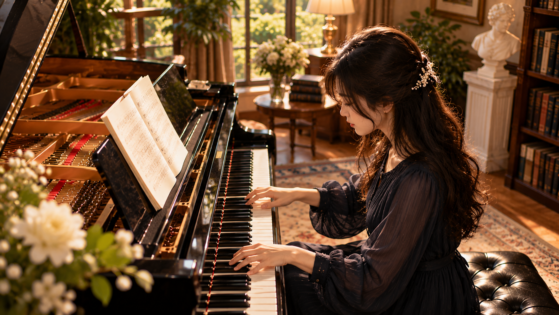
Technical work plays an important role in Grade 3 because it demonstrates the skills that support confident performance.
For Trinity piano exams, technical preparation includes scales and arpeggios, along with prescribed technical exercises. Trinity’s current guidance states that piano candidates prepare scales and arpeggios from memory, together with exercises selected according to the relevant requirements.
Rather than treating technical exercises as something separate from music-making, students should understand how these skills connect with their repertoire.
For instance, scale practice can improve finger coordination and evenness. Arpeggio work can support hand movement and chord awareness. Technical exercises can also help students become more comfortable with patterns that appear in their pieces.
Regular, focused practice is usually more effective than attempting to learn technical work hurriedly immediately before the exam.
What About Supporting Tests?
For a face-to-face Grade 3 exam, students also complete two supporting tests selected according to Trinity’s requirements. Depending on the grade and syllabus, supporting tests can include areas such as aural, sight-reading, improvisation and musical knowledge.
These skills are particularly valuable because they encourage students to become more complete musicians.
Sight-reading, for example, teaches a learner to approach unfamiliar music rather than relying entirely on memorised pieces. Aural work develops listening skills and musical awareness. Musical knowledge helps students understand what they are actually playing instead of simply reproducing notes from a page.
For this reason, supporting-test preparation should be incorporated into regular lessons rather than left until the final weeks.

Trinity Grade 3 Piano Digital Exam
Students who prefer an online assessment option can also consider Trinity’s Digital Classical & Jazz Grades.
Trinity currently provides two digital pathways: the Technical Work pathway and the Repertoire-only pathway. Under the Technical Work pathway, candidates perform three pieces alongside technical work, with the overall performance criteria replacing the traditional supporting tests. The Repertoire-only pathway allows candidates to focus entirely on repertoire by performing four pieces. Both pathways are marked out of 100.
This can make digital assessment particularly interesting for students who are comfortable performing in their own environment.
At the same time, recording an exam is not simply a matter of placing a phone beside the piano and pressing record. Candidates must follow Trinity’s filming and submission requirements, and the performance must be submitted as one continuous recording.
Therefore, online exam preparation should include camera positioning, sound quality, performance practice, recording rehearsals and familiarity with the submission requirements.
How Online Piano Lessons Can Help With Grade 3 Preparation
Online piano lessons can provide a practical way to prepare for Trinity Grade 3, particularly when lessons are conducted as individual one-to-one sessions.
A teacher can listen closely to the student’s playing, identify technical difficulties, demonstrate corrections, and provide immediate feedback. Since the lesson takes place in the student’s own practice environment, the teacher can also help identify issues with posture, hand position, keyboard setup and practice habits.
More importantly, online preparation does not have to mean simply following an exam book from week to week.
A structured programme can gradually introduce repertoire, technical exercises, sight-reading and aural work while leaving enough time for the student to develop musical confidence. This makes the preparation feel like genuine music education rather than exam drilling.

Building a Grade 3 Piano Practice Routine
A consistent practice routine is one of the biggest factors in successful Grade 3 preparation.
Instead of spending the entire practice session playing a piece from beginning to end, students can divide their time between different areas. A session might begin with a short technical warm-up, followed by focused work on difficult passages. Repertoire can then be practised slowly, with attention to rhythm, articulation, dynamics and phrasing.
The final part of a practice session can be used for sight-reading or another musicianship activity.
This approach is generally more productive because it encourages focused practice rather than repetition without purpose. A student who repeatedly plays the same mistake at full speed may simply become better at repeating the mistake.
Breaking difficult passages into smaller sections allows the brain and fingers to understand what needs to change. Gradually increasing the tempo can then help turn that understanding into reliable performance.
From Learning Notes to Understanding Music
One of the biggest differences between early piano study and Grade 3 is the growing importance of interpretation.
A student may know every note of a piece and still produce a performance that sounds flat. The next stage is understanding why the composer has used particular dynamics, articulations, rhythms, phrases and tempo changes.
Teachers can encourage students to ask simple questions while practising:
Where does this musical phrase begin and end?
Which notes need to stand out?
What mood does this section create?
How does the character change?
These questions help transform technical accuracy into musical communication.
As students become more comfortable with interpretation, they begin to realise that the score provides instructions, but the performer brings those instructions to life.
Common Challenges Students Face at Grade 3
Grade 3 can feel challenging because several skills begin developing simultaneously.
Some students struggle with coordinating both hands when rhythms or articulations become more complicated. Others may play accurately during practice but lose confidence when asked to perform from beginning to end.
Another common difficulty is uneven practice. A learner may spend most of the week practising favourite pieces while avoiding scales, sight-reading or technically demanding sections.
That imbalance can become noticeable during an exam.
A teacher’s role is therefore not only to teach the notes but also to identify weaknesses early. Regular performance practice, targeted technical exercises and short mock-exam sessions can gradually make the student more comfortable with the complete assessment experience.
How Long Does Trinity Grade 3 Piano Preparation Take?
There is no single preparation period that works for every student.
Someone who has already developed strong Grade 2 skills and maintains consistent practice may progress relatively quickly. Another learner may require more time to strengthen reading, technique or coordination before beginning full exam preparation.
Rather than rushing towards a particular exam date, it is better to consider whether the student can perform the selected repertoire securely while also handling the technical and musicianship requirements.
A good teacher can assess the student’s current level and create a realistic preparation timeline. This approach helps avoid the pressure of trying to learn everything in the final few weeks.
Preparing for a Trinity Grade 3 Piano Exam Online
Online preparation becomes especially effective when it follows a clear progression.
The early stage can focus on choosing suitable repertoire and building the required technical foundation. Once the pieces are comfortable, lessons can shift towards interpretation, accuracy, musical expression and performance consistency.
The later stage should increasingly resemble the actual exam. Students can perform complete pieces without interruption, practise technical work under exam-like conditions, complete supporting activities, and receive detailed feedback.
For digital candidates, recording rehearsals can be added to this process. Students can learn how to maintain concentration while the camera is running, check whether their hands and playing position are clearly visible, and become comfortable performing without stopping to correct mistakes.
This gradual transition from learning → refining → performing → recording can make the final exam experience much less intimidating.

Why One-to-One Online Piano Lessons Can Be Effective
Every student arrives at Grade 3 with a different musical background. Some may read music confidently but struggle with technique, while others may have strong playing ability but need more work on sight-reading or musical interpretation.
One-to-one lessons allow the teacher to respond to those individual needs.
Instead of spending equal time on every topic, the lesson can focus more heavily on the areas that need attention. A teacher can also adjust repertoire choices, practice assignments and lesson goals according to the student’s pace.
That personalised approach is particularly useful during exam preparation because the objective is not simply to complete a syllabus. The larger goal is to help the student become a more confident, independent and expressive pianist.
Trinity Grade 3 Piano | More Than an Exam
Preparing for Grade 3 can certainly help students work towards a recognised qualification, but the value of the process extends beyond the certificate.
Learning several contrasting pieces develops musical interpretation. Technical exercises improve coordination and control. Sight-reading encourages independence. Aural activities strengthen listening. Regular performance practice builds confidence.
Together, these skills create a stronger foundation for future piano study.
The Grade 3 exam can therefore be viewed as a milestone rather than an endpoint. Once students develop these habits, they are better prepared to approach more advanced repertoire and increasingly complex musical ideas.
Final Thoughts
Trinity Grade 3 Piano helps students build stronger technique, musical understanding and performance confidence through varied repertoire and focused musicianship.
With consistent practice and personalised guidance, Piano Lessons Online can make exam preparation structured and effective. At The Mystic Keys, one-to-one lessons support Trinity preparation while developing practical skills, musical expression and independence.
For more information and exciting resources about learning music, visit our website at The Mystic Keys. For more music content and exciting offers follow us on
Facebook, Instagram, YouTube, LinkedIn, Twitter, Pinterest, and Threads,