
String Bending Techniques for Emotional Playing
String bending is one of the most expressive techniques a guitarist can develop. Unlike simply playing a note, bending allows you to gradually move from one pitch toward another, creating a vocal-like quality that can make a guitar phrase feel more human and emotionally engaging. This technique is especially important in blues, rock, worship, gospel, country, and melodic lead guitar, where expression often matters as much as technical accuracy. When a guitarist bends a string with control, the movement between pitches can communicate tension, anticipation, sadness, joy, or intensity in a way that a perfectly straight note sometimes cannot. Learning string bending techniques for emotional playing is therefore not only about developing finger strength; it is about understanding pitch, timing, dynamics, phrasing, and musical intention. A well-executed bend should feel like part of the musical sentence rather than an isolated trick added to a solo.
1. Understand the Mechanics of String Bending Techniques on Guitar

A string bend begins when you fret a note and push or pull the string across the fretboard to raise its pitch. The amount of movement determines how far the pitch rises, which means the guitarist must develop both physical control and an accurate sense of pitch. Beginners often focus on moving the string as far as possible, but expressive bending requires much more precision. A half-step bend raises the note by one fret, while a whole-step bend raises it by two frets, and larger bends require even greater control. The supporting fingers of the fretting hand can help provide stability and strength, while the thumb positioned securely around the neck gives the hand a reliable anchor. Instead of relying entirely on one finger, many experienced guitarists use several fingers together to support the bending finger. This makes the movement smoother and reduces unnecessary tension. If you are developing your basic technique, practicing how to play guitar with proper finger positioning can provide a strong foundation before you begin working on advanced expressive bends.
2. Master Half-Step and Whole-Step Bends

Two of the most important string bending techniques for emotional playing to master are the half-step bend and the whole-step bend. A half-step bend moves the note upward by the equivalent of one fret, creating a subtle change in pitch that can sound restrained and emotional. A whole-step bend moves the note by two frets and usually produces a stronger expressive effect. The goal of these string bending techniques for emotional playing is not simply to reach the target pitch but to hear it clearly and arrive at it consistently. One effective exercise is to play the target note first, listen carefully to its pitch, return to the original note, and then bend until the two notes match. This develops the ear and the hand at the same time. Practicing bends slowly also helps you notice whether the pitch is sharp, flat, or accurate. Once your half-step and whole-step bends become reliable, you can combine these string bending techniques for emotional playing with slides, vibrato, hammer-ons, and pull-offs to create more sophisticated and expressive melodic phrases.
3. Use Pitch Accuracy With String Bending Techniques to Make Bends Sound Musical

Pitch accuracy is one of the most important elements of expressive bending. A bend that stops below the intended pitch can sound weak or unfinished, while a bend that goes too far can sound uncontrolled. For this reason, guitarists should treat their ears as an essential part of their technique. Rather than practicing bends mechanically, listen to the destination pitch and try to make the bent note sound exactly like the note you would play at the target fret. You can also use a tuner as a reference during practice, although your ears should gradually become the primary tool for judging accuracy. Another useful exercise is to alternate between a fretted target note and a bent note, checking whether both pitches sound identical. This creates a direct connection between what you hear and what your fingers do. Over time, accurate bending becomes less of a conscious calculation and more of an instinctive musical response, allowing you to concentrate on phrasing and emotion.
4. Add Vibrato After the Bend for More Expression

Combining a bend with vibrato is one of the most effective string bending techniques for emotional playing, as it can dramatically increase the emotional character of a guitar phrase. After reaching the desired pitch, the guitarist can gently move the string around that pitch to create a controlled fluctuation in sound. This combination is common in blues, rock, worship, and other styles where sustained guitar notes are used to express emotion. The most important principle is control. Vibrato should support the note rather than distract from it. A slow, wide vibrato can create a dramatic and passionate sound, while a faster and narrower vibrato may feel energetic or urgent. You can practice this by holding a whole-step bend at the target pitch and then adding a small amount of vibrato without allowing the pitch to drift too far. Learning how to use guitar vibrato effectively alongside these string bending techniques for emotional playing can help you develop a much more expressive and emotionally engaging lead-guitar vocabulary.
5. Experiment With String Bending Techniques, Bend Timing, and Release
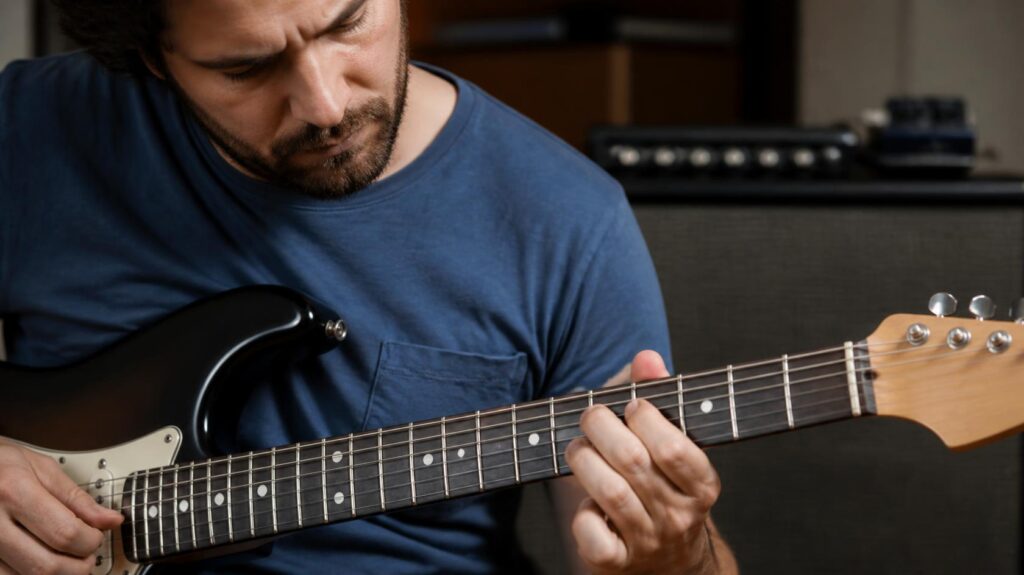
The emotional impact of a bend depends not only on how far the string moves but also on when the bend happens and how it is released. A bend can begin before the note is fully heard, creating a smooth rise into the pitch, or you can strike the note first and then gradually bend it upward. These approaches create very different musical effects. A slow bend can build anticipation, while a quick bend can create excitement or intensity. The release is equally important because lowering the string gradually can create another expressive movement rather than simply stopping the note. Try holding a note, bending it slowly, sustaining the target pitch, and then releasing it with control. Experimenting with these different movements will help you understand that emotional guitar playing is often created through small changes in timing and phrasing rather than through speed or technical complexity.
6. Combine String Bending With Guitar Phrasing
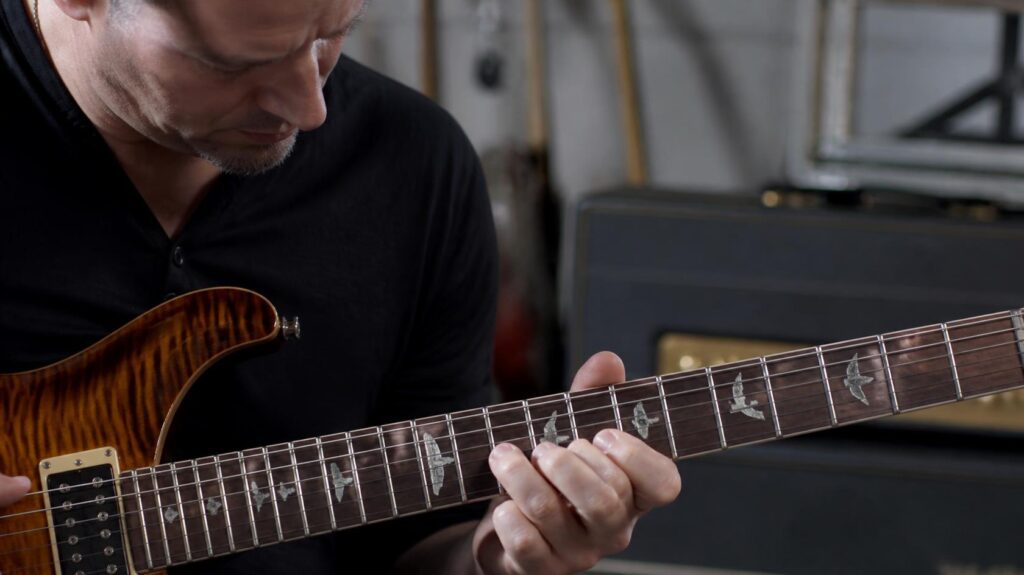
A great bend becomes even more effective when it is placed within a strong musical phrase. Instead of bending every available note, choose moments where the technique adds meaning to the melody. For example, you might play several simple notes and use a bend to emphasize the final note of the phrase. You can also use bends to connect two melodic ideas, answer another musical phrase, or create tension before resolving to a stable note. This approach is particularly useful when learning guitar solo phrasing because it encourages you to think beyond individual techniques. Listen to expressive guitarists and notice where they bend, where they leave space, and how they allow certain notes to sustain. The emotional effect often comes from the relationship between the bend and the surrounding notes. A simple melody with carefully chosen bends can therefore sound far more expressive than a technically difficult solo filled with unnecessary effects.
7. Practice String Bending Techniques With Different Musical Styles
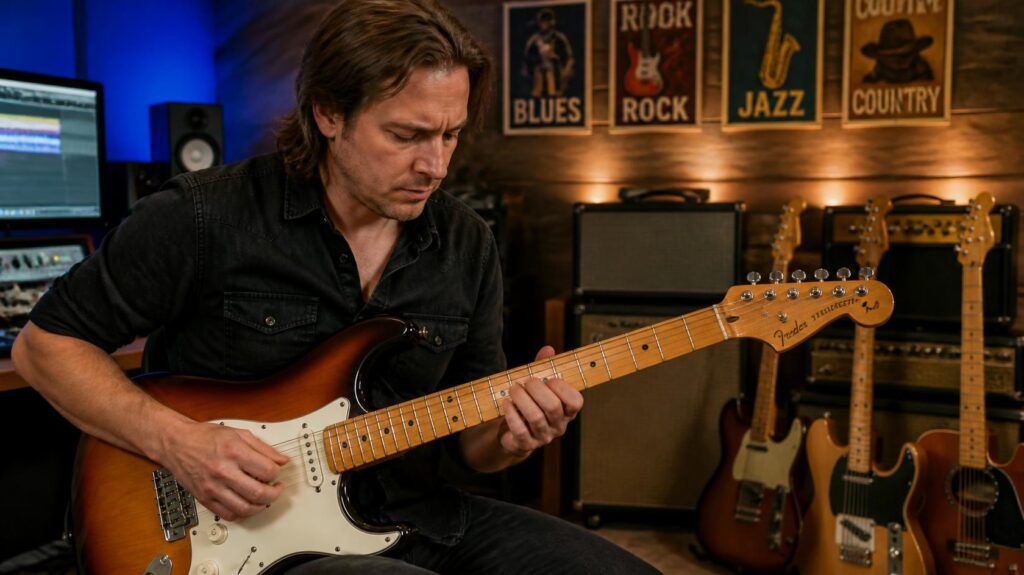
String bending can sound completely different depending on the style of music in which it is used. Blues guitar often uses expressive whole-step bends, microtonal movements, and vocal-like phrasing to create a strong emotional character. Rock guitar may use powerful bends combined with vibrato to produce intensity and sustain. Country guitar often uses precise bends to imitate vocal inflections, while worship guitarists may use controlled bends to add warmth and emotion to sustained melodic lines. Exploring different styles helps you understand how the same physical technique can communicate different feelings. You can practice a simple phrase in several musical contexts and change the speed, bend distance, vibrato, dynamics, and note selection. If you are developing your broader technique, exploring different guitar playing styles and techniques can also help you become more versatile and intentional in your musical expression.
8. Build an Emotional Guitar Practice Routine

Developing expressive bends requires consistent practice, but the goal should be quality rather than repetition alone. Begin with slow half-step bends and focus on matching the target pitch. Once you can consistently control them, move to whole-step bends and gradually introduce pre-bends, bend-and-release movements, and vibrato. Practice bends on different strings and at different positions on the fretboard because the physical response of the strings can vary. Record yourself occasionally and listen back to determine whether your bends sound controlled, musical, and appropriately timed. Most importantly, practice bending within real musical phrases instead of spending all your time on isolated exercises. Building a consistent guitar practice routine allows technical movements to become natural enough that you can focus on the emotion behind the music. The ultimate goal is not to perform the biggest or fastest bend, but to use the right bend at the right moment to make a musical idea feel more expressive.
Conclusion
String bending is much more than a technical guitar technique; it is a way of shaping pitch and communicating emotion. Accurate pitch, controlled movement, thoughtful timing, vibrato, dynamics, and phrasing all contribute to the character of a bend. When these elements work together, even a single sustained note can feel expressive and personal. The best way to develop this ability is to practice slowly, listen carefully, study different musical styles, and apply bends within real melodies and solos. With regular practice, string bending techniques for emotional playing can become a natural part of your guitar vocabulary, helping you create performances that sound more expressive, intentional, and connected to the music. If you want to develop your technique with structured guidance, you can learn guitar lessons online with The Mystic Keys, where focused instruction can help you build stronger technique, musical expression, and confidence in your playing.
For more information and exciting resources about learning music, visit our website at The Mystic Keys. For more music content and exciting offers follow us on
Facebook, Instagram, YouTube, LinkedIn, Twitter, Pinterest, and Threads.