

For more information and exciting resources about learning music, visit our website at The Mystic Keys. For more music content and exciting offers follow us on
Facebook, Instagram, YouTube, LinkedIn, Twitter, Pinterest, and Threads,

Learning how to play guitar in a worship band without overplaying is essential for guitarists who want to support the worship atmosphere without distracting from the vocals or other instruments. In worship music, guitar is not always meant to be the loudest or most noticeable part. Its purpose is to complement the song, support the congregation, and create the right musical atmosphere.
Whether you play acoustic or electric guitar, understanding when to play, when to simplify, and when to leave space can make your contribution more effective. With the right techniques, you can add depth and emotion to worship music while keeping the entire band balanced.
The first step in learning how to play guitar in a worship band without overplaying is understanding your role within the arrangement.
A worship band often includes vocals, keyboards, bass, drums, and sometimes additional instruments. Each musician contributes to the overall sound. If the guitar plays constantly or uses too many fills, it can compete with the vocals and make the arrangement feel crowded.
To avoid this:
Play only what supports the song.
Leave space between musical phrases.
Adjust your volume to suit the arrangement.
Prioritize the message and atmosphere of the song over technical display.
Remember, playing fewer notes can sometimes make a greater musical impact.

One of the most important skills in worship guitar is knowing when not to play.
Silence creates room for vocals, lyrics, and other instruments to stand out. If you fill every gap with strumming or lead guitar lines, the music can lose its clarity and emotional impact.
During important vocal lines.
During quiet verses and reflective moments.
When the piano or another instrument has a prominent melodic part.
Before a chorus or musical transition that needs room to build.
Practise playing a simple chord progression and deliberately leaving gaps. Listen to how those pauses affect the music.
Vocals are often the main focus of a worship song. Your guitar part should support the singer rather than compete with the melody.
During verses, consider using soft strumming, sustained chords, or gentle picking. When the vocalist holds a note or sings an important phrase, avoid adding unnecessary fills.
During instrumental breaks, you may have more room to introduce melodic lines or expressive guitar parts.
Practical tip: Record yourself playing along with a worship song. Listen specifically to whether your guitar makes the lyrics harder to hear. If it does, simplify your rhythm, reduce your volume, or change your tone.
Dynamics refer to changes in loudness and intensity. Controlling them helps you support the emotional development of a worship song.
Instead of playing with the same intensity throughout the song, adapt your playing to each section.
Verse: Use lighter strumming or gentle picking.
Pre-chorus: Gradually increase intensity when the arrangement calls for it.
Chorus: Play fuller chords while maintaining balance.
Bridge: Follow the band’s dynamic direction instead of automatically playing louder.
Quiet ending: Reduce your volume and allow the final chords to breathe.
These are general guidelines rather than fixed rules. Always follow the song’s arrangement and the worship leader’s direction.

Guitar fills can add emotion and connect musical phrases, but too many fills can distract listeners.
A fill is a short melodic phrase played between vocal lines or during instrumental sections. The key is to use fills intentionally.
Before adding one, ask yourself:
Is there space for this phrase?
Does it complement the vocal melody?
Does it fit the mood of the song?
Would the arrangement sound better without it?
Start with simple melodic phrases using notes from the song’s key. Avoid playing a fill after every vocal line. Sometimes one well-placed phrase is more effective than several complicated runs.
Complex chords and elaborate voicings are useful in the right context, but they are not always necessary.
Simple chord voicings can create a clear, supportive sound, especially when the keyboardist is already playing full chords.
For example, an electric guitarist might play two- or three-note chord shapes on the higher strings while the keyboard provides the fuller harmony. An acoustic guitarist might use a straightforward strumming pattern to maintain the song’s rhythmic foundation.
The goal is not to make your part less musical. It is to ensure that every instrument contributes something different to the arrangement.

Effects such as delay, reverb, chorus, and overdrive are common in contemporary worship music. They can create atmosphere, sustain, and depth, but too much processing can make the overall sound muddy.
To keep your tone balanced:
Use reverb to add space without losing clarity.
Adjust delay so repeated notes do not overwhelm the next musical phrase.
Keep overdrive appropriate to the song’s intensity.
Avoid excessive volume boosts when switching between tones.
Listen to how your effects interact with the keyboard and vocals.
A spacious guitar tone does not require playing constantly. A single sustained note or carefully timed chord can contribute more atmosphere than continuous melodic playing.
Good worship guitarists pay attention to the entire band, not just their own part.
The keyboard may already be providing sustained chords, while the bass supports the low end and the drums establish the groove. If your guitar duplicates every part, the arrangement may sound crowded.
Try these approaches:
With piano: Use lighter chord voicings, rhythmic accents, or complementary melodic lines.
With acoustic guitar: Coordinate strumming patterns so both guitars do not compete rhythmically.
With bass and drums: Maintain a steady groove without adding unnecessary rhythmic complexity.
With backing vocals: Leave room for harmonies and important vocal phrases.
Listening carefully allows you to make musical decisions that benefit the whole ensemble.
Worship music can change direction during a live performance. A worship leader may repeat a chorus, extend a bridge, move into a quiet prayer, or build the arrangement spontaneously.
As a guitarist, you need to respond to these changes rather than continuing with the same part automatically.
Watch for cues from the worship leader, listen to the drummer and keyboardist, and be ready to simplify your playing when the arrangement becomes quieter.
If the band is building towards a powerful chorus, increase your intensity gradually. If the worship leader brings the song down, reduce your volume and leave more space.
Following the musical direction of the team helps create a cohesive worship experience.
Avoid these common habits if you want to become a more supportive worship guitarist:
Playing continuously without considering the arrangement.
Using complicated fills during important vocal phrases.
Strumming too loudly during quiet sections.
Adding too many effects or excessive gain.
Copying another guitarist’s part without considering your band’s instrumentation.
Ignoring cues from the worship leader.
Focusing on technical ability instead of serving the song.
The solution is not to avoid creativity. It is to use your musical skills with intention and awareness.

You can develop better musical restraint through focused practice.
Step 1: Choose a worship song. Select a song you already know and listen to the original arrangement.
Step 2: Play only the chords. Use a simple strumming pattern without adding fills.
Step 3: Practise dynamics. Play the verse softly and increase intensity only when the arrangement calls for it.
Step 4: Add one or two fills. Place them in natural gaps between vocal phrases.
Step 5: Record your performance. Listen for crowded sections, excessive volume, and moments when your guitar competes with the vocals.
Step 6: Simplify where necessary. Remove anything that does not improve the arrangement.
Repeat this exercise with different worship songs to build your listening skills and musical judgment.
At The Mystic Keys, students can work towards developing the musical skills needed to play confidently in worship settings. Structured guitar lessons can help learners improve chord transitions, rhythm, tone control, musical listening, and expressive playing.
With guided practice, guitarists can learn to adapt their playing to different worship songs, follow musical cues, and support a band without overcrowding the arrangement.
Explore online guitar lessons at The Mystic Keys to learn more about developing your guitar technique and musical confidence.
Learning how to play guitar in a worship band without overplaying is about more than mastering chords and techniques. It requires listening, self-control, dynamic awareness, and an understanding of how your instrument fits into the larger arrangement.
Leave space for the vocals, use fills thoughtfully, control your effects, and follow the direction of the worship leader. By focusing on the needs of the song rather than the number of notes you play, you can become a more effective and supportive worship guitarist.
In worship music, the goal is not to play more—it is to play with purpose.

For more information and exciting resources about learning music, visit our website at The Mystic Keys. For more music content and exciting offers follow us on
Facebook, Instagram, YouTube, LinkedIn, Twitter, Pinterest, and Threads,
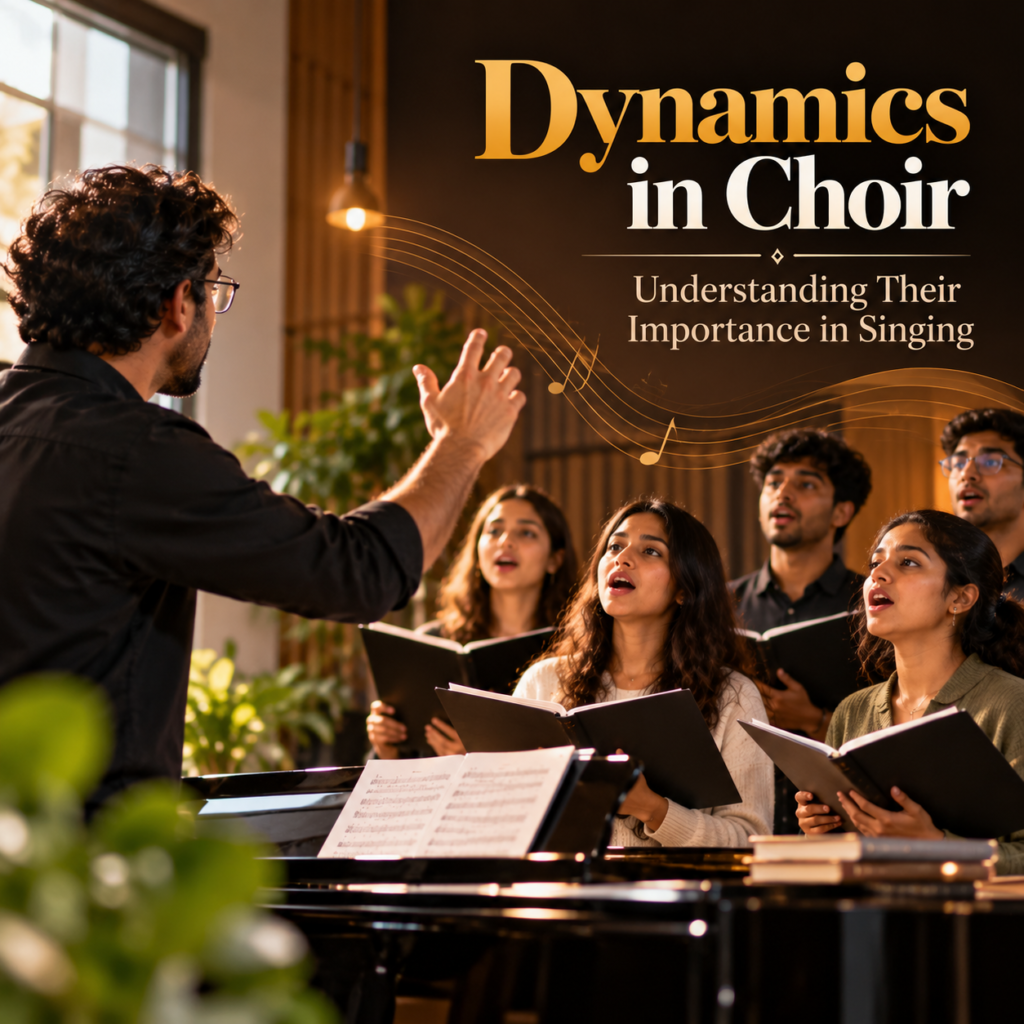
A choir is more than a group of singers performing together. It is a musical ensemble where voices blend to communicate emotions and bring melodies to life. While harmony, rhythm, and pitch are essential, dynamics in choir play an equally important role in creating an expressive performance.
Dynamics refer to variations in musical volume and intensity. They help choirs highlight lyrics, build excitement, express emotions, and create contrast. Understanding dynamics allows singers to move beyond accurate notes and deliver performances that connect with listeners.

Dynamics indicate how softly or loudly a musical passage should be performed. In a choir, singers must adjust their volume together to maintain balance and create a unified sound.
Common dynamic markings include pianissimo (pp) for very soft singing, piano (p) for soft, mezzo piano (mp) for moderately soft, mezzo forte (mf) for moderately loud, forte (f) for loud, and fortissimo (ff) for very loud singing.
Composers also use crescendo to indicate a gradual increase in volume and diminuendo or decrescendo for a gradual decrease. These changes help shape musical phrases and guide listeners through different emotional moments.
Dynamics give music its expressive character. When a choir sings at the same volume throughout a song, the performance may sound monotonous. Variations in intensity create contrast and make different sections more engaging.
For example, a soft opening followed by a gradual crescendo can build anticipation before a powerful chorus. Similarly, a gentle ending can leave listeners with a feeling of calmness or reflection.
These changes also help singers understand the structure of a composition. By responding to dynamic markings, choir members create a musical journey that keeps the audience interested.
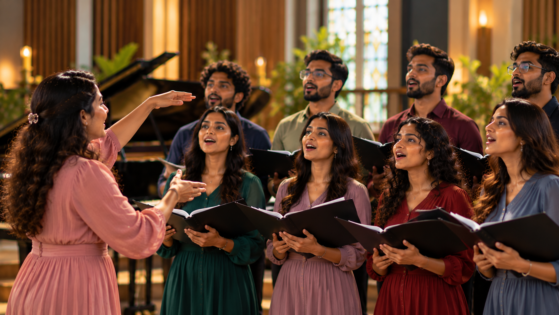
Soft dynamics, such as piano and pianissimo, create gentle and intimate moods. Singers must maintain clear tones and steady breath support while reducing their volume.
Moderate dynamics, including mezzo piano and mezzo forte, help maintain balance between voice sections. They allow the melody to remain clear without overpowering the accompanying harmonies.
Loud dynamics, such as forte and fortissimo, bring energy and dramatic intensity to a performance. However, singers must maintain vocal control rather than force their voices.
Gradual changes are equally important. A crescendo builds intensity, while a diminuendo gently reduces it, helping the choir create smooth transitions and expressive musical phrases.
Dynamics help singers communicate the emotions behind a song. Changes in volume can express sadness, excitement, hope, tenderness, or determination, making the lyrics more meaningful.
For instance, a soft passage may communicate vulnerability, while a gradual increase in intensity can express growing confidence. These variations allow the audience to connect more deeply with the music.
However, emotional expression does not always require louder singing. A quiet, controlled passage can be equally powerful when performed with sensitivity and clear diction. Understanding the mood of a composition helps singers choose the right approach.

A choir typically includes sopranos, altos, tenors, and basses, each contributing a different musical element. Dynamics help these sections maintain balance and ensure that important melodies remain audible.
When the sopranos carry the melody, the other sections may need to sing slightly softer to support the tune. If the melody shifts to the basses or altos, the balance must change accordingly.
Without proper dynamic control, one section may overpower the others, weakening the harmony. By listening carefully and adjusting their volume, singers create a balanced sound in which every voice contributes effectively.
The conductor guides the choir in interpreting and performing dynamic changes. Through hand gestures, facial expressions, and body movements, the conductor communicates when singers should increase or reduce their volume.
These visual cues help the entire ensemble respond together. A conductor may also guide singers in shaping a crescendo toward a particular lyric or softening a phrase without losing vocal support.
Regular rehearsals help singers understand these signals and anticipate changes. This coordination allows the choir to perform with greater unity, confidence, and musical expression.

Maintaining consistent dynamics can be challenging, especially when singers have different levels of experience. During loud passages, some may strain their voices, affecting tone quality and pitch accuracy.
Soft passages can be equally difficult. Singers may lose vocal support or reduce their volume so much that the words become unclear. Maintaining a steady tone at low volume requires careful breath control.
Differences in interpretation can also cause uneven crescendos and diminuendos. Regular rehearsals, attentive listening, and clear conducting help singers overcome these challenges and achieve a more consistent sound.
Improving dynamics begins with understanding the musical score. Singers should identify dynamic markings and recognize where the music requires changes in intensity.
Breathing exercises and sustained-note practice help develop the control needed for soft singing, powerful passages, and gradual transitions. Singers should focus on maintaining vocal quality at every dynamic level.
Listening exercises are equally useful. By paying attention to other voice sections, singers learn when to bring their parts forward and when to blend into the background. Recording rehearsals can also reveal areas where balance or dynamic contrast needs improvement.
Practising short phrases at different volumes further strengthens control. With consistent effort, singers become more comfortable performing dynamic changes naturally and accurately.
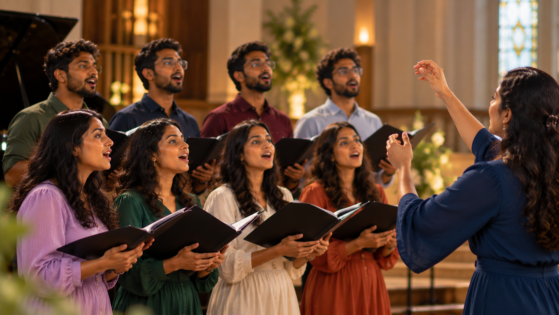
Different musical genres use dynamics in distinct ways. In classical choral music, composers often use detailed dynamic markings and gradual transitions to create dramatic development.
Gospel and contemporary worship music may build from gentle openings to powerful choruses, supporting the emotional and spiritual message. Pop arrangements frequently use contrasting verses and choruses to make songs more engaging.
Folk and traditional music may use subtler variations to preserve the natural character of the melody. Understanding the style of each composition helps choirs apply dynamics appropriately rather than following the same approach for every song.
Dynamics contribute significantly to an engaging and polished choir performance. In competitions, thoughtful dynamic control can demonstrate musical understanding, coordination, and expressive ability.
A well-prepared choir uses contrasts to highlight important musical moments while maintaining balance and vocal clarity. Smooth transitions between soft and loud passages also demonstrate effective teamwork and rehearsal.
Practising dynamics alongside pitch, rhythm, diction, and harmony helps singers deliver more convincing performances. The goal is not simply to sing louder or softer, but to communicate the music with control and intention.
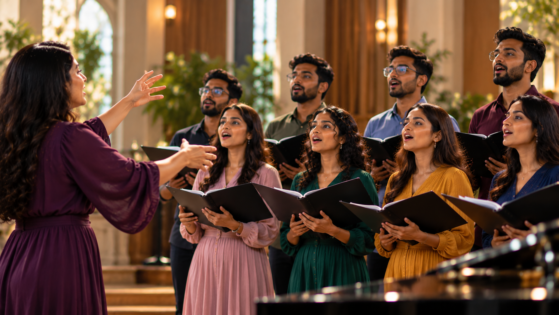
Dynamics transform choral singing by adding emotion, contrast, and depth to a performance. They help singers communicate lyrics effectively, maintain vocal balance, and create a meaningful musical experience for listeners.
Developing dynamic control requires breath management, attentive listening, and coordination with the conductor. With regular practice, singers can perform more confidently and expressively.
At The Mystic Keys, students can develop their musical expression through personalized online music lessons, including Worship Piano & Singing Lessons Online. By strengthening vocal techniques, musical awareness, and dynamic control, aspiring singers can enhance their ability to deliver expressive and engaging performances.
For more information and exciting resources about learning music, visit our website at The Mystic Keys. For more music content and exciting offers follow us on
Facebook, Instagram, YouTube, LinkedIn, Twitter, Pinterest, and Threads,
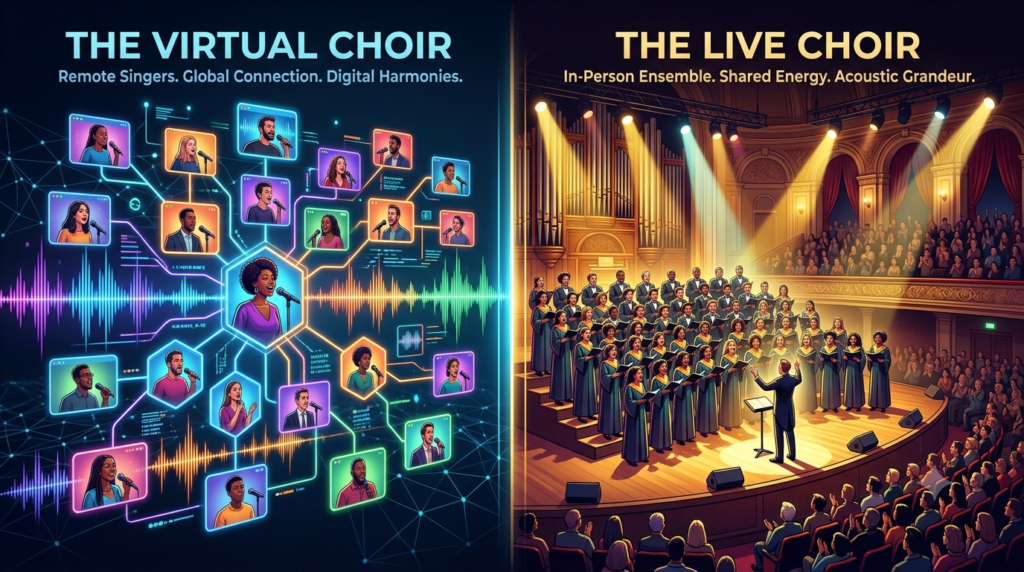
Understanding the difference between a virtual choir vs live choir can help singers, choir directors, music teachers, and worship teams choose the right format for their performances. Both approaches bring people together through music, but they differ in how singers rehearse, perform, collaborate, and connect with their audience.
A live choir performs together in the same physical space, allowing singers to hear one another and respond to a conductor in real time. A virtual choir brings singers together remotely, often through individual video or audio recordings that are combined into one performance. While live choirs emphasize in-person collaboration, virtual choirs offer flexibility and allow singers from different locations to participate.
In this guide, we will explore the key differences between virtual choir vs live choir performances, including sound quality, rehearsal methods, technology, costs, audience engagement, and the situations where each format works best.
A virtual choir is a group of singers who perform a musical piece from different locations. Instead of gathering in one room, each singer typically records their part individually using a phone, microphone, or computer. The recordings are then synchronized, edited, and combined into a finished audio or video performance.
Virtual choirs became especially popular when in-person gatherings were difficult, but they continue to provide opportunities for remote collaboration and creative music-making.

A virtual choir performance usually follows these steps:
Song selection: The choir director chooses a suitable song and arranges the vocal parts.
Practice materials: Singers receive sheet music, reference recordings, or practice tracks.
Individual rehearsals: Each singer learns their part independently, sometimes with online guidance.
Recording: Singers record their vocals while following a reference track and timing instructions.
Editing and synchronization: Audio and video recordings are aligned and mixed.
Final performance: The recordings are presented as a combined choir video or audio production.
This format allows singers to contribute without travelling to a shared rehearsal venue. However, successful virtual choir projects require clear instructions, careful preparation, and technical editing.
A live choir consists of singers who perform together in the same physical location. They may rehearse in a school, church, concert hall, community centre, or music studio before performing for an audience.
Live choirs rely on real-time communication, shared musical direction, and the ability to listen and respond to other singers. The conductor can adjust tempo, dynamics, phrasing, and balance while the performance is happening.
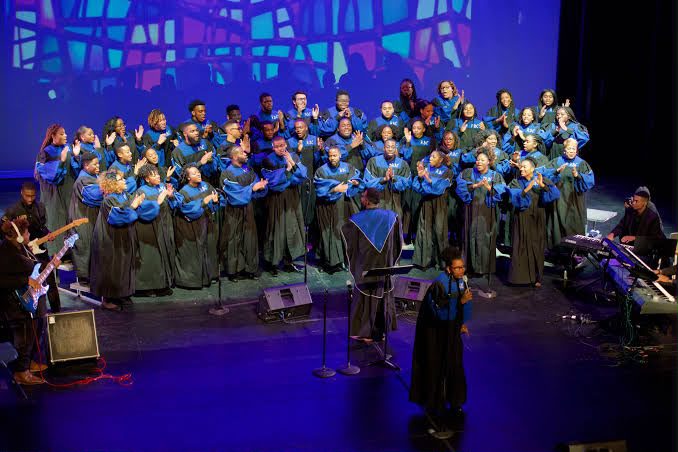
A typical live choir process includes:
Selecting songs and assigning vocal parts.
Conducting group rehearsals.
Practising harmonies, timing, and pronunciation.
Balancing the volume of different vocal sections.
Rehearsing entrances, endings, and transitions.
Performing together for an audience.
Because singers can hear one another directly, they can adjust their voices in response to the group. This makes live choir singing particularly valuable for developing ensemble awareness and musical communication.
The biggest difference between a virtual choir vs live choir is how singers collaborate. Virtual choirs rely on recordings and technology, while live choirs depend on real-time interaction.
| Feature | Virtual Choir | Live Choir |
|---|---|---|
| Performance location | Singers participate from different locations | Singers gather in one place |
| Rehearsals | Often individual or online | Usually in-person group rehearsals |
| Musical coordination | Managed through reference tracks and editing | Developed through listening and conducting |
| Timing | Recordings are synchronized during editing | Singers maintain timing together in real time |
| Technology | Recording equipment and editing software are often needed | Basic rehearsal spaces may be sufficient |
| Flexibility | Often easier for singers with different schedules | Requires coordinating attendance and location |
| Audience experience | Commonly viewed online or through recorded media | Often experienced in person |
| Travel | Usually minimal for singers | Travel may be required |
| Immediate feedback | Depends on online instruction and review | Available during rehearsals and performances |
| Social interaction | Mostly remote or online | Direct face-to-face interaction |
Neither format is automatically better. The right choice depends on the choir’s goals, the singers’ circumstances, the available resources, and the intended audience.
Sound quality is an important consideration when comparing virtual choir vs live choir performances. Both formats can produce excellent results, but they achieve them in different ways.
Virtual choir recordings can be edited carefully to create a polished final performance. A sound editor can adjust vocal levels, reduce some unwanted noise, synchronize recordings, and balance individual singers.
However, the final quality depends on several factors:
Microphone quality and recording conditions.
The singer’s distance from the microphone.
Background noise and room acoustics.
Accurate pitch and timing.
Consistent recording instructions.
The quality of the final audio mix.
A virtual choir may sound highly polished, but editing cannot completely replace accurate singing, expressive phrasing, or strong musical preparation.
Live choirs create a shared sound through the combination of individual voices in the same space. Singers can adjust their volume, vowel shapes, pitch, and phrasing by listening to one another.
The performance is also influenced by room acoustics, the choir’s balance, microphone placement, and sound reinforcement when needed.
Unlike a recorded performance, a live choir cannot usually correct mistakes after they occur. This makes preparation, concentration, and ensemble coordination especially important.
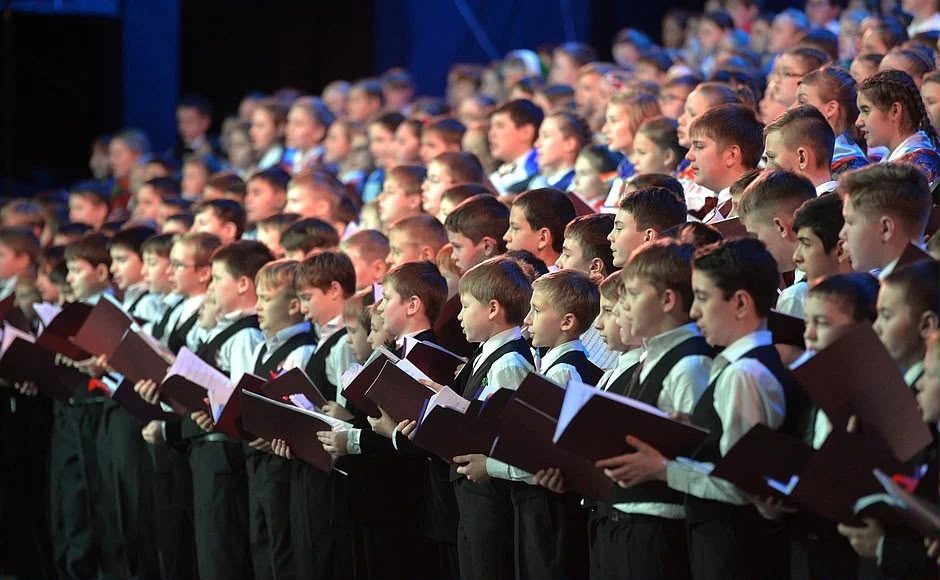
Rehearsal is another major difference between virtual choir vs live choir performances.
Virtual choir members may practise their vocal parts independently using recordings, sheet music, or digital resources. Online sessions can also help the director explain difficult sections and provide feedback.
This approach is useful for singers who live far apart or cannot attend regular rehearsals. However, singers must develop the discipline to practise independently and follow timing instructions accurately.
A virtual choir director can improve preparation by providing:
Separate practice tracks for each vocal part.
Clear instructions about tempo and entrances.
Reference videos demonstrating the song.
Recording guidelines.
Feedback on submitted recordings.
Live rehearsals allow singers to work on the music as a group. The conductor can identify problems immediately and help the choir improve its blend, balance, timing, and expression.
Singers also learn to follow visual cues, breathe together, listen across different vocal sections, and respond to changes in dynamics.
For beginners, these shared experiences can make it easier to understand how their individual parts fit into a larger musical arrangement.
Choir singing is not only about singing the correct notes. It also involves trust, communication, listening, and working towards a common goal.
Virtual choirs connect singers who may live in different cities or countries. Participants can contribute to the same musical project despite geographical distance.
This can create a sense of belonging and provide opportunities for people who might otherwise be unable to join a local choir. Singers also learn to take responsibility for their own preparation.
However, remote singers may have fewer opportunities for spontaneous interaction. Directors may need to organise online meetings and provide regular feedback to help participants feel connected.
Live choirs encourage direct communication and shared musical awareness. Singers can see the conductor’s gestures, hear other vocal parts, and adjust their performance immediately.
Rehearsing together also helps members build relationships and develop a shared sense of responsibility. These interactions can be especially beneficial for children, students, worship teams, and community choirs.
The two formats can both support teamwork, but live choirs generally provide more immediate face-to-face interaction.
Budget can influence whether a choir chooses a virtual or live performance.
Virtual choir projects may reduce expenses related to travel, venue hire, and physical rehearsal spaces. However, they can introduce other costs, including:
Microphones, headphones, or recording devices.
Audio and video editing software.
Technical support.
Online storage or file-sharing tools.
Time spent editing and synchronizing recordings.
A simple project can be completed with basic equipment, but larger productions may require professional audio mixing and video editing.
Live choirs may need to budget for rehearsal spaces, performance venues, transportation, sheet music, sound equipment, and event arrangements.
Some community or school choirs can keep expenses low by using existing facilities. Larger concerts may require additional lighting, microphones, sound engineers, and stage management.
The more affordable format depends on the size of the choir, the resources already available, and the complexity of the performance.

Audience experience is another important factor when choosing between virtual choir vs live choir performances.
Virtual choir performances can reach viewers through video platforms, websites, online events, and social media. People can watch from almost anywhere, and recordings can be shared long after the performance is complete.
Creative video layouts may also show singers in different locations, creating a visual representation of collaboration across distance.
However, recorded performances do not offer the same immediate interaction as a concert. Singers cannot directly respond to the audience’s reactions while recording individual parts.
Live performances allow audiences to experience the choir’s sound in the same space. Viewers can observe the singers’ expressions, follow the conductor’s movements, and respond through applause or other reactions.
The atmosphere of a live performance can make concerts, worship services, competitions, and community events particularly memorable.
Live performances can also be streamed or recorded, allowing choirs to combine an in-person event with online access.
Both virtual and live choir experiences can help young singers develop their musical abilities, but the best choice depends on their needs and learning environment.
Virtual choir projects can help children practise independently, learn their vocal parts, and become comfortable recording their voices. They may also allow students from different locations to participate in a shared project.
Younger singers may need additional support from a teacher or parent to follow practice tracks, record clearly, and stay motivated.
Live choir rehearsals allow children to learn by listening to others and following a conductor. They can practise singing in time, matching vowel sounds, controlling dynamics, and blending their voices with a group.
The social side of live singing can also encourage confidence and cooperation.
For beginners who need regular feedback, a live choir or a combination of live lessons and virtual projects can provide a helpful learning experience.
Choirs play an important role in many worship settings, and both virtual and live formats offer useful possibilities.
A virtual choir can bring singers from different churches, regions, or countries together for a special worship video. It can be useful for online services, seasonal celebrations, and collaborative music projects.
Because singers record separately, the director needs to provide clear reference tracks and guidance on tempo, pronunciation, and expression.
A live worship choir can respond to the congregation, follow the worship leader, and adjust dynamics as the service develops. Singers can also coordinate with instrumentalists in real time.
This makes live choirs especially useful when the music needs to respond naturally to the atmosphere of a worship service.
For churches that want both personal connection and broader reach, recording a live choir performance and sharing it online can offer a practical combination.
Yes. A hybrid approach can bring together the strengths of both formats.
For example, a choir could rehearse together in person, record a live performance, and share it online. Alternatively, a director could use online practice resources between in-person rehearsals to help singers prepare more effectively.
A hybrid choir project might include:
Online distribution of sheet music and practice tracks.
Group rehearsals for blend, balance, and musical expression.
A live performance for an in-person audience.
A recording or livestream for remote viewers.
Follow-up feedback to help singers improve.
This approach can expand access while preserving opportunities for direct musical interaction.
When deciding between virtual choir vs live choir, consider your main goal rather than assuming one format is always superior.
Choose a virtual choir if:
Singers live in different locations.
Travel or venue access is difficult.
You want to create a recorded online performance.
Participants need greater scheduling flexibility.
You want to reach a geographically broad audience.
Choose a live choir if:
Real-time musical interaction is a priority.
Singers need immediate guidance from a conductor.
You want to build in-person group relationships.
The performance is intended for a concert, competition, or worship service.
Singers need regular practice blending their voices together.
If your choir has several goals, consider combining online preparation with in-person rehearsals and performances.
At The Mystic Keys, we believe that musical growth involves more than learning notes. Singers benefit from developing listening skills, rhythm, confidence, and an understanding of how their voices contribute to a musical ensemble.
Through structured music learning and guided practice, students can work towards improving their vocal technique, musical expression, and performance confidence. These skills are useful whether they participate in a live choir, prepare for a virtual choir project, or sing as part of a worship team.
Students can also benefit from learning how to practise consistently, follow musical direction, and prepare songs with greater accuracy and expression.
Explore the music learning opportunities at The Mystic Keys to continue developing your musical journey.
The comparison between virtual choir vs live choir shows that both formats have distinct strengths. Virtual choirs offer flexibility, remote collaboration, and opportunities to share recorded performances with a wide audience. Live choirs provide real-time musical communication, direct feedback, and the shared experience of singing together in one place.
The best option depends on your singers, goals, resources, and performance setting. For some groups, virtual singing is the most practical choice. For others, the connection and spontaneity of live performance are essential. A hybrid approach can also provide the benefits of both.
Ultimately, what matters most is helping singers prepare well, listen carefully, work together, and communicate the music with confidence.
For more information and exciting resources about learning music, visit our website at The Mystic Keys. For more music content and exciting offers follow us on
Facebook, Instagram, YouTube, LinkedIn, Twitter, Pinterest, and Threads,

Understanding jazz vs rock guitar helps guitarists discover how different music styles shape chords, rhythm, tone, and improvisation. While jazz guitar focuses on complex harmonies, smooth chord voicings, and creative improvisation, rock guitar often emphasizes powerful riffs, strong rhythms, and expressive solos. Comparing jazz vs rock guitar also helps beginners understand how pop guitar fits between these styles and how each genre requires different playing techniques.
The guitar is one of the most versatile instruments in modern music. From energetic rock riffs to catchy pop melodies and sophisticated jazz harmonies, the same instrument can create completely different musical experiences. However, each genre has its own approach to rhythm, chords, improvisation, and tone.
In this guide, we will explore the key differences between jazz, pop, and rock guitar, including their playing techniques, musical structures, tones, and practice methods.
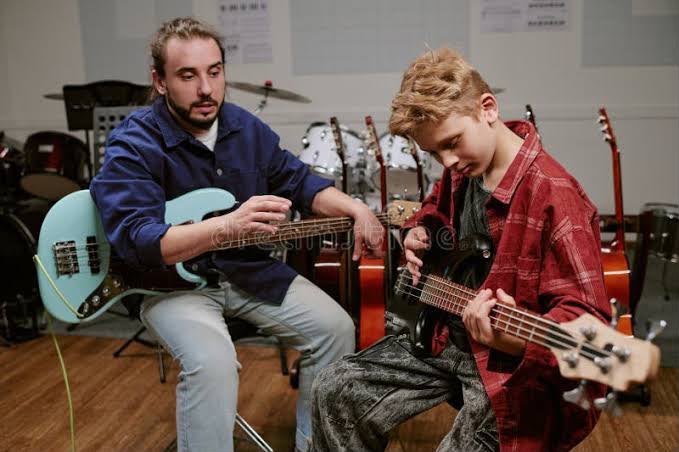
The first major difference lies in the musical purpose and character of each genre.
Jazz guitar often involves complex chords, melodic improvisation, and interactive playing. Guitarists may use extended chords, altered harmonies, and sophisticated rhythmic patterns to create a rich musical texture.
Rather than playing exactly the same part throughout a song, jazz guitarists frequently adapt their accompaniment and create new melodic ideas over the chord progression.
Pop guitar generally supports a song’s melody, vocal performance, and overall arrangement. Guitar parts may feature familiar chord progressions, memorable riffs, rhythmic strumming, or melodic hooks.
The goal is often to create a clear, engaging musical foundation that complements the song and makes it accessible to listeners.
Rock guitar typically emphasizes strong rhythms, distinctive riffs, power chords, and expressive lead playing. Depending on the subgenre, guitarists may use distortion, bends, slides, and powerful solos to create an energetic sound.
Although these descriptions represent common tendencies, there is considerable overlap. Pop can include sophisticated harmony, rock can feature intricate improvisation, and jazz can be melodic and rhythmically straightforward.
One of the clearest differences between these styles is how guitarists approach chords and harmony.
Jazz guitarists frequently use seventh chords, ninth chords, eleventh chords, and thirteenth chords. These extended harmonies add color and create more sophisticated musical textures.
For example, instead of playing only a basic G major chord, a jazz guitarist might use Gmaj7 or Gmaj9, depending on the song and arrangement.
Jazz players also learn chord inversions and voicings that place the same chord tones in different positions. This helps them move smoothly between chords while avoiding unnecessary repetition.
Pop songs often use familiar major and minor chord progressions that support a strong vocal melody.
For example:
G – D – Em – C
This progression is useful for practicing smooth transitions and accompanying a singer. Pop guitarists may use open chords, barre chords, arpeggios, or rhythmic strumming to create different textures.
Rock guitar frequently uses power chords, which emphasize the root and fifth of a chord. These shapes work especially well with distortion because they create a strong, direct sound.
A simple rock progression might use:
E5 – G5 – A5 – E5
Rock guitarists may also use full major and minor chords, suspended chords, and more complex harmonies depending on the style.
Key takeaway: Jazz guitar often emphasizes harmonic color and voice leading, pop guitar frequently supports melody with accessible harmony, and rock guitar commonly uses strong chord shapes and riffs to drive the music.
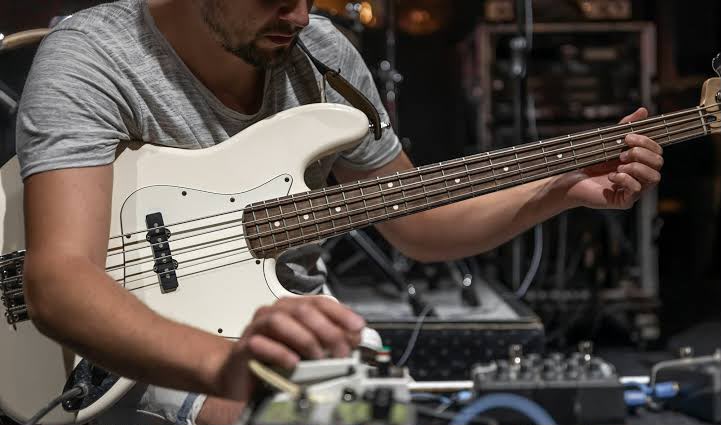
Rhythm is another important distinction between jazz, pop, and rock guitar.
Jazz guitarists often work with swing rhythms, syncopation, and flexible phrasing. In swing music, paired eighth notes are commonly performed with an uneven, long-short feel rather than as perfectly equal subdivisions.
Jazz guitarists may also use comping, short for accompanying. This involves playing chords in a rhythmic pattern that supports the soloist without overcrowding the music.
In a jazz ensemble, the guitarist listens to the drummer, bassist, and other musicians to determine when to play and how strongly to accent the rhythm.
Pop guitar often relies on steady, repetitive patterns that help establish the song’s groove.
Common techniques include:
Downstroke and upstroke strumming.
Eighth-note patterns.
Muted rhythmic strums.
Arpeggiated chord patterns.
Repeated rhythmic hooks.
Consistency is particularly important because the guitar often supports the vocal melody and helps maintain the song’s structure.
Rock guitar generally emphasizes a strong pulse, rhythmic precision, and accents that reinforce the drums and bass.
Palm-muted riffs, repeated eighth notes, power-chord patterns, and syncopated rhythms are common techniques. Depending on the subgenre, rock can range from simple, driving rhythms to highly complex patterns.
Practicing with a metronome or drum track can help guitarists develop the timing required for all three styles.

Improvisation is a central part of many jazz performances, although it is also common in rock and appears in some pop arrangements.
Jazz guitarists often create solos using scales, chord tones, arpeggios, chromatic approaches, and rhythmic variations.
Rather than relying on one scale for an entire song, they learn to understand how individual notes relate to the changing chords.
For example, when a progression moves from Dm7 to G7 and then Cmaj7, a jazz guitarist may shape a melodic line around the chord tones of each harmony.
This requires knowledge of the fretboard, harmony, rhythm, and active listening.
Pop guitar solos usually serve the song’s emotional and melodic direction. They may use memorable phrases, repeated motifs, simple scales, bends, or melodic variations.
The solo is often arranged to fit the song’s structure and complement the vocals rather than continuously explore changing harmonies.
Rock solos can emphasize expressive bends, vibrato, slides, pentatonic scales, and fast runs. Some styles feature long improvisations, while others use carefully composed solos.
Rock guitarists may improvise over repeated chord progressions or develop a solo that has been planned in advance.
The main difference: Jazz improvisation often responds directly to changing harmonies, while pop and rock solos frequently prioritize memorable melodies, emotional impact, and the character of the song.
The sound of a guitar is shaped by the instrument, amplifier, effects, playing technique, and musical context.
Jazz guitarists often favor a clean, warm, rounded tone that allows individual notes and chord voicings to remain clear.
Hollow-body and semi-hollow electric guitars are associated with many traditional jazz styles, although solid-body guitars and acoustic instruments are also widely used.
A jazz guitarist may use little distortion and moderate amounts of reverb, depending on the desired sound.
Pop guitar tones vary considerably. Some songs use bright, clean tones, while others feature chorus, delay, compression, or light overdrive.
The guitar’s role in the arrangement determines the tone. A clean arpeggio may create atmosphere, while a more prominent melodic part may require additional effects.
Rock guitar is often associated with overdrive and distortion, which add sustain, harmonic richness, and intensity.
Guitarists may also use delay, reverb, wah, and modulation effects to create distinctive sounds. However, clean rock guitar tones are equally important in many songs.
There is no single correct tone for any genre. The best approach is to choose a sound that supports the musical part and fits the arrangement.
Each genre develops a different set of techniques, although many skills transfer between styles.
Jazz guitarists often practice:
Seventh-chord and extended-chord voicings.
Chord inversions and smooth voice leading.
Walking-style bass notes and chord accompaniment.
Arpeggios and chord-tone targeting.
Swing phrasing and syncopation.
Improvisation over changing chord progressions.
These techniques help guitarists navigate sophisticated harmony while maintaining musical expression.
Pop guitarists often focus on:
Open chords and barre chords.
Consistent strumming patterns.
Clean chord changes.
Arpeggios and broken chords.
Muted strumming.
Melodic hooks and song accompaniment.
These skills are useful for playing with singers, performing covers, and supporting a variety of arrangements.
Rock guitarists often develop:
Alternate picking.
String bending and vibrato.
Slides and hammer-ons.
Pull-offs and legato playing.
Riff development and lead solos.
Some rock styles also require advanced picking, tapping, or rhythmic precision.
Learning techniques from different genres can make guitarists more adaptable and improve their overall musicianship.
Song structure influences how guitarists approach their parts.
Jazz musicians often perform from chord charts or lead sheets containing the melody and chord symbols. A tune may include a repeating harmonic form over which musicians take turns improvising.
Arrangements can also include introductions, interludes, ensemble sections, and different endings.
Because some jazz performances are flexible, guitarists must understand the form of the piece and listen carefully to the other musicians.
Pop songs commonly use structured sections such as verses, choruses, bridges, and instrumental breaks.
Guitar parts may repeat throughout the song to create consistency. Small variations in texture or intensity can help distinguish one section from another.
Rock songs may follow conventional verse-chorus structures or use extended instrumental sections, repeated riffs, breakdowns, and guitar solos.
The guitar can play a central role in defining the song’s identity through its main riff or lead melody.
Understanding song structure helps guitarists know when to maintain a repeated part, introduce a variation, or leave space for another instrument.
The difficulty of learning a genre depends on the student’s goals, previous experience, and the music they want to play.
Pop guitar can be an accessible starting point because many songs use a small number of repeated chords and straightforward strumming patterns.
Beginners can often learn simplified arrangements relatively early and develop confidence by accompanying familiar melodies.
Rock guitar can also be approachable. Simple riffs and power chords allow students to play recognizable musical patterns without mastering complex chord voicings immediately.
As students progress, they can explore lead techniques, faster rhythms, and more demanding solos.
Jazz guitar may feel more challenging at first because many styles involve extended chords, chord changes, syncopation, and improvisation.
However, beginners can start with simple jazz melodies, basic seventh chords, and easy swing patterns. Gradually learning these skills makes more advanced jazz music easier to understand.
The best starting point is the style that keeps you motivated to practice. You can also begin with pop or rock guitar and gradually explore jazz as your chord knowledge and listening skills improve.
Absolutely. Learning multiple styles can strengthen your understanding of the instrument and make you a more versatile musician.
Pop guitar can help you develop steady rhythm and song accompaniment. Rock guitar can strengthen your riff playing, picking, and expressive lead techniques. Jazz guitar can expand your knowledge of harmony, chord voicings, and improvisation.
You do not need to master one genre completely before exploring another.
A practical approach is to choose one simple song or exercise from each style and focus on the skills it teaches.
For example:
Pop: Practice a four-chord progression with steady strumming.
Rock: Learn a short riff using power chords and palm muting.
Jazz: Practice a seventh-chord progression and improvise a simple melody using chord tones.
This approach helps you compare the musical differences while building transferable skills.

A consistent routine can help you develop a foundation across jazz, pop, and rock guitar.
Minutes 1–5: Chord practice
Review basic major and minor chords, then practice seventh chords if you are comfortable with the fundamentals.
Minutes 6–10: Rhythm practice
Use a metronome to practice steady pop strumming, a rock riff, or a simple swing rhythm.
Minutes 11–15: Technique practice
Choose a genre-specific technique, such as palm muting for rock, arpeggios for jazz, or clean chord transitions for pop.
Minutes 16–20: Song practice
Work on a short passage from a song in your chosen style. Focus on timing, tone, and musical expression.
You can rotate the genre you focus on each day or spend a full week exploring one style before moving to another.
The key is to practice deliberately rather than rushing through too many techniques at once.
At The Mystic Keys, structured guitar lessons can help students develop the technical foundation and musical understanding needed to explore different genres.
Whether you want to learn pop accompaniment, play expressive rock riffs, or understand jazz harmony, a step-by-step learning approach can help you build confidence and progress at a suitable pace.
With consistent practice and guidance, students can work on:
Improving chord knowledge and transitions.
Developing rhythm and timing.
Understanding different musical styles.
Building picking and strumming techniques.
Learning to play melodies and riffs.
Exploring improvisation and musical expression.
Learning across genres can also help students discover their individual musical preferences while developing a broader understanding of the guitar.
Explore online guitar lessons at The Mystic Keys to learn more about developing your guitar skills.
Understanding how jazz guitar differs from pop and rock guitar helps you recognize the unique techniques and musical ideas behind each style.
Jazz guitar often emphasizes harmonic complexity, smooth chord voicings, swing rhythms, and improvisation. Pop guitar frequently supports catchy melodies through accessible chord progressions and consistent rhythmic patterns. Rock guitar often focuses on powerful riffs, energetic rhythms, distortion, and expressive lead playing.
Although the genres have distinct characteristics, they share many fundamental skills. Chord knowledge, timing, listening, technique, and musical expression are valuable in every style.
Whether you are a beginner or an experienced guitarist, exploring jazz, pop, and rock can expand your abilities and help you become a more versatile musician.
Learn the fundamentals, explore different sounds, and let your musical curiosity guide your guitar journey.
For more information and exciting resources about learning music, visit our website at The Mystic Keys. For more music content and exciting offers follow us on
Facebook, Instagram, YouTube, LinkedIn, Twitter, Pinterest, and Threads,
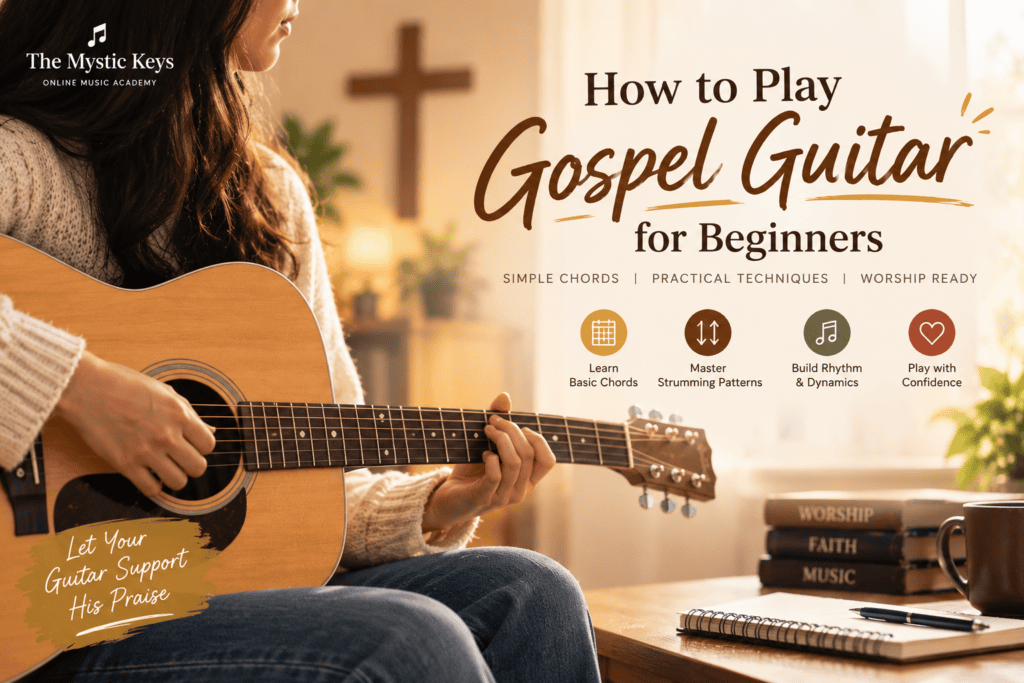
Learning how to play gospel guitar for beginners is a great way to develop your musical skills while accompanying gospel songs and worship music. Gospel guitar combines simple chords, rhythmic strumming, expressive dynamics, and meaningful musical accompaniment. If you are new to guitar, understanding how to play gospel guitar for beginners can help you build confidence without feeling overwhelmed by advanced techniques.
The best way to start is by learning basic guitar chords, practicing steady strumming patterns, and understanding common gospel chord progressions. With regular practice and the right guidance, beginners can gradually learn how to support singers, follow worship songs, and play gospel music with greater confidence. This guide explains how to play gospel guitar for beginners step by step, from essential chords to practical worship techniques.

Before learning specific techniques, it is helpful to understand how the guitar fits into gospel music.
Gospel guitar is not only about playing chords. It helps establish the rhythm, support the harmony, and create an atmosphere that complements the vocals.
Depending on the song and musical arrangement, guitarists may use:
Rhythm guitar: Maintains the groove through chords and strumming.
Fingerpicking: Creates softer, more delicate accompaniment.
Arpeggios: Plays the notes of a chord individually to add movement.
Chord embellishments: Adds small musical details to make progressions more expressive.
Lead fills: Short melodic phrases played between vocal lines.
Beginners should start with rhythm guitar because it provides a strong foundation for playing with singers and other musicians.
As your skills improve, you can explore fingerpicking, melodic fills, and more advanced gospel techniques.
One of the first steps in learning gospel guitar is becoming comfortable with basic open chords.
Start with these commonly used chords:
G major
C major
D major
E minor
A minor
E major
A major
These chords appear in many popular song arrangements and provide a useful foundation for learning chord progressions.
Choose two chords, such as G and C. Form the first chord, strum it steadily, and then move to the second chord without stopping the beat.
Repeat the process slowly until the transition becomes comfortable.
Next, practice changing between G and D, C and G, and Em and C.
Beginner tip: Focus on clean chord sounds rather than speed. If a string sounds muted or buzzes, adjust your finger placement and press close to the fret without touching the neighboring strings.
As you become more comfortable, practice the chords in the context of complete songs rather than treating every chord as an isolated exercise.

Gospel music often uses major and minor chords arranged into progressions that support the melody and create emotional movement.
A few useful progressions for beginners include:
In the key of G major, this progression is:
G – C – D – G
Practice playing each chord for four steady beats. Once you can change chords smoothly, try using two beats per chord.
In G major, this becomes:
G – D – Em – C
This progression is useful for learning how major and minor chords can work together to create different moods.
In G major, this becomes:
Em – C – G – D
Practice this progression slowly and listen to how the minor chord at the beginning changes the feeling of the sequence.
These are general chord progressions used across many styles of contemporary music, including some gospel and worship arrangements. Not every gospel song uses them, so learn the actual chords of the songs you want to play.
Rhythm is one of the most important skills for a gospel guitarist. Even when you know all the correct chords, inconsistent timing can make it difficult for singers to stay together.
Start with a simple downstroke pattern.
Count:
1 – 2 – 3 – 4
Strum downward once on each beat while keeping your hand relaxed.
Once you can maintain a steady pulse, try a basic eighth-note pattern:
1 & 2 & 3 & 4 &
Move your strumming hand evenly between the beats, using a combination of downstrokes and upstrokes. Begin slowly and increase the tempo only when the pattern feels comfortable.
Gospel songs often move between quieter verses and energetic choruses. Your strumming should support those changes.
Use fuller strums when the music becomes more energetic.
Reduce unnecessary strumming when singers need space.
Keep the rhythm steady even when changing volume.
Remember that a strong gospel rhythm does not always mean playing loudly. Good timing, controlled dynamics, and listening to the other musicians are equally important.
A metronome produces a steady beat that helps you develop timing and consistency.
For beginners, start at a comfortable tempo, such as 60 beats per minute.
Practice a simple four-chord progression while maintaining the beat. If you make a chord-change mistake, try to continue counting rather than stopping completely.
Gradually increase the tempo when you can play accurately.
You can also practice with a simple drum loop or instrumental backing track once you feel comfortable with the metronome.
The goal is not simply to play faster. It is to maintain a reliable groove that supports the song and helps the singers feel secure.

Dynamics refer to changes in musical volume and intensity. They are especially important when accompanying vocals.
A guitarist who plays at the same volume throughout a song may make the performance sound flat, even when the chords are correct.
Try practicing a simple progression in three stages:
Stage 1: Soft verse
Use gentle strumming or lightly picked chords to create space for the singer.
Stage 2: Building intensity
Increase the energy gradually as the melody develops. Keep your rhythm controlled rather than suddenly becoming much louder.
Stage 3: Full chorus
Use stronger strumming when the arrangement calls for it, while ensuring that the guitar does not overpower the vocals.
Practice moving between these levels without changing the tempo.
Learning to control dynamics will help you accompany singers more musically and respond to the needs of the song.
Although strumming is a useful starting point, gospel guitar can also include fingerpicking and arpeggios.
An arpeggio involves playing the notes of a chord separately rather than strumming all the strings at once.
For example, form a G major chord and pick its strings slowly, one at a time. Listen to how the individual notes create a softer texture.
You can practice this technique during quieter sections of a song or when accompanying a singer who needs a gentle musical background.
Start with a simple picking pattern and maintain an even rhythm. Avoid adding complicated patterns before you can play the basic chords cleanly.
As your coordination improves, experiment with different picking sequences and use them to complement the melody.
Playing gospel guitar in a worship setting requires more than knowing the song. Your role is to support the singers and help maintain the musical flow.
Here are a few important habits to develop.
Pay attention to the singer’s phrasing, breathing, and volume. If the vocal line becomes soft or reflective, reduce the intensity of your accompaniment.
Know where the verses, choruses, bridges, introductions, and endings occur. This helps you avoid unnecessary playing during transitions.
You do not need to fill every moment with strumming or melodic notes. Sometimes a simple chord played at the right moment is more effective than a complicated guitar part.
In a live setting, the song may repeat a chorus, extend an ending, or move into another section. Watching for cues helps you respond appropriately.
A steady rhythm allows singers to focus on their lyrics and delivery instead of trying to follow an unpredictable accompaniment.
Developing these habits will help you become a more dependable guitarist in a worship team.

A capo is a device attached across the guitar strings to raise their pitch. It allows guitarists to use familiar chord shapes while playing a song in a higher key.
For example, if a song is difficult to play using its original chord shapes, a capo may allow you to use simpler open chords while matching the desired pitch.
However, a capo does not automatically make every song easier. You still need to understand the chord shapes, the song’s key, and how the capo affects the sound.
When playing with singers, always choose a key that suits their vocal range. A guitar arrangement should support the singer rather than force them to sing notes that are too high or too low.
Listening carefully to gospel recordings is an effective way to understand how guitar fits into the music.
Instead of listening only to the melody, focus on the accompaniment.
Ask yourself:
Is the guitarist strumming continuously or playing occasional chords?
Does the guitar become louder during the chorus?
Are individual notes picked between vocal phrases?
Does the guitarist leave space for the singer?
How does the guitar work with the piano, bass, and drums?
Try listening to the same song several times, focusing on one musical element during each listen.
You can then practice a simplified version using the chords and rhythm you have learned.
Avoid trying to copy every detail immediately. Understanding the role of the guitar in the arrangement is more important than reproducing an advanced part perfectly.
Learning gospel guitar takes patience. Avoiding a few common mistakes can make your progress smoother.
Speed can make chord changes less accurate. Begin slowly and increase the tempo gradually.
Different songs need different rhythmic approaches. Listen to the arrangement and adapt your playing accordingly.
Playing loudly throughout the entire song can overwhelm the vocals. Practice changing your intensity to suit the music.
Beginners sometimes add too many strums or fills because they want to make the guitar part sound impressive. Focus on supporting the song first.
Technical practice is important, but listening to singers and other musicians helps you understand how to play in a real ensemble.
Occasional long sessions are less useful than a realistic routine you can maintain consistently.
You do not need to practice for hours every day to make progress. A focused 20-minute routine can help beginners develop the essential skills.
Minutes 1–5: Chord practice
Review three or four chords and work on smooth transitions.
Minutes 6–10: Rhythm practice
Play a simple strumming pattern with a metronome. Concentrate on keeping the beat steady.
Minutes 11–15: Chord progression
Practice a progression such as G–C–D–G or G–D–Em–C. Play it slowly before increasing the tempo.
Minutes 16–20: Song practice
Choose one gospel or worship song and combine the chords and rhythm. Pay attention to the song structure and the dynamics.
Repeat this routine regularly, adjusting it as your skills improve. On days when you have more time, work on fingerpicking, capo use, or playing along with recordings.
At The Mystic Keys, students can build a stronger musical foundation through structured guitar learning and guided practice.
For beginners, developing the correct technique early can make learning new songs easier and help prevent unhelpful playing habits.
With consistent guidance, students can work toward:
Learning basic chords and smooth transitions
Developing reliable strumming and timing
Understanding chord progressions
Improving rhythmic control and dynamics
Learning to accompany singers
Building confidence when playing with other musicians
Whether your goal is to play at church, accompany a worship team, or enjoy gospel music at home, a step-by-step learning approach can help you progress at a comfortable pace.
Explore online guitar lessons at The Mystic Keys to learn more about developing your guitar skills.
Learning how to play gospel guitar for beginners starts with simple chords, steady rhythm, and consistent practice. You do not need advanced techniques to begin accompanying gospel songs. By focusing on chord progressions, strumming patterns, dynamics, and listening skills, you can build a strong foundation.
As you progress, explore fingerpicking, arpeggios, capo use, and more expressive accompaniment techniques. Most importantly, learn to listen to the singers and other musicians so that your playing supports the music rather than competing with it.
Start simple, practice consistently, and let your musical confidence grow one song at a time.
For more information and exciting resources about learning music, visit our website at The Mystic Keys. For more music content and exciting offers follow us on
Facebook, Instagram, YouTube, LinkedIn, Twitter, Pinterest, and Threads.
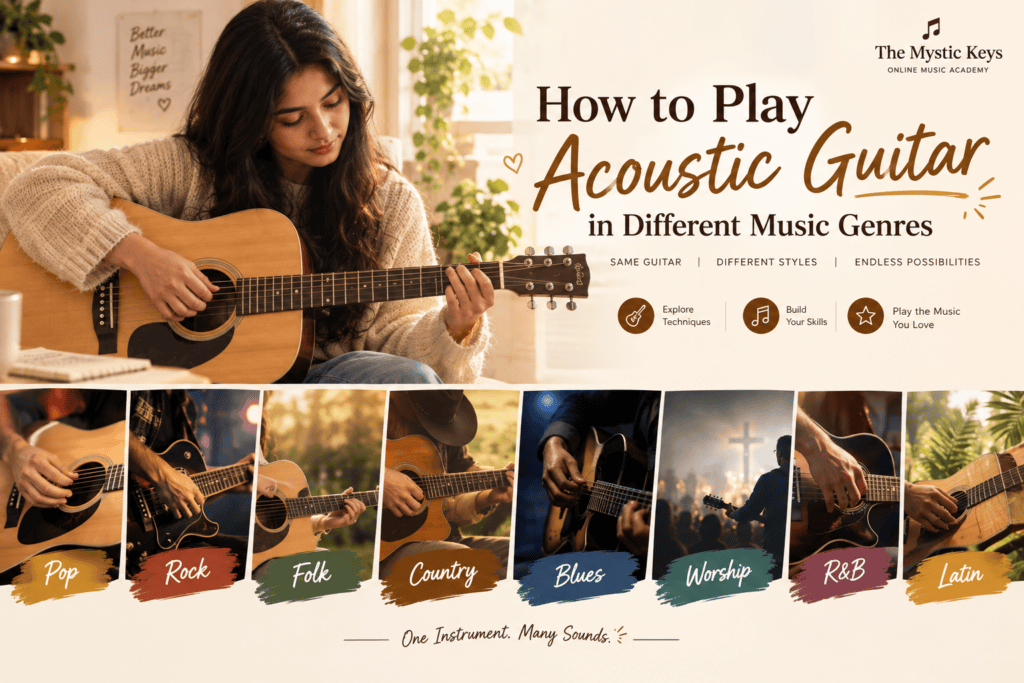
Learning how to play acoustic guitar in different music genres can help guitarists become more versatile, creative, and confident musicians. The acoustic guitar is used in a wide variety of styles, including pop, rock, folk, country, blues, jazz, and worship music. Although the instrument remains the same, the way you play it can completely change the mood and character of a song.
For example, gentle fingerpicking can create an intimate, emotional atmosphere, while energetic strumming can bring excitement and movement to a performance. Understanding these differences allows guitarists to adapt their playing to different musical situations.
At The Mystic Keys, learning music is about more than memorizing chords. Developing rhythm, listening skills, technique, and musical expression helps students understand how to use their instruments creatively.
In this guide, we will explore the techniques, rhythms, and practice methods that help you play acoustic guitar across different genres.

Before exploring individual genres, it is important to understand the fundamental techniques that shape acoustic guitar playing.
1. Strumming
Strumming involves moving your picking hand across multiple strings to create rhythmic accompaniment. It is commonly used in pop, rock, country, folk, and worship music.
To improve your strumming:
2. Fingerpicking
Fingerpicking involves plucking individual strings with your thumb and fingers rather than strumming every string together. It allows you to play bass notes, chord tones, and melodies simultaneously.
Fingerpicking is especially useful for folk, country, blues, and acoustic ballads. Begin with a simple pattern in which your thumb plays a bass note while your fingers play the higher strings.
3. Chord Transitions
Smooth chord changes are essential across almost every genre. Practise moving between common open chords, such as G, C, D, Em, and Am, without interrupting the rhythm.
Start slowly and focus on clean notes before increasing your speed.
4. Rhythm and Dynamics
Rhythm determines how the music moves, while dynamics describe how loudly or softly you play. A guitarist might use gentle strumming during a verse and stronger strokes during a chorus to create contrast.
These foundational skills make it easier to adapt to different musical styles.

Pop music often uses memorable melodies, accessible chord progressions, and consistent rhythms. Acoustic guitar can provide the main accompaniment for a singer or add texture to a larger arrangement.
For practice, choose a simple four-chord progression, such as G–D–Em–C. Play it slowly with even strumming, then experiment with different accents and dynamics.
The goal is not simply to play the correct chords. It is to make the accompaniment sound natural and support the song.

Acoustic guitar plays an important role in rock music, particularly in unplugged performances, acoustic ballads, and songs that alternate between quiet verses and powerful choruses.
Start with a simple progression and play it with muted, controlled strokes. Then repeat it with fuller strumming to hear the difference.
Acoustic rock does not always require playing loudly. The contrast between restrained and powerful sections often makes the arrangement more effective.
Folk music frequently emphasizes storytelling, clear melodies, and natural-sounding accompaniment. The acoustic guitar is particularly effective because it can support a singer while creating a warm, flowing sound.
Fingerpicking: Use your thumb for the lower strings and your fingers for the higher strings to create a repeating pattern.
Open chords: Allow the strings to ring clearly when the harmony permits.
Alternating bass notes: Alternate between bass notes within a chord to add movement beneath the melody.
Gentle strumming: Use relaxed strokes that leave room for the vocals.
A useful exercise is to play a G chord by picking the
bass string followed by three higher strings. Repeat the pattern evenly before applying it to other chords.
Folk playing teaches guitarists to balance melody, harmony, and rhythm without overcrowding the arrangement.

Country guitar often combines rhythmic strumming, melodic picking, and bright, clearly articulated notes. Depending on the song, the guitar may provide a steady accompaniment or play a more prominent melodic part.
Begin by practising a simple country-style progression with steady bass notes. Once comfortable, add a short melody between chord changes.
Country guitar rewards precision and consistency. Clean picking and a reliable rhythmic pulse help create its characteristic sound.
Blues guitar emphasizes expression, rhythmic feel, and the relationship between chords and melody. Acoustic blues can sound gentle and intimate or energetic and percussive.
Blues chord progressions: Learn the basic 12-bar blues structure, commonly built around the I, IV, and V chords.
Shuffle rhythm: Practise a long-short rhythmic feel rather than playing every subdivision evenly.
Hammer-ons and pull-offs: Use these techniques to connect notes smoothly and create expressive phrases.
Slides: Move between notes to produce a connected, vocal-like sound.
Start with a simple blues progression in A, using A7, D7, and E7. Practise changing between the chords while maintaining a steady pulse.
After becoming comfortable with the rhythm, add a short melody using notes from the A minor pentatonic scale.
The most important lesson in blues is expression. Small changes in timing, articulation, and note emphasis can make a simple phrase sound much more musical.

Jazz guitar introduces richer harmonies, syncopated rhythms, and more complex chord voicings. Although some jazz styles are associated with electric guitar, acoustic guitar can also provide beautiful harmonic accompaniment and melodic lines.
Begin by learning a few seventh chords and switching between them slowly. Focus on muting unwanted strings so that each chord sounds clear.
Next, try playing a simple melody while adding selected chord notes beneath it.
Jazz can be challenging for beginners, so build your skills gradually. Familiarity with basic chords and rhythm will make more advanced harmonies easier to understand.
Acoustic guitar is widely used in worship settings because it can provide rhythmic support, reinforce harmony, and help create a comfortable foundation for congregational singing.
Effective worship guitar playing requires more than knowing chord shapes. Musicians must listen carefully, maintain steady timing, and respond to the needs of the song.
Consistent strumming: Maintain a reliable groove that supports the singers and other musicians.
Controlled dynamics: Use lighter strumming during reflective sections and fuller playing when the song builds.
Chord transitions: Learn to move smoothly between chords without disrupting the flow.
Listening and coordination: Pay attention to the vocalist, drummer, and other instruments rather than concentrating only on your own playing.
Musical space: Avoid filling every moment with strumming. Sometimes a sustained chord or a brief pause makes the arrangement more effective.
For practice, take a familiar worship song and play the verse softly. Gradually increase the intensity in the chorus while keeping the rhythm steady.
At The Mystic Keys, students can develop their instrumental technique alongside the listening, timing, and ensemble awareness needed for expressive music-making.
R&B and soul often use smooth chord progressions, subtle rhythmic accents, and expressive accompaniment. Acoustic guitar can contribute warmth and rhythmic detail without dominating the arrangement.
Begin with a slow progression using Am7, Dm7, G7, and Cmaj7. Play the chords softly and experiment with leaving small spaces between rhythmic accents.
The key is control. Subtle timing and touch often matter more than playing many notes.
Latin-inspired acoustic styles, including bossa nova, often feature syncopated rhythms and carefully balanced bass and chord patterns. Fingerstyle playing is particularly useful because it allows the guitarist to combine both elements.
Start with a simple chord progression and play the bass notes steadily. Add soft chord tones above them, then gradually introduce rhythmic variations.
Practise slowly with a metronome before increasing the tempo. A relaxed, consistent pulse is essential for this style.
One of the most useful ways to improve is to play the same chord progression in several different styles.
For example, try G–D–Em–C in the following ways:
| Genre | Playing approach |
|---|---|
| Pop | Steady, even strumming |
| Rock | Strong accents and dynamic builds |
| Folk | Gentle fingerpicking or relaxed strumming |
| Country | Alternating bass and melodic picking |
| Blues | Shuffle rhythm and expressive phrases |
| Worship | Controlled dynamics and supportive strumming |
| R&B | Smooth chords and subtle syncopation |
| Bossa nova | Fingerstyle bass-and-chord patterns |
This exercise shows that the genre is shaped not only by the chords you choose but also by your rhythm, articulation, dynamics, and picking technique.
When learning how to play acoustic guitar in different music genres, beginners sometimes focus too heavily on speed or complicated techniques.
Avoid these common mistakes:
A focused practice routine will help you build transferable skills without becoming overwhelmed.
You do not need to practise for hours every day to explore different genres. A short, structured routine can help you make steady progress.
Monday – Pop: Practise open chords and steady strumming.
Tuesday – Folk: Work on fingerpicking and alternating bass notes.
Wednesday – Rock: Focus on rhythmic accents, muting, and dynamic contrast.
Thursday – Blues: Practise a 12-bar progression and simple melodic phrases.
Friday – Country: Work on picking accuracy and bass patterns.
Saturday – Worship or R&B: Practise dynamics, listening, and rhythmic control.
Sunday – Review: Play your favourite exercise from each style and identify what needs improvement.
Adjust the schedule to your experience level and available time. Consistent, attentive
practice is more useful than rushing through several techniques without mastering them.
Learning acoustic guitar becomes more rewarding when you have a clear learning path and guidance suited to your level.
At The Mystic Keys, online music lessons can help students build their skills through a structured and supportive learning experience.
Students can work towards:
Whether you are beginning your guitar journey or looking to expand your existing skills, a consistent practice routine and appropriate instruction can help you progress with greater confidence.
Explore online guitar lessons at The Mystic Keys to learn more about developing your playing.
Learning how to play acoustic guitar in different music genres helps you become a more adaptable and expressive musician. Pop develops your strumming consistency, folk encourages fingerpicking, rock builds rhythmic energy, country improves picking precision, and blues teaches you to play with expression. Jazz, worship, R&B, and Latin styles offer further opportunities to develop your musical understanding.
You do not have to master every genre immediately. Start with the style you enjoy most, practise its essential techniques, and gradually explore others.
The more styles you learn, the more ways you discover to express yourself through music.
For more information and exciting resources about learning music, visit our website at The Mystic Keys. For more music content and exciting offers follow us on Facebook, Instagram, YouTube, LinkedIn,
Twitter, Pinterest, and Threads.


Finding the best online music academy in Ireland is not just about choosing any platform—it’s about finding the right place that offers quality teaching, flexibility, and real musical growth.
With so many options available, students need an academy that provides structured learning, expert guidance, and a supportive environment. This is where The Mystic Keys stands out as a leading choice for online music education.
To identify the best online music academy in Ireland, you need to look for:
The Mystic Keys combines all of these elements to create a complete and effective learning experience.

When it comes to choosing the best online music academy in Ireland, The Mystic Keys offers a unique advantage through its student-focused approach.
✔ Personalized One-on-One Learning
Every student receives individual attention through live 1:1 sessions. This helps:
✔ Structured Curriculum for All Levels
The Mystic Keys provides a clear learning path for:
Each lesson is designed to build skills step-by-step, ensuring consistent progress.
✔ Flexible Scheduling
Students can:
This flexibility makes it ideal for learners across Ireland.

✔ Expert Teachers
At The Mystic Keys, students learn from:
This ensures high-quality learning.
The Mystic Keys creates an engaging and effective learning environment.
Students benefit from:
This makes learning more practical and enjoyable.
As the best online music academy in Ireland, The Mystic Keys offers:
Students can explore different areas of music based on their interests.
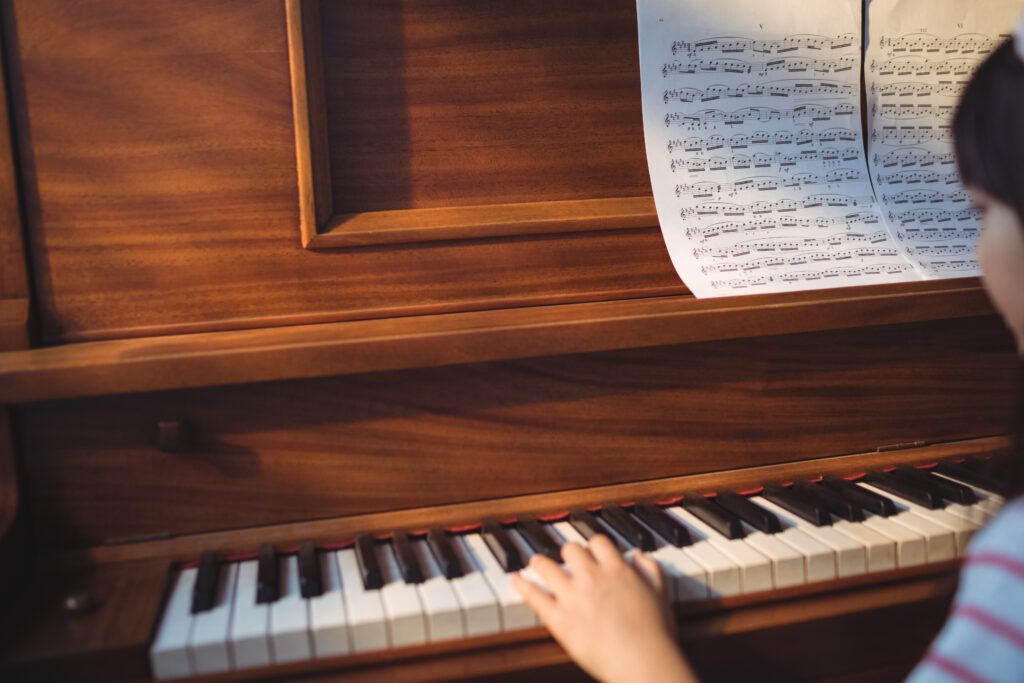
Online learning becomes highly effective when done correctly.
The Mystic Keys ensures:
This makes online music education as effective as in-person learning.
❌ Lack of guidance → ✔ Personalized teaching
❌ Inconsistent practice → ✔ Structured plans
❌ Low confidence → ✔ Performance training
❌ Slow progress → ✔ Step-by-step curriculum
The Mystic Keys addresses these challenges effectively.
When selecting the best online music academy in Ireland, always check:
The Mystic Keys meets all these criteria, making it a reliable choice

Students prefer The Mystic Keys because it offers:
This combination makes it one of the most trusted online academies.
👉 Visit our page, Piano Lessons Online to explore more about our piano curriculum.
Finding the best online music academy in Ireland comes down to choosing a platform that supports your growth, builds your confidence, and helps you enjoy learning music.
The Mystic Keys stands out by offering personalized lessons, expert guidance, and a structured approach that helps students succeed.
👉 If you’re looking for real progress and a supportive learning experience, The Mystic Keys is the right choice.
For more information and exciting resources about learning music, visit our website at The Mystic Keys. For more music content and exciting offers follow us on
Facebook, Instagram, YouTube, LinkedIn, Twitter, Pinterest, and Threads.

Learning music has become more accessible than ever. Students no longer need to live near a music school, travel across the city for every lesson, or follow a rigid classroom schedule. With the growth of online music education, students across Canada can now connect with music teachers from different locations and learn from home. An Online Music Academy in Canada can provide this flexibility while offering structured lessons, personalised guidance, and access to experienced music educators without the need for in-person travel..
However, having many options also creates a new challenge: How do you find the right online music academy in Canada?
The answer is not simply about choosing the academy with the most courses or the lowest price. A good online music academy should match the student’s goals, learning style, schedule, preferred instrument, and expectations from the lessons.
Whether you are looking for music lessons for yourself, searching for classes for your child, preparing for a music examination, or simply hoping to develop your skills, knowing what to look for can make the decision much easier.

An online music academy is a music education platform that provides lessons through digital communication tools such as video conferencing. Instead of attending a physical music school, students participate in live lessons from their home or another convenient location.
Depending on the academy, students may be able to learn instruments such as piano, guitar, violin, drums, ukulele, keyboard, or vocals. Some academies also provide music theory, ear training, examination preparation, songwriting, or other areas of musical development.
The biggest difference between online academies is not necessarily the technology they use. It is how the learning experience is structured.
Some platforms may focus mainly on recorded lessons, while others offer live classes with a teacher. Certain academies may provide group sessions, whereas others focus on one-on-one instruction. Understanding these differences is important before enrolling.
Canada has a diverse population spread across large cities, suburbs, and smaller communities. For some students, finding a suitable teacher nearby can be difficult, particularly when they are looking for a specific instrument, teaching style, genre, or level of expertise.
Online learning can remove some of these geographical limitations.
A student can attend a lesson without spending time travelling to and from a music school. Parents can also avoid arranging transportation for every lesson, while adult learners can fit music education more easily around work and family responsibilities.
Another advantage is flexibility. Many online academies work with students across different locations and may offer lesson timings that are more adaptable than traditional music schools.
At the same time, convenience should not become the only reason for choosing an academy. The quality and structure of the lessons still matter.

Before comparing different online music academies, it helps to understand why you want to learn music.
A beginner who wants to learn piano for personal enjoyment may need a very different learning approach from a student preparing for an ABRSM, Trinity College London, or Rockschool examination.
Similarly, someone interested in Western vocals may be looking for a different teaching style from a student who wants to learn Hindustani or Carnatic music.
Your goal could be learning an instrument from scratch, improving existing skills, preparing for examinations, developing music theory knowledge, learning to sing confidently, or simply making music part of your routine.
Once that goal is clear, it becomes easier to evaluate whether an academy’s teaching approach is actually suitable.
The range of courses is another important factor to consider.
A well-structured online music academy may offer various instruments and musical disciplines. This gives students more choices based on their interests. Courses may include piano, keyboard, guitar, violin, drums, ukulele, Western vocals, Indian classical vocals, and other specialised areas.
However, a long course list does not always mean better teaching.
Instead of asking only, “How many courses do they offer?”, check the teachers available for your chosen course. Their experience and expertise should match your learning goals.
For example, vocal students should look for teachers who understand vocal technique, musicality, pronunciation, repertoire, and performance development. Simply offering singing as a course is not enough.

One of the most important questions to ask is whether the lessons are live, recorded, or a combination of both.
Recorded videos can be useful for revision and independent practice, but they cannot completely replace interaction with a teacher. During a live lesson, the teacher can listen to the student’s playing or singing, identify mistakes, demonstrate techniques, answer questions, and adjust the lesson according to the student’s progress.
One-on-one live classes can provide an even more personalised learning experience.
Instead of following exactly the same lesson as every other student, the teacher can spend more time on areas where the individual needs support. That can be particularly valuable for beginners who may need additional explanation and encouragement during the early stages.
The teacher is one of the most important parts of any music-learning experience.
An academy may have an attractive website, modern technology, and a large selection of courses, but the actual learning experience ultimately depends heavily on the teacher.
When researching an online music academy in Canada, look at the qualifications and experience of its instructors. Depending on the course, relevant certifications could include Trinity College London, ABRSM, Rockschool, university-level music education, performance qualifications, or other recognised training.
Experience also matters.
A teacher who regularly works with beginners may approach a first lesson very differently from a teacher who primarily prepares advanced performers. Likewise, teaching children requires patience, communication, and lesson planning that may differ from teaching adults.
Therefore, it is worth looking beyond the qualification itself and considering whether the teacher’s experience matches the student’s needs.

Every student learns differently.
Some may understand concepts quickly but struggle with rhythm. Others may have good technique but need more confidence. Beginners may need extra practice, while advanced students may focus on specific skills.
Personalised lessons allow teachers to address these individual needs.
A good online music academy should adapt lessons to the student’s level, progress, interests, and goals. This makes learning more engaging and avoids a one-size-fits-all approach.
For children, personalised instruction can include suitable songs and activities while building strong musical foundations.
If an academy offers a trial or demo lesson, it can be an excellent opportunity to understand how the learning experience actually works.
A website can tell you about teachers, courses, technology, and pricing, but a live lesson gives you a better idea of the teacher’s communication style and the overall learning environment.
During a demo, pay attention to whether the teacher explains concepts clearly, listens to the student, encourages questions, and adjusts the lesson according to the student’s level.
The experience should feel like a genuine learning session rather than simply a sales conversation.
Online music lessons depend on technology, so the academy should have a clear and practical system for conducting classes.
Ask which platforms are used for lessons. Common options include Zoom and Google Meet, although the specific platform matters less than whether the lessons are stable and easy to access.
It is also useful to understand how lesson recordings and supplementary learning materials are handled.
For instance, recordings can allow students to revisit difficult sections after class, while notes, exercises, sheet music, or other materials can support independent practice between lessons.
A straightforward technical setup can make online learning considerably more comfortable, particularly for younger students and parents.

For many Canadian students, scheduling is an important consideration.
School, university, work, extracurricular activities, family commitments, and changing routines can make fixed lesson timings difficult to maintain.
An online academy that considers teacher availability alongside the student’s schedule can provide greater flexibility.
However, flexibility does not mean that students should treat lessons casually. Consistent attendance and regular practice remain important for musical progress. The ideal arrangement is one that provides reasonable scheduling flexibility while still encouraging a steady learning routine.
Cost is naturally an important part of the decision, but it should not be the only deciding factor.
A lower-priced lesson may seem attractive initially, but the actual value depends on what the student receives in return. Teacher expertise, lesson duration, individual attention, learning materials, recordings, examination support, and scheduling flexibility can all influence the overall experience.
Rather than comparing prices alone, compare what is included in the learning experience.
A slightly different fee may make sense if the student receives personalised instruction, qualified teaching, structured progression, and additional academic or examination support.

Students who want to pursue formal music examinations should check whether the academy provides appropriate preparation.
Examination systems such as Trinity College London, ABRSM, and Rockschool have specific requirements relating to repertoire, technique, theory, performance, and musical understanding.
An academy experienced in examination preparation can help students understand those requirements and prepare systematically.
That does not mean every student needs examination training. For someone learning purely for enjoyment, a performance-focused or recreational approach may be more appropriate.
The important point is to choose an academy that aligns with the student’s long-term objective.
Reviews can offer useful insight into an online music academy. Look beyond the star rating and read what students and parents say about teaching quality, communication, scheduling, and support.
Choose reviews that match your needs. For example, a parent seeking piano lessons for a child may find feedback from other parents more relevant.
Remember that reviews reflect individual experiences. Consider them alongside teacher qualifications, course structure, and a trial lesson.

The right online music academy can look different for a six-year-old beginner, a teenager preparing for examinations, and an adult learning music after work.
Young students often benefit from teachers who can maintain attention, introduce concepts creatively, and communicate clearly with both the child and parent.
Teenagers may need a balance between structured learning and their own musical interests. Adult students, meanwhile, often appreciate flexibility and lessons that connect directly with their personal goals.
Learning style matters as well.
Some students prefer structured progression, while others enjoy learning through songs and practical application. Identifying these preferences can help you find a teacher and academy that feel like a natural fit.
A short conversation with the academy can answer many questions before you make a commitment.
You might ask about the teacher’s qualifications, lesson duration, class frequency, scheduling, course structure, examination preparation, recordings, learning materials, and what happens if a class needs to be rescheduled.
It is also worth asking how the academy evaluates student progress.
A clear answer can indicate whether the academy has a structured approach to learning rather than simply conducting individual lessons without a broader progression plan.

Ultimately, finding the right online music academy in Canada comes down to fit.
The academy should offer suitable courses, qualified teachers, interactive lessons, an accessible learning system, and an approach that matches the student’s goals. Personal attention and consistent communication can make the online experience feel much more engaging than simply watching instructional videos.
A strong academy should also make the learning journey practical. Students need a system that works with their schedules, technology that is easy to use, and resources that help them continue practising between lessons.
Most importantly, the student should feel that the lessons are helping them move forward.
Online music education is no longer simply an alternative for people who cannot attend a physical music school.
With live instruction, personalised lesson planning, qualified teachers, digital resources, and flexible scheduling, online learning can provide a structured musical education from the comfort of home.
For students in Canada, this can open up access to teachers and learning opportunities that may not be available within their immediate neighbourhood.
The key is to choose thoughtfully rather than simply selecting the first academy that appears in a search result.

Finding the right Online Music Academy in Canada starts with understanding your musical goals. Consider the teachers, course structure, personalised attention, flexibility, learning resources, and overall experience before enrolling.
For those looking for Piano Lessons Online or other personalised music classes, The Mystic Keys offers live, one-on-one online lessons designed around different levels, goals, and schedules.
Ultimately, the right academy is one that makes learning music structured, flexible, engaging, and enjoyable.
For more information and exciting resources about learning music, visit our website at The Mystic Keys. For more music content and exciting offers follow us on Facebook, Instagram, YouTube, LinkedIn,
Twitter, Pinterest, and Threads.

Music has always been more than a form of entertainment. It is a way to express emotions, develop creativity, build discipline, and connect with people across cultures. As music education continues to evolve, students no longer need to depend entirely on traditional classrooms or local music schools. With the growth of online learning, finding a Music Academy USA students can learn from has become easier, more flexible, and more accessible.
For beginners, choosing the right online academy can feel overwhelming. There are numerous platforms, instructors, courses, and learning formats available, but not every option provides the same quality of instruction or level of personalization. A good online music academy should offer more than video lessons or pre-recorded tutorials. It should create a structured learning experience where students receive guidance, practice consistently, understand their progress, and gradually develop confidence.
That is where choosing the right online music academy in USA becomes important.
The way people learn music has changed significantly. Students today may have busy school schedules, professional commitments, family responsibilities, or other activities that make attending regular classes at a physical academy difficult.
Online music lessons offer an alternative that fits more naturally into different lifestyles. Students can attend lessons from home without spending time travelling to and from a music school. This convenience can be particularly useful for families looking for lessons for children, as well as adults who want to learn music alongside work or other responsibilities.
More importantly, online education has developed beyond simply watching instructional videos. Live one-on-one lessons allow students to interact directly with an instructor, ask questions, receive immediate feedback, and work on areas that require additional attention.
As a result, an online Music Academy USA can provide an engaging learning environment without requiring students to be physically present in a traditional classroom.

Choosing a music academy should not be based only on the number of courses listed on its website. The actual learning experience matters just as much.
A useful starting point is to understand how the academy conducts its lessons. Live instruction, personalized feedback, structured practice, and regular interaction can make a considerable difference, particularly when students are learning an instrument or developing vocal technique.
The instructor also plays an important role. An experienced teacher should understand that every student learns differently. Someone completely new to piano may need a very different approach from an intermediate student preparing for an examination or working on performance skills.
Therefore, while comparing an online music academy, consider the teaching methodology, instructor qualifications, course options, lesson structure, flexibility, and opportunities for assessment.
One of the biggest advantages of online music education is the possibility of personalized instruction.
In a one-on-one lesson, the instructor can focus entirely on one student’s development. Instead of following the exact same pace as a group, the student can spend more time on challenging concepts and move forward when they are ready.
For example, a beginner learning piano may initially need help with posture, hand position, rhythm, reading notation, and basic coordination. Once those foundations become comfortable, lessons can gradually introduce scales, chords, repertoire, improvisation, or more advanced techniques.
Similarly, vocal students may need individualized guidance with breathing, pitch, pronunciation, tone, and vocal control. Personalized attention allows the instructor to identify these areas and adapt lessons accordingly.
This approach can make online learning feel much closer to having a private music teacher rather than simply following an online course.

Another factor worth considering is the variety of courses available through an academy.
Students may begin their musical journey with one instrument and later become interested in another. A learner who starts with piano, for instance, may eventually want to explore singing, guitar, or music theory. Having multiple learning options under one academy can make that transition easier.
A comprehensive online music academy may offer courses such as piano, keyboard, guitar, violin, drums, ukulele, Western vocals, Hindustani vocals, Carnatic music, and music-related performance skills.
However, variety should not come at the expense of quality. An academy offering numerous courses should still maintain appropriate standards for instructors and provide a clear learning structure for each subject.
The goal is not simply to find an academy with the longest course list. Instead, students should look for an institution where the available courses are supported by suitable instructors and meaningful lesson plans.
The quality of a music lesson is closely connected to the instructor delivering it.
A qualified instructor brings more than technical knowledge. Good teachers know how to explain difficult concepts in an understandable way, identify mistakes, encourage consistent practice, and adapt their teaching style to different learners.
For students interested in formal music education, instructor experience with recognized examination systems can also be valuable. Depending on the student’s goals, preparation for programs such as Trinity College London, ABRSM, or Rockschool may be an important consideration.
At the same time, certification should not be the only factor. Teaching experience, communication skills, musical versatility, and the ability to work with different age groups can also contribute significantly to the learning experience.

One common concern about online music education is whether students can receive enough personal interaction through a screen.
Modern video-conferencing platforms have made live music lessons much more interactive than many people might expect. Students can communicate directly with instructors, demonstrate their playing or singing, receive corrections, and work through exercises during the lesson.
For instruments such as piano, guitar, violin, and ukulele, instructors can demonstrate techniques while observing the student’s hand position and playing. Vocal instructors can listen closely to pitch, rhythm, pronunciation, and technique during live sessions.
Technology therefore becomes a bridge rather than a barrier when the academy has designed its lessons around interaction and feedback.
A student’s schedule can change from week to week. School examinations, work commitments, family activities, travel, and other responsibilities may affect availability.
For that reason, flexibility is another important consideration when selecting an online music academy in USA.
Instead of forcing every learner into a fixed classroom timetable, a flexible academy can coordinate lessons according to instructor availability and the student’s schedule. This can make regular attendance easier and reduce the chances of music lessons becoming another source of stress.
Consistency remains important, of course. Flexible scheduling works best when students still maintain a regular practice and lesson routine.

Convenience alone does not guarantee progress.
A student can attend online lessons every week and still struggle to improve if there is no clear direction. Effective music education generally requires a progression—from fundamental concepts to increasingly complex skills.
A structured approach helps students understand what they are learning and why they are learning it. Beginners can build a strong foundation before moving into advanced techniques, while experienced musicians can focus on specific areas that match their goals.
Progress can also be easier to understand when instructors regularly review previous work and introduce new challenges at an appropriate pace.
In this way, the best online learning experience is not simply about attending individual classes. It is about creating a continuous musical journey.
A strong online academy should be able to accommodate different age groups and learning objectives.
Children often benefit from lessons that combine structure with creativity. Keeping lessons engaging while gradually developing technical skills can help young learners build a positive relationship with music.
Adults, on the other hand, may approach music education with very different goals. Some may want to learn an instrument they have always admired, while others may wish to return to music after years away from it. Certain learners may even be preparing for examinations or developing skills for personal performance.
Because these learners have different expectations, personalized teaching becomes particularly valuable.
An online Music Academy USA that works with both children and adults can provide a broader learning environment while still tailoring instruction to individual needs.
Lessons provide guidance, but improvement also happens between classes.
Students need opportunities to review what they learned, practice techniques, and revisit difficult sections. Supplementary learning resources can therefore strengthen the experience.
Recorded lessons can be useful because students can revisit instructions after class. Practice materials, exercises, sheet music, and other resources can also help reinforce concepts introduced during lessons.
This creates a connection between the live class and independent practice. Rather than treating each lesson as an isolated session, students can continue working on their skills throughout the week.

For some learners, music is primarily about enjoyment and personal expression. Others prefer working toward a specific academic or performance milestone.
Music examinations can provide that additional structure. Recognized examination boards such as Trinity College London and ABRSM offer graded pathways that allow students to work toward defined levels of musical development.
An academy experienced in examination preparation can help students understand the requirements, select suitable repertoire, develop technical skills, and prepare systematically.
Still, examinations are not essential for every student. The right learning path should depend on the student’s interests and objectives rather than treating certification as the only measure of progress.
One of the most interesting developments in online music education is how easily geographical boundaries can be crossed.
A student in the USA does not necessarily have to restrict their choices to music teachers located in the same neighborhood or city. Online platforms can connect learners with instructors from different musical backgrounds and locations.
This can be particularly valuable for students interested in specific musical traditions. Someone exploring Indian classical music, for example, may want an instructor with specialized knowledge of Hindustani or Carnatic traditions. Another student might prefer Western classical training, contemporary vocals, or popular music.
Online learning can therefore broaden access to specialized instruction while allowing students to remain in their own environment.
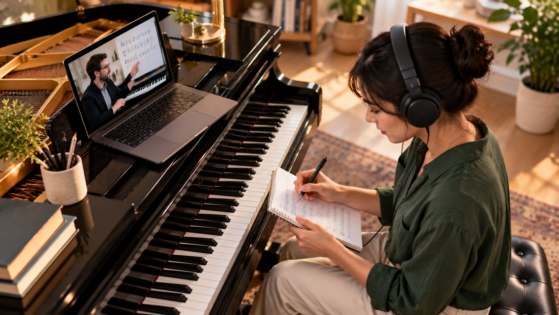
Before enrolling, it is helpful to compare academies based on factors that directly affect the learning experience.
Start by understanding whether lessons are live or pre-recorded. Next, examine the instructor profiles and their qualifications. Course options, lesson duration, scheduling flexibility, communication methods, learning resources, and examination support can then be considered.
It is also worth understanding how the academy communicates with students between lessons. Clear scheduling, reliable communication, access to recordings or supplementary materials, and responsive support can make the overall experience smoother.
Price is naturally another consideration, but it should be viewed alongside the quality and structure of the education being offered.
Ultimately, the right choice depends on the student’s age, current ability, musical interests, schedule, and long-term goals.
Online music education has moved far beyond the idea that learning requires sitting inside a traditional classroom.
With live instruction, individual attention, digital resources, flexible scheduling, and qualified instructors, students can build meaningful musical skills from the comfort of home.
For beginners, this can mean developing a strong foundation without feeling overwhelmed. Intermediate learners can concentrate on technique and repertoire, while advanced students can work toward examinations, performance goals, or more specialized areas of music.
The effectiveness of the experience, however, depends on how thoughtfully the academy combines technology with teaching. A video call by itself does not create quality music education. The combination of a skilled instructor, personalized guidance, structured learning, consistent practice, and student engagement is what makes the difference.

Finding a suitable Music Academy USA means choosing an environment where learning feels structured, flexible, and enjoyable.
An online academy can provide personalized instruction, qualified instructors, flexible scheduling, and useful learning resources. The Mystic Keys offers one-on-one online music lessons, making it easier for students to learn from home while receiving individual guidance. For those looking for Piano Lessons Online, this approach can help develop technique, musical understanding, and confidence through live instruction.
Before choosing an academy, consider the instructor’s experience, lesson structure, scheduling options, feedback, and available learning resources. These factors can make a significant difference in a student’s progress.
For learners searching for an online music academy in USA, a personalized approach with experienced instructors and flexible online lessons can provide a practical foundation for a rewarding musical journey.
For more information and exciting resources about learning music, visit our website at The Mystic Keys. For more music content and exciting offers follow us on Facebook, Instagram, YouTube, LinkedIn,
Twitter, Pinterest, and Threads.
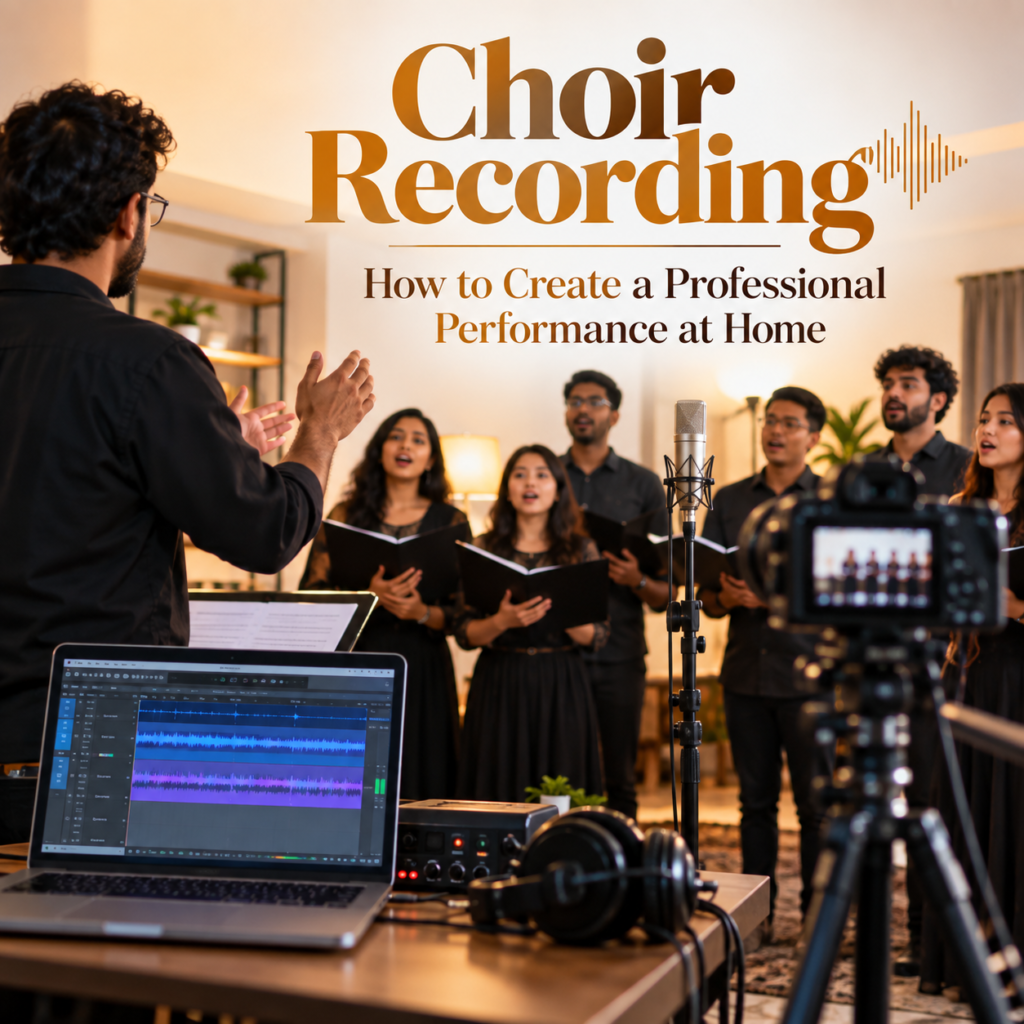
A choir performance can sound powerful in a rehearsal room, where the combined voices naturally fill the space. However, creating a professional choir recording that captures the same energy requires much more than simply placing microphones in front of the singers and pressing Record. From vocal preparation and microphone placement to acoustics, ensemble balance, performance direction, and post-production, every element plays an important role in shaping the final sound.
A professional choir recording brings together vocal preparation, ensemble balance, microphone technique, acoustics, performance direction, and careful post-production. Every voice needs to contribute to the overall sound without overpowering the others, while the recording should still preserve the emotion and character of a live choir.
Whether you are recording a school choir, church choir, professional ensemble, or a group preparing for an online performance, the goal remains the same: create a recording that sounds unified, clear, expressive, and engaging.

The quality of a choir recording is largely determined before anyone enters the recording space. Even excellent microphones and professional editing cannot completely fix an ensemble that is struggling with pitch, timing, pronunciation, or dynamics.
A well-prepared choir should already be comfortable with the melody, harmonies, lyrics, entrances, cut-offs, breathing points, and changes in dynamics. Rehearsals should also focus on how the individual sections work together rather than simply learning their own parts.
This is particularly important because recording makes small inconsistencies much easier to notice. A slightly late entrance or an uneven vowel may disappear during a large live performance, but it can become surprisingly noticeable when captured by a microphone.
For that reason, the final rehearsal should feel less like learning and more like performing. The singers should know what they are singing, where they need to listen, and how their part contributes to the complete musical picture.
The room itself becomes part of the recording. A choir recorded in a naturally resonant space can have warmth, depth, and atmosphere, while an unsuitable room may produce excessive echo, harsh reflections, or a dull and lifeless sound.
Large halls, auditoriums, churches, and purpose-built recording spaces can work beautifully because they often provide natural acoustic depth. However, the largest room is not automatically the best choice. Too much reverberation can blur harmonies and make lyrics difficult to understand.
Before recording, listen carefully to the room from different positions. Ask the choir to sing a short section while someone listens from the intended microphone position. Pay attention to whether the sound feels balanced and whether consonants remain clear.
Once the space has been selected, unnecessary background noise should also be reduced. Air-conditioning systems, fans, traffic, footsteps, buzzing equipment, and outside conversations can become surprisingly distracting in a finished recording.

Microphone placement can only work effectively when the singers themselves are positioned thoughtfully.
A common approach is to arrange the choir in sections, such as soprano, alto, tenor, and bass, while considering the number of singers in each group. Stronger voices may need to be positioned differently from quieter voices so that one section does not dominate the recording.
Height can also make a difference. Risers or stepped platforms allow singers at the back to project more clearly without forcing them to sing louder. At the same time, singers should maintain enough space to breathe comfortably and hear one another.
The arrangement should support communication between the singers. Choir members need to hear the surrounding parts because ensemble singing depends heavily on listening. When everyone can hear the musical balance around them, maintaining pitch, timing, and dynamics becomes much easier.
A professional choir recording does not necessarily require a microphone for every singer. In many situations, a carefully positioned stereo microphone setup can capture a natural and cohesive ensemble sound.
The microphone arrangement depends on the size of the choir, the room, the desired sound, and the recording equipment available. Stereo techniques can provide a sense of width while preserving the relationship between the choir and its acoustic environment.
Microphone height and distance are particularly important. Placing microphones too close can make individual voices overly prominent and reduce the sense of ensemble. Moving them too far away, however, may cause the recording to lose clarity and introduce too much room sound.
The best position is usually the result of listening and testing rather than following a fixed measurement. Record a short passage, listen back carefully, make a small adjustment, and repeat until the choir sounds balanced and natural.
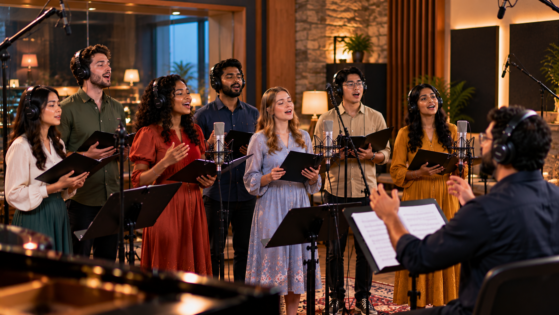
A professional choir recording should sound like one musical instrument made up of many voices.
That does not mean every singer must sound identical. Instead, the different vocal colours should blend into a unified sound while the individual sections remain distinguishable when the music requires it.
Balance becomes especially important when the arrangement changes. A section carrying the melody may need greater presence, while supporting harmonies should remain slightly behind it. When the musical texture becomes quieter, singers need to maintain control rather than allowing the sound to disappear.
Dynamics should also be intentional. A choir recording becomes much more expressive when the ensemble can move naturally from delicate passages to powerful climaxes. Simply singing everything at the same volume can make even a technically accurate performance feel flat.
Clear diction is one of the most overlooked aspects of choir recording.
When several voices sing the same lyrics simultaneously, consonants can easily become blurred. Words that sound perfectly understandable during rehearsal may become unclear once the voices, room acoustics, and recording equipment are combined.
The choir should therefore pay attention to consonant timing, vowel shape, word endings, and pronunciation. Final consonants need to be coordinated so that they sound together rather than arriving at different moments.
At the same time, diction should never become exaggerated. The objective is not to make every consonant sound harsh, but to create enough clarity for the listener to understand the words while preserving a smooth vocal blend.

Even a well-rehearsed choir may not deliver a perfect performance in a single take. Recording several complete takes gives the conductor and recording team options while keeping the performance natural.
Each take should be treated as a real performance rather than simply a technical exercise. Encourage the singers to maintain their energy, expression, posture, and musical focus from beginning to end.
If a particular section contains a mistake, it may also be possible to record that passage separately. However, excessive editing can create inconsistencies in tone, timing, room ambience, and vocal energy.
The strongest recordings usually come from performances that are already musically convincing, with editing used to refine the result rather than construct the entire performance from fragments.
The conductor plays an important role even when the final recording does not show them.
Clear gestures help singers coordinate entrances, releases, tempo changes, dynamics, and expressive moments. During recording, the conductor also helps maintain consistency between takes.
A good recording session should therefore have clear communication between the conductor, singers, and recording team. Everyone should understand which take is being recorded, where the performance begins, whether a section needs to be repeated, and what changes are required.
This organised approach saves time and keeps the choir focused. Instead of repeatedly stopping because of uncertainty, the ensemble can concentrate on delivering a confident performance.
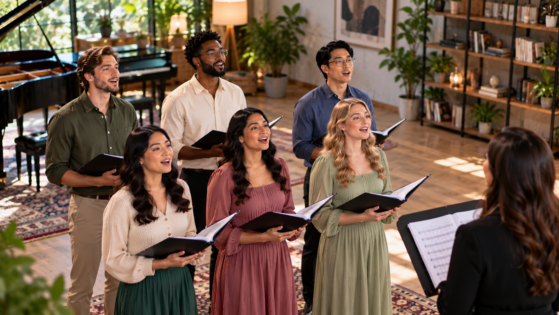
Singers need to hear themselves and the rest of the choir clearly during a recording session.
If monitoring is inadequate, singers may unconsciously change their volume or pitch because they cannot hear the surrounding voices properly. That can affect the blend and make the performance less consistent.
The recording team should therefore ensure that the choir can communicate easily with the conductor and that playback can be checked between takes.
Short playback sessions are particularly useful. They allow everyone to identify issues that may not have been obvious while singing, such as uneven entrances, excessive volume from one section, unclear lyrics, or an overly reverberant room.
Once recording is complete, post-production begins. This stage can make a significant difference, but editing should support the musical performance rather than make it sound artificial.
Small timing corrections, carefully selected takes, noise reduction, equalisation, compression, and appropriate reverb can help create a polished result. However, too much processing may remove the natural character of the choir.
Pitch correction also needs to be approached carefully. Choir singing depends on the relationship between voices, and aggressive correction can produce an unnatural or disconnected sound.
A good mix should feel effortless. Listeners should notice the music rather than the technology behind it.

Reverb can give a choir recording the sense of space associated with a concert hall or church. It helps connect individual voices and can make the ensemble sound larger and more immersive.
However, too much reverb can quickly reduce clarity. Lyrics become difficult to understand, harmonies begin to overlap, and entrances can lose definition.
The right balance allows the listener to experience both the voices and the space around them. A carefully controlled amount of ambience can make a recording feel expansive without allowing the sound to become muddy.
A professional mix should guide the listener through the performance.
Melodies should remain understandable, harmonies should support rather than compete, and important dynamic moments should have enough impact. The overall volume should also remain consistent without removing the natural rise and fall of the music.
Depending on the project, additional instruments may be present alongside the choir. In that case, the vocal arrangement needs even greater attention. Piano, orchestra, percussion, or backing tracks should complement the choir rather than cover important vocal lines.
The final mix should retain the emotional character of the performance. Technical perfection is valuable, but a recording that feels expressive and alive will connect more strongly with its audience.

Before publishing or sharing the recording, listen to the complete version from beginning to end.
Check whether the opening feels clean, whether lyrics remain understandable, whether transitions sound natural, and whether the final chord ends cleanly. Listen for background noises, unexpected volume changes, clipping, excessive reverb, or noticeable edits.
It is also useful to listen through different devices. Headphones can reveal small details, while speakers can provide a better sense of the overall balance. A phone or laptop can also reveal whether the recording remains clear under everyday listening conditions.
Sometimes, taking a short break before the final review makes problems easier to notice. Fresh ears can identify details that become difficult to recognise after repeated listening.
Creating a professional choir recording is not simply a matter of pressing a record button. It is a collaborative process involving singers, conductor, recording engineer, and sometimes a producer or editor.
The singers bring preparation, blend, expression, and musicality. The conductor shapes interpretation and ensemble coordination. The recording team captures the sound and creates the technical foundation for the final production.
When these elements work together, the result can preserve much more than correct notes. It can capture the energy of the ensemble, the emotion behind the lyrics, and the unique character of the performance.

A successful choir recording begins long before the microphones are switched on. Strong preparation creates confidence, thoughtful positioning improves balance, suitable acoustics provide depth, and careful recording techniques preserve the natural character of the voices.
From there, tasteful editing and mixing can refine the performance while keeping its authenticity intact. The ultimate goal is not to make the choir sound artificially perfect—it is to make the real musical performance sound its best.
At The Mystic Keys, musical learning goes beyond individual technique, helping students develop confidence, musical expression, listening skills, and the ability to perform as part of an ensemble. For those interested in developing their skills further, Worship Piano & Singing Lessons Online offer personalised guidance in piano, vocals, worship music, and performance, making it possible to learn and grow from wherever you are.
When every singer listens, every section works together, and every technical decision serves the music, a choir recording can transform a live performance into something that audiences can experience again and again.
For more information and exciting resources about learning music, visit our website at The Mystic Keys. For more music content and exciting offers follow us on Facebook, Instagram, YouTube, LinkedIn,
Twitter, Pinterest, and Threads.