
Music Learning | How It Improves Academic Performance
Many parents encourage their children to learn music because they want them to develop a new hobby or discover a creative passion. However, music education offers benefits that extend far beyond learning melodies, rhythms, or instruments. In fact, researchers and educators have consistently found that learning music can positively influence academic performance by strengthening cognitive abilities, improving concentration, and building essential life skills.
Academic success is not determined solely by intelligence. Rather, it depends on a combination of focus, discipline, memory, confidence, creativity, and problem-solving abilities. Interestingly, these are the very qualities that music learning nurtures over time. Whether a child is learning the piano, guitar, drums, vocals, or another instrument, regular practice contributes to skills that naturally transfer into classroom learning.
Although every child progresses differently, consistent music education creates habits that support both personal growth and academic achievement. As students continue their musical journey, they often discover that the discipline required during lessons also helps them perform better in school.

The Connection Between Music Learning and Brain Development
Music is one of the few activities that engages multiple areas of the brain simultaneously. While learning a song, students must read notes, listen carefully, coordinate movements, recognize patterns, and maintain rhythm. As a result, the brain is constantly processing different types of information at the same time.
This level of engagement strengthens neural pathways responsible for learning, memory, and decision-making. Consequently, children who participate in regular music lessons often develop stronger cognitive abilities that support various academic subjects.
Furthermore, learning music encourages the brain to process information more efficiently. Since students repeatedly practice recognizing patterns, solving musical challenges, and coordinating their actions, these mental exercises gradually improve overall brain function. Therefore, many of the skills developed during music lessons naturally extend to classroom activities.
Music Strengthens Memory and Information Retention
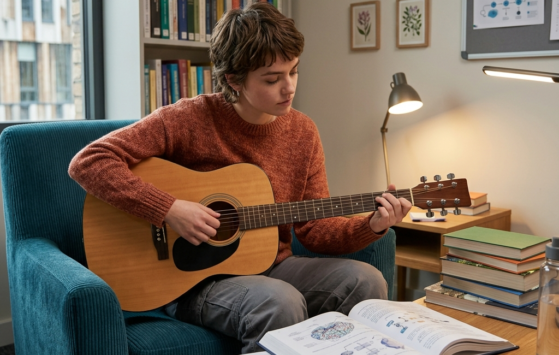
Strong memory plays a significant role in academic success. Students are expected to remember formulas, vocabulary, historical events, scientific concepts, and mathematical procedures throughout their education. Music learning provides excellent training for memory because it requires continuous recall of notes, rhythms, lyrics, finger positions, and performance techniques.
As learners progress through increasingly complex pieces, they become more skilled at organizing and retaining information. Instead of relying solely on repetition, they learn to recognize patterns and understand structures, making recall more efficient.
Moreover, musical practice encourages both short-term and long-term memory development. During lessons, students must remember immediate instructions while simultaneously retaining concepts learned over weeks or months. This ongoing mental exercise supports better learning habits across all academic subjects.
Because of these improvements, many students find it easier to absorb classroom material, prepare for examinations, and recall information during tests.

Improved Concentration Leads to Better Classroom Performance
Maintaining focus has become increasingly challenging in today’s digital world. Constant notifications, entertainment, and distractions can make it difficult for students to concentrate on their studies. Fortunately, music learning provides an environment where sustained attention becomes a natural part of the process.
During practice sessions, students must carefully listen, observe, and respond without losing concentration. Even a brief lapse in attention may affect rhythm, timing, or accuracy. Consequently, learners gradually build longer attention spans through consistent practice.
Additionally, music teaches students to remain mentally present while working toward specific goals. Rather than rushing through a piece, they learn to focus on each section until it is mastered. Over time, this habit transfers into academic settings, allowing students to remain attentive during lessons, complete assignments more effectively, and study with greater efficiency.

Music Learning Encourages Discipline and Time Management
Academic achievement depends not only on intelligence but also on consistency. Students who develop disciplined routines are often better prepared to handle school responsibilities, extracurricular activities, and personal commitments.
Learning music naturally promotes these habits. Improvement does not happen overnight, and students quickly realize that regular practice produces better results than occasional effort. As they establish a practice schedule, they also learn the importance of planning their time wisely.
Furthermore, balancing music lessons alongside schoolwork encourages students to organize their daily routines. Instead of procrastinating, they become more aware of deadlines and responsibilities. Eventually, these organizational skills contribute to improved academic performance because learners are better equipped to manage homework, projects, and examinations.
Better Problem-Solving and Critical Thinking Skills
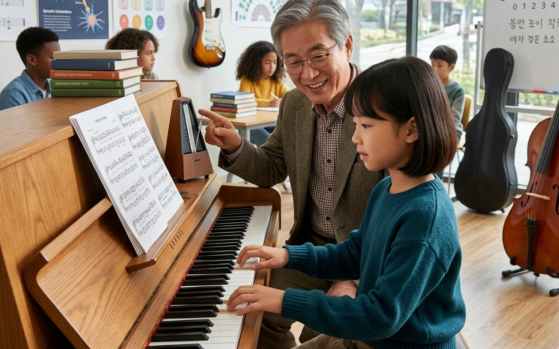
Every musical piece presents unique challenges. Students may encounter difficult rhythms, unfamiliar techniques, or complex passages that require careful analysis before they can perform them correctly.
Rather than becoming discouraged, learners are encouraged to break larger problems into smaller, manageable sections. This process teaches them to analyze mistakes, identify solutions, and make gradual improvements through consistent effort.
Similarly, academic subjects often require students to solve complex problems step by step. Because music reinforces logical thinking and structured problem-solving, learners become more confident when approaching mathematical equations, scientific concepts, and analytical assignments.
Over time, this ability to think critically becomes valuable not only in school but also in everyday decision-making.

How Music Learning Enhances Language and Reading Skills
Music and language share several important similarities. Both involve recognizing patterns, interpreting symbols, understanding rhythm, and developing listening skills. Therefore, students who receive music education often strengthen language-related abilities alongside their musical growth.
Reading musical notation requires learners to decode symbols quickly while translating them into coordinated physical actions. Likewise, reading comprehension depends on recognizing patterns, understanding meaning, and processing information efficiently.
In addition, singing helps improve pronunciation, vocabulary, listening accuracy, and verbal expression. Since students regularly pay close attention to pitch, tone, and rhythm, they also develop stronger auditory processing skills that support reading and language development.
As these abilities continue to improve, many learners become more confident readers and communicators inside the classroom.
Music Learning Supports Mathematical Understanding
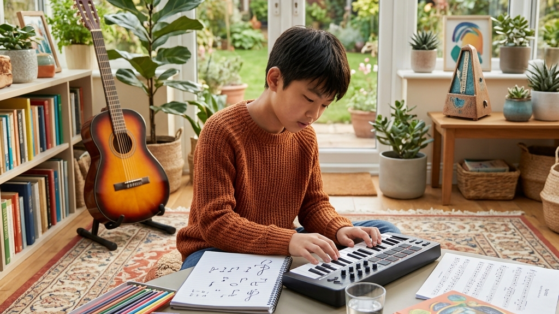
Mathematics and music are closely connected through patterns, fractions, sequences, timing, and logical relationships. Every rhythm involves counting beats, recognizing divisions, and understanding proportions.
For example, students frequently work with whole notes, half notes, quarter notes, and eighth notes. Without realizing it, they practice mathematical concepts while learning rhythm and timing.
Moreover, musical structures often require learners to identify patterns and predict sequences. These exercises strengthen logical reasoning, which is also essential for solving mathematical problems.
Although music is not a replacement for mathematics education, it certainly reinforces many foundational concepts that students encounter throughout their academic journey.

Increased Creativity Improves Learning Across Subjects
Creativity is often associated with the arts, but it also plays an essential role in academic success. Students use creative thinking when writing essays, solving science problems, developing projects, or presenting innovative ideas.
Music encourages learners to experiment, interpret compositions, improvise, and express themselves confidently. As they become more comfortable exploring different musical possibilities, they also develop flexible thinking skills that benefit other areas of education.
Furthermore, creativity helps students approach challenges from multiple perspectives. Instead of relying on a single solution, they learn to evaluate different possibilities before making decisions. Consequently, academic learning becomes more engaging and enjoyable.

Music Builds Confidence That Carries Into the Classroom
Confidence influences how students participate in school activities. Children who believe in their abilities are generally more willing to answer questions, join discussions, and take on challenging assignments.
Learning music provides numerous opportunities to build self-confidence. Every mastered song, completed lesson, and successful performance serves as a reminder of personal growth. Although progress may seem gradual, each achievement reinforces the belief that consistent effort leads to improvement.
Additionally, performing in front of teachers, classmates, or audiences helps students become more comfortable speaking and presenting in public. As a result, they often participate more actively in classroom discussions and school presentations.

Emotional Well-Being Supports Better Academic Results
Emotional health has a significant impact on learning. Students who feel overwhelmed or stressed often struggle to concentrate, retain information, or stay motivated.
Music offers a healthy outlet for emotional expression. Playing an instrument or singing allows students to relax, reduce stress, and manage their emotions more effectively. Consequently, they return to their studies with greater focus and a calmer mindset.
Besides reducing stress, music also creates a sense of accomplishment and enjoyment. Since positive emotions contribute to better learning experiences, students are often more motivated to engage with their academic responsibilities.
Social Skills Developed Through Music Learning
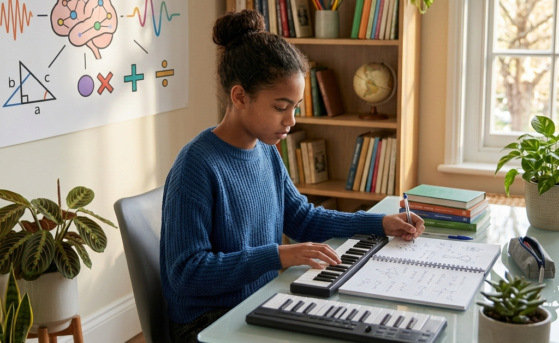
Although many music lessons involve individual practice, students also benefit from collaborative experiences such as ensembles, duets, bands, orchestras, or choir performances.
Working with others teaches important interpersonal skills, including communication, cooperation, listening, patience, and mutual respect. Every performer has a role, making teamwork essential for achieving a successful performance.
Similarly, these qualities are valuable during classroom group projects, discussions, and collaborative assignments. Students who develop strong social skills through music often become more effective team members in academic settings as well.

The Long-Term Academic Benefits of Music Learning
The advantages of music education extend well beyond childhood. Skills such as discipline, perseverance, adaptability, critical thinking, and effective communication remain valuable throughout higher education and professional life.
Students who learn music often become lifelong learners because they understand that improvement requires continuous practice and dedication. This growth mindset encourages them to embrace challenges rather than avoid them.
Furthermore, universities and employers increasingly appreciate applicants who demonstrate commitment to extracurricular learning. Music education reflects qualities such as responsibility, resilience, creativity, and determination, all of which contribute to long-term success.
Supporting Music Learning at Home
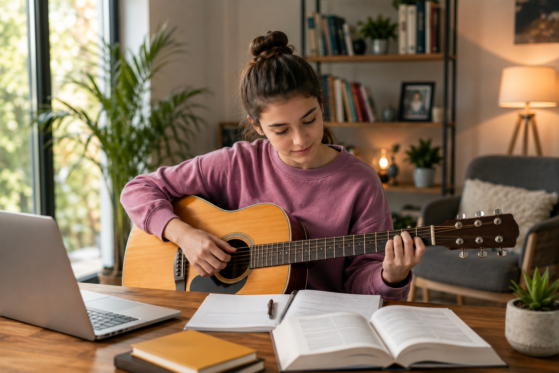
Parents play an important role in helping children enjoy music while balancing their academic responsibilities. Encouragement, rather than pressure, creates a positive learning environment where students feel motivated to improve.
Establishing a regular practice schedule, celebrating small achievements, and attending performances can significantly boost a child’s enthusiasm. At the same time, maintaining realistic expectations allows students to enjoy the learning process without unnecessary stress.
Most importantly, parents should remember that progress in music, much like academic growth, develops gradually through patience and consistency.

Conclusion
Music learning is much more than an artistic pursuit. It is a comprehensive educational experience that strengthens the mind, develops valuable life skills, and supports academic achievement in meaningful ways. From improving memory and concentration to encouraging discipline, creativity, confidence, and emotional well-being, music equips students with abilities that extend far beyond the practice room.
While every learner’s journey is unique, the positive influence of music can be seen across many aspects of education. As students continue to practice, they not only become better musicians but also more focused, resilient, and capable learners.
Ultimately, investing in music education is an investment in a child’s overall development. The lessons learned through music often become lifelong strengths, helping students achieve success both inside and outside the classroom. At The Mystic Keys, we believe that every music lesson is an opportunity to inspire confidence, nurture creativity, and support a child’s overall learning journey, helping students grow both as musicians and as lifelong learners.
For more information and exciting resources about learning music, visit our website at The Mystic Keys. For more music content and exciting offers follow us on
Facebook, Instagram, YouTube, LinkedIn, Twitter, Pinterest, and Threads.