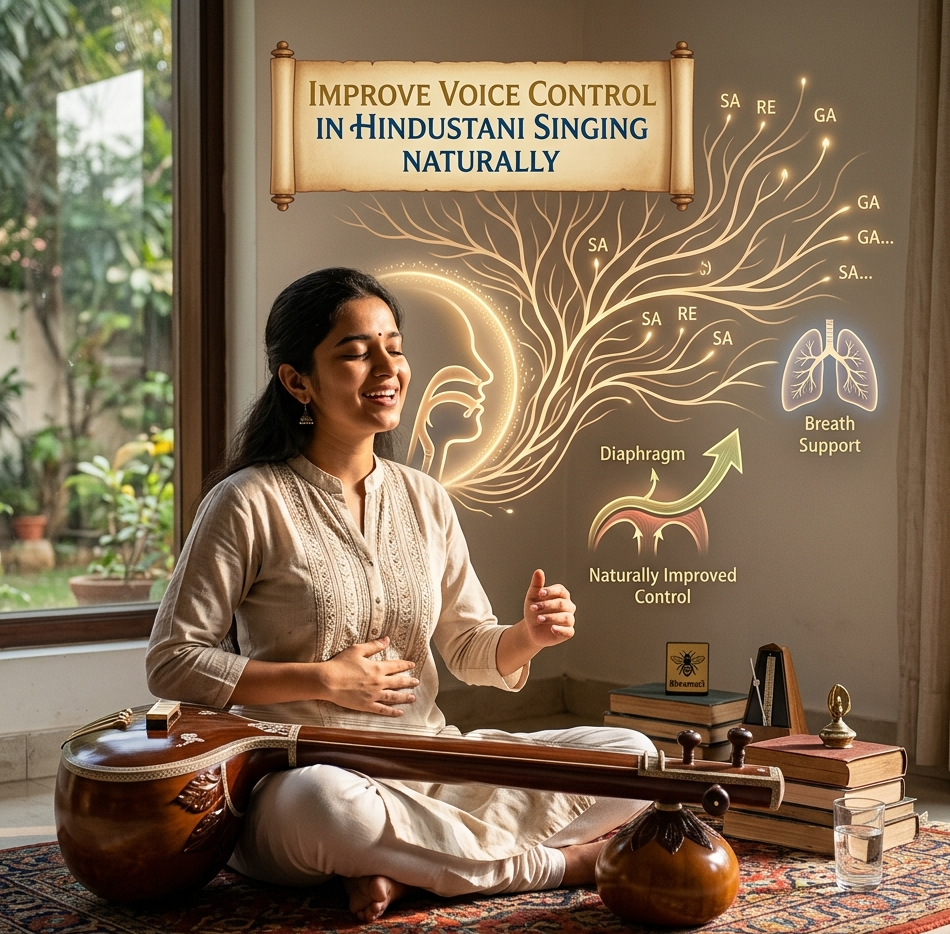
Improve Voice Control in Hindustani Singing Naturally
In Hindustani singing, voice control is not merely about singing loudly or reaching high notes. It is the ability to guide the voice with precision, emotional depth, stability, and ease. A controlled voice can move delicately through ragas, maintain sur during complex passages, and express emotion without strain. More importantly, it allows the singer to remain relaxed while performing demanding compositions.
The encouraging part is that natural voice control does not require harsh training methods or excessive force. The voice responds best to balance, patience, and intelligent riyaaz. Instead of pushing the throat aggressively, singers can develop strength and flexibility gradually, much like a musician tunes an instrument carefully over time.

Understanding Voice Control in Hindustani Singing
Before improving voice control, it helps to understand what the term actually involves in Hindustani music. Many students focus only on pitch accuracy, believing that staying in sur automatically means they have good control. While sur is essential, true voice control extends much further.
A controlled voice maintains steadiness during long notes, transitions smoothly between swaras, adjusts volume effortlessly, and responds accurately to emotional expression. It also supports clarity in aalap, precision in taans, and softness during delicate phrases. Every aspect of classical singing becomes more refined when the singer gains command over breath and vocal movement.
At the same time, voice control is deeply connected to relaxation. Tension in the throat, jaw, shoulders, or tongue can interfere with natural sound production. Therefore, singers who sound effortless are often those who have learned how not to force the voice. Their strength comes from coordination rather than pressure.
As this understanding develops, practice becomes more meaningful. Instead of singing louder or harder, the focus shifts toward singing smarter and more consciously.

The Importance of Breath in Hindustani Singing
Breath is the invisible foundation of vocal control. Without stable breath support, even a melodious voice can sound shaky or strained. In Hindustani music, where long aalaps and sustained swaras are common, breath management becomes especially important.
However, good breathing does not mean taking extremely large breaths. The real goal is controlled airflow. When the breath moves steadily, the voice gains stability and resonance naturally. On the other hand, uneven breathing often causes pitch instability, trembling notes, and vocal fatigue.
Many singers unknowingly lift their shoulders while inhaling. This creates tension and limits airflow. A calmer and more effective method involves breathing deeply through the diaphragm, allowing the abdomen to expand gently. Such breathing feels grounded and relaxed rather than forced.
Once breathing improves, singers often notice that their voice becomes fuller and more dependable. Sustaining notes grows easier, transitions feel smoother, and taans become cleaner. Over time, proper breath control also increases vocal stamina, making long riyaaz sessions more comfortable.

Improve Voice Control With Slow Practice
One of the biggest mistakes learners make is rushing through exercises too quickly. Fast singing may appear impressive, but genuine control develops through slow and attentive practice. In Hindustani music, vilambit riyaaz plays a powerful role because it trains the voice to move with awareness.
When singers practice slowly, they begin noticing tiny imperfections in pitch, pronunciation, and breath flow. Gradually, the mind and voice learn to coordinate more precisely. This process strengthens muscle memory in a natural way.
For example, singing simple alankars in a slow tempo helps stabilize swaras and improves tonal clarity. The voice learns how to land accurately on each note instead of sliding carelessly between them. Similarly, slow meend practice teaches smooth transitions and enhances flexibility without creating strain.
As consistency increases, speed eventually develops on its own. Fast taans become clearer because the foundation underneath them is secure. Therefore, slowing down during practice is not a sign of weakness. It is often the fastest route toward lasting improvement.
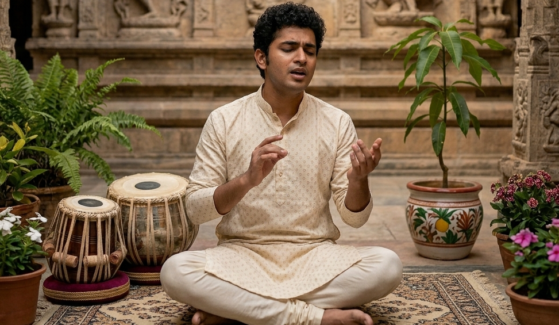
Developing Stability Through Sustained Notes
Sustained-note practice is one of the simplest yet most powerful methods for improving voice control. Holding a swara steadily trains the voice to remain balanced without shaking, cracking, or drifting off pitch.
In the beginning, sustaining notes may reveal hidden weaknesses. Some singers notice instability in volume, while others struggle with breath consistency. Instead of feeling discouraged, it is helpful to treat these moments as indicators of where growth is needed.
A good approach involves choosing a comfortable note and sustaining it calmly while listening carefully to pitch alignment with the tanpura. The objective is not loudness but steadiness. Even a soft note can build tremendous control when sung with focus.
Over time, this exercise improves resonance and strengthens the connection between hearing and vocal production. The singer becomes more aware of subtle pitch variations and gains better command over tonal balance.
Eventually, sustained-note practice begins influencing every aspect of singing. Aalaps become more expressive, phrases feel grounded, and even difficult passages sound more confident.
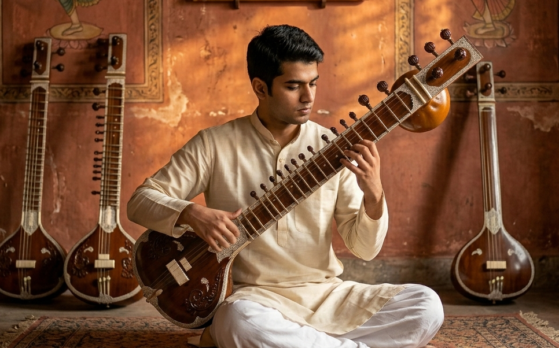
Improve Voice Control Through Active Listening
Many singers underestimate the importance of listening. Yet voice control develops not only through singing but also through deep observation. In Hindustani music, careful listening shapes musical sensitivity and trains the ear to recognize nuance.
When students regularly listen to experienced vocalists, they begin absorbing patterns of phrasing, breath placement, tonal stability, and emotional expression. Gradually, the mind starts understanding how controlled singing actually sounds.
Listening also sharpens pitch awareness. A trained ear helps the voice adjust more accurately because the brain learns to identify subtle differences between correct and incorrect intonation. As this inner hearing improves, vocal precision naturally follows.
At the same time, passive listening is not enough. Focused listening creates greater benefits. Paying attention to how artists sustain notes, handle meends, or navigate taans can provide valuable insight for one’s own riyaaz.
Interestingly, singers who listen deeply often develop maturity in their expression as well. Their voice gains not just technical control but emotional refinement too.

Avoiding Common Habits That Damage Control
Sometimes improvement requires removing harmful habits rather than adding more exercises. Many vocal issues arise because singers push the throat unnecessarily or practice without sufficient awareness.
Excessive force is one of the most common problems. Trying to sing higher notes by tightening the throat usually creates strain and reduces flexibility. Instead of expanding naturally, the voice becomes rigid and tired.
Another issue involves inconsistent practice. Voice control develops gradually through repetition and balance. Long gaps in riyaaz can weaken coordination and make progress unstable. Even short daily sessions often produce better results than occasional intense practice.
Hydration and rest also matter significantly. A tired or dehydrated voice struggles to respond smoothly. Since the vocal cords are delicate tissues, they function best when the body itself is healthy and rested.
Additionally, comparing one’s voice constantly with others can create unnecessary frustration. Every singer has a unique tonal quality and learning pace. Sustainable improvement happens more effectively when attention stays focused on personal growth.
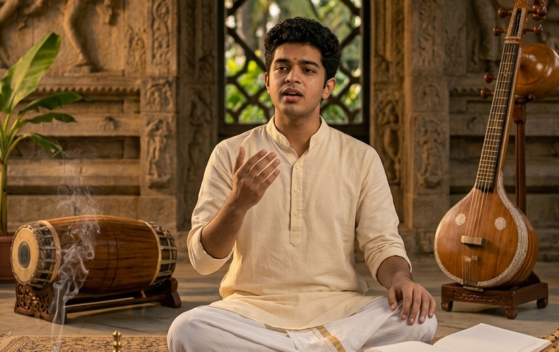
Improve Voice Control While Expressing Emotion
In Hindustani singing, voice control is not only technical. It also supports emotional communication. A singer may hit every note correctly, yet the performance can still feel lifeless if emotional depth is missing.
Controlled singing allows emotions to flow with clarity rather than chaos. Soft phrases can sound intimate, powerful notes can feel commanding, and subtle movements can create longing or devotion. Technical mastery becomes meaningful when it serves expression.
This is why experienced musicians often emphasize bhava along with accuracy. The voice should not sound mechanical. Instead, it should feel alive and responsive to the mood of the raga.
As singers become more comfortable with breath, pitch, and stability, emotional freedom increases naturally. Fear decreases, tension reduces, and expression begins flowing more organically.
Eventually, the audience stops noticing technique separately. They simply experience the music.

Patience Is the Real Secret Behind Natural Voice Control
Every meaningful aspect of Hindustani music develops slowly, and voice control is no exception. In today’s fast-paced world, many learners expect quick results, but the voice matures through steady practice and proper guidance. Platforms like The Mystic Keys and structured Hindustani Vocal Lessons Online help students build this foundation with consistency and discipline.
There will be days when riyaaz feels effortless and others when progress seems slow. Such phases are completely normal. Over time, however, small improvements begin to add up quietly. Notes become steadier, breathing feels calmer, and difficult passages grow easier with regular practice.
Most importantly, natural voice control should never feel forced. A healthy voice develops through awareness, patience, and love for the music. In the end, Hindustani singing is not about overpowering the voice, but about understanding it and allowing it to grow with authenticity.
For more information and exciting resources about learning music, visit our website at The Mystic Keys. For more music content and exciting offers follow us on
Facebook, Instagram, YouTube, LinkedIn, Twitter, Pinterest, and Threads.