Improve Hand Synchronization on Guitar (Complete Guide)
If your guitar playing sounds messy, uneven, or out of time, the problem is often poor hand synchronization on guitar. Many players struggle to improve hand synchronization on guitar because their fretting hand (left hand) and picking hand (right hand) are not working together properly.
The result?
Buzzing or muted notes
Sloppy fast playing
Lack of clarity
Poor timing
But here’s the truth: every guitarist struggles with this at some stage.
The difference between beginners and advanced players is simple—control and coordination.
In this guide, you’ll learn exactly how to improve hand synchronization on guitar with practical exercises, proven techniques, and a structured routine.
What Is Hand Synchronization in Guitar?
Hand synchronization is the ability to coordinate both hands so that each note is played cleanly and at the exact same time.
When you pick a string, your fretting finger must press the note at that exact moment.
If your timing is off:
The note sounds late or early
The tone becomes unclear
Your playing feels disconnected
Think of it like this: Your hands should act like a perfectly timed team, not two separate players.
Signs Your Hand Synchronization Needs Improvement
You may need to improve hand synchronization on guitar if you notice:
Notes sound unclear or muddy
Fast passages feel out of control
You struggle to stay in time
Your playing sounds “sloppy” even at slow speeds
You make frequent mistakes during simple exercises
If this sounds familiar, don’t worry—this is completely fixable.
Why Hand Synchronization Is Difficult
Before fixing the problem, it helps to understand why it happens.
1. Playing Too Fast Too Soon
Most players rush into speed without building control.
Speed without accuracy = sloppy playing
2. Weak Muscle Memory
Your fingers are not trained to move together yet.
3. Lack of Focused Practice
Random practice doesn’t build coordination.
4. Ignoring Timing
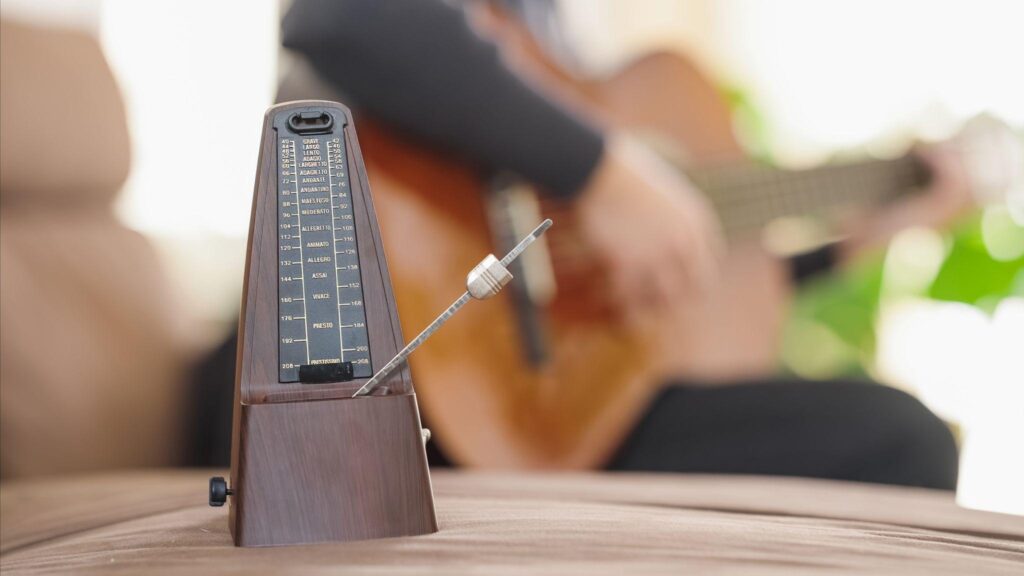
Practicing without a metronome creates rhythm issues.
5. Tension in Hands
Tension slows you down and reduces control.
Step-by-Step Exercises to Improve Hand Synchronization
These exercises are designed to build coordination from the ground up.
This strengthens weaker fingers and improves control.
5. Burst Practice Technique
This helps build speed safely.
How it works:
Play 4 notes fast
Stop
Reset
This trains your hands to stay synchronized at higher speeds.
6. Accent Practice
Play evenly
Accent (stress) every 4th note
This improves timing and rhythmic control.
20-Minute Daily Practice Routine
If you’re short on time, follow this highly effective routine:
5 minutes: Chromatic exercise 5 minutes: Scale with metronome 5 minutes: String crossing 5 minutes: Apply to a song
Consistency matters more than duration.
Applying Synchronization to Songs
Exercises are important—but real progress happens when you apply them to music.
Steps:
Choose a slow song
Break it into small sections
Practice slowly
Focus on clean notes
Gradually increase speed only after mastering control.
Common Mistakes to Avoid
Avoid these if you want faster improvement:
Practicing too fast
Skipping warm-ups
Ignoring timing
Playing with tension
Not listening carefully
Pro Tips from Experienced Guitarists
Record yourself and listen back
Slow practice = fast improvement
Stay relaxed while playing
Focus on accuracy first
Repeat consistently
Advanced Tips for Intermediate Players
If you already have basic control, try:
Playing scales in triplets and 16th notes
Practicing with backing tracks
Using string skipping exercises
Learning alternate picking precision drills
Improving hand synchronization on guitar is not about natural talent.
It’s about:
Patience
Consistency
Focused practice
If you practice correctly—even for 20 minutes a day—you will notice improvement within weeks.
If you want structured guidance, you can also explore our Guitar Lessons Online, designed to help you improve faster with step-by-step training and expert support.
Intersted in learning music with us? Register now
For more information and exciting resources about learning music, visit our website at The Mystic Keys. For more music content and exciting offers follow us on