How to Build Speed Without Losing Accuracy
Playing faster on the piano can make a performance sound exciting and confident, but speed should never come at the cost of accuracy. Learning how to build piano speed requires patience, control, and consistent practice. Many pianists try to increase their tempo too quickly and end up developing missed notes, uneven rhythms, unnecessary tension, or poor finger control.
The key to building piano speed without losing accuracy is to develop control first and increase tempo gradually. With structured practice, proper technique, and patience, you can become faster while keeping your playing clean and consistent.
Build Piano Speed With Slow Practice
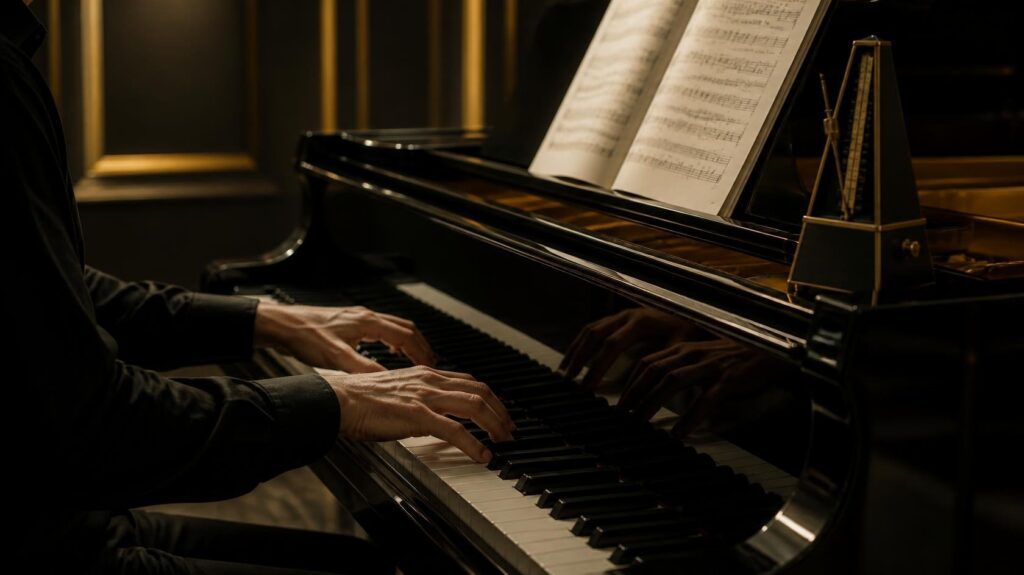
Speed is only useful when you can maintain control. Playing a piece quickly with frequent mistakes can reinforce incorrect movements and make those mistakes harder to correct later.
Accuracy helps you develop:
- Better finger coordination
- Consistent rhythm
- Stronger muscle memory
- Cleaner articulation
- Greater confidence during performances
Instead of asking, “How fast can I play this?” ask, “How fast can I play this correctly?”
Start at a Comfortable Tempo

One of the most effective ways to build speed is to begin at a tempo where you can play the passage comfortably and accurately.
Use a metronome and choose a starting speed that allows you to play every note correctly. Once the passage feels controlled, increase the tempo slightly.
For example:
60 BPM → 66 BPM → 72 BPM → 78 BPM → 84 BPM
Small increases give your fingers time to adapt without sacrificing control.
Practise Slowly Before Playing Fast

Slow practice may seem unrelated to speed, but it is one of the foundations of fast and accurate piano playing.
When you practise slowly, you have more time to notice:
- Incorrect fingering
- Uneven notes
- Weak finger movements
- Rhythm problems
- Unnecessary hand tension
Practising a difficult passage slowly and correctly allows your brain and fingers to learn the correct movement pattern before you introduce higher speed.
Build Piano Speed Using a Metronome
A metronome is an excellent tool for developing controlled speed.
Start at a manageable tempo and repeat the passage several times. If you can play it accurately and comfortably, increase the tempo by a small amount.
If mistakes begin to appear, slow down again.
The goal is not to continuously increase the number on the metronome. The goal is to find the highest tempo at which you can still maintain accuracy and control.
Break Difficult Passages Into Smaller Sections
Trying to practise an entire piece at a fast tempo can make improvement difficult. Instead, identify the sections where you lose accuracy.
Work on those passages separately.
For example:
- Practise four to eight measures slowly.
- Repeat until the notes feel secure.
- Gradually increase the tempo.
- Connect the passage to the next section.
- Eventually practise the entire phrase at performance speed.
This focused approach saves practice time and helps you solve specific technical problems.
Keep Your Technique Relaxed While Building Speed
Tension is one of the biggest obstacles to developing piano speed.
When pianists try to play faster, they may unconsciously tighten their fingers, wrists, forearms, or shoulders. This can make movements less efficient and can make fast passages feel much harder.
Keep checking your body while practising.
Your shoulders should remain relaxed, your wrists should move naturally, and your fingers should not use more force than necessary.
Relaxed movement allows greater speed with less effort.
Build Piano Speed With Short Practice Sessions
Fast piano playing does not mean moving your fingers as far or as forcefully as possible. Efficient technique uses controlled and economical movements.
Avoid lifting your fingers excessively from the keys. Keep unnecessary movements to a minimum and pay attention to smooth transitions between notes.
Good fingering is equally important. Use consistent fingering that supports the musical pattern rather than changing fingers randomly during practice.
Build Piano Speed by Practising Difficult Sections
Rhythmic variations can help strengthen difficult passages and improve finger control.
Suppose you have a passage of evenly spaced sixteenth notes. Instead of always practising it the same way, try alternating long-short and short-long rhythms.
This can help you identify weaker fingers and improve coordination.
Once the passage feels comfortable with the variations, return to the original rhythm and tempo.
Use Short Bursts of Speed
Another useful technique is to practise short sections at a faster tempo rather than trying to play an entire piece quickly.
Choose a small group of notes and play them at your target speed. Stop, relax, and repeat.
For example:
Slow practice → short fast burst → relax → repeat
This allows your hands to experience the desired speed without forcing them to maintain that tempo for an extended period.
Don't Practise Mistakes at Full Speed
If you repeatedly make the same mistake while practising quickly, your brain can begin to memorise that incorrect movement.
When this happens, stop and reduce the tempo.
Identify exactly where the problem occurs, practise that small section slowly, and gradually rebuild the speed.
A useful rule is:
If accuracy breaks down, the tempo is too fast for that stage of practice.
Record Yourself
Recording your practice can reveal problems that you may not notice while playing.
Listen for:
- Uneven notes
- Rushing
- Slowing down in difficult passages
- Incorrect notes
- Excessive accents
- Changes in dynamics
- Tension in your playing
You can then adjust your practice based on what you hear.
Give Your Brain Time to Learn
Building speed is not only a physical process. Your brain needs time to coordinate movement, timing, memory, and musical expression.
Consistent practice is usually more effective than trying to increase your speed dramatically in a single session.
Even 15–20 minutes of focused technical practice can be valuable when you practise with a clear goal.
Learn With the Right Guidance
Developing speed while maintaining accuracy requires more than simply playing faster. Proper fingering, posture, rhythm, hand coordination, and technique all play an important role.
Working with an experienced teacher can help identify inefficient movements and create exercises suited to your current level. For students who prefer flexible learning, piano lessons online can provide live guidance while allowing you to practise from home.
Learning how to build speed without losing accuracy is a gradual process. The fastest way to improve is not to rush your practice but to build reliable technique step by step.
Start slowly, use a metronome, practise difficult sections separately, keep your body relaxed, and increase tempo only when your accuracy remains consistent.
Remember:
Accuracy creates control. Control creates confidence. And confidence makes speed possible.
With patient and consistent practice, you can develop faster piano playing without sacrificing the precision and musicality that make a performance sound great.
Intersted in learning music with us? Register now
For more information and exciting resources about learning music, visit our website at The Mystic Keys. For more music content and exciting offers follow us on
Facebook, Instagram, YouTube, LinkedIn, Twitter, Pinterest, and Threads.