
How to Prepare for Your First International Music Examination
Introduction
Taking your first international music examination is an exciting milestone in your musical journey. It gives you an opportunity to demonstrate your skills, measure your progress, and gain recognition for the time and effort you have invested in learning music. However, preparing for an examination can also feel challenging, especially when you are unfamiliar with the examination process.
Whether you are learning piano, guitar, violin, drums, or vocals, an international music examination requires more than simply learning a few songs. Students may need to demonstrate musical knowledge, technical ability, rhythm, listening skills, and performance confidence, depending on the examination board and grade.
With proper preparation, consistent practice, and guidance from an experienced teacher, students can approach their first examination with greater confidence.
Let’s explore how to prepare for your first international music examination and make the experience both productive and rewarding.
1. Understand What an International Music Examination Involves
Before beginning your preparation, it is important to understand what an international music examination is and what it aims to assess.
International music examinations are structured assessments offered by recognised music examination boards. They provide students with an opportunity to demonstrate their musical development through practical performance and, depending on the board and examination format, additional technical or theoretical assessments.
Some well-known examination boards include:
Trinity College London: Offers graded examinations across different instruments and musical disciplines.
ABRSM: Provides graded music examinations covering practical performance, music theory, and other musical skills.
Rockschool: Offers graded examinations focused on contemporary music styles and instruments.
LCM (London College of Music): Provides examinations in classical, contemporary, and popular music disciplines.
Each examination board has its own syllabus, assessment criteria, grade structure, and examination formats.
Before registering, students should explore the available options and understand which examination best suits their instrument, musical interests, and current ability.
2. Choosing the Right Board for Your International Music Examination
Choosing the right examination board is one of the first decisions students need to make. Different boards offer different learning pathways, musical styles, and assessment approaches.
For example, a student interested in classical piano may prefer a syllabus that focuses on traditional repertoire and technical development. Someone learning electric guitar or contemporary vocals may prefer an examination pathway that includes modern musical styles.
When choosing an examination, consider:
Instrument and musical style: Make sure the examination offers a suitable pathway for your chosen instrument.
Current ability: Select a grade that matches your existing skills rather than choosing a level that is unnecessarily difficult.
Examination requirements: Review the syllabus, performance requirements, and additional assessments.
Teacher guidance: Discuss suitable examination options with your music teacher before registering.
Your first examination should provide an appropriate challenge while allowing you enough time to develop the required skills.
3. Understanding the International Music Examination Syllabus
Once you have selected an examination board and grade, the next step is to understand the official syllabus.
The syllabus explains what students are expected to prepare and how their performance will be assessed. It may include repertoire requirements, technical exercises, sight reading, aural skills, improvisation, or theoretical knowledge, depending on the examination.
Students should pay attention to:
The number and selection of examination pieces.
Required scales, arpeggios, or technical exercises.
Performance duration and assessment requirements.
Supporting tests, where applicable.
Marking criteria and performance expectations.
Rules for the chosen examination format.
Avoid relying entirely on information from older examination materials. Examination syllabuses can change, so always consult the current official requirements for your chosen board and grade.
Understanding the syllabus early helps you organise your preparation and prevents last-minute surprises.
4. Selecting the Right Pieces for Your Music Examination
Repertoire preparation is an important part of many international music examinations. Students are generally required to prepare selected pieces that demonstrate their musical understanding and performance abilities.
Choosing suitable pieces can make the preparation process more enjoyable and manageable.
When selecting examination pieces, consider the following:
Technical suitability: Choose pieces that match your current playing or singing ability and give you opportunities to develop new techniques.
Musical variety: Where the syllabus allows, select pieces with different moods, styles, rhythms, and musical characteristics.
Personal interest: Learning music you genuinely enjoy can help maintain motivation during preparation.
Performance readiness: Choose pieces that you can develop to a reliable standard within your available preparation time.
Once you have selected your repertoire, begin learning each piece gradually. Focus on accuracy before increasing the tempo or adding more expressive details.

5. Building Technical Skills for an International Music Examination
Technical skills are essential for performing music accurately and confidently. Depending on the instrument and examination board, students may be assessed on scales, arpeggios, exercises, instrumental techniques, or other technical requirements.
For piano students, this may involve finger independence, scales, arpeggios, hand coordination, and control of dynamics.
Guitar students may need to develop chord transitions, picking techniques, scales, and rhythmic accuracy.
Vocal students may work on breathing, pitch accuracy, vocal control, articulation, and tone production.
Drummers may focus on coordination, timing, rhythmic patterns, and control over different playing techniques.
To improve technical ability:
Practise challenging exercises slowly.
Focus on accuracy and consistency.
Repeat difficult sections regularly.
Maintain relaxed and comfortable technique.
Follow the fingering or technical instructions provided by your teacher.
Gradually increase speed without compromising control.
A strong technical foundation makes it easier to perform examination pieces with greater confidence.
6. Develop Your Music Theory Knowledge
Music theory helps students understand how music is organised and why different musical elements work together.
Although theory requirements vary between examination boards and grades, having a basic understanding of musical concepts can make practical learning much easier.
Important areas to explore include:
Scales and key signatures.
Rhythm and time signatures.
Intervals and chords.
Musical symbols and terminology.
Dynamics and articulation.
Basic harmony and musical structure.
For example, understanding key signatures can help piano students recognise which notes are altered throughout a composition. Guitar students can use their knowledge of chords and scales to understand musical patterns, while singers can benefit from understanding pitch and intervals.
Try to connect theoretical concepts with your instrument rather than studying theory entirely separately. This makes the information easier to understand and apply.
7. Practise Sight Reading and Listening Skills
Some international music examinations include additional assessments that test skills beyond prepared performances.
Sight reading requires students to perform unfamiliar music by reading the notation. Listening or aural assessments may involve recognising rhythms, pitches, intervals, musical features, or other sounds.
These skills are important because they help students become more independent and well-rounded musicians.
How to Improve Sight Reading
Practise reading short musical passages regularly.
Identify the key and time signatures before playing.
Observe the rhythm and note patterns.
Look for repeated musical phrases.
Maintain a steady tempo instead of stopping frequently.
Gradually increase the difficulty of the exercises.
How to Improve Listening Skills
Listen carefully to different musical styles.
Practise recognising changes in pitch and rhythm.
Identify differences between major and minor sounds.
Pay attention to dynamics and articulation.
Repeat simple melodies by listening.
Discuss musical features with your teacher.
Even when these assessments are not part of your chosen examination, developing listening and reading skills can improve your overall musical understanding.
8. Create a Consistent Music Practice Schedule
One of the most important parts of examination preparation is maintaining a regular practice routine.
Students often make the mistake of practising extensively just before an examination. However, musical development takes time, and consistent practice is generally more effective than relying on last-minute preparation.
A balanced practice routine might include:
| Practice area | Suggested time |
|---|---|
| Examination pieces | 20 minutes |
| Technical exercises | 10 minutes |
| Music theory | 10 minutes |
| Sight reading or listening | 10 minutes |
| Reviewing difficult sections | 10 minutes |
This is an example schedule and can be adjusted according to the student’s grade, instrument, and available time.
A few additional tips can make practice more effective:
Set small and achievable daily goals.
Practise difficult sections separately.
Record your performances to identify areas for improvement.
Take short breaks when necessary.
Review previously learned material regularly.
Track your progress from week to week.
The objective is to make practice a consistent habit rather than a stressful activity.
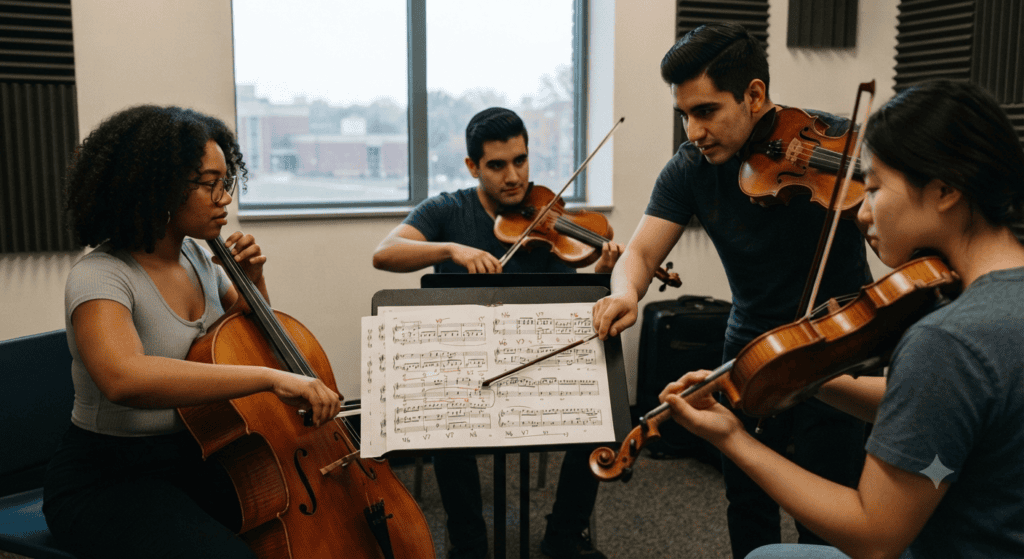
9. Learn to Perform with Musical Expression
An examination performance should demonstrate more than technical accuracy. Students must also understand how to communicate the character and emotion of the music.
Musical expression involves dynamics, articulation, phrasing, tempo, tone quality, and interpretation.
For example, a gentle piano melody may require smooth phrasing and a softer touch, while an energetic guitar piece may need stronger rhythmic emphasis and precise articulation.
To develop musical expression:
Understand the mood of each composition.
Follow the dynamic markings in the score.
Pay attention to changes in tempo.
Practise smooth transitions between phrases.
Listen to different interpretations of the same piece.
Avoid playing every section with the same intensity.
A musical performance becomes more engaging when students understand what they are communicating through their instrument or voice.
10. Practise Performing in Front of an Audience
Performing in an examination environment can feel very different from practising at home. Students may experience nervousness, become distracted, or make mistakes they would not normally make during practice.
One effective way to prepare is to simulate examination conditions.
Students can:
Perform their complete repertoire without stopping.
Ask family members to listen to their performances.
Organise mock examinations with their teachers.
Record themselves playing or singing.
Practise starting confidently and maintaining their tempo.
Learn to continue performing after making a small mistake.
These activities help students become more familiar with performing in front of others.
The more comfortable students become with performing, the easier it can be to manage the pressure of an actual examination.
11. Manage Examination Stress and Build Confidence
Feeling nervous before your first international music examination is completely normal. Even experienced musicians can feel anxious before performing.
The important thing is to prepare mentally as well as musically.
Here are some ways to manage examination nerves:
Prepare well in advance: Give yourself enough time to become comfortable with every examination requirement.
Avoid last-minute cramming: Use the final days to review and reinforce what you already know.
Practise deep breathing: Take a few slow breaths before beginning your performance.
Focus on your preparation: Remind yourself of the practice and effort you have invested.
Accept small mistakes: Do not allow one incorrect note to affect the rest of your performance.
Maintain a positive attitude: Think of the examination as an opportunity to demonstrate your progress rather than a situation in which you must be perfect.
Confidence develops through preparation, experience, and a positive approach to learning.
12. Prepare Everything Before Examination Day
Once your examination date is approaching, make sure all the practical arrangements are in place.
Students should review the examination instructions provided by their chosen examination board and confirm the requirements for their specific format.
Use this checklist to organise your final preparation:
Review all examination pieces.
Practise the required technical exercises.
Revise music theory concepts relevant to your grade.
Complete mock performances.
Confirm your examination date and time.
Check the examination location or online assessment instructions.
Prepare any required documents or identification.
Check instrument and recording requirements, where applicable.
Get sufficient rest before the examination.
For digital examinations, check the official recording, video, and submission instructions in advance. Do not assume that every examination board follows the same process.
Being organised can help you avoid unnecessary stress on the day.
13. Remember That the Examination Is Part of Your Musical Journey
Your first international music examination should not be viewed only as a test or a certificate to achieve. It is also an opportunity to understand your strengths, recognise areas for improvement, and develop a deeper connection with music.
Every stage of preparation teaches students something valuable. Learning challenging pieces develops patience, technical exercises improve control, and performance practice builds confidence.
Regardless of the final result, the skills developed during preparation can support future musical growth.
Students should celebrate their progress and remember that becoming a musician is a continuous learning journey.

How The Mystic Keys Helps Students Prepare for International Music Examinations
At The Mystic Keys, we understand that preparing for your first international music examination requires structured guidance, consistent practice, and individual attention. Our online music lessons help students build a strong foundation in their chosen instrument while developing essential skills such as technique, music theory, rhythm, sight reading, listening, and musical expression. With personalised instruction from experienced music educators, students can work towards their musical goals at a pace suited to their abilities. Whether you are preparing for a graded piano, guitar, vocal, violin, or drum examination, The Mystic Keys provides a supportive learning environment that encourages confidence, discipline, and steady progress. Our aim is not just to help students prepare for an examination, but to help them become more capable and confident musicians.
Conclusion
Preparing for your first international music examination is an important step towards becoming a more confident and skilled musician. From choosing the right examination board to developing technical abilities, understanding music theory, and practising performance skills, every part of the preparation process contributes to your musical growth.
The key is to begin early, understand the examination requirements, practise consistently, and seek guidance whenever you face difficulties.
Remember that every musician starts somewhere. With dedication, patience, and the right support, your first international music examination can become a positive and rewarding experience that inspires you to continue learning and exploring music.
For more information and exciting resources about learning music, visit our website at The Mystic Keys. For more music content and exciting offers follow us on
Facebook, Instagram, YouTube, LinkedIn, Twitter, Pinterest, and Threads,