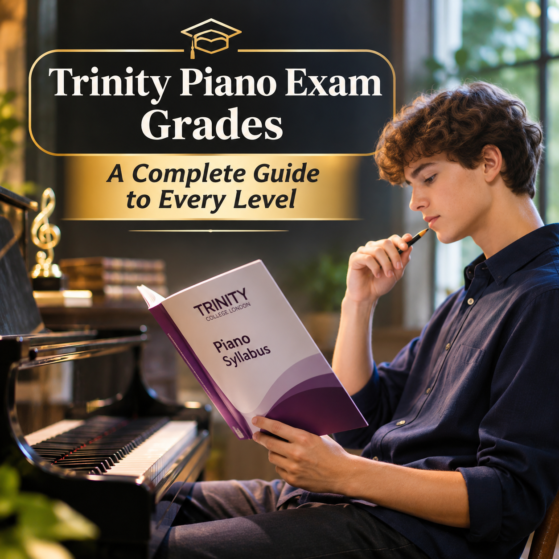
Trinity Music Certificate Benefits | Why Is It Worth Achieving?
A Trinity music certificate recognises your musical abilities and the effort behind them. It also provides clear learning goals and opportunities to measure your progress.
But what makes a Trinity music certificate worth achieving? Let’s explore its key benefits.

What Is a Trinity Music Certificate?
A Trinity music certificate is a qualification awarded by Trinity College London, an internationally recognised examination board specialising in music and performing arts.
Its music examinations assess practical abilities, musical understanding, technique, and performance skills. Students can pursue qualifications across various disciplines, including piano, guitar, vocals, violin, and drums.
Furthermore, Trinity offers structured learning pathways that allow students to progress from introductory levels to advanced grades.
Trinity Music Certificate Benefits | International Recognition That Adds Value
One of the biggest advantages of a Trinity music qualification is its international recognition. Trinity College London qualifications are regulated within the UK’s Regulated Qualifications Framework (RQF).
Consequently, students can earn a qualification that demonstrates their musical abilities against recognised assessment standards. This can be valuable when exploring further music education and performance opportunities internationally.
Moreover, recognised qualifications can strengthen a student’s academic and musical portfolio.

Structured Learning | One of the Key Trinity Music Certificate Benefits
Learning an instrument requires consistent practice and a strong foundation. Trinity’s graded examination system provides a structured pathway, allowing students to progress from Initial Grade, where available, to Grade 8.
Each level introduces new challenges and encourages learners to improve their technique, musical understanding, and performance abilities.
As a result, students have clear goals to work towards instead of practising without a defined direction.
Develops Confidence and Performance Skills
Playing an instrument during practice and performing before an examiner are two different experiences. Trinity examinations help students become comfortable demonstrating their musical abilities.
Through regular preparation, learners develop concentration, confidence, and the ability to manage performance pressure.
Additionally, these skills are useful beyond music, particularly during presentations, competitions, and other public performances.

Strengthens Musical Technique and Understanding
A strong musical foundation goes beyond learning individual songs. Students also need to understand rhythm, technique, notation, and musical expression.
Depending on the instrument and examination format, Trinity assessments may include repertoire, technical work, sight-reading, aural skills, and improvisation.
For example, piano students develop scales, arpeggios, and sight-reading, while guitar learners strengthen rhythm, finger technique, and interpretation.
Consequently, students become more independent musicians with a deeper understanding of their instruments.
Trinity Music Certificate Benefits for Higher Education Opportunities
Trinity qualifications can also support students interested in pursuing music at a higher academic level.
Trinity’s eligible Level 3 graded music qualifications, including Grades 6, 7, and 8, carry UCAS tariff points that may contribute towards UK university applications.
The practical examination tariff points are:
| Trinity Grade | Pass | Merit | Distinction |
|---|---|---|---|
| Grade 6 | 8 | 10 | 12 |
| Grade 7 | 12 | 14 | 16 |
| Grade 8 | 18 | 24 | 30 |
These points can strengthen a student’s academic profile. However, university admission requirements vary, and earning a qualification does not guarantee admission.

Encourages Discipline, Patience, and Consistency
Musical progress takes time and dedication. Learning difficult compositions, improving coordination, and mastering techniques require regular practice.
Preparing for Trinity examinations encourages students to establish consistent routines and work towards achievable goals.
Furthermore, balancing music practice with academics and other responsibilities helps learners develop time-management skills.
These qualities remain valuable whether students pursue music professionally or enjoy it as a lifelong interest.
Provides Meaningful Feedback and Measures Progress
Understanding strengths and areas for improvement is essential for musical development. Trinity examinations provide assessment results and examiner feedback to help students evaluate their performance.
Students can achieve Pass, Merit, or Distinction results, depending on their performance.
Moreover, this feedback helps teachers identify areas that need attention and plan future lessons more effectively.
As learners progress through different grades, they also build a record of their musical achievements.

Opens Pathways Towards Advanced Music Qualifications
Completing graded examinations can encourage students to explore more advanced musical opportunities.
After higher grades, learners can consider Trinity’s performance diploma pathways, including Associate (ATCL), Licentiate (LTCL), and Fellowship (FTCL), depending on the discipline.
These qualifications allow musicians to demonstrate advanced performance abilities and musical expertise.
Therefore, students can continue developing their skills beyond Grade 8 and explore opportunities in performance, teaching, and further music education.
Building a Stronger Musical Portfolio With Trinity Certification
A recognised music qualification adds value to a student’s academic and personal portfolio. It provides documented evidence of musical learning, dedication, and achievement.
For young learners, completing different grades creates milestones they can share with educational institutions and teachers.
Similarly, adult learners can use these qualifications to demonstrate their musical experience and commitment to continuous learning.

Encourages a Lifelong Connection With Music
Not everyone who learns music wants to become a professional musician. Many simply enjoy playing their favourite songs or exploring different instruments.
However, structured learning makes the experience more fulfilling. Trinity qualifications encourage students to explore new compositions, develop their abilities, and appreciate different musical styles.
Ultimately, music is a skill that can be enjoyed throughout life, and every achievement makes the journey more meaningful.
Understanding Trinity Graded Exams and Music Certificate Exams
Trinity offers different examination pathways to suit learners’ musical goals.
Trinity Graded Music Examinations follow a progressive structure, from Initial Grade, where available, to Grade 8. Depending on the format, assessments cover repertoire, technical work, and supporting musical skills.
Trinity Music Certificate Examinations offer a performance-focused alternative at Foundation, Intermediate, and Advanced levels, corresponding broadly to Grades 3, 5, and 8. Students prepare a recital programme and are assessed on their performance.
Both pathways recognise musical achievement, although their assessment formats differ. Choosing the right option depends on individual learning goals and preferences.

How Can You Prepare for a Trinity Music Examination?
Successful examination preparation requires regular practice, appropriate guidance, and an understanding of the syllabus.
Start by selecting an instrument and a suitable grade based on your current abilities. An experienced music teacher can then help you develop techniques, prepare repertoire, and identify areas for improvement.
Additionally, consistent practice and mock performances help students become familiar with examination expectations.
With structured guidance and dedication, learners can approach their examinations with greater confidence.
Why Choose The Mystic Keys for Your Trinity Music Learning Journey?
At The Mystic Keys, we believe every learner deserves the right guidance to develop their musical potential.
With 15 years of experience in music education, we offer personalised, one-on-one online music lessons across piano, guitar, vocals, violin, and other instruments.
Our experienced tutors focus on building strong foundations, improving musical techniques, and developing performance confidence.
Furthermore, students interested in Trinity and other recognised examination pathways receive guidance based on their chosen syllabus and learning goals.
With flexible online classes, learners from different parts of the world can access individual music instruction from the comfort of their homes.
Whether you are a beginner or preparing for advanced grades, The Mystic Keys can support your musical development.

Final Thoughts | Is Achieving a Trinity Music Certificate Worth It?
Absolutely! A Trinity music qualification offers much more than a certificate. It encourages musical development, builds confidence, and provides opportunities to explore further education and advanced learning.
More importantly, the journey teaches discipline, patience, and the satisfaction of achieving meaningful goals.
Whether you are taking your first musical steps or aiming for advanced qualifications, every milestone brings you closer to becoming a confident musician.
Start building your musical future with The Mystic Keys!
Explore our personalised online music lessons and take your next step towards musical excellence.
Learn. Practise. Progress. Achieve.
For more information and exciting resources about learning music, visit our website at The Mystic Keys. For more music content and exciting offers follow us on
Facebook, Instagram, YouTube, LinkedIn, Twitter, Pinterest, and Threads.