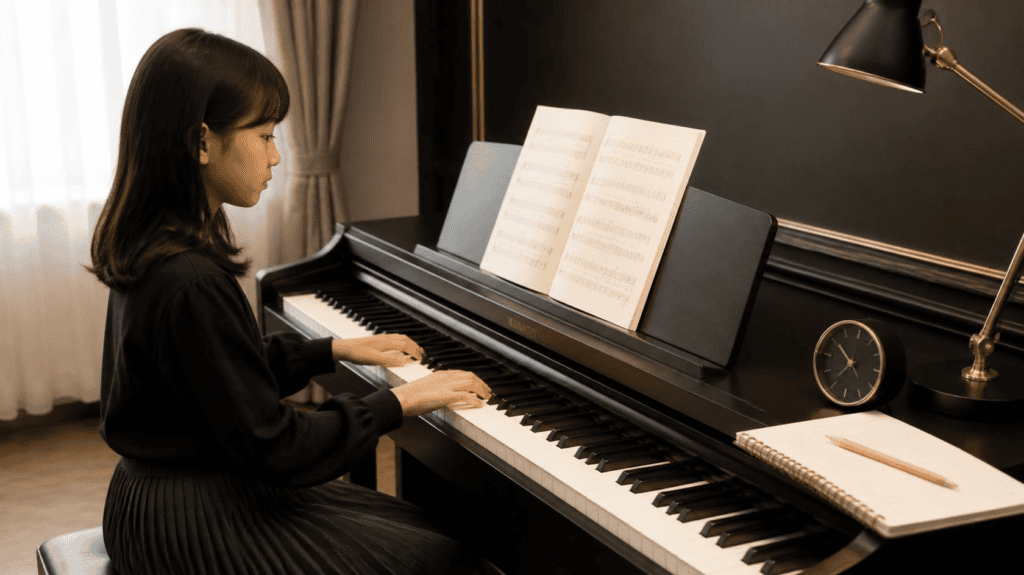
Billy Joel Style | How to Play Piano Like Billy Joel
Billy Joel Style | How to Play Piano Like Billy Joel
Few pianists have managed to make the piano sound as powerful, emotional, and instantly recognizable as Billy Joel. His distinctive Billy Joel style blends classical technique, blues-inspired phrasing, rock energy, and expressive storytelling, allowing his playing to move effortlessly from energetic rock anthems to intimate ballads. Rather than serving as simple accompaniment, the piano often becomes the driving force behind the song, adding rhythm, emotion, and character to every performance.
Learning to play in a Billy Joel-inspired style is therefore about much more than learning a few of his songs. It means understanding how he uses rhythm, chords, dynamics, melody, and movement to make a piano performance feel alive.
The good news is that you do not need to copy every detail of his technique to capture the spirit of his playing. Instead, by studying the musical ideas behind his style and applying them to your own playing, you can gradually develop a more confident, expressive, and powerful sound.
So, what exactly makes Billy Joel’s piano style so distinctive? Let’s explore the essential elements and discover how you can bring some of that character into your own playing.

Understanding Billy Joel’s Piano Style
Billy Joel’s musical identity comes from a fascinating combination of influences. His playing reflects elements of classical piano, rock and roll, blues, gospel, jazz, and traditional pop songwriting. This mixture allows his music to move comfortably between delicate passages and explosive moments.
One important characteristic is his ability to make the piano serve the song. Rather than filling every moment with complicated notes, Joel often chooses patterns that strengthen the rhythm, support the vocals, or emphasize the emotional direction of a section.
This is particularly noticeable in songs such as Piano Man, New York State of Mind, Scenes from an Italian Restaurant, and Vienna. Each has a different musical personality, yet the piano remains central to the storytelling.
Consequently, if you want to play like Billy Joel, the first step is not simply learning more notes. It is learning to make every musical choice purposeful.

Start With Strong Piano Technique
A strong technical foundation makes it much easier to explore Billy Joel-inspired playing. His performances can demand control, coordination, rhythmic accuracy, and considerable stamina, particularly when the music shifts between powerful chord patterns and melodic passages.
Start by becoming comfortable with major and minor scales, arpeggios, chord inversions, and common chord progressions. These fundamentals may seem basic, but they give you the freedom to move around the keyboard without constantly thinking about where your fingers need to go.
At the same time, avoid treating technique as an isolated exercise. Try applying your scales and chords musically. For example, practice a chord progression in different inversions and listen to how the movement between chords changes the character of the progression.
This approach is especially useful because Billy Joel’s playing often sounds effortless even when the underlying movement is technically demanding. Building that same sense of ease requires consistent practice.

Billy Joel Style | Develop a Powerful Left Hand
One of the most important aspects of a Billy Joel-inspired piano style is the left hand.
The left hand frequently provides the foundation for the music, whether through bass notes, rhythmic patterns, broken chords, or energetic accompaniment figures. A strong left hand can immediately make your playing sound fuller and more confident.
Instead of always playing the root note of each chord, experiment with different bass movements. Try alternating between the root and fifth, using octave patterns, or connecting chords through nearby bass notes.
For instance, when playing a simple chord progression, the left hand can create movement while the right hand handles chords or melody. This separation gives the music greater depth and allows the piano to function almost like an entire rhythm section.
However, power does not mean playing everything loudly. The real goal is control. Your left hand should provide energy without overpowering the melody.
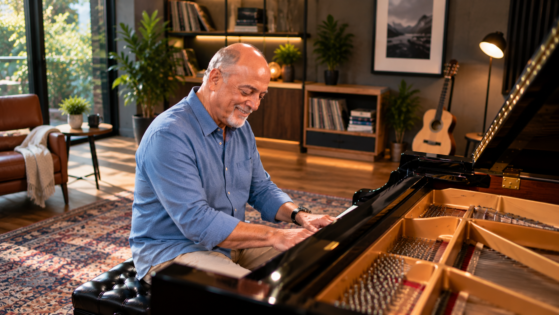
Master Rhythmic Piano Playing
Billy Joel’s music often has a strong rhythmic identity. His piano parts can sound almost percussive, particularly in his more energetic rock and pop performances.
That means rhythm deserves as much attention as harmony.
Begin by practicing chord patterns with a metronome. Once the timing feels comfortable, experiment with accents and syncopation. Try placing certain chords slightly ahead of or behind the expected beat while still maintaining a solid underlying pulse.
This is where your playing can begin to feel less mechanical. Instead of simply playing the correct notes at the correct time, you start creating a groove.
Moreover, listen carefully to the relationship between the piano and drums in Billy Joel recordings. The piano often works together with the rhythm section rather than existing separately from it. Understanding that relationship can dramatically improve your sense of timing.

Use Chords to Create Movement
Billy Joel is an accomplished songwriter, and his piano style is closely connected to his harmonic choices. His songs often use familiar chords, but the way those chords are arranged and connected gives them their distinctive character.
Learning common progressions is therefore useful, but stopping there will make your playing sound predictable. Once you know a progression, experiment with inversions, suspended chords, seventh chords, passing chords, and bass movement.
For example, rather than jumping directly from one root-position chord to another, choose inversions that keep your right hand close to the previous chord. This creates a smoother musical line and makes the progression feel more sophisticated.
As you become more comfortable, listen for moments where a chord seems to create tension before resolving. Those small harmonic decisions are often what make a simple progression emotionally engaging.

Learn to Balance Melody and Accompaniment
A major strength of Billy Joel’s piano playing is his ability to make the instrument sound both harmonic and melodic.
When accompanying a singer, the piano should support the vocal line rather than compete with it. However, during instrumental sections, the piano can take a more prominent melodic role.
You can practice this balance by playing chords softly while bringing a melody forward with your upper notes. Pay attention to your touch and make certain notes intentionally louder than others.
This is especially valuable when learning Piano Man or New York State of Mind. Rather than treating the piano part as one block of notes, listen for which musical elements should sit in the foreground and which should remain underneath.
As a result, your playing becomes more expressive without necessarily becoming more complicated.
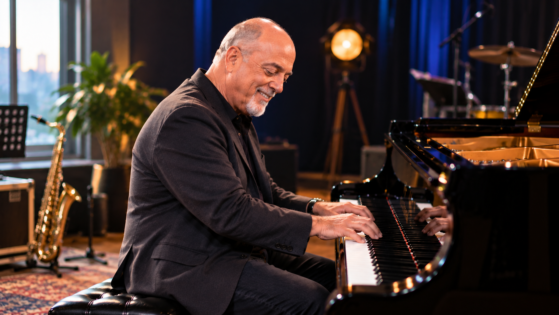
Billy Joel Style | Explore Dynamics and Expression
Technical accuracy is only one part of playing like Billy Joel. Expression is what gives the performance its personality.
A common mistake among developing pianists is playing every note at approximately the same volume. While this may be accurate, it can make even a beautiful song feel flat.
Instead, think about the emotional journey of the music. A verse might require a lighter touch, while a chorus could gradually become stronger. A dramatic transition may call for increased intensity, whereas a quieter passage may benefit from restraint.
Use changes in volume, articulation, pedal, and touch to shape your phrases. Allow certain chords to feel heavier while keeping others lighter.
Most importantly, do not be afraid of contrast. Billy Joel’s music often moves between intimate moments and powerful climaxes, and those changes are a major part of what makes the performances compelling.
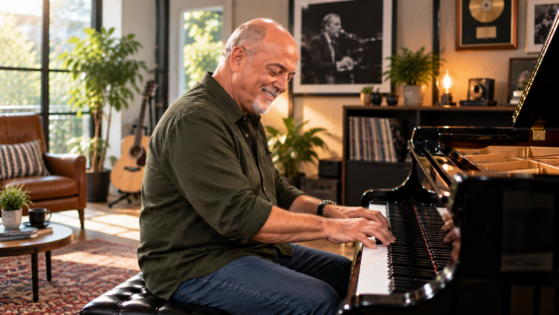
Bring Classical Influence Into Your Playing
Billy Joel’s musical background includes significant exposure to classical piano, and traces of that influence can be heard throughout his work.
Studying classical technique can therefore be extremely useful if you want to explore his style. Scales, arpeggios, finger independence, articulation, and structured practice all contribute to better keyboard control.
At the same time, you do not need to become a classical concert pianist before exploring rock piano. Instead, use classical exercises to improve the skills that support your overall musicianship.
For example, practicing arpeggios can help you become more comfortable with wide keyboard movement. Finger-independence exercises can make complicated chord-and-melody combinations easier. Classical pieces can also teach you how to shape phrases and control dynamics.
The result is a stronger technical foundation that can then be combined with the rhythmic energy of rock and pop.

Billy Joel Style | Study Billy Joel’s Songs Carefully
One of the most effective ways to understand his style is to learn his music rather than simply listening to it.
Choose songs at different difficulty levels and study what the piano is doing in each section. Ask yourself questions such as: Where does the left hand become more active? How does the accompaniment change between the verse and chorus? Which notes create the melodic emphasis? How does the rhythm change the character of the song?
Start with a song that matches your current level rather than immediately choosing the most technically challenging arrangement. Once you can play it comfortably, analyze the musical decisions behind it.
Some particularly useful songs to study include:
- Piano Man – excellent for understanding accompaniment, chord movement, and storytelling.
- New York State of Mind – useful for studying expressive chord voicings and melodic accompaniment.
- Vienna – valuable for exploring dynamics, phrasing, and emotional expression.
- Scenes from an Italian Restaurant – particularly interesting for studying changes in arrangement, energy, and musical character.
Learning these pieces is not about becoming a copy of Billy Joel. Instead, each song can serve as a musical lesson from which you take ideas for your own playing.
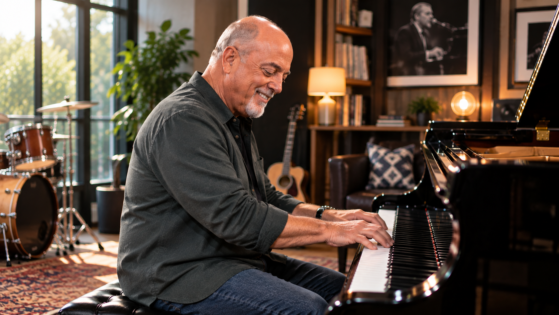
Practice Playing With a Band or Backing Track
Billy Joel’s style becomes much easier to understand when you hear the piano within a complete musical arrangement.
If you usually practice alone, try using backing tracks. Playing alongside drums, bass, and other instruments will force you to think differently about your timing and dynamics.
Suddenly, the piano is no longer responsible for filling every space. You have to listen, leave room, respond to the rhythm section, and maintain the groove.
This experience can be incredibly useful for developing a rock and pop piano style. It also teaches an important lesson: great accompaniment is often about knowing what not to play.
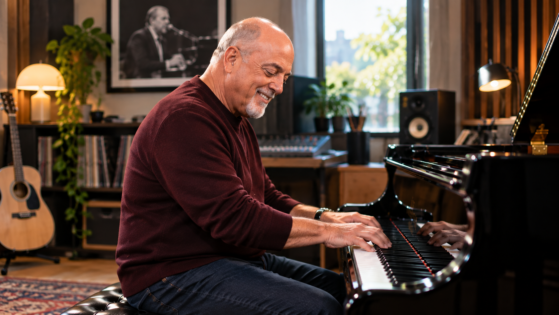
Develop Your Own Billy Joel-Inspired Sound
While studying another musician is valuable, the ultimate goal should be to develop your own musical identity.
Take the elements you admire in Billy Joel’s playing—strong rhythms, expressive chords, melodic ideas, dynamic contrasts, and powerful left-hand patterns—and experiment with them in your own compositions or arrangements.
Try taking a simple chord progression and giving it a more energetic left-hand pattern. Then experiment with different inversions in the right hand. Add a short melodic phrase, change the dynamics, and introduce rhythmic accents.
Through this process, you begin to understand that style is not something you simply imitate. It is something you build from musical choices.
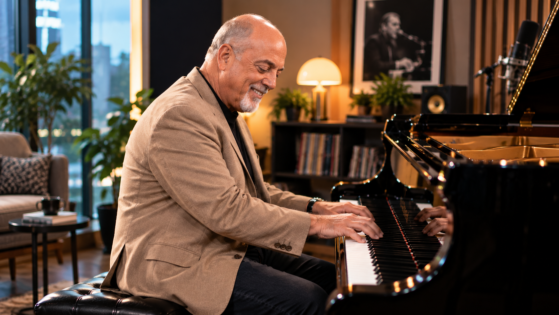
Billy Joel Style | Common Mistakes to Avoid
When learning a famous pianist’s style, it can be tempting to focus entirely on speed and technical difficulty. However, playing faster does not automatically make your performance sound more like Billy Joel.
Another common mistake is concentrating only on the notes. Two pianists can play exactly the same notes and produce completely different performances because of differences in timing, articulation, dynamics, and touch.
Ignoring rhythm can also weaken the overall result. A technically accurate performance without a strong groove may still feel lifeless.
Finally, avoid trying to reproduce every detail of a recording immediately. Give yourself time to understand the structure first, then gradually add stylistic details as your confidence grows.
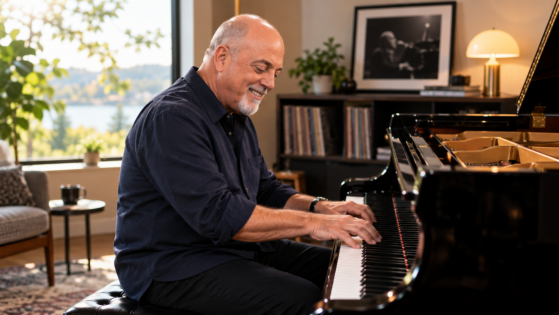
A Practical Practice Routine
If you want to incorporate Billy Joel-inspired techniques into your regular practice, create a routine that combines technique, rhythm, repertoire, and creativity.
Begin with a short warm-up involving scales, arpeggios, and chord inversions. Move into rhythmic exercises with a metronome, focusing on consistent timing and accented patterns. After that, spend time learning a Billy Joel song, paying attention to its harmony and accompaniment rather than simply memorizing the notes.
Once the repertoire work is complete, dedicate a few minutes to improvisation. Take the chord progression from the song and create your own melody or rhythmic accompaniment.
This final step is particularly important because it transforms practice from imitation into musicianship. You are no longer simply reproducing something you heard; you are learning how to use the same musical concepts independently.

Billy Joel Style | Listen Like a Musician
Perhaps one of the simplest ways to improve is also one of the most overlooked: listen carefully.
Rather than playing Billy Joel’s songs as background music, listen specifically to the piano. Notice when the playing becomes softer, where the rhythm becomes more intense, how the chords move, and how the piano interacts with the voice.
Listen to the same section several times. On the first listen, focus on rhythm. Next, listen to the bass movement. Then pay attention to the right-hand voicings and melody.
With repeated listening, details that initially seemed invisible—or rather, inaudible—begin to stand out.
Over time, this develops your musical ear, which is just as important as developing your fingers.

Final Thoughts
Playing piano like Billy Joel is not about complicated chords—it’s about strong technique, rhythm, expressive harmony, and emotional storytelling. Learn his music, understand what makes his style unique, and then use those ideas to develop your own sound.
At The Mystic Keys, we believe great musicians inspire you to become a better version of yourself. After all, the goal isn’t just to sound like Billy Joel—it’s to discover your own musical voice.
For more information and exciting resources about learning music, visit our website at The Mystic Keys. For more music content and exciting offers follow us on
Facebook, Instagram, YouTube, LinkedIn, Twitter, Pinterest, and Threads.