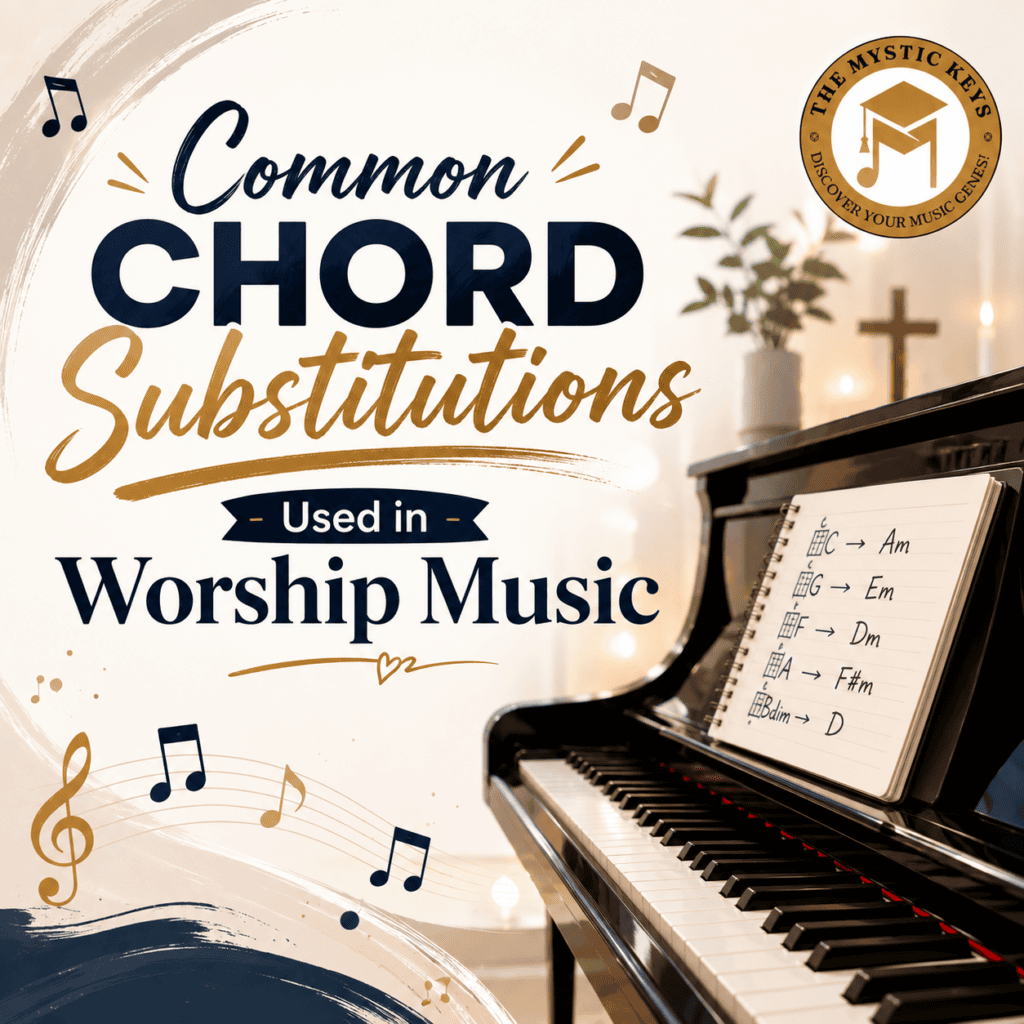
Common Chord Substitutions Used in Worship Music
Worship music often sounds simple on the surface. Many songs use familiar chord progressions, repeated sections, and accessible melodies. Yet experienced worship musicians can make the same progression sound much richer by using carefully chosen chord substitutions.
Chord substitutions allow a musician to replace a basic chord with another chord that performs a similar harmonic function. The result can be a smoother transition, a more expressive progression, a stronger sense of movement, or a richer musical texture.
For example, instead of always playing a basic C major chord, a pianist or guitarist might use Cmaj7, Cadd9, Am7, or another related voicing depending on the musical context. These choices do not necessarily change the underlying song. Instead, they can add color and movement while preserving the familiar harmonic foundation.
This is particularly useful in worship music because musicians often need to balance simplicity with musical expression. The congregation needs to recognize the song, while the band may want to create a fuller and more expressive arrangement.
Understanding chord substitutions gives worship musicians another way to achieve that balance.
What Are Chord Substitutions?
A chord substitution occurs when one chord is replaced by another chord that can perform a similar function within the progression.
The replacement might have similar notes, a similar harmonic role, or a similar relationship to the surrounding chords.
For example, a simple progression might be:
C – G – Am – F
A musician could introduce variations such as:
Cmaj7 – G/B – Am7 – Fadd9
The fundamental progression remains recognizable, but the sound becomes more sophisticated.
Why Use Chord Substitutions?
There are several reasons musicians use substitutions.
They can:
- Create smoother bass movement.
- Add harmonic color.
- Make transitions more interesting.
- Support a vocal melody.
- Create emotional tension and release.
- Connect two chords more naturally.
- Prevent repetitive progressions from sounding static.
- Add a more contemporary worship sound.
The key is to use substitutions intentionally rather than adding complicated chords simply because they are available.
Start With Chord Extensions
Before learning complicated substitutions, worship musicians should become comfortable with chord extensions.
Common extensions include:
- Major 7ths
- Minor 7ths
- Add9 chords
- Suspended chords
- 6th chords
These chords can often replace basic triads without dramatically changing the harmonic identity of a song.
Major 7 Chords
A major 7 chord adds the seventh note of the major scale to a major triad.
For example:
C major: C – E – G
Cmaj7: C – E – G – B
The result is softer and more spacious than a basic C chord.
This can work particularly well during reflective worship sections.
Minor 7 Chords
A minor 7 chord adds the minor seventh above a minor triad.
For example:
Am: A – C – E
Am7: A – C – E – G
Minor 7 chords can create a warmer and more relaxed sound.
They are especially useful when the arrangement needs a little more harmonic depth without becoming overly complicated.
Add9 Chords for Contemporary Worship
Add9 chords are extremely useful in worship music.
A basic major chord can often be replaced with an add9 version.
For example:
C → Cadd9
The added ninth creates a more open sound while keeping the basic major chord intact.
Why Add9 Chords Work So Well
Add9 chords can sound spacious without becoming overly jazzy.
They are particularly effective on acoustic guitar and piano because the additional note can create a beautiful upper texture.
For example, a progression such as:
C – G – Am – F
can become:
Cadd9 – G – Am7 – Fadd9
The progression remains familiar, but the overall sound becomes more atmospheric.
Suspended Chords Create Movement
Suspended chords replace the third of a chord with another scale degree, usually the second or fourth.
The two most common forms are:
sus2
and
sus4
For example:
Dsus2: D – E – A
Dsus4: D – G – A
Sus Chords Are Excellent for Worship
Suspended chords create a sense of anticipation because they often want to resolve back to the standard chord.
For example:
Dsus4 → D
creates a simple tension-and-release effect.
This can be particularly effective during transitions, builds, and repeated worship sections.
Slash Chords Create Smoother Bass Movement
Slash chords are another extremely useful tool.
A slash chord indicates that a particular bass note should be played underneath the main chord.
For example:
C/G
means a C chord with G in the bass.
But slash chords can do more than change the bass note.
They can create smooth bass lines between chords.
Example of a Descending Bass Line
Consider:
C → G/B → Am
The bass moves:
C → B → A
That descending movement creates a smoother transition than simply playing C → G → Am.
This technique is particularly effective on piano because the left hand can control the bass while the right hand plays the chord.
The ii-V-I Progression
The ii-V-I progression is one of the most important harmonic patterns in Western music and is especially common in jazz, gospel, and contemporary worship arrangements.
In the key of C major:
Dm7 → G7 → Cmaj7
This progression creates a strong sense of movement toward the tonic.
Using ii-V-I in Worship
A basic progression might move directly from a chord to the tonic.
Instead of making the transition abrupt, a musician can insert a ii-V movement before arriving at the destination.
For example:
C → Am → Dm7 → G7 → C
This can add a sense of harmonic direction.
However, it should be used tastefully. If the song is intentionally simple, too many additional chords may distract from the vocal and congregational singing.
Dominant Chords Can Create Strong Resolution
Dominant chords naturally create tension that wants to resolve.
In the key of C, G7 is the dominant seventh chord.
G7 → C
has a stronger sense of resolution than simply:
G → C
Use Dominant Chords at Important Moments
A dominant seventh can work particularly well before a major transition.
For example, when moving toward a chorus or returning to the beginning of a section, a dominant chord can create anticipation.
The listener may not consciously identify the chord, but they can feel that something is about to resolve.
Secondary Dominants
Secondary dominants are another useful form of harmonic substitution.
A secondary dominant temporarily treats another chord as though it were the tonic.
For example, in the key of C, the normal progression might include:
C → Am
A musician could introduce E7 → Am.
E7 is the dominant seventh of A minor, so it creates stronger movement toward Am.
Why Secondary Dominants Work
They create temporary harmonic tension.
The listener hears the unexpected chord and then experiences a satisfying resolution.
In worship music, this can be particularly effective during instrumental sections, transitions, or moments where the arrangement needs additional emotional movement.
Passing Chords Connect Two Chords
Passing chords are used to connect two main chords.
Instead of moving directly from one chord to another, the musician introduces a brief chord between them.
For example:
C → Am
might become:
C → C#dim7 → Dm7 → G7 → C
The exact substitution depends on the musical context.
Passing Chords Should Usually Be Brief
Passing chords work because they create movement.
If every transition contains several additional chords, the arrangement can become unnecessarily complicated.
Use them where they enhance the musical direction.
Tritone Substitution for Advanced Players
Tritone substitution is an advanced harmonic technique commonly associated with jazz and gospel playing.
A dominant seventh chord can sometimes be replaced by another dominant seventh chord located a tritone away.
For example:
G7
can be substituted with:
Db7
before resolving to C.
Is Tritone Substitution Suitable for Every Worship Song?
Not necessarily.
This is a technique that should be used carefully.
It can add sophisticated harmonic movement to an instrumental arrangement, but excessive use can make a simple worship song sound stylistically disconnected from its original character.
Advanced musicians should think about the song’s purpose before introducing this kind of substitution.
Chord Inversions Can Sound Like Substitutions
Sometimes the easiest way to create a more sophisticated progression is not to replace the chord at all.
Instead, change its inversion.
For example:
C → G → Am
can become:
C → G/B → Am
The chord itself remains G major, but B is placed in the bass.
Why Inversions Matter
Inversions can create smoother movement between chords.
On piano, the left hand can create a connected bass line while the right hand maintains comfortable chord shapes.
On guitar, different voicings can create similar effects.
This is one of the most practical ways to improve worship accompaniment without dramatically changing the harmony.
Practice With Familiar Worship Songs
Choose a song you already know extremely well.
Play the original progression first.
Then experiment with one change at a time.
Try an add9.
Try a seventh chord.
Try an inversion.
Try a slash chord.
Try a passing chord.
Compare Before and After
Listen carefully to each version.
Ask whether the substitution actually improves the arrangement.
If it sounds better, remember it.
If it sounds unnecessarily complicated, return to the original.
This develops musical judgment.
Communicate With the Worship Team
Chord substitutions should also fit the band’s overall arrangement.
If the keyboardist suddenly changes the harmony while the acoustic guitarist continues playing the original chord, the result may sound confusing.
Agree on Harmonic Changes
When using more advanced substitutions, communicate with the worship leader and other musicians.
Everyone should understand where significant harmonic changes are happening.
This is particularly important during rehearsals and spontaneous worship moments.
Conclusion
Chord substitutions can transform familiar worship progressions into richer and more expressive musical arrangements. From simple chord extensions and suspended chords to slash chords, passing chords, secondary dominants, diminished chords, and more advanced reharmonization techniques, there are many ways to add harmonic color without losing the identity of a song.
The most important principle is restraint. A worship musician should not substitute chords simply to demonstrate technical knowledge. Every harmonic decision should serve the song, support the melody, complement the other musicians, and help create the appropriate emotional atmosphere.
Start with simple techniques such as major 7ths, minor 7ths, add9 chords, inversions, and slash chords. Once these become comfortable, explore passing chords, secondary dominants, and more advanced harmonic concepts. Practice them in different keys and apply them to songs you already know.
Ultimately, the goal is not to make worship music complicated. The goal is to make it musically intentional.
At The Mystic Keys, our personalized Worship Piano Lessons Online and Worship Guitar Lessons Online help musicians develop chord knowledge, rhythm, harmony, improvisation, accompaniment skills, and musical sensitivity. With one-on-one guidance from experienced teachers, students can learn how to use advanced techniques appropriately while keeping the focus on supporting the worship team and serving the song.
For more information and exciting resources about learning music, visit our website at The Mystic Keys. For more music content and exciting offers follow us on
Facebook, Instagram, YouTube, LinkedIn, Twitter, Pinterest, and Threads.

Piano Learning for Advanced Learners
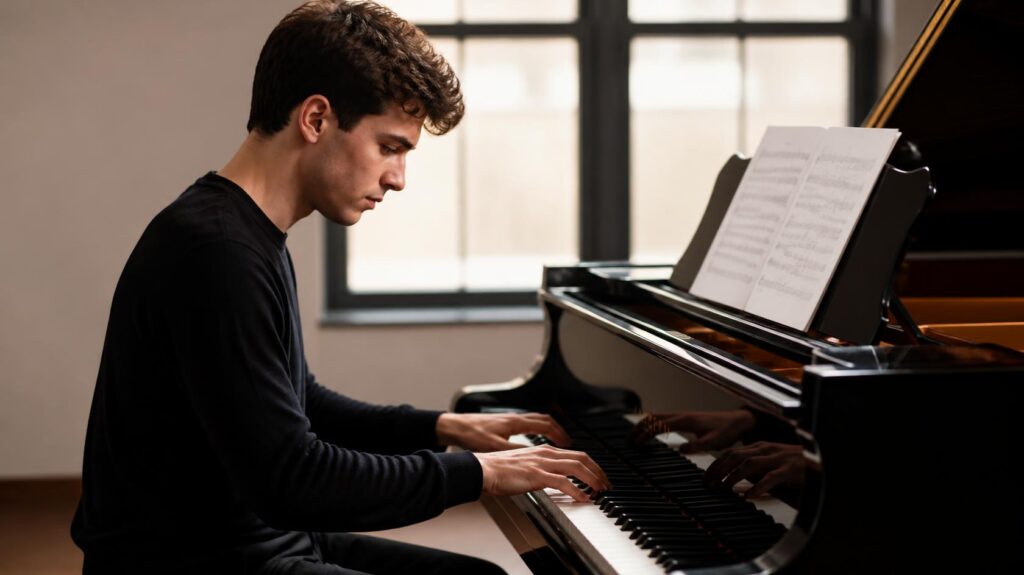
Learning piano does not stop when a student becomes technically proficient. In many ways, reaching an advanced level opens the door to a completely different stage of musical development. At this point, the focus gradually moves beyond simply playing the correct notes and toward interpretation, tone, phrasing, musical independence, improvisation, repertoire depth, and individual expression. Piano Learning for Advanced Learners requires a more thoughtful approach because advanced students often need highly specific guidance rather than a general sequence of exercises.
An advanced pianist may already be comfortable with scales, arpeggios, chords, sight-reading, and demanding repertoire. However, technical ability alone does not automatically produce a mature performance. Two pianists can play exactly the same notes and create completely different musical experiences. The difference often comes from touch, timing, articulation, pedaling, dynamics, phrasing, harmonic awareness, and the ability to understand the character of the music. Advanced learning is therefore about transforming technical control into meaningful musical communication.
What Changes at the Advanced Level?
At beginner and intermediate levels, much of piano learning involves acquiring fundamental skills. Students learn how to read music, coordinate both hands, develop finger technique, understand basic theory, and play increasingly challenging pieces.
At an advanced level, these foundations should already be reasonably secure. The challenge becomes using them with greater freedom and control.
Technique Becomes a Tool for Expression
An advanced pianist should not practice technique simply to become faster.
Technique should make musical expression easier.
A pianist may need exceptional finger control for a rapid passage, but the ultimate purpose is to make that passage sound effortless and musical. Technical exercises become more meaningful when they are connected to actual repertoire and expressive goals.
Advanced Pianists Need Deeper Musical Understanding
Playing difficult notes accurately is only one part of advanced musicianship.
Students need to understand how a composition is constructed.
They should be able to identify phrases, themes, harmonic movement, cadences, modulations, recurring patterns, and structural sections.
Analyze Before You Perform
Before spending hours repeating a difficult passage, take time to understand what is happening musically.
Ask why the composer wrote a particular harmonic progression.
Identify where a phrase begins and ends.
Look for repeated ideas.
Notice where the music changes character.
This analysis can influence decisions about dynamics, articulation, tempo, and phrasing.
Developing Individual Interpretation
One of the most important goals of advanced piano study is developing an individual interpretation.
A technically correct performance can still sound emotionally flat if every phrase is played in exactly the same manner.
Advanced pianists need to make thoughtful choices about how they want the music to communicate.
Don’t Simply Copy Recordings
Listening to great pianists can be extremely educational, but copying another musician’s interpretation completely can prevent you from developing your own musical voice.
Listen to different performances.
Notice how they differ in tempo, articulation, dynamics, pedaling, and phrasing.
Then consider what interpretation feels convincing to you and why.
Advanced Piano Learning Requires Refined Touch
Touch becomes increasingly important as pianists progress.
At an advanced level, simply playing a note correctly is not enough.
The pianist needs to control how that note begins, how long it speaks, how it connects to neighboring notes, and how it balances with everything else.
Learn to Control Different Types of Touch
Different musical situations may require different approaches.
A passage might need a light, delicate touch.
Another may require weight and depth.
A melody may need a singing quality while the accompaniment remains soft and understated.
Developing these differences allows the piano to become much more expressive.
Dynamics Are More Than Loud and Soft
Advanced dynamics involve much more than simply following markings such as piano and forte.
The pianist needs to shape the direction of a phrase.
A crescendo may need to begin subtly and grow gradually.
A diminuendo may need to release tension rather than simply become quieter.
Shape the Entire Musical Sentence
Think of a phrase as something that moves toward a destination.
Where is its emotional peak?
Where does the tension increase?
Where does it resolve?
These questions help create natural musical phrasing.
Pedaling Requires Precision
Pedaling can dramatically affect the sound of advanced piano repertoire.
Too little pedal can make music sound dry or disconnected.
Too much pedal can blur harmony and articulation.
The goal is not simply to follow pedal markings mechanically.
Listen to the Harmony
Pedaling should respond to harmonic movement and the acoustic environment.
Change the pedal when necessary to keep the harmony clear.
In some passages, partial or carefully timed pedal changes may produce a cleaner result than simply holding the pedal continuously.
The ear should ultimately guide the decision.
Advanced Students Should Practice Slowly
Even experienced pianists benefit enormously from slow practice.
When playing at performance speed, mistakes can sometimes pass unnoticed because everything happens so quickly.
Slow practice exposes unnecessary tension, unevenness, inaccurate rhythm, and weak finger control.
Slow Practice Reveals Details Piano Learning Advanced
Practice difficult passages slowly enough that you can hear every note.
Pay attention to balance between the hands.
Listen to articulation.
Observe tension in the wrists and shoulders.
Then gradually return to faster tempos.
Work on Difficult Passages Separately
Advanced repertoire can contain extremely demanding sections.
Playing the entire piece repeatedly is not always the most efficient way to improve.
Isolate the Technical Problem
If one arpeggio passage is causing difficulty, practice that passage separately.
If a leap is unreliable, work specifically on the movement between the two positions.
If a rhythm is difficult, practice the rhythm independently.
Targeted practice allows you to solve the actual problem instead of repeatedly running into it during full performances.
Develop Greater Hand Independence
At an advanced level, the two hands often have completely different musical roles.
One hand may carry a melody while the other provides a delicate accompaniment.
Sometimes both hands may contain independent melodic lines.
Listen to Each Layer
Practice each musical layer separately.
Identify which voice should be prominent.
Then combine the parts while maintaining that balance.
This is particularly important in contrapuntal music, where several independent voices need to remain clear.
Learn to Bring Out Inner Voices
Advanced repertoire frequently contains important musical information that is not located in the highest note.
An inner voice may contain a secondary melody or harmonic movement.
Practice Voices Separately
Try playing the inner melody alone.
Then add the surrounding material quietly.
This teaches your hands to distribute weight between different fingers and voices.
The result is a more sophisticated and transparent performance.
Expand Your Repertoire
Advanced pianists benefit from exploring different composers, periods, and musical styles.
Playing only one type of repertoire can limit musical development.
Explore Baroque counterpoint, Classical forms, Romantic expression, Impressionistic textures, contemporary compositions, jazz, popular music, worship music, or other styles that interest you.
Different Styles Develop Different Skills
Baroque music can strengthen articulation and independence.
Classical repertoire develops structural awareness and clarity.
Romantic music challenges phrasing and expressive control.
Jazz can develop harmony, rhythm, and improvisation.
Contemporary music can introduce different textures and rhythmic approaches.
A broad repertoire can make you a more versatile musician.
Improvisation Can Take Advanced Playing Further
Improvisation is an excellent way to develop musical independence.
When reading a score, the pianist follows decisions already made by the composer.
During improvisation, the pianist must make musical decisions in real time.
Experiment Without Fear
Try improvising over a simple chord progression.
Change the rhythm.
Create variations of a familiar melody.
Move the melody into a different register.
Experiment with different harmonic colors.
Improvisation can help pianists become more comfortable making creative choices.
Advanced Pianists Should Strengthen Their Ear
At higher levels, the ear becomes increasingly important.
A pianist should be able to hear when something is rhythmically uneven, harmonically unclear, or poorly balanced.
Listen Before You Correct
Instead of immediately looking at the score after making a mistake, listen to what sounded wrong.
Can you identify the problem?
Was the note too loud?
Was the rhythm late?
Was the phrase disconnected?
Was the harmony unclear?
Developing this awareness makes you more independent as a musician.
Memorization Should Go Beyond Finger Memory
Advanced pianists often perform from memory, but relying only on muscle memory can be risky.
A strong memory system includes several layers.
You should understand the harmonic progression, structure, melodic patterns, fingering, and physical movements.
Know the Music Away From the Piano
Try mentally reviewing the piece without playing it.
Can you visualize the opening?
Can you identify the chord progression?
Can you hear the melody internally?
Can you describe the structure?
Mental practice can strengthen your understanding and provide additional security during performance.
Performance Practice Becomes Essential
Advanced musicians need to prepare not only the notes but also the performance experience.
Play complete pieces without stopping.
Practice entering the piece confidently.
Practice recovering after mistakes.
Learn to Continue Through Errors
A professional performance does not require absolute perfection.
Mistakes may happen.
What matters is whether you can recover without losing the musical flow.
Practice continuing after small errors rather than immediately stopping and restarting.
Record Your Performances
Recording is one of the most effective tools available to advanced pianists.
When you are playing, your attention is divided between technique, reading, expression, and memory.
Listening afterward provides a different perspective.
Listen Like an Audience Member
Ask yourself:
Is the melody clear?
Does the phrasing make sense?
Are the dynamics convincing?
Is the tempo stable?
Does the performance communicate the intended character?
This kind of critical listening can reveal details that are difficult to notice while playing.
Develop Your Own Practice Strategy
Advanced students should gradually become independent learners.
Rather than relying entirely on a teacher to decide what needs to be practiced, you should learn to diagnose your own weaknesses.
Ask Better Practice Questions
Instead of saying, “I can’t play this passage,” ask:
What exactly is going wrong?
Is it technical?
Rhythmic?
Memory-related?
A fingering problem?
A coordination issue?
Once you identify the cause, you can choose a more effective solution.
Avoid Practicing on Autopilot
Advanced pianists can sometimes become trapped in repetitive practice.
Playing the same passage dozens of times without actively listening may reinforce mistakes instead of correcting them.
Every Repetition Should Have a Purpose Piano Learning Advanced
Before repeating a passage, know what you are trying to improve.
You might focus on evenness during one repetition and dynamics during another.
Intentional practice keeps the brain engaged.
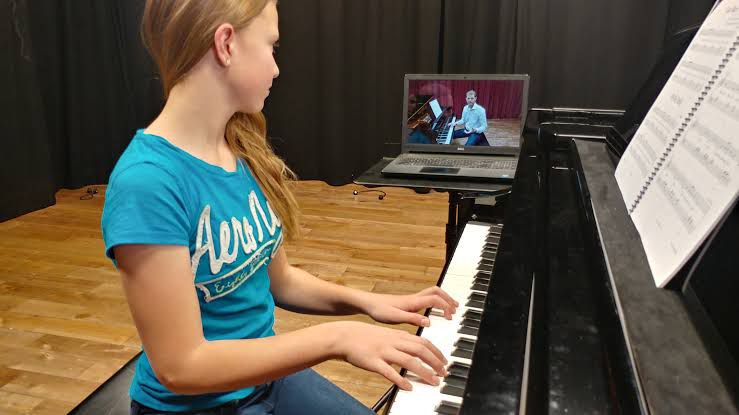
Work With an Experienced Teacher
At an advanced level, personalized feedback becomes particularly valuable.
Small technical or musical problems can be difficult to identify independently.
A skilled teacher can listen closely, offer alternative interpretations, suggest efficient practice methods, and challenge the student appropriately.
Piano Learning Advanced
There is no single curriculum that suits every advanced pianist.
One student may need to develop technique.
Another may need greater expressive freedom.
Another may be preparing for an examination, competition, audition, or performance.
Individualized instruction allows lessons to respond to those needs.
Become Your Own Teacher
A strong teacher eventually helps you develop the ability to evaluate your own playing.
You learn what good technique feels like.
You learn how to identify tension.
You learn how to hear balance.
You learn how to structure practice.
This independence can continue benefiting you for the rest of your musical life.
Conclusion
Piano Learning for Advanced Learners is ultimately about going beyond technical accuracy and developing a deeper understanding of music. Advanced pianists need to refine their touch, phrasing, dynamics, pedaling, rhythm, interpretation, listening, memory, and ability to communicate emotion. They also need to become increasingly independent in the way they practice and solve musical problems.
At this stage, progress often comes from paying attention to details that may have been overlooked earlier. A single phrase can require careful analysis. A few measures may need hours of focused work. A familiar piece may reveal entirely new possibilities after deeper study. Advanced learning is therefore less about simply playing harder music and more about understanding music at a deeper level.
The strongest advanced pianists continue to remain curious. They listen to different interpretations, explore new repertoire, experiment with improvisation, refine their technique, and regularly question how they can communicate more effectively. Technical mastery provides the tools, but musical understanding gives those tools purpose.
At The Mystic Keys, personalized Piano Lessons Online can support advanced learners with focused guidance in repertoire, technique, interpretation, improvisation, music theory, performance preparation, and musical expression. One-on-one instruction allows lessons to be adapted to each pianist’s level and goals, helping advanced students continue developing their individual sound and musicianship.
For more information and exciting resources about learning music, visit our website at The Mystic Keys. For more music content and exciting offers follow us on
Facebook, Instagram, YouTube, LinkedIn, Twitter, Pinterest, and Threads.
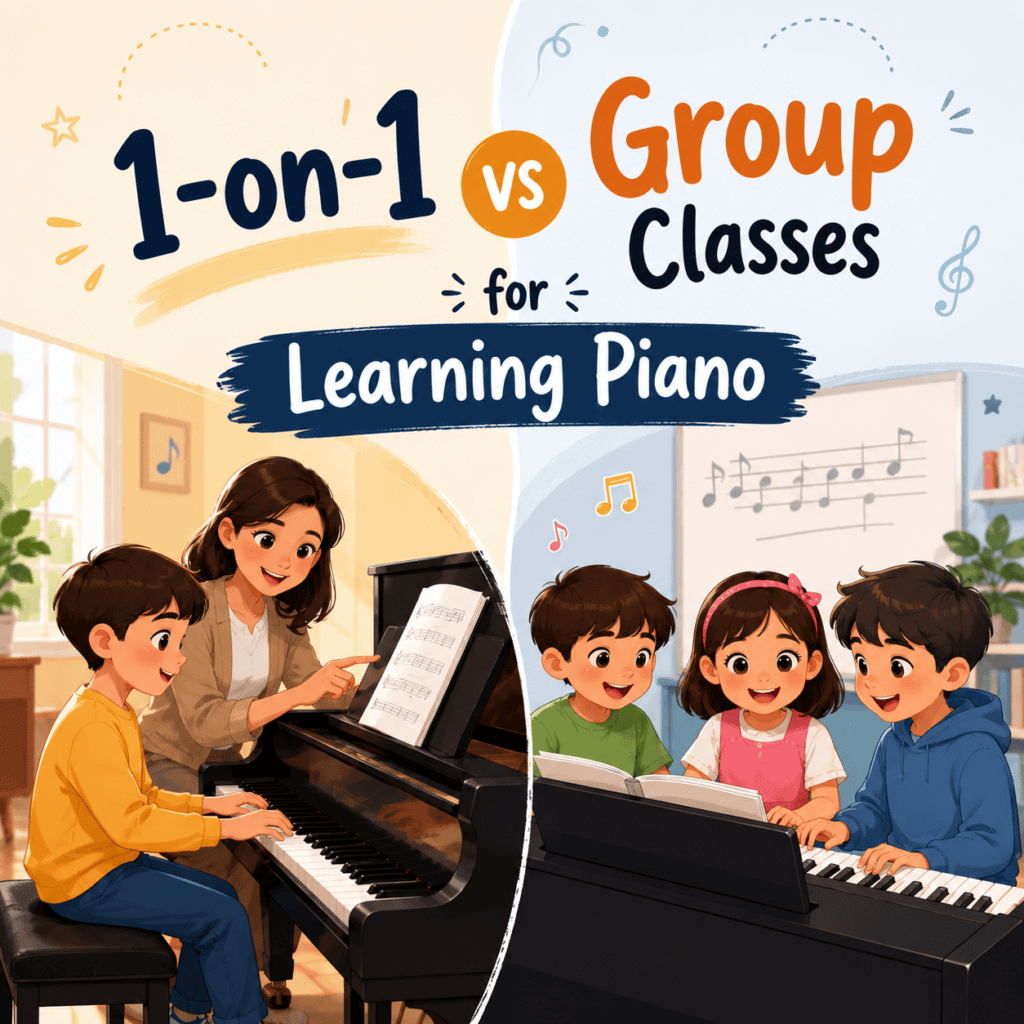
1-on-1 classes vs group classes for learning piano
Learning piano can be an exciting and rewarding experience, but choosing the right type of lesson can make a significant difference in how comfortably and consistently a student progresses. Two common options are 1-on-1 vs Group Piano Classes and group piano classes. Both approaches can introduce students to technique, music theory, rhythm, sight-reading, and repertoire, but they create very different learning experiences. Understanding the differences can help students and parents decide which format is better suited to their goals, personality, schedule, and current ability.
A group class can provide a social and collaborative environment where students learn alongside others. It can be enjoyable for learners who like interacting with their peers and may also make music feel like a shared activity. A 1-on-1 lesson, on the other hand, gives the teacher the opportunity to concentrate entirely on one student. The lesson can move at the student’s pace, with the teacher spending more time on specific difficulties and adapting the material according to the student’s progress. Neither format is automatically right for everyone, but understanding what each offers makes the decision much easier.
What Are 1-on-1 Piano Classes?
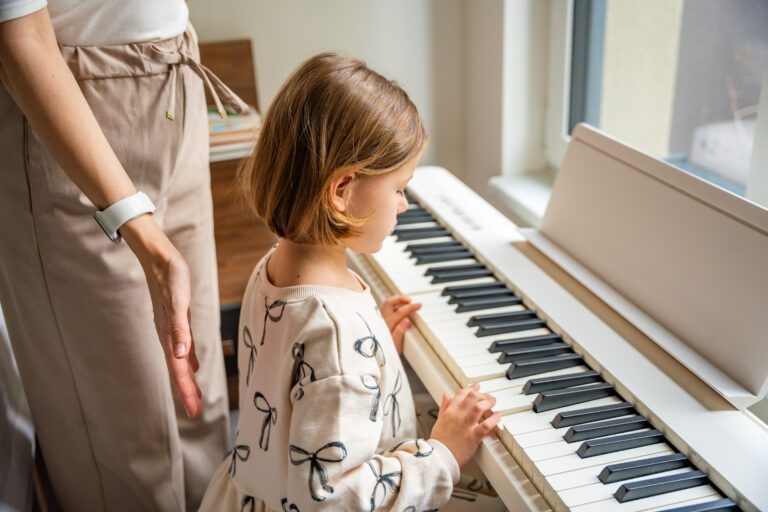
A 1-on-1 piano class involves one student and one teacher working together throughout the lesson. The teacher can observe the student’s playing closely, identify technical issues, answer questions immediately, and adjust the lesson according to the student’s needs.
This format creates a highly personalized learning experience. A beginner who needs additional time to understand rhythm can spend more time on it, while a student who learns quickly can move ahead rather than waiting for the rest of a group.
Personalized Attention
One of the biggest advantages of private piano instruction is individual attention. The teacher can listen carefully to every passage and notice details that might otherwise be missed.
Finger position, posture, hand coordination, rhythm, articulation, dynamics, and pedaling can all be addressed specifically for that student.
What Are Group Piano Classes?
Group piano classes involve several students learning together under the guidance of one teacher. Depending on the class structure, students may work on similar exercises, learn songs together, participate in rhythm activities, or take turns performing for one another.
Group lessons can create a lively environment and introduce students to the social side of music.
Learning With Other Students
For some learners, seeing another student attempt a similar exercise can make learning feel less intimidating.
Students may also become motivated by watching their classmates progress and can develop confidence through playing in front of others.
Individual Pace Is a Major Difference
One of the clearest differences between private and group learning is the speed of instruction.
In a group class, the teacher has to balance the needs of multiple students. Some learners may understand a concept quickly, while others may need additional explanation.
1-on-1 vs Group Piano Classes Adapt to the Student
In an individual lesson, the teacher does not need to follow a pace designed for several learners.
If a student is struggling with a particular skill, the teacher can spend additional time on it.
If the student has already mastered the material, the lesson can progress to something more challenging.
This flexibility can be particularly useful when students have different levels of previous musical experience.
Feedback Is More Immediate in Private Lessons
Feedback is essential when learning piano because small technical problems can become habits if they are not corrected.
In a group, a teacher has to divide attention among several students.
Teachers Can Correct Problems Immediately
During a 1-on-1 lesson, the teacher can notice exactly what is happening when a student plays.
If the wrist is tense, the fingering is inefficient, or the rhythm is inconsistent, the teacher can address the issue immediately.
The student can then try the movement again with the correction.
This continuous feedback can make learning more efficient.
Group Classes Encourage Social Learning
One of the strongest benefits of group classes is interaction.
Students can listen to one another, perform together, participate in rhythm activities, and experience music as a collaborative activity.
Playing With Others Builds Confidence
Some students become more comfortable performing when they regularly play in front of peers.
Group environments can also introduce learners to ensemble skills and teach them to listen while other musicians are playing.
These experiences can be valuable for students who eventually want to perform in bands, ensembles, or other collaborative settings.
1-on-1 Lessons Can Be More Flexible
Private lessons can often be structured around the student’s specific needs.
A student interested in classical piano may follow one learning path, while another interested in pop, worship music, film music, or improvisation may follow another.
Lessons Can Reflect Individual Goals
A student preparing for an examination may need focused work on scales, sight-reading, and repertoire.
Another student may simply want to play favorite songs.
In a 1-on-1 setting, the teacher can balance foundational skills with the student’s personal interests.
Group Classes Can Make Learning More Affordable
Cost is another factor to consider.
Group classes often allow the cost of instruction to be shared among several students, which can make them more accessible for some families.
Consider Value, Not Only Price
Although private lessons may cost more per session, students receive dedicated teacher attention throughout the lesson.
The best choice therefore depends not only on the price of the class but also on the student’s learning needs and goals.
Beginners Can Benefit From Both Formats
There is no rule saying that beginners must learn through one particular format.
A complete beginner can succeed in a group class if the teaching is well structured and the class level is appropriate.
A beginner can also benefit greatly from private instruction because foundational technique can be established from the beginning.
Early Technique Matters
Posture, hand position, fingering, rhythm, and basic coordination are easier to develop correctly when students receive regular feedback.
This is one reason individual instruction can be particularly useful during the early stages of learning.
Advanced Students Often Need More Individual Attention
As students progress, their musical challenges become increasingly specific.
They may be working on advanced repertoire, interpretation, improvisation, technical passages, performance preparation, or examination requirements.
Complex Skills Need Focused Guidance
An advanced pianist may spend an entire lesson refining a few measures of music.
A group class may not always provide enough time for that level of detailed attention.
Private lessons can allow the teacher and student to focus deeply on specific musical problems.
Which Format Is Better for Children?
The answer depends on the child.
Some children thrive in a social environment and enjoy learning alongside friends.
Others become distracted in groups and benefit from having the teacher’s full attention.
Consider the Child’s Personality
Parents can think about whether their child:
- Enjoys group activities.
- Is comfortable performing in front of others.
- Gets distracted easily.
- Needs frequent individual feedback.
- Learns quickly or needs more repetition.
- Has specific musical interests.
These factors can help determine which format is more suitable.
How to Decide Between 1-on-1 and Group Classes
There is no universal answer.
Consider your goals, personality, budget, schedule, learning speed, and preferred environment.
If you want highly personalized instruction and detailed feedback, 1-on-1 piano classes may be the stronger choice.
If you enjoy social interaction, shared learning, and performing with peers, group classes may be a better fit.
Think About Your Long-Term Goal
Ask yourself what you ultimately want to achieve.
If your goal is simply to enjoy playing piano, either format may work.
If you want to prepare for examinations, competitions, auditions, advanced repertoire, or a specific performance, individualized instruction may offer greater flexibility.
Can Students Combine Both Formats?
Students do not necessarily have to choose one format permanently.
A pianist might take private lessons while participating in group workshops, ensemble sessions, or performances.
Different Formats Can Complement Each Other
Private instruction can provide technical development and personalized feedback.
Group experiences can develop listening, collaboration, and performance confidence.
Combining the two can provide a broader musical education when circumstances allow.
Conclusion
Choosing between 1-on-1 vs Group ultimately depends on what the student needs from their learning experience. Group classes can provide social interaction, collaborative learning, shared motivation, and opportunities to become comfortable playing alongside others. They can be enjoyable and encouraging, particularly for students who thrive in a social environment.
1-on-1 classes offer a different advantage: complete individual attention. The teacher can adapt the pace, repertoire, exercises, and explanations according to one student’s needs. Technical issues can be addressed immediately, difficult passages can receive additional attention, and lessons can be shaped around personal musical goals. For students who want a highly personalized learning experience, this flexibility can be especially valuable.
There is no single format that guarantees success. The most important factors are the quality of teaching, consistency of practice, appropriate goals, and the student’s enjoyment of learning. When students receive the right guidance and remain engaged with their instrument, either format can become a meaningful part of their musical journey.
At The Mystic Keys, personalized Piano Lessons Online give students the opportunity to learn through one-on-one instruction tailored to their level, interests, and goals. Whether you are a complete beginner, a returning pianist, a child, or an advanced learner, structured individual guidance can help you develop technique, musical understanding, confidence, and a sustainable practice routine.
For more information and exciting resources about learning music, visit our website at The Mystic Keys. For more music content and exciting offers follow us on
Facebook, Instagram, YouTube, LinkedIn, Twitter, Pinterest, and Threads.

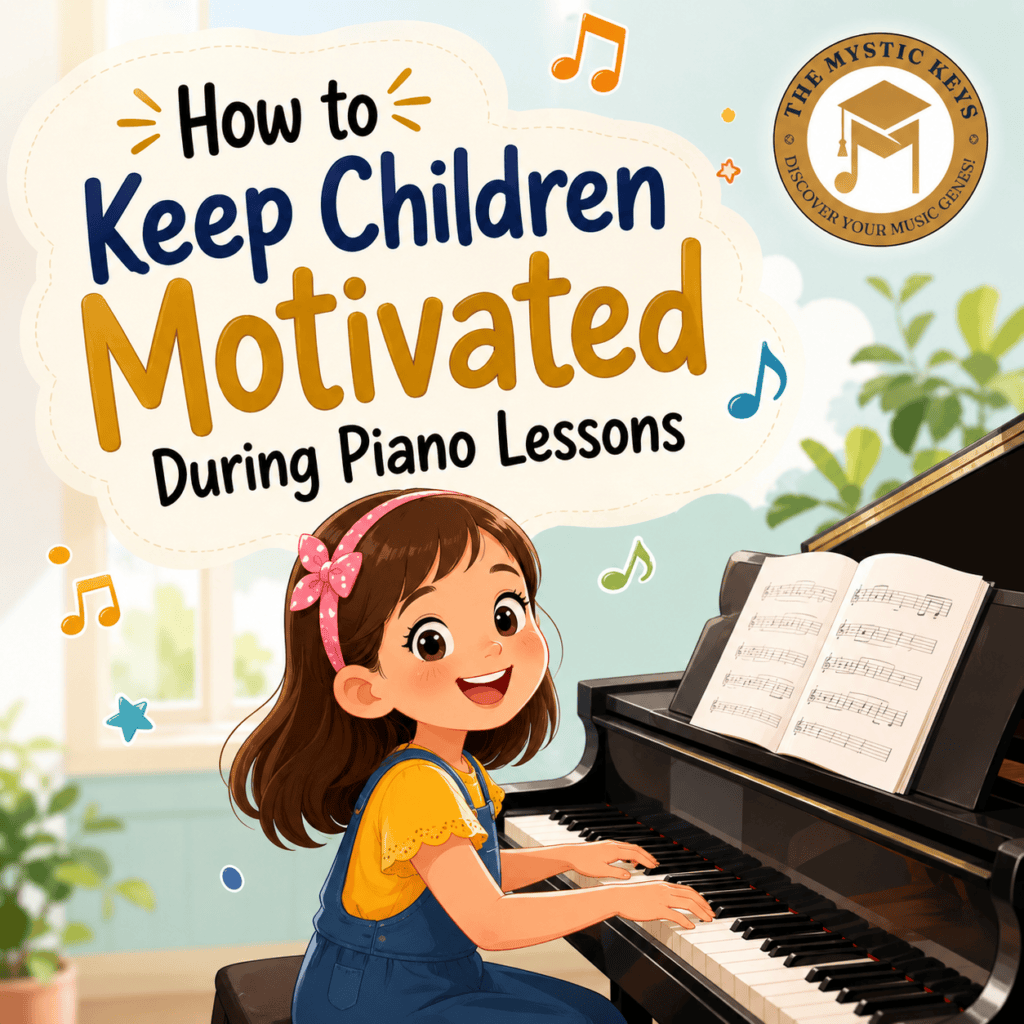
How to Keep Children Motivated During Piano Lessons
Learning the piano can be an exciting experience for children. They get to explore sounds, learn songs, develop new skills, and eventually create music on their own. However, keeping a Children Motivated During Piano Lessons can sometimes be challenging. A child may be enthusiastic when lessons begin but lose interest when practice becomes difficult or when progress feels slower than expected. Understanding how motivation works can help parents and teachers create a learning environment where children remain curious, encouraged, and excited about playing.
Children do not always approach music with the same goals as adults. An adult may be motivated by a long-term goal such as completing an examination, performing on stage, or mastering advanced repertoire. A child may simply want to learn a favorite song, play something for a parent, or experiment with the piano. These smaller sources of enjoyment are important. When children associate piano lessons with achievement, creativity, and enjoyment rather than constant pressure, they are more likely to develop a positive relationship with music.
Why Children Lose Motivation During Piano Lessons
A child losing interest does not necessarily mean they dislike the piano. Children Motivated During Piano Lessons, Motivation can decrease for many reasons. The music may be too difficult, practice may feel repetitive, or the child may not understand why they are learning a particular exercise. Sometimes children simply need a change in routine.
Difficulty Can Become Discouraging
When a piece is far beyond a child’s current ability, every practice session can feel like a struggle. Repeated mistakes may make the child believe that they are not good at piano.
Choosing music at an appropriate level can make a significant difference. Children should experience challenges, but those challenges should be achievable with effort.
Repetition Can Feel Boring
Repetition is necessary for developing musical skills, but children may not always understand its purpose.
Instead of asking a child to repeat the same passage endlessly, teachers can turn repetition into a small challenge. They might count successful attempts, change the tempo, add a rhythm variation, or turn the exercise into a musical game.
This keeps practice purposeful without making it feel monotonous.
Help Children Set Small Goals
Large musical goals can seem overwhelming to young learners.
Instead of focusing only on mastering an entire piece, break the process into smaller achievements.
A child might aim to learn four measures, play a rhythm correctly, memorize a short phrase, or perform one section without stopping.
Small Wins Build Motivation
Every completed goal gives children a sense of achievement.
These small successes show them that their effort is producing results.
Over time, several small achievements become a much larger accomplishment, and the child begins to understand that improvement happens through consistent effort.
Let Children Choose Some of Their Music
One of the easiest ways to increase motivation is to give children some control over what they learn.
A structured curriculum is important, but children should also have opportunities to choose songs they genuinely enjoy.
Connect Lessons to Their Interests
If a child loves movie music, introduce suitable arrangements from films.
If they enjoy popular songs, find beginner-friendly versions.
If they like games or cartoons, explore music connected to those interests.
The music does not have to replace technical exercises or foundational repertoire. Instead, it can provide something exciting for the child to look forward to.
Make Piano Lessons Interactive
Children generally respond well when lessons involve active participation rather than simply listening to instructions.
A teacher can incorporate rhythm games, ear-training activities, musical puzzles, improvisation, movement, and creative challenges.
Turn Learning Into Discovery
Instead of always telling children what to do, ask questions.
“What do you think this melody will sound like?”
“Can you find the highest note?”
“Can you make this section sound mysterious?”
“Can you create a rhythm for me to copy?“
These questions encourage children to think like musicians rather than simply follow instructions.
Use Praise Carefully and Meaningfully
Encouragement is essential, but praise is most useful when it focuses on specific effort or improvement to keep Children Motivated During Piano Lessons
Instead of simply saying, “You’re amazing,” identify what the child actually did well.
“You kept the rhythm steady.”
“That chord change was much smoother today.”
“You remembered the entire phrase without looking.”
Praise Progress, Not Just Talent
Constantly telling a child that they are naturally talented can unintentionally make mistakes feel threatening.
If children believe that being “talented” is the reason they succeed, they may become discouraged when something becomes difficult.
Praise effort, patience, focus, and improvement.
This helps children understand that musical ability develops through learning and practice.
Keep Practice Sessions Manageable
Children may struggle to concentrate for long periods, particularly when they are beginners.
A short, focused practice session can be much more effective than forcing a child to sit at the piano for an extended period.
Create a Simple Practice Routine
A practice session might include a few minutes of warm-up, a technical exercise, work on a current piece, and a favorite song.
The exact duration should depend on the child’s age, ability, attention span, and learning goals.
The important thing is to make practice achievable.
Create a Positive Practice Environment
The environment surrounding practice can influence motivation.
If every practice session involves criticism, arguments, or pressure, the piano can quickly become associated with negative emotions.
Encourage Without Constantly Correcting
Parents can support children by creating a regular practice opportunity and celebrating progress.
They do not necessarily need to correct every mistake.
If a teacher is providing technical instruction, parents can focus on encouragement and consistency rather than becoming another instructor at home.
Allow Children to Make Mistakes
Mistakes are unavoidable when learning music.
A child who is afraid of playing the wrong note may become hesitant and stop experimenting.
Mistakes Are Part of Musical Growth
Encourage children to continue after small mistakes.
They can learn that a wrong note does not ruin an entire performance.
This develops resilience and helps them become more comfortable playing in front of others.
Over time, children learn that mistakes are information rather than evidence that they cannot play.
Introduce Performance Gradually
Performing can be a powerful source of motivation, but too much pressure can have the opposite effect.
A child does not need to begin with a large recital.
Start With Comfortable Performances
A child might first play for a parent, then a sibling, a teacher, or a small group of friends.
As confidence develops, larger performances can become more comfortable.
The purpose should be to celebrate what the child has learned rather than create fear around mistakes.
Use Technology as a Learning Tool
Technology can sometimes make practice more engaging when used thoughtfully.
Children can record themselves, listen back to their playing, explore rhythm exercises, or use interactive learning resources.
Let Children Hear Their Progress
Recording a piece at the beginning of the month and again several weeks later can help children hear improvement that they may not notice from day to day.
This creates a tangible sense of progress.
It can also encourage children to take greater ownership of their learning.
Encourage Creativity at the Piano
Not every moment at the piano needs to involve reading from a book.
Children can benefit from opportunities to improvise and experiment.
Ask them to create a short melody using a few notes.
Let them invent a rhythm.
Ask them to play something that sounds happy, calm, dramatic, or mysterious.
Creativity Makes the Instrument Personal
When children create their own music, the piano becomes more than a place where they reproduce instructions.
It becomes a tool for self-expression.
This can strengthen their emotional connection to music and make them more interested in continuing to learn.
Connect Practice to Real Musical Experiences
Children are often more motivated when they understand how their practice connects to something meaningful.
A technical exercise may seem boring by itself, but it becomes more interesting when the child realizes that it helps them play a favorite song.
Explain Why They Are Learning Something
Teachers can briefly explain the purpose behind an exercise.
For example, a scale may help develop finger coordination.
A rhythm exercise may help the child stay steady when playing with other musicians.
Chord practice may make it easier to accompany a singer.
Understanding the purpose gives practice greater meaning.
Avoid Turning Every Lesson Into a Test
Children need opportunities to learn without feeling that every mistake is being judged.
If every lesson feels like an examination, anxiety can replace curiosity.
Give Children Room to Explore
A lesson can include structured learning and free exploration.
After working on technique or repertoire, allow the child to experiment with sounds, rhythms, or melodies.
This balance helps maintain both discipline and enjoyment.
Keep Expectations Age-Appropriate
Children develop at different rates.
Their attention span, coordination, reading ability, and ability to practice independently can vary considerably.
Don’t Compare Children
Comparing one child with another can quickly damage motivation.
One student may learn songs quickly while another develops excellent rhythm.
Another child may have strong musical memory but need more time with reading.
Every learner has different strengths.
The goal should be individual progress rather than competition.
Help Children Become Independent Musicians
As children become more experienced, they should gradually learn how to practice without constant adult supervision.
A teacher can show them how to identify difficult passages, choose appropriate tempos, and organize their practice.
Teach Them How to Solve Problems
Instead of immediately fixing every problem for a child, ask questions.
“What happened there?”
“Which hand is causing the difficulty?”
“What would make that transition easier?”
These questions encourage children to develop problem-solving skills Children Motivated During Piano Lessons
Conclusion
Keeping children motivated during piano lessons requires more than simply reminding them to practice. Children need achievable challenges, meaningful encouragement, opportunities to make choices, creative activities, and music that connects with their interests. They also need to understand that mistakes and difficult moments are normal parts of learning.
Parents and teachers play an important role in creating this environment. By focusing on progress rather than perfection, keeping practice manageable, celebrating small achievements, and gradually encouraging independence, adults can help children develop confidence without turning music into a source of pressure.
Most importantly, children should have opportunities to enjoy making music. A favorite song, a creative improvisation, a successful performance, or simply mastering a difficult passage can provide the motivation to keep going. When children associate piano learning with curiosity, achievement, and enjoyment, they are much more likely to continue developing their musical skills over time.
At The Mystic Keys, our personalized Piano Lessons Online provide children with structured, engaging instruction designed around their individual learning pace, interests, and musical goals. With guidance from experienced teachers, children can develop piano technique, rhythm, music reading, creativity, and confidence while building a positive and lasting relationship with music.
For more information and exciting resources about learning music, visit our website at The Mystic Keys. For more music content and exciting offers follow us on
Facebook, Instagram, YouTube, LinkedIn, Twitter, Pinterest, and Threads.