

Carnatic Music Notation | How Students Learn Compositions
Carnatic Music Notation | How Students Learn Compositions
Carnatic music, one of the oldest classical music traditions in the world, is deeply rooted in oral learning, disciplined practice, and a highly structured system of composition. While many assume it is passed down only by listening and imitation, the Carnatic music notation system plays a crucial supporting role in helping students understand, remember, and internalize compositions with greater clarity. Over time, this notation becomes a bridge between tradition and learning, allowing students to move from basic exposure to deeper musical expression.

Carnatic Music Notation in the Living Tradition of Learning
At the heart of Carnatic music lies the guru–shishya parampara, a tradition in which the teacher directly passes knowledge to the student. In this setup, students do not simply read music from a page; they experience it through repetition, listening, and correction. Yet, notation quietly enters this space and acts as a guiding companion rather than replacing oral teaching.
Students usually start by listening to simple exercises like sarali varisai and janta varisai, and they gradually move toward geethams and varnams. As they become more familiar with ragas and talas, notation serves as a structured memory aid. It does not replace the teacher’s guidance but reinforces it, especially when students revisit compositions on their own.

Understanding the Carnatic Notation System
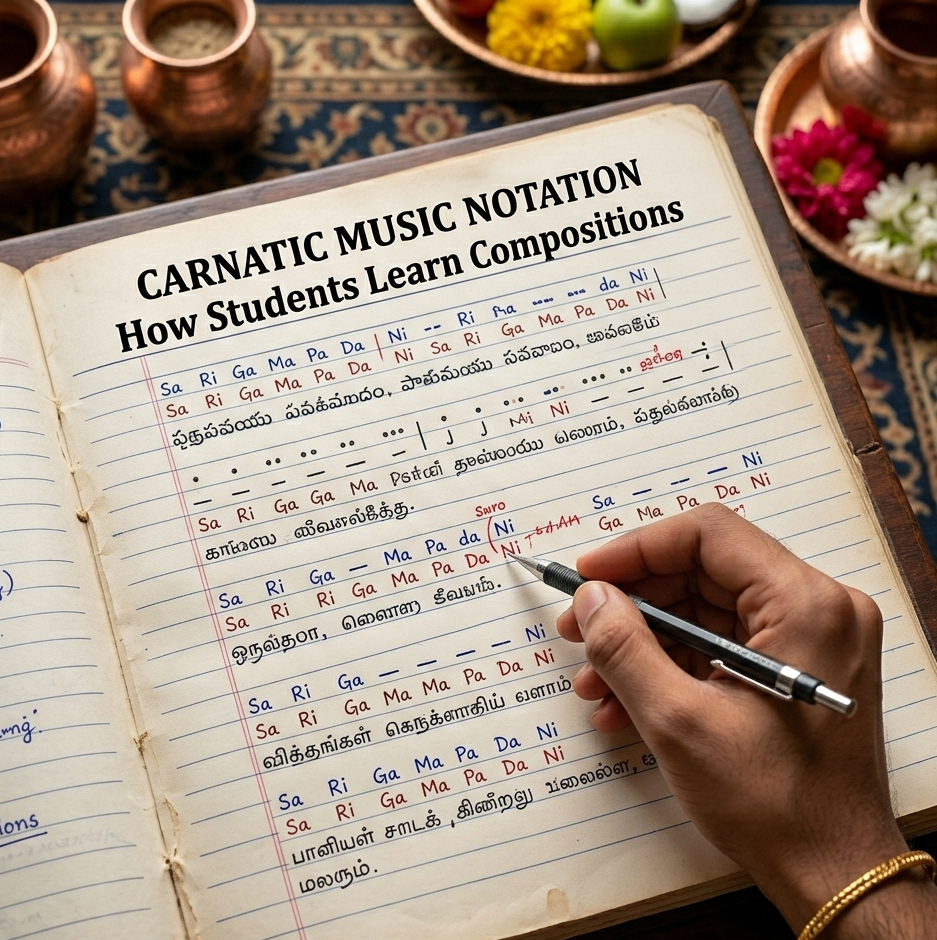
The Carnatic notation system is relatively straightforward in structure but powerful in function. It uses a combination of syllables, symbols, and rhythmic markers to represent both melody and rhythm in a compact form. Unlike Western staff notation, it does not always attempt to capture every nuance but focuses on the skeletal framework of a composition.
Swaras such as Sa, Ri, Ga, Ma, Pa, Da, and Ni form the foundation of melodic writing. These are often written in shorthand (S, R, G, M, P, D, N) and combined with symbols to indicate pitch variations like higher or lower octaves. Alongside this, rhythmic cycles (tala) are indicated using vertical bars or spacing, helping students understand timing and structure.
As learners progress, they begin to recognize that notation is less about perfection and more about orientation. It provides a map, while the teacher and listening experience fill in the emotional and stylistic details.
How Students Begin Reading Compositions
When students first encounter notated compositions, the process can feel mechanical. They often focus on decoding swaras rather than understanding musical flow. However, with consistent exposure, reading gradually becomes more intuitive.
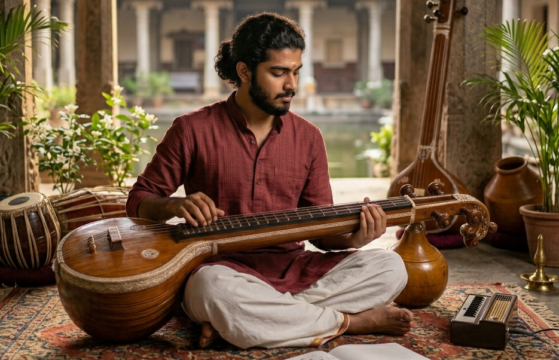
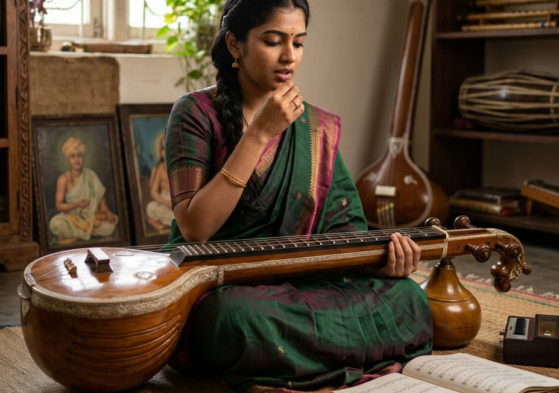
A typical learning process starts with the teacher singing a line, followed by the student repeating it while referring to notation. Over time, the student begins to associate written swaras with sound patterns, which strengthens both memory and accuracy. This combination of listening and reading slowly builds confidence.
Eventually, students stop relying on notation line-by-line and start seeing phrases as complete musical ideas. This shift is important because Carnatic music values fluidity and expression over rigid reading.

Carnatic Music Notation in Raga and Tala Understanding
Raga and tala are the two pillars that shape every Carnatic composition, and notation reflects both in subtle but meaningful ways. While swaras define melody, raga rules determine how those swaras behave within a composition.
Notation helps students see how certain phrases repeatedly follow raga grammar. For example, a raga may favor specific note sequences or avoid others, and these patterns become visible on the page. However, true understanding still comes from listening, because notation alone cannot fully express gamakas (ornamentations).
Similarly, tala is indicated through structured divisions that guide rhythm. Students learn to align syllables with beats, which strengthens their sense of timing. As practice continues, rhythm becomes internalized rather than calculated.
Moving Beyond Symbols | The Importance of Listening
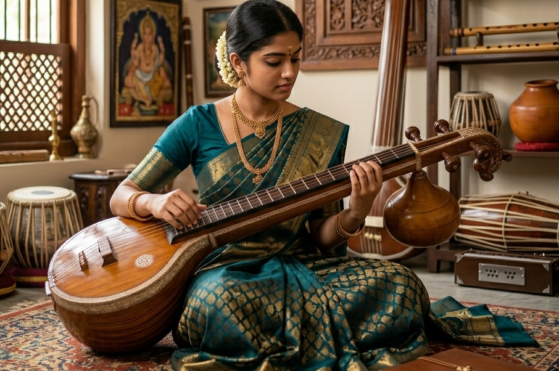
Even though notation provides structure, Carnatic music remains deeply auditory. Students are repeatedly encouraged to listen to recordings and live performances because written swaras cannot capture the emotional texture of a composition.
Gamakas, in particular, highlight this limitation. These subtle oscillations and slides between notes are central to Carnatic expression, yet they are only partially represented in notation. As a result, students learn to treat written material as a reference rather than a complete guide.
Over time, listening and notation work together. One strengthens understanding of structure, while the other develops musical sensitivity. This balance is what shapes a well-rounded performer.
Learning Compositions Through Repetition and Reflection
Repetition is an essential part of Carnatic training, and notation supports this process by providing consistency. Students often revisit the same composition multiple times, each time gaining a deeper understanding of its structure and expression.
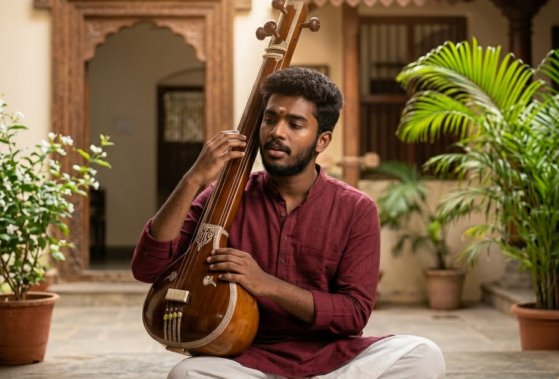
During practice, they may first rely heavily on notation, but gradually reduce dependence as familiarity grows. Teachers often encourage students to close the book and sing from memory, using notation only for correction or revision.
Reflection also plays a subtle role. As students revisit compositions, they begin noticing patterns, variations, and emotional depth that were not obvious initially. This slow unfolding is one of the most rewarding aspects of Carnatic learning.

Carnatic Music Notation in Modern and Traditional Balance
In contemporary music education, notation has become even more important due to digital learning platforms and written archives. Students now have access to compositions from different gharanas and schools, which makes notation a useful standardizing tool.
At the same time, traditional teaching methods continue to emphasize oral transmission. The two approaches do not conflict; instead, they complement each other. Notation provides accessibility, while oral teaching preserves authenticity.
This balance ensures that Carnatic music remains both rooted in tradition and open to wider learning opportunities.
Conclusion | Carnatic Music Notation as a Guide, Not a Replacement
The Carnatic music notation system ultimately serves as a guide that supports the deeper journey of musical learning. It helps students understand structure, remember compositions, and connect theory with practice. However, it never replaces the essential elements of listening, guidance, and emotional engagement. In modern learning spaces, teachers and mentors actively strengthen this balance by combining structured lessons with traditional listening practices across platforms such as Carnatic Vocal Lessons Online.
As students grow in their musical journey, they gradually move beyond symbols on a page. What remains is a living understanding of raga, rhythm, and expression—shaped equally by tradition and thoughtful learning, often guided through mentorship models like The Mystic Keys.
For more information and exciting resources about learning music, visit our website at The Mystic Keys. For more music content and exciting offers follow us on
Facebook, Instagram, YouTube, LinkedIn, Twitter, Pinterest, and Threads.