Why Some Students Learn Piano Faster Than Others
Learning piano is a personal journey, and not every student progresses at the same pace. Some learners seem to understand chords quickly, read music almost immediately, or coordinate both hands after only a few lessons. Others may need considerably more time to develop the same skills. This difference can sometimes make students wonder whether they are simply “slow” at learning piano. In reality, faster piano learning is influenced by many factors, including practice quality, consistency, previous musical experience, concentration, motivation, listening ability, teaching methods, and even the way a student approaches mistakes.
The important thing to remember is that learning quickly does not necessarily mean learning better. A student who takes longer to understand a concept may eventually develop a deeper understanding of it. Likewise, a student who progresses rapidly at the beginning may later encounter challenges when more advanced skills are introduced. Piano learning is not a race. Understanding what affects progress can, however, help students practise more effectively and make their learning experience more productive.
What Really Influences Faster Piano Learning?
There is no single reason why one student progresses faster than another. Piano playing combines several different abilities at once. A learner needs to understand rhythm, read notation, coordinate both hands, remember patterns, listen carefully, control dynamics, develop finger independence, and interpret music expressively.
A beginner who already has experience with another instrument may find some of these skills familiar. Someone who regularly listens to music may have stronger aural awareness. A student who has excellent concentration may absorb instructions quickly. Another learner may need repeated demonstrations before the same concept becomes comfortable.
This is why comparing two students purely by the number of lessons they have completed can be misleading. Their starting points, learning environments, goals, practice routines, and previous experiences may be completely different.
Faster piano learning usually happens when several helpful factors work together rather than because of one special ability.
Faster Piano Learning Starts With Effective Practice
One of the biggest differences between students is not necessarily how long they practise, but how they practise.
A student might spend an hour playing the same piece from beginning to end without paying attention to mistakes. Another student might spend thirty minutes identifying difficult passages, slowing them down, correcting fingering, practising each hand separately, and then putting the sections together.
The second approach can often produce more meaningful progress.
Effective practice requires attention. Instead of simply repeating what feels comfortable, students should identify what needs improvement. If a particular transition between chords is difficult, that transition deserves focused attention. If rhythm becomes inconsistent in one section, the student should isolate the rhythm rather than repeatedly playing the entire piece and hoping the problem disappears.
Practice becomes more productive when students ask questions such as:
- What exactly am I struggling with?
- Which section needs the most attention?
- Am I practising slowly enough?
- Is my fingering consistent?
- Am I listening to what I am playing?
- Can I play this section accurately several times in a row?
This kind of deliberate practice can make learning more efficient without requiring extremely long practice sessions.
Consistency Matters More Than Occasional Long Sessions
A student who practises regularly has more opportunities to reinforce what was taught in lessons. Even relatively short sessions can be useful when they happen consistently.
For example, practising for 20–30 minutes on several days of the week can create a stronger learning routine than practising for two hours once every week and then leaving the instrument untouched.
The brain benefits from repeated exposure. When a student revisits scales, chords, pieces, rhythms, and technical exercises regularly, previously learned information becomes more familiar.
Consistency also prevents students from spending the beginning of every lesson trying to remember what they learned previously.
For faster piano learning, the goal should not be to practise as much as possible. It should be to create a sustainable routine that allows skills to develop gradually and continuously.
Previous Musical Experience Can Make a Difference
Students do not always begin piano with the same musical background.
Someone who has previously studied violin, guitar, singing, drums, or another instrument may already understand concepts such as rhythm, pitch, musical notation, phrasing, or scales. These skills can make certain aspects of piano learning easier.
A singer, for example, may already have a strong awareness of melody and pitch. A guitarist may understand chord structures. A drummer may have a developed sense of rhythm. A student who has previously learned another keyboard instrument may already understand hand positioning and note relationships.
This does not mean beginners without musical experience are at a disadvantage. It simply means they may need to build some foundational skills that experienced musicians already possess.
Everyone starts somewhere, and previous experience is only one part of the learning process.
Listening Is an Underrated Part of Faster Piano Learning
Piano students sometimes focus so heavily on their fingers that they forget to listen.
Good pianists do not simply produce notes. They constantly hear what they are creating. They notice whether a melody is balanced, whether chords are too loud, whether the rhythm is stable, whether a phrase is expressive, and whether the sound matches their musical intention.
Developing this awareness can make practice more effective.
Students can improve their listening skills by actively listening to professional performances, comparing different interpretations, singing melodies before playing them, recording their own performances, and identifying differences between what they intended to play and what they actually played.
Listening also helps students recognise mistakes more independently. Instead of waiting for a teacher to point out every problem, students gradually learn to hear those problems themselves.
That independence is an important part of faster piano learning.
Motivation Changes the Way Students Practise
Motivation can strongly influence how a student approaches learning.
A student who genuinely wants to learn a particular song may willingly practise a difficult technique because they understand why it matters. A student who has no connection with the repertoire may struggle to remain engaged even if the material is technically appropriate.
This is one reason personal musical interests can be valuable.
Teachers can often use a mixture of structured exercises and enjoyable repertoire. Students may need scales, technical exercises, sight-reading, and theory, but they can also benefit from learning music that makes them excited to sit at the piano.
Motivation does not eliminate difficult work. Instead, it can make students more willing to work through difficulty.
Clear Goals Can Improve Learning Efficiency
Students often make faster progress when they know what they are working toward.
A vague goal such as “I want to get better at piano” does not provide much direction. A more specific goal could be:
- Learn three new chords this month.
- Play a particular song without stopping.
- Improve sight-reading.
- Memorise one section of a piece.
- Prepare for a graded examination.
- Improve left-hand coordination.
- Perform a song for family or friends.
Clear goals make practice easier to organise. They also allow students to recognise progress that might otherwise go unnoticed.
A student may feel that they are not improving because they cannot yet perform an entire piece. But if they can now play a difficult eight-bar section that was impossible two weeks ago, that is meaningful progress.
How Concentration Supports Faster Piano Learning
Piano practice requires active attention. Simply sitting at the instrument does not guarantee effective learning.
When students practise while checking their phones, watching videos, talking, or allowing their attention to wander, they may spend considerable time at the piano without absorbing much of what they are doing.
Focused practice can be surprisingly powerful.
Even a short session in which the student concentrates completely on one task can be more useful than a longer session filled with distractions. This is particularly important when learning new material because the brain needs attention to recognise patterns, remember information, and coordinate movements.
Creating a quiet practice environment, putting away unnecessary distractions, and setting a specific goal before beginning can help students make better use of their available time.
Mistakes Are Part of the Learning Process
Some students try to avoid mistakes because they believe mistakes mean they are not progressing.
In reality, mistakes can provide valuable information.
If a student repeatedly misses the same note, loses the beat at the same point, or struggles with a particular chord change, the mistake identifies something that needs attention.
The important question is not, “How can I avoid ever making mistakes?” but rather, “What is this mistake telling me?”
Students who analyse their mistakes can become more independent learners. They learn to recognise patterns in their difficulties and develop strategies for correcting them.
This mindset can support faster piano learning because practice becomes more analytical rather than simply repetitive.
Slow Practice Can Actually Make You Faster
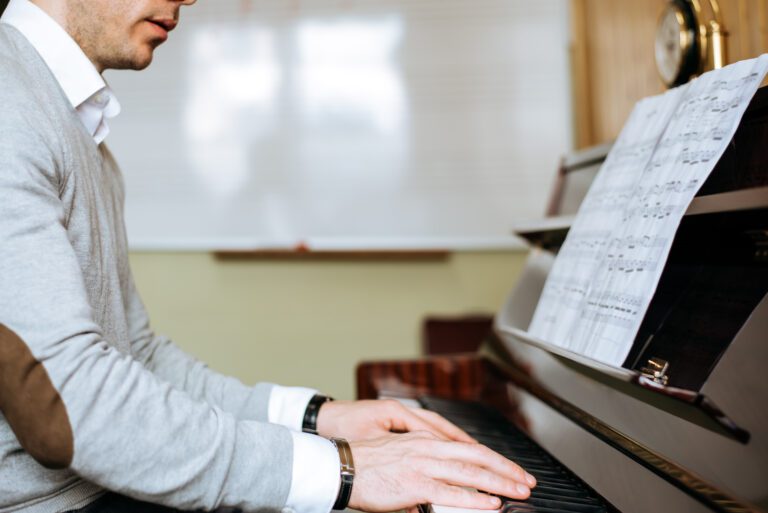
It may seem contradictory, but slowing down is often one of the most effective ways to eventually play faster.
When students repeatedly practise a difficult passage at full speed, they may reinforce errors. Their fingers become accustomed to incorrect movements, uneven rhythms, or unnecessary tension.
Slow practice gives the brain and hands time to understand exactly what is happening.
A student can check:
- Fingering
- Rhythm
- Hand position
- Articulation
- Dynamics
- Coordination
- Accuracy
Once the movement becomes reliable, the tempo can gradually increase.
Trying to rush the learning process often creates additional problems. Careful slow practice may take longer initially, but it can produce stronger results later.
The Teacher’s Role in Faster Piano Learning
A good teacher does more than demonstrate how to play notes.
A teacher observes how a student approaches the instrument, identifies difficulties, explains concepts in different ways, adjusts exercises, provides feedback, and helps establish realistic goals.
Two students may struggle with the same piece for completely different reasons. One might have difficulty reading rhythm, while another might understand the rhythm but struggle with hand coordination.
Personalised feedback allows the teacher to address the actual problem instead of giving both students exactly the same solution.
This is one reason individual instruction can be useful. The lesson can be adjusted according to the learner’s current ability, goals, strengths, and challenges.
Music Reading Can Affect Learning Progress
Students who develop comfortable music-reading skills may find it easier to approach new repertoire.
Reading music involves recognising notes, rhythms, intervals, patterns, dynamics, articulations, and other musical information. Like reading a language, it becomes easier with regular exposure.
Students should not wait until they are learning advanced pieces to develop this skill. Even a few minutes of sight-reading during regular practice can help.
Reading simple material consistently can gradually improve recognition speed and confidence.
Over time, students begin to see musical patterns rather than processing every individual note separately. This can make learning new pieces more efficient.
Understanding Patterns Makes Music Easier to Remember

Piano music contains patterns everywhere.
There are repeated chord progressions, scales, arpeggios, rhythmic structures, sequences, melodic shapes, and recurring sections. Recognising these patterns can reduce the amount of information a student feels they need to memorise individually.
For example, instead of thinking about every note in a chord separately, a student can recognise the chord as one harmonic shape.
Instead of treating every measure as completely new, students can identify repeated phrases.
This type of musical understanding can help students learn repertoire more efficiently because they are organising information rather than simply memorising isolated movements.
Confidence Can Influence How Students Approach Difficult Music
Confidence does not mean believing that everything will be easy.
Healthy confidence means believing that difficult skills can be developed through practice.
Students who become frustrated after a mistake may stop practising the difficult section. Students who understand that mistakes are normal may be more willing to slow down, repeat the passage, and try another strategy.
Confidence can therefore influence persistence.
It is also important for students not to confuse confidence with immediate success. Sometimes the most useful learning happens when a student is struggling with something that is just beyond their current ability.
The challenge is finding the balance between material that is too easy and material that is overwhelmingly difficult.
Why Comparing Students Can Be Misleading
One student may learn a song in two weeks while another needs six weeks. That does not automatically mean the first student is a better musician.
Perhaps the first student has played another instrument for years. Perhaps the second student is developing music reading from the beginning. Perhaps one has more time available for practice.
Students should therefore compare their current abilities with their own previous abilities rather than constantly measuring themselves against other learners.
Progress can appear in many forms:
- A cleaner chord change
- Better rhythm
- Improved posture
- More controlled dynamics
- Faster note recognition
- Better memory
- Greater confidence
- Improved listening
- Less tension
- More expressive playing
These improvements may not always be obvious from the outside, but they are important parts of musical development.
Faster Piano Learning Does Not Mean Rushing
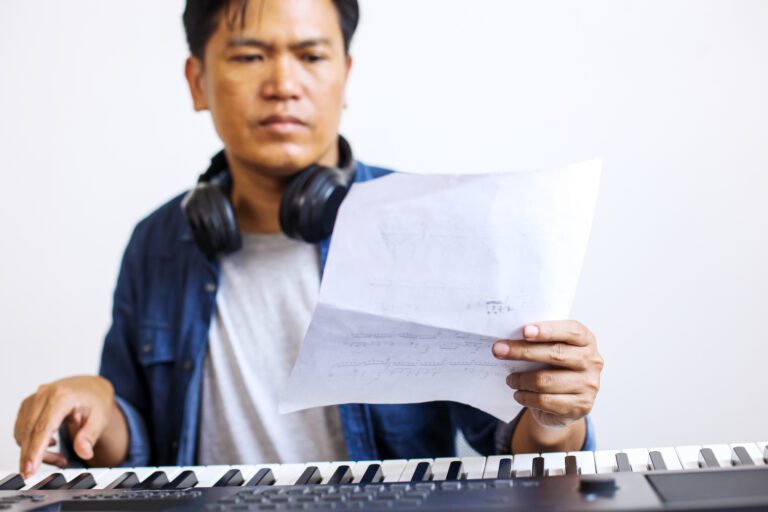
There is an important distinction between learning efficiently and rushing through material.
Rushing can create weak foundations. A student might memorise a piece quickly but struggle to explain its rhythm, harmony, structure, or technique.
Efficient learning is different. It means using practice time intelligently while still giving important skills enough time to develop.
A student should aim for secure learning rather than simply fast learning.
If a technique takes several weeks to become comfortable, that time is not necessarily wasted. The skill may later become the foundation for more advanced repertoire.
How Students Can Improve Their Own Learning Process
Students who want to make their piano learning more efficient can begin with a few practical changes.
First, establish a realistic practice schedule. Consistency matters more than occasional marathon sessions.
Second, divide practice into specific tasks. Instead of playing an entire piece repeatedly, work separately on technique, difficult passages, rhythm, memory, and musical expression.
Third, listen actively. Record yourself occasionally and evaluate your playing.
Fourth, practise slowly when necessary. Accuracy should come before speed.
Fifth, ask questions during lessons. If something is unclear, ask the teacher to demonstrate it again or explain it differently.
Sixth, track progress. Keep a practice notebook or simple record of what you worked on and what improved.
Finally, remain patient. Musical development is cumulative. Skills learned today can make tomorrow’s learning easier.
The Role of Regular Feedback
Feedback gives students information they cannot always identify themselves.
A teacher may notice unnecessary tension in the shoulders, inconsistent fingering, incorrect rhythm, poor hand position, uneven dynamics, or a misunderstanding of musical notation.
Without feedback, students can sometimes practise the same mistake repeatedly.
Regular lessons provide opportunities to correct these problems before they become deeply established habits.
For students aiming for faster piano learning, feedback should not be viewed simply as correction. It is a tool for understanding how to practise more effectively.
Learning Faster While Building Strong Foundations
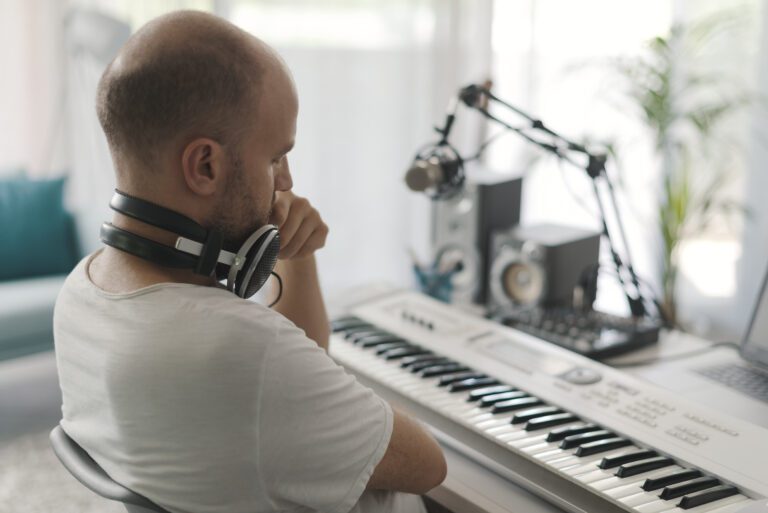
The most useful kind of progress is progress that lasts.
A student may learn a piece quickly, but the real question is whether they can apply what they learned to another piece. Can they recognise the chord progression elsewhere? Can they read a similar rhythm? Can they use the same technical movement in another context?
Transferable skills are extremely valuable.
The goal of piano education is not simply to accumulate songs. It is to develop a musician who can understand, interpret, practise, listen, and eventually learn independently.
That is why a student’s learning journey should include more than repertoire. Technique, theory, sight-reading, ear training, rhythm, musical interpretation, and performance skills all contribute to long-term development.
Every Student Has a Different Musical Timeline
There is no universal timetable for becoming a good pianist.
Some learners progress quickly in technique but slowly in sight-reading. Others read confidently but need more time to develop expressive playing. Some students memorise easily but struggle with improvisation. Others may have excellent ears but need more time to coordinate their hands.
These differences are normal.
Instead of asking, “Why am I not learning as fast as someone else?” students can ask, “What skill am I developing right now, and what can I do to improve it?”
That shift in perspective can make practice more constructive and less stressful.
Building Your Own Faster Piano Learning Routine
A practical weekly routine could include a combination of:
- Technical exercises
- Scales and chords
- Sight-reading
- Current repertoire
- Difficult passage practice
- Ear training
- Rhythm exercises
- Memorisation
- Free playing or improvisation
- Listening and self-evaluation
The exact balance can change depending on the student’s level and goals.
A beginner may spend more time learning basic coordination and reading. An intermediate student may focus more heavily on repertoire, technique, and musical interpretation. An advanced student may devote substantial time to stylistic understanding, performance preparation, improvisation, and detailed technical work.
The routine should evolve as the student develops.
Faster Piano Learning Is About Working Smarter, Not Simply Harder
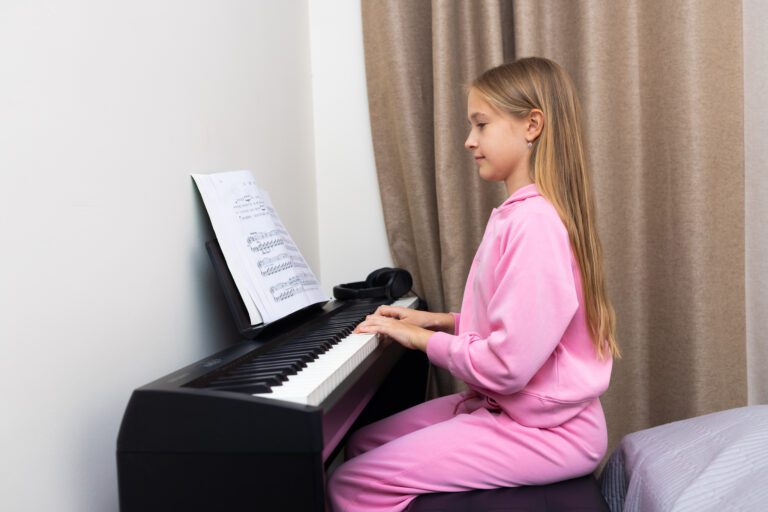
Students often assume that the fastest way to improve is to spend more hours at the piano.
Time certainly matters, but the quality of that time matters too.
Focused practice, thoughtful repetition, active listening, good technique, regular feedback, clear goals, and consistency can all contribute to more efficient progress.
Most importantly, students should remember that musical growth is not a competition. Someone else’s progress does not reduce the value of your own.
The student who takes longer to learn a piece may be developing skills that become extremely valuable later. The student who learns quickly may still need to spend significant time developing musical maturity and expression.
Every learner has strengths, challenges, and a different starting point.
Learning Piano With the Right Guidance
A structured learning environment can make the process easier by giving students clear direction and regular feedback. At The Mystic Keys, students can learn through personalised online music lessons designed around their level, goals, and musical interests. One-on-one instruction allows teachers to identify individual challenges, adjust lessons accordingly, and guide students through technique, repertoire, music reading, theory, ear training, and performance development.
With consistent practice and appropriate guidance, students can build stronger habits without feeling pressured to match someone else’s timeline.
Faster piano learning is ultimately not about rushing through lessons. It is about understanding how you learn, practising with purpose, listening carefully, staying consistent, and building skills that remain useful as your musical journey continues. With patience and the right approach, progress becomes less about how quickly you can finish a piece and more about how confidently you can become the musician you want to be.
For more information and exciting resources about learning music, visit our website at The Mystic Keys. For more music content and exciting offers follow us on
Facebook, Instagram, YouTube, LinkedIn, Twitter, Pinterest, and Threads.