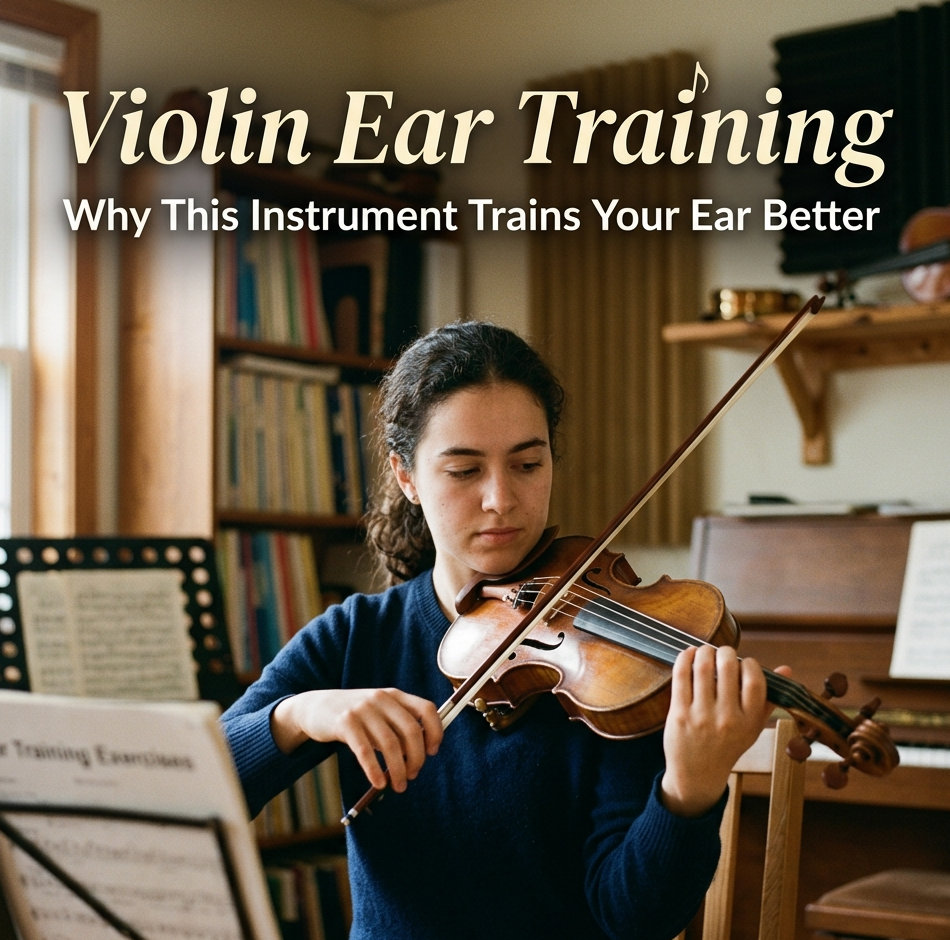
Violin ear training | Why This Instrument Trains Your Ear Better
Violin ear training begins with a unique challenge that shapes everything a musician hears and plays. The violin meets the listener right at the edge of precision and emotion, and it actively pulls the ear into constant awareness. Unlike many instruments that provide fixed reference points, it requires the player to create every note through continuous listening. This simple difference transforms how the ear develops, as the musician must actively shape pitch in real time instead of relying on predefined positions.
When someone first begins learning the violin, even the act of producing a single correct pitch becomes an exercise in attention. There are no frets or keys to guide the fingers automatically. Instead, the ear must constantly verify whether the sound matches intention, and over time this feedback loop becomes sharper, faster, and more intuitive.
This is where violin training quietly starts reshaping auditory perception. The instrument doesn’t just produce music—it teaches the brain how to hear more accurately.
Why the absence of frets sharpens auditory awareness
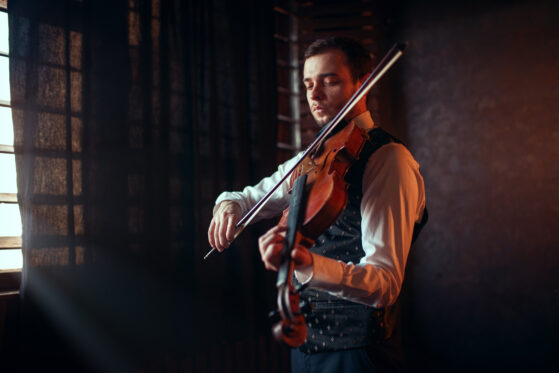
On instruments like the piano, players define pitch in a clear, physical way. They press a key, and the instrument produces a fixed note. The violin removes that certainty and places full responsibility on the player. Every millimeter of finger placement changes the pitch slightly, so the player depends on listening far more than on muscle memory alone.
At first, this challenge can feel overwhelming, but over time the ear gradually takes control. The player starts noticing subtle differences that previously went unnoticed. A slightly sharp or flat note no longer feels vague; instead, it immediately feels off and even uncomfortable.
As this sensitivity develops, something interesting begins to happen. The brain starts predicting pitch relationships more accurately even before the sound is fully produced. This predictive ability signals advanced ear training and reflects a deeper internalization of musical sound.

Violin ear training and micro-adjustments build pitch memory
One of the most powerful aspects of violin learning is the constant micro-adjustment process. Every note is evaluated, corrected, and refined in real time. Over weeks and months, this repetition builds what musicians often call pitch memory.
Rather than memorizing notes intellectually, the ear begins to recognize them instinctively. A student eventually knows when something is slightly off even before consciously analyzing it. This kind of awareness is difficult to develop through instruments that do not require continuous pitch correction.
Gradually, intervals—like the distance between two notes—start to feel familiar in a physical sense. The ear begins to associate emotional color and spatial feeling with sound distance, turning listening into something almost tactile.
Violin ear training and expressive listening through vibrato
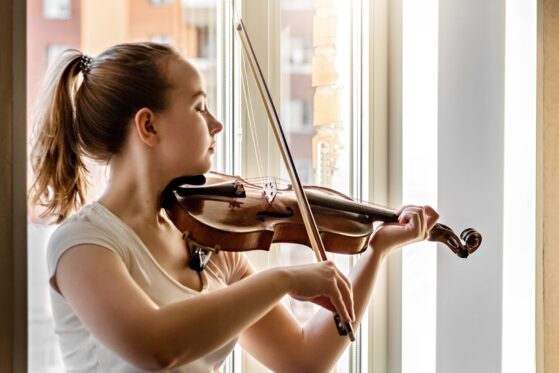
Once basic intonation becomes more stable, vibrato introduces a new layer of complexity. Unlike a static tone, vibrato continuously oscillates around a central pitch, requiring the ear to focus not just on accuracy but also on balance within motion.
Instead of locking onto a single fixed point, the listener learns to perceive a range. This strengthens relative pitch perception, making it easier to distinguish small tonal differences in other musical contexts as well.
Over time, vibrato also trains emotional listening. The ear begins to connect slight variations in pitch with expressive meaning, which deepens musical sensitivity far beyond technical accuracy.

Interval recognition through constant interaction
The violin naturally reinforces interval training because melodies are built through shifting hand positions and string crossings. Each movement creates a new relationship between notes that must be evaluated immediately.
As this continues, the ear stops treating notes as isolated sounds. Instead, it begins to recognize patterns and distances between them. A perfect fifth or a minor third gradually becomes identifiable not through calculation, but through recognition.
Interestingly, this skill transfers well beyond the violin itself. Musicians often find that they can pick out harmonies or tune instruments by ear more easily after consistent violin practice.
Violin ear training and the real-time feedback loop advantage
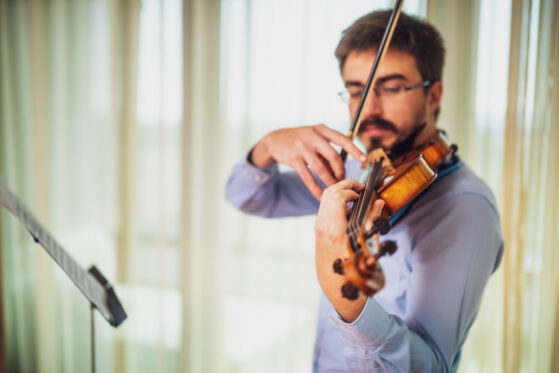
One of the most defining features of violin ear training is its real-time feedback system. Every sound produced is instantly evaluated and corrected. This creates a loop where listening, adjusting, and producing happen almost simultaneously.
Unlike many learning systems where feedback comes after the action, the violin demands immediate correction. That urgency strengthens auditory processing speed. The brain learns to respond faster, filter distractions more effectively, and prioritize pitch accuracy under continuous motion.
Over time, this responsiveness becomes automatic, shaping not just musical ability but general listening awareness.
Emotional connection strengthens auditory precision
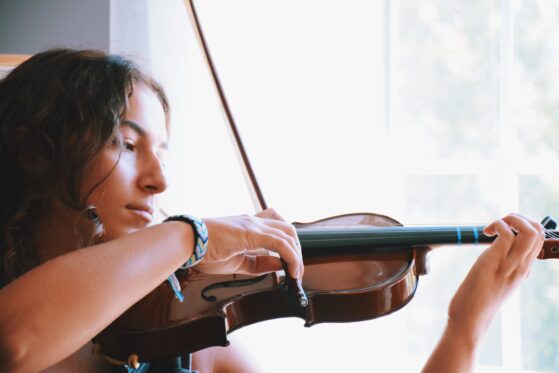
Something often overlooked in technical discussions is the emotional depth of violin sound. Because the instrument closely resembles the human voice in its expressive range, the ear naturally engages with it on a deeper level.
This emotional engagement plays an important role in ear training. When a sound feels meaningful, the brain pays closer attention to its subtle details. Slight pitch variations, tone color, and dynamics become more noticeable because they carry expressive weight.
As a result, ear training doesn’t feel mechanical. It becomes immersive, almost conversational, as if the instrument and listener are constantly communicating.

Violin ear training among instruments and its unique impact
Every instrument trains the ear in some way, but the violin demands a particularly active form of listening. There is no separation between playing and hearing—they are intertwined at every moment.
Because of this, progress on the violin often reflects directly in overall musical perception. Chords in other instruments become clearer, tuning becomes more instinctive, and even non-musical sounds may begin to feel more structured.
The combination of continuous pitch adjustment, expressive nuance, and real-time correction creates an environment where the ear is constantly evolving.
A gradual transformation in how sound is perceived
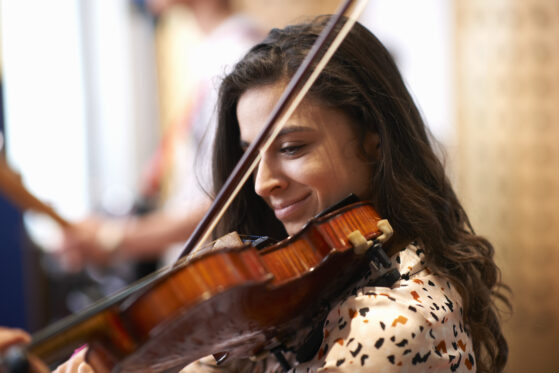
Over time, violin training does more than improve musical ability—it reshapes how sound itself is experienced. What once felt like a single tone begins to reveal layers. Pitch, texture, and emotional tone start separating in perception.
This transformation does not happen suddenly. It builds quietly through repetition, correction, and attentive listening. One day, a student simply realizes that they are hearing things they never noticed before.
That moment marks the true impact of violin ear training: not just playing in tune, but hearing the world with greater clarity and depth. Structured learning environments such as The Mystic Keys and their Violin Lessons Online programs often help accelerate this journey, offering guided practice that sharpens listening skills while steadily developing musical sensitivity over time.
For more information and exciting resources about learning music, visit our website at The Mystic Keys. For more music content and exciting offers follow us on
Facebook, Instagram, YouTube, LinkedIn, Twitter, Pinterest, and Threads.