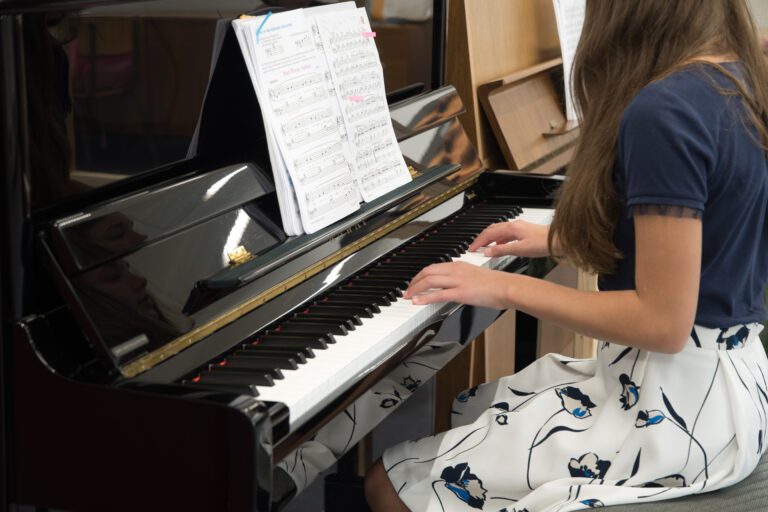
Understanding the Trinity College London piano exam
Before preparing for Trinity piano exams, understand which assessment format you intend to take. Trinity College London offers graded piano examinations with repertoire choices, technical work, and different assessment options. Its piano syllabus includes music from classical traditions, jazz, popular music, stage and screen, and other styles.
Students can generally choose between face-to-face exams and digital performance exams, subject to the available options and current syllabus rules. Digital exams may be particularly convenient for students who prefer to record their performance in a familiar setting.
The assessment requirements differ by format. Face-to-face Classical and Jazz graded exams include supporting tests, while Digital Performance Grades do not include supporting tests. Digital candidates can also choose between a Technical Work pathway and a Repertoire-only pathway, where available.
For this reason, do not prepare from an old video, an outdated workbook, or a general piano exam checklist alone. Start with the official syllabus for your instrument, grade, and chosen exam format.
Trinity College London Piano Exams: What to Expect from Grades 1–5
Each grade develops a different combination of technique, musical understanding, and performance ability. The following guide describes practical preparation priorities rather than replacing the official requirements for each grade.
Grade 1: Build a strong foundation
Grade 1 is about developing reliable basic technique and learning to perform short pieces with confidence. Focus on correct posture, relaxed hands, accurate notes, a steady pulse, and simple musical expression.
Practise reading the score rather than relying entirely on memory. Learn the rhythm and fingering carefully, and make sure you can begin each piece confidently without needing repeated prompts.
Grade 2: Improve coordination and control
At Grade 2, aim to make your playing more consistent. Practise coordinating both hands, maintaining an even rhythm, observing dynamics, and managing changes in articulation.
Pay attention to the musical character of each piece. A lively selection should sound energetic without becoming rushed, while a gentle piece should retain a steady pulse and controlled tone.
Grade 3: Develop musical independence
Grade 3 preparation should strengthen your ability to manage more demanding passages without losing musical flow. Work on fingering choices, hand balance, phrasing, dynamic contrast, and smooth transitions between sections.
Begin to listen critically to your own playing. Notice whether the melody is clear, whether accompaniment parts are too loud, and whether the tempo remains stable throughout the piece.
Grade 4: Refine expression and technique
At Grade 4, more detailed musical decisions become important. Practise controlling tone, shaping phrases, observing articulation, and keeping difficult passages rhythmically secure.
Divide technically demanding sections into smaller units. Work slowly, identify the exact movement causing difficulty, and gradually restore the intended tempo without sacrificing accuracy.
Grade 5: Prepare with greater musical maturity
Grade 5 is an opportunity to demonstrate more developed control, fluency, and interpretation. You should be able to maintain the musical structure of a piece while managing more challenging technical passages.
Give particular attention to consistency from beginning to end, accurate articulation, dynamic detail, and the relationship between melody and accompaniment. Practise complete performances regularly so that you can maintain concentration under exam conditions.
The precise repertoire, technical exercises, and other assessment requirements depend on the current syllabus and your chosen pathway. Review the official Trinity piano grade and repertoire information before finalising your preparation.

How to Prepare for Trinity College London Piano Exams
Your repertoire is an important part of your preparation. The aim is not simply to memorise the notes but to present a musically convincing performance that demonstrates control and understanding.
Choose pieces that suit your strengths
Read through the available repertoire before making your selection. Consider the technical demands, musical character, rhythm, fingering, and the amount of practice each piece will require.
Choose pieces that challenge you without overwhelming your current ability. A piece that sounds impressive but remains unreliable may be a less suitable choice than one you can perform accurately and expressively.
Trinity’s piano repertoire lists include a range of musical styles, allowing candidates to explore different sounds and characters. Check that each selected piece is permitted under the current syllabus and pathway.
Practise difficult sections separately
Avoid repeatedly playing a piece from beginning to end while ignoring the sections that cause problems. Instead, identify the difficult bars and practise them in short groups.
Try this sequence:
Play the passage slowly enough to maintain accuracy.
Check the notes, fingering, rhythm, and hand coordination.
Repeat the passage until it feels controlled.
Gradually increase the tempo.
Connect the passage to the bars immediately before and after it.
Return to the entire piece once the difficult section becomes more reliable. This helps you improve efficiently while maintaining the overall musical flow.
Develop musical expression
Correct notes are essential, but expressive playing requires attention to dynamics, articulation, phrasing, tempo, and tone quality.
Ask your teacher to help you identify the main musical phrases and understand how the piece should sound. Notice where the music builds in intensity, where a phrase comes to rest, and which voice or melody should stand out.
Listen to your performance critically. A recording can reveal rushed passages, uneven rhythm, unclear articulation, or dynamic differences that may be difficult to notice while playing.
Practise performing without stopping
During practice, it is tempting to stop immediately whenever a mistake occurs. This can help when correcting a passage, but it does not fully prepare you for a complete performance.
Once a piece is reasonably secure, practise playing from beginning to end without restarting. If you make a small mistake, learn to recover and continue in time.
This approach builds concentration and teaches you how to respond calmly when something unexpected happens during an examination.
Technical Work for Trinity College London Piano Exams
Technical preparation is another important area of Trinity piano exams where applicable. The exact technical requirements must be taken from the syllabus for your grade and assessment pathway. Trinity provides official technical-work resources for piano students, including grade-specific exercises.
Practise slowly before increasing speed
When learning a scale or exercise, begin at a tempo that allows you to play every note accurately. Focus on evenness, appropriate fingering, relaxed movement, and a consistent tone.
Do not increase the speed simply because you can complete the exercise once. Repeat it until the movement feels comfortable and the notes remain clear.
Keep your hands relaxed
Unnecessary tension can affect speed, control, and endurance. Sit comfortably, keep your shoulders relaxed, and avoid excessive pressure in your wrists and fingers.
If a passage repeatedly feels uncomfortable, ask your teacher to check your posture and technique. Do not force a movement that causes pain.
Use a metronome when appropriate
A metronome can help you develop a stable pulse and recognise uneven passages. Start slowly and increase the tempo in manageable steps.
Use it as a practice aid rather than a substitute for listening. You still need to understand phrasing and musical character, even when playing at a steady tempo.
Supporting tests and musical knowledge
Candidates taking face-to-face Classical and Jazz piano graded exams should prepare for the supporting tests required by their chosen grade. These can include aural work, sight-reading, improvisation, and musical knowledge. The precise requirements and available choices should be checked in the relevant syllabus. Digital Performance Grades do not include these supporting tests.
Aural skills
Aural preparation develops your ability to listen, recognise musical details, and respond to what you hear. Work on recognising differences in pitch, rhythm, dynamics, and musical character as required by your grade.
Practise listening carefully before answering. If you are asked to identify a musical feature, focus on the sound rather than guessing based on what seems familiar.
Sight-reading
Sight-reading requires you to look at unfamiliar music and perform it as accurately as possible with limited preparation.
To improve, practise short examples regularly. Before playing, take time to notice the key signature, time signature, rhythm, hand positions, and any changes in dynamics or articulation.
Begin at a manageable level and aim for continuity rather than perfection. Avoid stopping every time you make a mistake, because maintaining the pulse is an important part of developing sight-reading confidence.
Improvisation
Improvisation gives you the opportunity to create music using a musical stimulus or framework. Your preparation should match the tasks and requirements of your grade.
Start with simple rhythmic patterns, short melodic phrases, and familiar musical structures. Learn to listen to what you play and create ideas that have a clear beginning and ending.
You do not need to create complicated music to demonstrate musical understanding. A coherent, rhythmically controlled response is a better starting point than a complicated idea that you cannot manage confidently.
Musical knowledge
For grades where musical knowledge is assessed, learn to describe relevant features of your repertoire. These may include musical terms, notation, rhythm, structure, and other concepts specified in the syllabus.
Practise explaining what you notice in your pieces. Understanding the music helps you make more informed interpretive decisions and can strengthen your overall musicianship.
Trinity provides official piano support resources with examples and learning materials to help candidates and teachers prepare.
Supporting Tests in Trinity College London Piano Exams
Trinity offers different exam formats, and the best option depends on your needs, confidence, and assessment preferences.
Feature | Face-to-face exam | Digital performance exam |
|---|---|---|
Assessment | Live examination | Submitted video performance |
Repertoire | Prepare the pieces required by the relevant syllabus | Choose the applicable technical or repertoire pathway |
Supporting tests | Included for Classical and Jazz graded exams | Not included |
Preparation priority | Performance, technical work, and required supporting tests | Recording a complete performance that meets the chosen pathway’s requirements |
Practical consideration | Attend the booked venue and follow its instructions | Follow the current filming, recording, and submission guidance |
The digital format may appeal to students who prefer recording at home, while face-to-face assessment provides the experience of performing in a live examination setting. Trinity states that Digital Performance Grades carry the same qualification and award as their face-to-face counterparts.
Before choosing, read the official instructions carefully. A digital exam is not simply a video of your favourite pieces: the selected pathway determines what must be included, and the recording must comply with Trinity’s submission requirements.
Choosing the Right Trinity College London Piano Exam Format
The final month before an exam is a useful time to identify weaknesses and make your preparation more consistent. Adjust the plan according to your grade, current progress, and teacher’s recommendations.
Week 1
Identify weaknesses
Play through your repertoire, review technical work, and identify the sections that need the most attention. Check the syllabus so you know that all required components are covered.
Week 2
Strengthen technique
Focus on difficult passages, fingering, rhythm, accuracy, and expression. Continue practising the required technical exercises and supporting tests, if applicable.
Week 3
Simulate the exam
Perform your pieces in sequence without unnecessary stops. Practise the other exam components under realistic conditions and review any mistakes afterwards.
Week 4
Polish and prepare
Maintain your established tempo, refine musical details, and practise confidently without overworking your hands. For digital exams, confirm the recording setup and submission requirements well in advance.
If you have more than four weeks, use the additional time to develop technique and musical understanding instead of rushing through the repertoire. If the exam is close and several pieces remain unreliable, discuss the timing with your teacher rather than assuming that more hours of practice will automatically solve the problem.
A Four-Week Plan for Trinity College London Piano Exams
Even students who practise regularly can lose confidence when their preparation is not balanced. Avoid these common habits:
Memorising without understanding the music: learn to read and interpret the score, even when you also memorise your pieces.
Ignoring technical work: check the syllabus and allocate time to every required component.
Practising only favourite sections: spend more time on weaknesses, while continuing to maintain your strongest passages.
Playing too quickly too soon: build accuracy and control before working towards the target tempo.
Leaving digital recording until the last minute: practise with the required camera setup and review the official recording instructions.
Comparing your progress with other students: focus on your own development, the syllabus, and feedback from your teacher.
A balanced preparation routine is usually more effective than practising one part of the exam intensively while leaving the others until the final week.
How piano lessons online can support exam preparation
A teacher can help you identify technical weaknesses, choose appropriate repertoire, interpret musical markings, and prepare for the requirements of your grade. Regular feedback also helps you avoid repeating mistakes that may become difficult to correct later.
Online lessons can support this process when the teacher can hear your playing clearly, observe your hands, and demonstrate techniques effectively. Students should ensure that their camera and instrument are positioned so the teacher can give useful feedback.
At The Mystic Keys, students can explore structured piano tuition with one-on-one online lessons and guidance tailored to their learning level. Learners preparing for Trinity examinations can enquire about repertoire selection, technical work, supporting-test preparation, and an appropriate practice schedule.
Explore Piano Lessons Online to learn more about the available courses and discuss your goals with the teaching team.
Conclusion: Pass Trinity piano exams with confidence
Success in Trinity piano exams comes from consistent preparation, careful attention to the syllabus, and a balanced approach to performance and musicianship. From Grade 1 through Grade 5, students should focus on accurate playing, secure technique, musical expression, and the additional assessment components required by their chosen exam format.
Start by reviewing the official syllabus, selecting suitable repertoire, and creating a realistic practice plan. Work on difficult passages slowly, practise performing without stopping, and seek feedback from a teacher who understands the examination requirements.
Most importantly, remember that an examination is an opportunity to demonstrate your progress, not simply a test of perfection. With thoughtful preparation and regular practice, you can approach your next grade with greater confidence while developing skills that will continue to benefit your piano playing long after the exam.
For more information and exciting resources about learning music, visit our website at The Mystic Keys. For more music content and exciting offers follow us on
Facebook, Instagram, YouTube, LinkedIn, Twitter, Pinterest, and Threads.