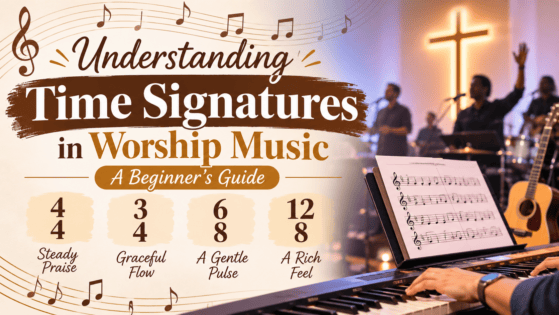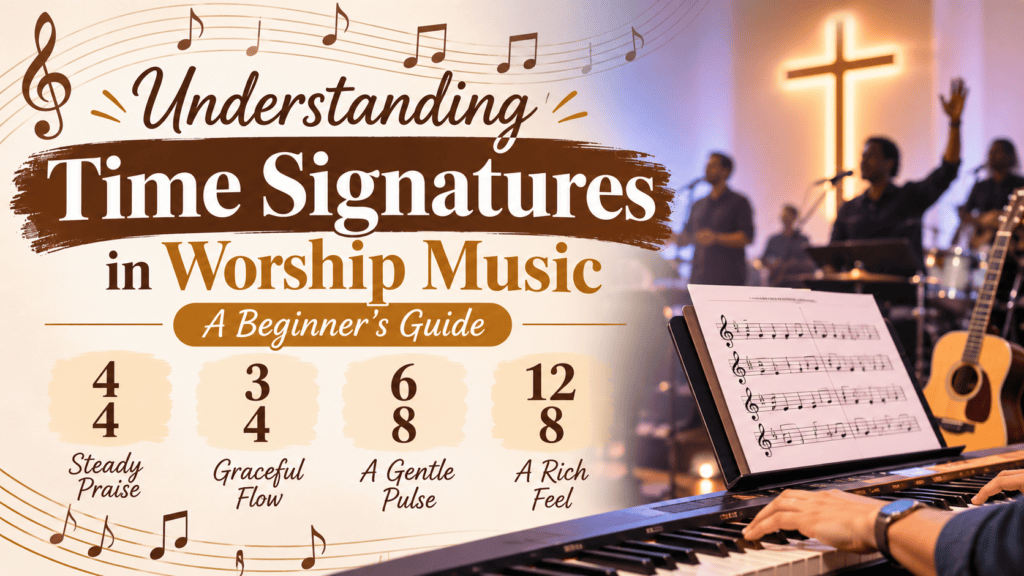
Understanding Time Signatures in Worship Music
introduction
Worship music brings people together through meaningful lyrics, powerful melodies, and rhythms that support congregational singing. To play worship songs confidently, musicians need to understand how beats are organised and how musical patterns guide the flow of a song. Understanding time signatures in worship music helps singers, pianists, guitarists, drummers, and worship leaders stay in time, coordinate transitions, and create a smooth musical experience for the congregation.
Whether you play piano, guitar, drums, or sing in a worship team, learning time signatures can make rehearsals more productive and live performances more confident. From the steady pulse of 4/4 worship songs to the flowing feel of 6/8 ballads, each time signature creates a different rhythmic character.
In this guide, we explain what time signatures mean, explore the most common time signatures in worship music, and share practical ways to recognise and practise them.
What Are Time Signatures in Worship Music?
A time signature is a musical symbol written at the beginning of a piece of music that indicates how beats are grouped into measures, also called bars.
It usually appears as two numbers written one above the other. Each number provides information about the rhythmic structure of the music.
For example, in a time signature of 4/4:
The top number indicates that each measure contains four beats.
The bottom number indicates which note value represents one beat. In this case, the quarter note receives one beat.
Time signatures help musicians understand how to count a song, where measures begin and end, and how to organise rhythms during a performance.
In worship music, understanding time signatures is especially useful because songs may move between quiet verses, powerful choruses, instrumental sections, and spontaneous moments of worship.
Why Understanding Time Signatures in Worship Music Matters
A worship team usually includes several musicians and singers performing together. Everyone needs to understand the rhythmic structure to keep the music coordinated.
Learning time signatures offers several practical benefits.
1. Stay in Time With the Worship Team
When every musician understands the beat, the team can maintain a steady rhythm. This is particularly important when the drummer, pianist, guitarist, and singers need to coordinate entrances and transitions.
2. Improve Song Transitions
Worship sets often include multiple songs connected through instrumental passages or sustained chords. Recognising the time signature helps musicians prepare for changes in rhythmic feel and avoid confusing transitions.
3. Support Congregational Singing
A clear, consistent beat helps the congregation follow the melody and sing comfortably. Musicians who understand the time signature can support the natural phrasing of the lyrics without rushing or dragging the tempo.
4. Make Rehearsals More Efficient
Instead of repeatedly guessing the rhythm, musicians can count measures, identify strong beats, and practise difficult sections accurately.
5. Improve Musical Confidence
Understanding the rhythmic structure makes it easier to learn unfamiliar worship songs, follow chord charts, and respond to a worship leader’s direction.
1. Understanding 4/4 Time in Worship Music
<text>4/4 time is one of the most common time signatures in contemporary worship music. It is often called common time and provides a steady, familiar rhythmic foundation for many worship songs.</text>
In 4/4 time, each measure contains four quarter-note beats.
Count it like this:
1 – 2 – 3 – 4 | 1 – 2 – 3 – 4
The first beat often feels strongest, although the emphasis depends on the song’s arrangement and rhythmic style.
How 4/4 Time Sounds in Worship
Four-beat patterns can create a steady, accessible feel that works well for congregational singing. They are common in contemporary praise songs, worship anthems, and many guitar-driven arrangements.
How to Play 4/4 on Piano
A pianist can begin by playing one chord on each beat or sustaining a chord for a full measure. As confidence grows, the player can add broken chords, rhythmic patterns, and passing notes while maintaining the underlying four-beat pulse.
How to Play 4/4 on Guitar
Guitarists can start by strumming four downstrokes per measure, one on each beat. A simple pattern is:
Down – Down – Down – Down
Once the beat feels comfortable, experiment with down-up strumming patterns and accents that suit the song.
How to Play 4/4 on Drums
Drummers often begin with a basic pattern that places the kick drum on beats 1 and 3 and the snare on beats 2 and 4, with hi-hat subdivisions keeping the pulse moving. The exact pattern depends on the song and arrangement.
2. Understanding 3/4 Time in Worship Music
3/4 time contains three quarter-note beats in each measure. It often creates a flowing, circular feel associated with waltzes and certain reflective or hymn-like arrangements.
Count it like this:
1 – 2 – 3 | 1 – 2 – 3
The first beat commonly receives the main emphasis.
How 3/4 Time Sounds in Worship
Three-beat music can feel gentle, graceful, or reflective. Its rhythmic movement differs from the four-beat patterns that many contemporary worship musicians encounter most frequently.
How to Practise 3/4 Time
Start by counting aloud while clapping the first beat of every measure. Then play a simple chord progression, changing chords at the beginning of each measure.
Guitarists can practise three steady downstrokes per bar, while pianists can play a bass note on beat one followed by lighter chord notes on beats two and three.
Drummers can establish a clear three-beat pulse before adding fills or more complex patterns.
The key is to avoid accidentally adding a fourth beat because you are accustomed to 4/4 time.
3. Understanding 6/8 Time in Worship Music
6/8 time is another important time signature in worship music, especially for songs with a flowing, swaying, or lilting feel.
In 6/8 time, each measure contains six eighth-note beats. However, the beats are commonly felt in two larger groups of three.
Count the subdivisions like this:
1 – 2 – 3 – 4 – 5 – 6
Feel the larger pulse as:
ONE – two – three – FOUR – five – six
This grouping creates two main pulses per measure rather than six equally strong beats.
How 6/8 Time Sounds in Worship
Six-eight time can give a worship song a gentle, rolling motion. It often suits reflective ballads and arrangements that benefit from a flowing rhythmic feel.
How to Play 6/8 on Piano
Try playing a bass note on counts 1 and 4, with chord notes or broken-chord patterns filling the remaining subdivisions. This helps emphasise the two main pulses.
How to Play 6/8 on Guitar
Start by strumming two groups of three eighth notes per measure. You can accent the first and fourth subdivisions to maintain the underlying pulse.
A simple counting pattern is:
DOWN – up – up | DOWN – up – up
How to Play 6/8 on Drums
Drummers can establish the two main pulses with a steady kick and snare or other suitable percussion pattern. The specific placement depends on the song’s arrangement and intended feel.
Avoid Confusing 6/8 With 3/4
Both time signatures involve groupings of three, but they are not interchangeable.
3/4: Usually feels like three main beats per measure.
6/8: Usually feels like two main beats, each divided into three eighth notes.
Listening for the larger pulse helps musicians identify the difference.
4. Understanding 2/4 Time in Worship Music
2/4 time contains two quarter-note beats in each measure. It often produces a direct, compact rhythmic feel.
Count it like this:
1 – 2 | 1 – 2
Although 2/4 may be less prominent than 4/4 in many contemporary worship arrangements, it is useful to understand when learning different hymns, traditional songs, and rhythmic styles.
How to Practise 2/4 Time
Begin by clapping two steady beats per measure. Play a chord on each beat, then experiment with a bass note on beat one and a lighter chord on beat two.
For drummers, establish a clear two-beat pattern that supports the melody without making the song feel rushed.
Remember that the tempo and phrasing determine the musical character. Two beats per bar do not automatically mean the song should be played quickly.
5. Understanding 12/8 Time in Worship Music
12/8 time contains twelve eighth-note subdivisions per measure. These are commonly grouped into four larger beats, with each beat divided into three.
Count the subdivisions like this:
1 – 2 – 3 – 4 – 5 – 6 – 7 – 8 – 9 – 10 – 11 – 12
Feel the main pulses as:
ONE – two – three, TWO – two – three, THREE – two – three, FOUR – two – three
This creates a compound quadruple feel, which can sound broad, rolling, or deeply expressive.
How 12/8 Time Works in Worship Music
Twelve-eight can suit songs with a flowing, triplet-based rhythm. Musicians should listen for four main pulses rather than counting all twelve subdivisions as equally strong beats.
How to Practise 12/8 Time
Start slowly and tap four main beats per measure. Then divide each beat into three evenly spaced notes.
Pianists can practise broken-chord patterns, guitarists can use gentle compound-meter strumming, and drummers can maintain the four-pulse foundation while adding suitable subdivisions.
How to Identify Time Signatures in Worship Songs
You do not always need to read sheet music to begin recognising time signatures. Listening carefully to the rhythmic pattern can help you identify how the beats are grouped.
Step 1: Find the Main Pulse
Listen to the song and tap your foot to the beat. Try to identify the pulse that feels natural rather than tapping every individual drum hit or guitar strum.
Step 2: Count Repeated Groups of Beats
Count along with the music and notice where the pattern seems to restart.
If you repeatedly count four main beats before the pattern begins again, the song may be in 4/4. If you feel three main beats, it may be in 3/4.
For compound meters such as 6/8, listen for two main pulses, each divided into three smaller parts.
Step 3: Listen to the Drums and Bass
The kick drum, bass line, and other rhythmic instruments often make the underlying pulse easier to hear.
However, do not rely on one instrument alone. A drum fill or syncopated bass line can temporarily make the rhythm feel different without changing the time signature.
Step 4: Check the Chord Chart or Sheet Music
If the music notation is available, look at the beginning of the piece for the time signature. Chord charts may not always display it, so you may need to consult a full score or an authorised arrangement.
Step 5: Practise Counting While Playing
Once you have identified the likely time signature, count aloud while playing simple chords. If the counting fits naturally across repeated measures, you are developing a stronger understanding of the song’s rhythmic structure.
Common Mistakes When Learning Time Signatures in Worship Music
Understanding time signatures becomes easier when you recognise the mistakes that can interfere with your progress.
1. Counting Every Song in 4/4
Because 4/4 is familiar to many musicians, they may automatically count every song in four beats. This can make it difficult to learn songs in 3/4, 6/8, or 12/8.
How to improve: Practise examples in different meters and listen carefully for the main pulse.
2. Confusing Tempo With Time Signature
Tempo describes how fast or slow the beats occur. A time signature describes how beats are grouped into measures.
A song in 4/4 can be slow, moderate, or fast. Likewise, a song in 6/8 can be played at different speeds.
How to improve: Separate the question “How fast is the beat?” from “How are the beats grouped?”
3. Counting 6/8 as Six Equal Main Beats
In many 6/8 songs, musicians feel two larger pulses rather than six equally strong beats.
How to improve: Count all six subdivisions, but emphasise counts 1 and 4 to feel the two main groups.
4. Ignoring the Conductor or Worship Leader
Even when the time signature is understood, musicians can lose coordination if they ignore cues, transitions, or changes in the arrangement.
How to improve: Watch the conductor or worship leader, listen to the other musicians, and agree on transitions during rehearsal.
5. Adding Too Many Rhythmic Variations Too Early
Complicated strumming, drum fills, and piano patterns can make it harder to maintain a steady pulse while learning an unfamiliar meter.
How to improve: Begin with a simple pattern, count consistently, and add musical variations only after the rhythm feels secure.
Practical Exercises to Master Time Signatures in Worship Music
The best way to understand time signatures is to practise them regularly with simple exercises.
Exercise 1: Clap Different Time Signatures
Set a comfortable tempo and clap while counting:
4/4: 1 – 2 – 3 – 4
3/4: 1 – 2 – 3
2/4: 1 – 2
6/8: 1 – 2 – 3 – 4 – 5 – 6, emphasising 1 and 4.
12/8: Count twelve subdivisions, grouped into four sets of three.
Repeat each pattern until you can maintain the pulse without stopping.
Exercise 2: Play One Chord Per Measure
Choose a simple chord progression and play one chord at the beginning of each measure.
For 4/4, count four beats before changing chords. For 3/4, count three. For 6/8, feel the two larger pulses before beginning the next measure.
This exercise helps you understand how the same chord progression can feel different in different meters.
Exercise 3: Practise With a Metronome
Use a metronome to maintain a steady pulse. Begin slowly and focus on counting accurately rather than playing quickly.
For compound meters, make sure you understand whether the metronome click represents the main pulse or a smaller subdivision.
Exercise 4: Practise With Your Instrument
Piano: Play simple bass notes and chords while counting aloud.
Guitar: Use steady downstrokes before adding more complex strumming patterns.
Drums: Establish the main pulse with a simple kick, snare, or cymbal pattern.
Vocals: Sing a familiar melody while clapping or tapping the underlying beat.
Practising with your own instrument helps you apply time signatures in a realistic worship setting.
How Understanding Time Signatures Improves Worship Team Coordination
When every musician understands the rhythmic structure, the worship team can play with greater unity and confidence.
A pianist can support the rhythm without overcrowding the arrangement. A guitarist can choose strumming patterns that match the song’s feel. A drummer can maintain the pulse while responding to dynamic changes, and vocalists can phrase lyrics naturally.
Understanding time signatures also helps during transitions between songs. If the team knows how a song is counted, it becomes easier to plan introductions, endings, instrumental passages, and changes in energy.
Ultimately, musical knowledge should support the purpose of worship rather than distract from it. Clear counting, careful listening, and thoughtful arrangements help create a musical environment in which the congregation can participate comfortably.

How The Mystic Keys Can Help You Learn Worship Music
Learning to play worship music confidently involves more than memorising chords. Musicians benefit from understanding rhythm, timing, harmony, and how their instrument supports the entire arrangement.
At The Mystic Keys, students can develop their musical abilities through personalised lessons with internationally certified teachers. Whether you want to learn worship piano, improve your guitar playing, develop your vocal skills, or understand rhythm and time signatures more clearly, structured music lessons can help you build a strong foundation.
With regular practice and the right guidance, you can become more confident during rehearsals and contribute more effectively to a worship team.
The Mystic Keys supports musical growth through personalised online training, including Worship Piano & Singing Lessons Online, helping learners develop their skills, confidence, and musical expression.
Conclusion
Understanding time signatures in worship music helps musicians recognise rhythmic patterns, maintain a steady beat, and work together more effectively. From the familiar four beats of 4/4 to the flowing feel of 6/8 and 12/8, each time signature contributes a different character to a song.
Start by learning to count the beats, listen for the main pulse, and practise simple patterns with your instrument. As your understanding improves, you will find it easier to learn worship songs, follow musical transitions, and support your team with greater confidence.
Remember that rhythm is not just about counting. It is about listening, responding, and creating a musical foundation that allows everyone to worship together.
For more information and exciting resources about learning music, visit our website at The Mystic Keys. For more music content and exciting offers follow us on
Facebook, Instagram, YouTube, LinkedIn, Twitter, Pinterest, and Threads,