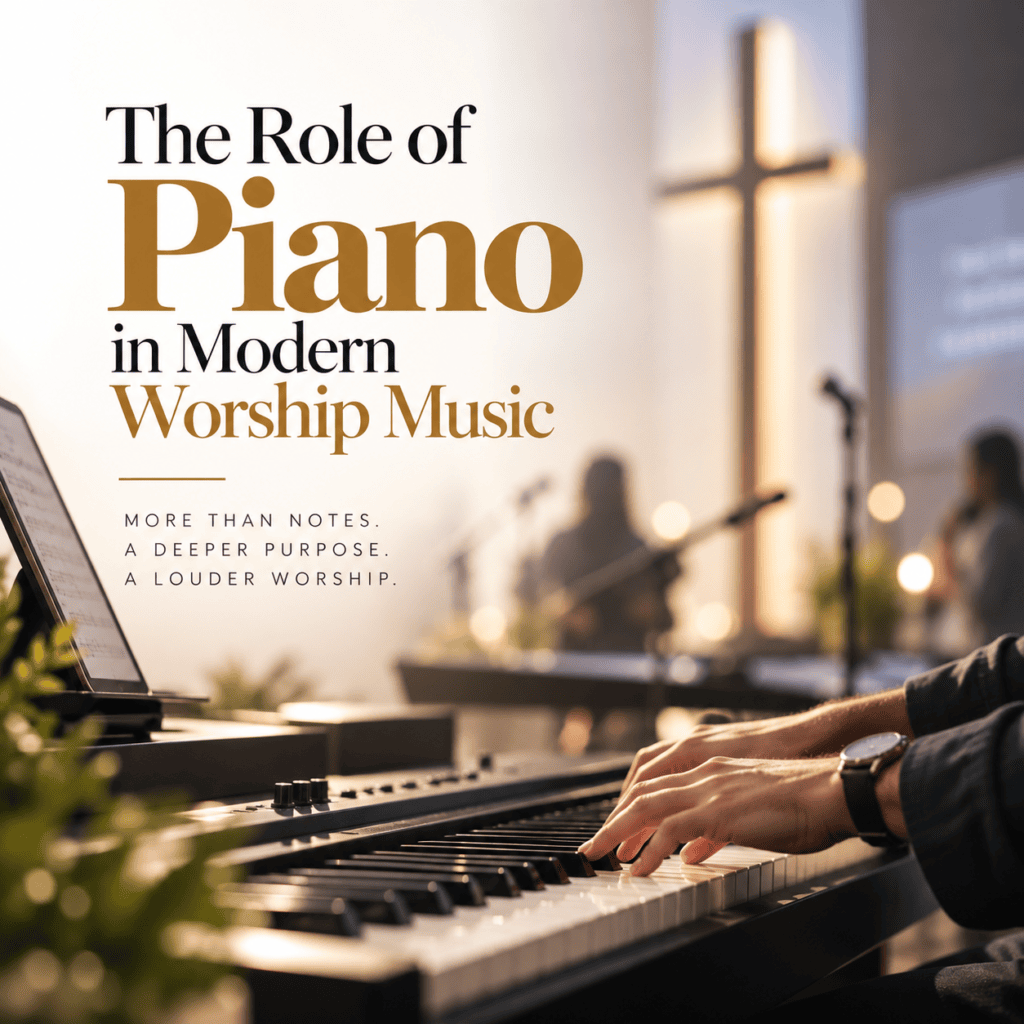
The Role of Piano in Modern Worship Music
The piano in modern worship is far more than an instrument that plays chords underneath a worship song. In a contemporary worship setting, the piano can help establish the atmosphere, support the vocalist, strengthen harmonic movement, connect different sections of a song, and create moments of intimacy or celebration. Depending on the arrangement, a pianist may move between gentle pads of harmony, rhythmic chord patterns, melodic responses, spontaneous transitions, and powerful moments that help the entire worship team build musical intensity.
Modern worship music has also changed the way pianists approach their instrument. The traditional idea of a pianist simply reading a complete arrangement from beginning to end does not always apply in a worship environment. A worship pianist needs to listen carefully, understand the song structure, follow the worship leader, respond to the congregation, and work together with guitars, drums, bass, vocals, and other instruments. The result is a role that requires both technical ability and musical sensitivity.
For this reason, learning worship piano is not simply about learning worship songs. It is about learning how to serve the song and the worship moment through music.
Why Piano Has Such an Important Place in Worship
The piano has a unique position within a worship band because it can occupy several musical roles at the same time. It can provide harmonic support without becoming rhythmically dominant, but it can also become more prominent when the arrangement calls for it.
A guitarist may create a rhythmic pulse. The bass player establishes the low-frequency foundation. The drummer shapes the groove and energy. Vocals communicate the lyrics and central melody. The piano can connect many of these elements through harmony.
This flexibility makes the piano particularly useful during worship.
A pianist might begin a song with simple, spacious chords and gradually introduce more movement as the band builds. During a quieter verse, the pianist may reduce the number of notes and allow the vocal to remain the focus. When the chorus arrives, fuller voicings and stronger rhythmic playing can help create a sense of expansion.
The instrument is therefore constantly adapting to the musical environment.
That adaptability is one of the most important skills a worship pianist can develop.
Piano Creates the Harmonic Foundation
One of the most obvious roles of piano in modern worship is harmonic support.
Most worship songs rely heavily on chord progressions. The piano can make those harmonies clear and provide a foundation around which the other instruments can build.
However, playing the correct chords is only the beginning.
A pianist needs to think about how those chords are played.
A simple major chord can be played in several different registers and inversions. The same progression can sound completely different depending on whether the pianist uses thick voicings, open voicings, inversions, suspended chords, added tones, or simple triads.
This gives worship pianists considerable creative control.
For example, during a quiet worship section, a pianist might use open and widely spaced voicings to create room. During a powerful chorus, the same harmonic progression might be played with fuller voicings to support the increased energy of the band.
The harmony hasn’t necessarily changed.
The musical impact has.
That is why worship pianists need to understand chord voicings rather than simply memorising chord names.
The Piano Helps Create the Atmosphere
One of the most distinctive characteristics of modern worship is its emphasis on atmosphere.
A worship song may move from a quiet, intimate verse into a powerful chorus and then return to a reflective bridge. The piano can help connect these emotional changes.
A pianist can create atmosphere through:
- Chord selection
- Register
- Dynamics
- Sustain pedal
- Rhythmic density
- Repetition
- Space
- Suspended chords
- Added chord tones
- Gradual harmonic movement
Sometimes the best thing a pianist can do is play very little.
This is an important lesson for developing musicians.
When a worship moment becomes quiet, filling every space with notes can actually make the arrangement feel crowded. Leaving space allows the vocals and other instruments to breathe.
The piano becomes part of the atmosphere rather than competing with it.
Learning to Play With Space
Space is one of the most important concepts for a worship pianist.
Beginners often feel that they must constantly play because silence can feel uncomfortable. But experienced musicians understand that silence can be just as powerful as sound.
Imagine a worship leader singing a quiet line.
The pianist could play several chords, arpeggios, fills, and melodic phrases underneath it.
Or the pianist could play one carefully chosen chord and allow it to sustain.
The second approach may actually communicate more.
This doesn’t mean worship piano should always be minimal. It means the pianist should understand when musical density is appropriate.
A strong worship pianist learns to recognize the difference between playing because the music needs it and playing because they feel they have to keep playing.
Piano Supports the Worship Leader
The relationship between the pianist and worship leader is extremely important.
The worship leader may change the intensity of a phrase, repeat a chorus, extend a bridge, stop the band, or move spontaneously into another section. The pianist needs to be alert enough to respond.
This is why worship musicians need more than technical preparation.
They need awareness.
A pianist who is focused entirely on sheet music or memorised patterns may miss important cues.
A pianist who is listening carefully can respond.
This could mean reducing the volume when the worship leader becomes quieter, increasing harmonic intensity when the leader builds toward a chorus, or holding a chord while waiting for the next musical direction.
The pianist becomes a musical partner rather than simply someone following a predetermined arrangement.
The Importance of Dynamics in Worship Piano
Dynamics can completely change the emotional effect of a worship song.
If every section is played at the same volume and intensity, the arrangement has nowhere to go.
A pianist needs to understand musical growth.
A song might begin softly.
The first verse may remain restrained.
The pre-chorus can gradually increase the energy.
The chorus can become fuller.
A bridge might build toward the strongest point of the arrangement.
Then everything can suddenly become quiet again.
The piano can contribute to every one of these transitions.
This is why dynamics should be treated as an active part of worship accompaniment rather than an occasional performance technique.
A good pianist listens to the entire band and adjusts accordingly.
Piano and the Worship Band
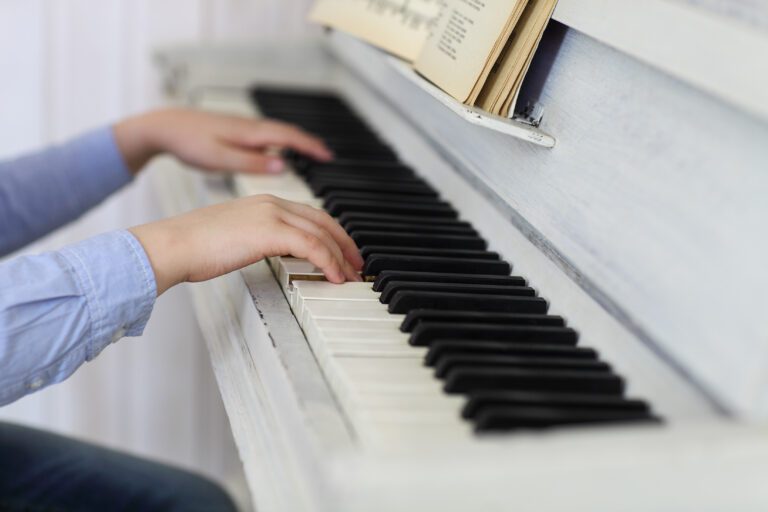
Modern worship rarely involves piano in isolation.
The pianist is usually working alongside a combination of vocals, guitars, bass, drums, keyboards, and sometimes additional instruments.
This creates an important question:
Where does the piano fit?
If the guitarist is already playing a dense rhythmic pattern, the pianist may not need to duplicate it.
If the bass player is strongly defining the root movement, the pianist can use lighter or higher voicings.
If the drums are building intensity, the piano can reinforce the harmonic movement.
This is what creates an arrangement that sounds like a band rather than several individual musicians playing simultaneously.
Listening becomes essential.
Choosing the Right Piano Sound
Modern worship often uses digital keyboards, stage pianos, synthesizers, and layered sounds rather than an acoustic piano alone.
The sound selected by the pianist can influence the entire arrangement.
A natural piano sound may work beautifully for an intimate worship section. A layered piano and pad sound may create a wider atmosphere during sustained sections.
However, having access to many sounds doesn’t mean every sound needs to be used.
The most effective sound is the one that serves the arrangement.
A worship pianist should consider:
- Is the sound too bright?
- Is it too dominant?
- Does it leave space for vocals?
- Does it blend with the guitars?
- Does it support the mood of the song?
- Does it become distracting when played continuously?
Good sound selection is another form of musical discipline.
Chord Voicings Can Transform Worship Piano
One of the most useful technical areas for worship pianists to study is chord voicing.
Instead of always playing basic root-position chords, experiment with inversions and extensions.
For example, chords containing:
- Major 7ths
- Minor 7ths
- Add9 tones
- Suspended notes
- Open fifths
- Slash chords
can add colour to an arrangement.
But these sounds should be used thoughtfully.
The purpose isn’t to make every chord sophisticated.
The purpose is to find the voicing that supports the mood and musical direction of the moment.
Sometimes a simple triad is exactly what the song needs.
At another point, an added ninth or suspended chord may create the tension necessary to lead naturally into the next section.
Understanding this vocabulary gives the pianist more options without forcing complexity into every arrangement.
The Piano Can Connect Different Sections
Transitions are another important part of worship piano.
Moving from verse to chorus may be straightforward, but worship sets can sometimes involve extended instrumental sections, repeated choruses, spontaneous moments, or transitions between songs.
The pianist can help make those changes feel natural.
A simple chord can be sustained.
A short melodic phrase can connect two sections.
A passing chord can create movement.
A rising bass line can prepare the next section.
These techniques become especially useful when the worship leader changes direction unexpectedly.
The more familiar a pianist is with harmony, the easier it becomes to create these transitions naturally.
Repetition Is a Musical Tool
Modern worship frequently uses repetition.
A chorus or bridge may be repeated several times, but that doesn’t mean the pianist has to play exactly the same way every time.
This is where musical awareness becomes important.
The first time a chorus appears, the pianist might play simply.
The second time, the accompaniment can become fuller.
The third time, the pianist might add rhythmic movement or higher-register voicings.
The harmony may remain unchanged while the musical intensity develops.
This creates a sense of progression without requiring a completely different arrangement.
Playing Less Can Sometimes Serve More
One of the most difficult lessons for developing worship pianists is learning restraint.
Technical ability can create a temptation to demonstrate everything you know.
But worship accompaniment isn’t primarily about showing how many chords, fills, or techniques you can play.
It is about serving the musical moment.
A pianist may know beautiful chord substitutions but choose not to use them.
They may be capable of complicated improvisation but decide to hold a simple chord.
They may know an elaborate accompaniment pattern but recognise that the vocalist needs space.
That kind of restraint is not a lack of skill.
It is a sign that the musician is listening.
Developing the Right Skills for Worship Piano
Becoming a strong worship pianist requires several areas of development at the same time.
Chord Knowledge
You should be comfortable with major, minor, seventh, suspended, and extended chords and understand how they function within common progressions.
Rhythm
You need a reliable internal pulse and the ability to play different rhythmic patterns without losing the groove.
Ear Training
You should gradually become capable of recognising chord movement, melody, and musical cues by listening.
Transposition
Worship leaders may change keys to suit a vocalist, so being comfortable transposing songs is extremely useful.
Improvisation
You don’t necessarily need to become a jazz improviser, but you should be able to create simple introductions, transitions, fills, and endings.
Listening
Perhaps most importantly, you need to hear what the rest of the team is doing.
These skills work together.
The Spiritual and Musical Responsibility of Worship Playing
Worship music has a purpose beyond musical performance.
That doesn’t mean musical quality is unimportant. Rather, it means musicians need to understand the purpose of their role within the worship setting.
The pianist contributes through musical service.
That requires humility, preparation, attentiveness, and teamwork.
A technically impressive piano part isn’t automatically the right piano part.
The better question is:
Does what I’m playing support this moment?
That question can guide many musical decisions.
How to Practise for Modern Worship
Worship piano practice should extend beyond simply learning songs.
Choose a familiar worship song and practise it in several different ways.
First, play the basic chord progression.
Then practise the same progression using different inversions.
Next, try a simple rhythmic pattern.
Then reduce the arrangement and practise playing with plenty of space.
After that, experiment with building intensity gradually.
Finally, practise starting and ending the song without relying completely on a written arrangement.
You can also practise playing along with recordings.
This teaches you to listen to the other instruments and understand how your piano part fits into the overall arrangement.
Final Thoughts
The piano in modern worship has a unique ability to support harmony, atmosphere, rhythm, transitions, vocals, and emotional development. But the most effective worship pianist isn’t necessarily the one who plays the most complicated parts.
The strongest foundation is musical awareness.
Know your chords. Develop your rhythm. Listen carefully. Learn to use dynamics. Understand space. Follow the worship leader. Pay attention to the rest of the band. And most importantly, learn when your playing should become more present and when it should become less noticeable.
Modern worship piano is ultimately about balance: between sound and silence, technique and sensitivity, preparation and spontaneity, individual playing and serving the whole team.
With structured guidance and personalised practice, pianists can develop the technical and musical skills needed to become confident worship musicians. At The Mystic Keys, students can explore Worship Piano & Singing through guided online lessons designed to develop practical playing, musical understanding, and confidence for worship settings.
For more information and exciting resources about learning music, visit our website at The Mystic Keys. For more music content and exciting offers follow us on
Facebook, Instagram, YouTube, LinkedIn, Twitter, Pinterest, and Threads.