Spontaneous Worship | How to Improvise With Confidence
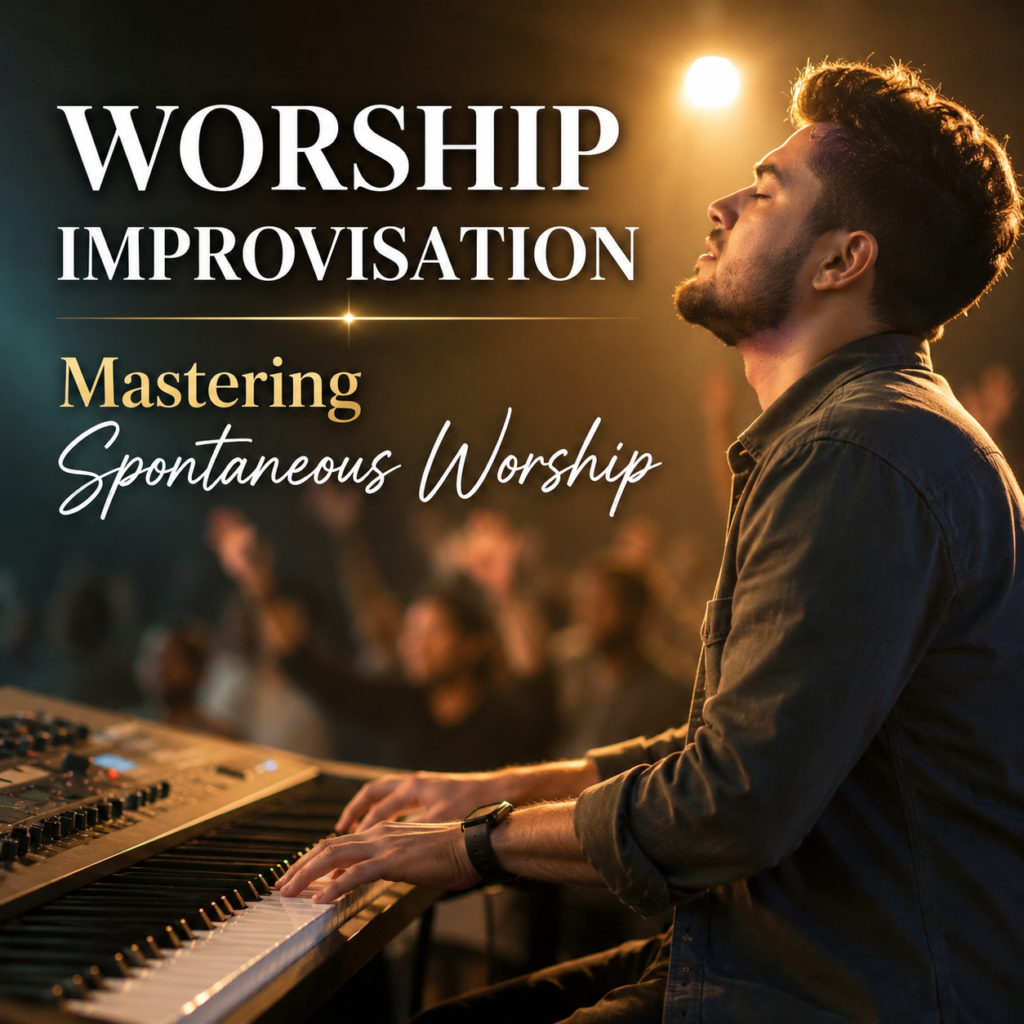
Spontaneous worship can be one of the most beautiful and powerful parts of a worship experience. Unlike a song that follows a fixed arrangement, spontaneous worship allows the musician to respond to the moment, the congregation, and the atmosphere of worship. It creates space for musical expression that feels natural rather than rehearsed.
However, improvisation can also feel intimidating. You may know your chords, scales, and songs well, yet suddenly find yourself wondering, “What should I play next?” The fear of making a mistake can make you play too cautiously or fall back on the same patterns repeatedly.
The good news is that spontaneous worship is not about playing complicated music. Instead, it is about listening, responding, and creating with confidence. With the right musical foundation and regular practice, you can learn to improvise naturally while still keeping your playing meaningful and supportive.

What Is Spontaneous Worship?
Spontaneous worship is musical expression that happens beyond the fixed structure of a prepared song. Rather than simply following verses, choruses, bridges, and instrumental sections exactly as written, the musician responds to what is happening in the worship moment.
A worship leader may repeat a chorus, sing an unscripted line, change the intensity, or leave space for prayer. The instrumentalist then has an opportunity to support that direction musically. A simple chord progression might continue underneath a vocal prayer, while a gentle melodic phrase can connect one section to another.
Because there is no completely predetermined arrangement, spontaneous worship requires flexibility. You need to be comfortable enough with your instrument that you can make musical decisions without constantly thinking about where your fingers should go.
That is why improvisation in worship is less about showing what you can play and more about knowing how to respond.
Why Spontaneous Worship Matters in Worship
A worship service does not always follow a perfectly predictable plan. Sometimes a song needs to continue longer than expected. At other times, a worship leader may move into prayer, repeat a particular phrase, or transition into another song without much warning.
In these moments, improvisation becomes extremely valuable.
Instead of stopping abruptly or becoming nervous, a confident musician can create a musical bridge that keeps the atmosphere connected. The music can become softer when the moment calls for reflection or gradually build when the worship leader wants greater energy.
Moreover, improvisation gives musicians the freedom to avoid sounding mechanical. Even when playing a familiar song for the hundredth time, small variations in rhythm, voicing, dynamics, and melody can make the performance feel fresh.
Most importantly, spontaneous playing allows you to serve the moment rather than simply reproduce a song.
Start With a Strong Chord Foundation
Before you begin experimenting with improvisation, make sure your chord foundation is solid. Confidence comes much more easily when common chord progressions feel natural under your fingers.
For example, if you are playing in the key of G, become comfortable moving between chords such as G, C, Em, and D. Instead of only practising them in a fixed order, experiment with different combinations and transitions.
Try playing the same progression slowly, then change the rhythm. Next, experiment with different chord inversions or voicings. You can also hold a chord for several beats and listen to how it changes the atmosphere.
This type of practice may seem simple, but it develops an important skill: musical familiarity. Once your hands know where to go, your mind has more freedom to listen and respond.

Learn to Hear the Key and Chord Movement
Improvisation becomes much easier when you can hear what is happening rather than depending entirely on written chord charts.
Start by identifying the key of a worship song. Once you know the key, listen carefully to how the chords move within it. Over time, you will begin to recognise familiar patterns and anticipate where the progression may go.
For instance, when you become familiar with common worship progressions, a change from one chord to another starts to feel predictable. That recognition allows you to think ahead instead of reacting at the last second.
Ear training can therefore become one of your most useful improvisation tools. Spend a few minutes listening to worship songs without immediately looking for the chords. Try to identify the tonal centre, recognise chord changes, and hum a melody over the progression.
As your ears become stronger, improvisation starts feeling less like guessing and more like having a musical conversation.

Keep Your Spontaneous Worship Simple
One of the biggest misconceptions about spontaneous worship is that good improvisation has to sound impressive.
In reality, some of the most effective worship playing can be extremely simple.
A sustained chord, a gentle arpeggio, a repeated rhythmic pattern, or a short melodic phrase may contribute more to a worship moment than a technically difficult solo. The goal is not to fill every second with sound. Instead, you want to create musical space that supports the people leading and participating in worship.
For example, during a quiet prayer, a complicated run may distract from the moment. A few carefully chosen notes could provide exactly the right amount of musical support.
Therefore, learn to appreciate space and restraint. Knowing when not to play is just as important as knowing what to play.
Use Motifs Instead of Random Notes
When you improvise, avoid thinking that you need to constantly invent something new. A much more musical approach is to create a short phrase, or motif, and develop it.
Play a simple three- or four-note idea. Repeat it with a small rhythmic change. Then move it slightly higher or lower. You could also leave a pause before repeating it.
This creates a sense of continuity. Rather than sounding like unrelated notes being played randomly, your improvisation begins to feel intentional.
A simple melodic idea can also become a musical response to what the worship leader is singing. If a particular phrase is repeated vocally, you might echo part of its melody instrumentally.
Consequently, improvisation becomes more expressive without requiring complicated technique.

Listen More Than You Play
Perhaps the most important skill in spontaneous worship is listening.
You need to listen to the worship leader, the singers, the other musicians, and the congregation. Pay attention to changes in volume, tempo, energy, and lyrical emphasis.
If the worship leader becomes quieter, your playing may need to become softer as well. When the song builds, you can gradually increase your intensity. If another instrumentalist begins playing a prominent melody, creating another busy musical line may make the arrangement feel crowded.
Good improvisation is therefore not about trying to stand out. It is about fitting into the larger musical picture.
Before adding a musical idea, ask yourself: Does this support the moment? If the answer is yes, play it with confidence. If not, leaving space may be the better musical decision.

Practise Spontaneous Worship Without a Worship Band
You do not need to wait for a worship service to practise spontaneous playing.
Choose a simple chord progression and set aside 10–15 minutes. Play the progression repeatedly while experimenting with different rhythms, voicings, dynamics, and melodies.
After that, try playing along with a worship song without copying the original arrangement exactly. Keep the basic harmonic structure, but experiment with your own accompaniment.
Another useful exercise is to play a backing track and intentionally avoid repeating the same pattern for several minutes. Move between simple and expressive sections while maintaining the key and chord progression.
Gradually, these exercises train you to make decisions in real time. As a result, spontaneous playing begins to feel less stressful because you have already practised making musical choices without a written arrangement.

Build Confidence Through Musical Boundaries
Improvisation does not mean having unlimited choices. In fact, having a few boundaries can make improvising much easier.
Start with one key. Use a small group of chords. Limit yourself to a particular rhythm or a handful of notes from the relevant scale.
Once those boundaries become comfortable, gradually introduce more possibilities.
This approach removes the overwhelming feeling of “I can play anything, so what should I play?” Instead, you have a manageable musical environment in which you can experiment.
Over time, your vocabulary expands naturally. Chord extensions, passing chords, melodic fills, inversions, rhythmic variations, and other techniques can then be introduced without making the music unnecessarily complicated.

Learn to Recover From Mistakes
Even experienced musicians make mistakes during spontaneous worship.
A wrong note, missed chord, or unexpected transition does not automatically ruin the moment. What matters is how you respond.
If you make a mistake, avoid stopping suddenly unless the situation genuinely requires it. Listen for the next chord and find your way back into the progression. Often, the audience will barely notice a small musical error if you continue playing confidently.
This is an important mindset shift. Instead of thinking, “I must never make a mistake,” think, “I know how to recover when something unexpected happens.”
That difference can dramatically improve your confidence.

Use Dynamics to Create Emotional Movement
Improvisation is not only about the notes you play. It is also about how you play them.
Dynamics can transform a simple chord progression. Playing softly can create intimacy and space, while gradually increasing volume and intensity can help build momentum.
Try starting with sparse chords and plenty of space. As the worship moment develops, introduce fuller voicings, stronger rhythmic patterns, or a gentle melodic line. When the intensity reaches its peak, you can simplify again to create contrast.
These changes help your improvisation breathe. Rather than maintaining the same energy throughout, the music responds naturally to the emotional direction of the worship.
Develop Your Own Spontaneous Worship Vocabulary
Every experienced worship musician develops a collection of musical ideas that become part of their personal vocabulary.
These might include favourite chord voicings, transition patterns, melodic phrases, rhythmic approaches, fills, and ways of building intensity.
However, the goal is not to memorise hundreds of impressive techniques. Start by collecting a few ideas that you genuinely enjoy using. Practise them in different keys and over different progressions.
For example, take one simple melodic phrase and practise moving it through several keys. Then experiment with playing it softly, rhythmically, or as a response between vocal phrases.
Eventually, these ideas become second nature. When a spontaneous moment arrives, you will have musical vocabulary available without having to consciously construct every note.

Spontaneous Worship Is a Skill You Can Develop
Nobody becomes a confident improviser simply by deciding to “play spontaneously.” Confidence develops through preparation.
Learn your chords. Strengthen your ear. Practise scales and melodic patterns. Study worship songs. Experiment with rhythm and dynamics. Most importantly, spend time improvising without worrying about whether every idea sounds perfect.
With consistent practice, you will begin to recognise patterns more quickly. Your hands will respond more naturally, your ears will guide your choices, and unexpected moments will become opportunities rather than sources of anxiety.
The more comfortable you become with your instrument, the less attention you need to give to technique. That freedom allows you to focus on the worship itself.
Final Thoughts
Spontaneous worship is not a performance test. It is an opportunity to respond musically to what is happening in the moment. At The Mystic Keys, students can develop the musical foundation and confidence needed to express themselves naturally during worship.
Confidence does not come from knowing exactly what you will play next. Instead, it comes from trusting your musical foundation enough to discover what comes next. Worship Piano & Singing Lessons Online can help you strengthen your chord knowledge, ear training, improvisation, and musical expression through guided practice.
Start small. Keep your playing simple. Listen carefully. Leave space. Experiment regularly, and do not be afraid of mistakes. Over time, improvisation will become less about searching for the “perfect” note and more about expressing the right musical response at the right moment.
Whether you play piano, guitar, or another worship instrument, the goal remains the same: support the worship, follow the moment, and let your musicality serve the message.
With practice, spontaneity stops feeling unpredictable—and starts becoming one of the most natural and expressive parts of your worship playing.
For more information and exciting resources about learning music, visit our website at The Mystic Keys. For more music content and exciting offers follow us on
Facebook, Instagram, YouTube, LinkedIn, Twitter, Pinterest, and Threads.