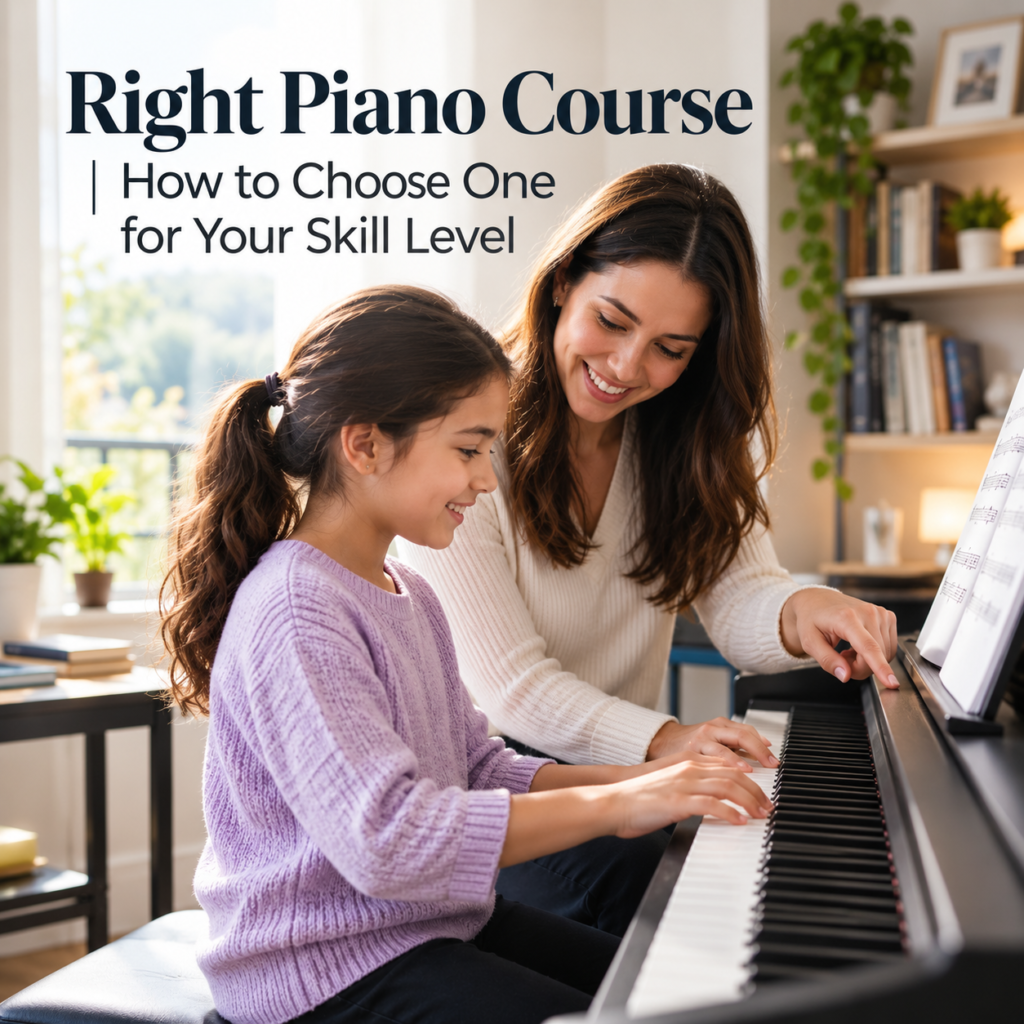
Right Piano Course | How to Choose One for Your Skill Level
Learning the piano can be an incredibly rewarding experience. From playing your favourite songs to understanding music theory and eventually creating your own arrangements, the instrument offers endless possibilities for musical growth. However, with so many options available today, finding the right piano course for your skill level, goals, and learning style can feel surprisingly difficult.
A quick search can bring up beginner piano lessons, advanced performance courses, classical piano programs, online tutorials, exam-focused courses, and everything in between. While having so many options is useful, it can also leave you wondering: Which piano course is actually right for my skill level?
The answer depends on more than simply choosing a course labelled “beginner,” “intermediate,” or “advanced.” Your previous experience, musical goals, preferred learning style, practice routine, and even the type of music you want to play can all influence your decision.
Let’s explore how you can choose a piano course that matches where you are now while also helping you progress confidently toward where you want to be.
Why Choosing the Right Piano Course Matters
A good piano course should do more than teach you how to play a few songs. It should give you a structured path that gradually develops your technique, musical understanding, confidence, and independence.
For a complete beginner, starting with material that is too difficult can quickly become frustrating. On the other hand, an experienced pianist may lose interest if the lessons spend too much time covering concepts they already understand.
The right level creates a balance between challenge and achievement. You should feel that the lessons require effort, but you should also be able to see consistent progress.
That balance becomes especially important when learning online. Without the physical presence of a teacher beside you, the course structure, lesson quality, feedback, and progression system need to provide enough guidance to keep you moving forward.

Start by Understanding Your Current Piano Skill Level
Before enrolling in a course, take a realistic look at what you can already do.
If you have never played the piano before, you are most likely a beginner. You may not yet know how to read notes, identify keys, use correct finger positions, or coordinate both hands. In this situation, a foundational course is the best place to begin.
Perhaps you learned piano years ago and remember basic scales, chords, or a few songs. In that case, you may not need to start completely from scratch. A beginner-to-intermediate course or a level assessment can help identify where your current abilities fit.
Intermediate players usually have a reasonable understanding of rhythm, notation, chords, scales, and basic technique. At this stage, lessons should begin moving beyond simply playing notes correctly. Musical expression, dynamics, improvisation, more complex chord patterns, sight-reading, and repertoire selection can become increasingly important.
Advanced pianists, meanwhile, often need a more specialised approach. Their goals may involve performance, classical repertoire, composition, accompaniment, improvisation, music exams, or developing a particular playing style.
Therefore, choosing your course based on your actual abilities rather than the number of years you have played is essential.
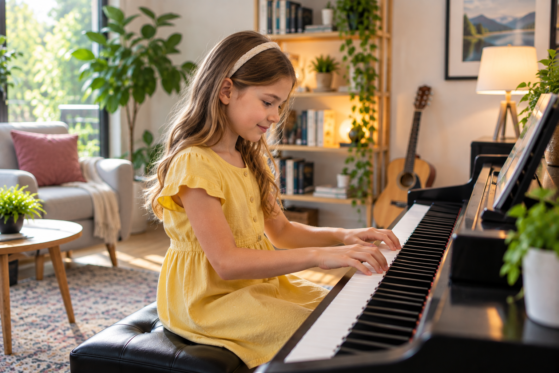
Piano Courses for Complete Beginners
Starting piano as a beginner can feel both exciting and overwhelming. There is a lot to learn, but the early stages should not feel unnecessarily complicated.
A suitable beginner piano course should introduce the instrument gradually. You should learn how the keyboard is organised, how to sit and position your hands, how to identify notes, and how to maintain basic rhythm.
Reading music is another important foundation. Although it may initially seem intimidating, learning to read simple notation alongside practical playing can make your progress much easier in the long run.
Good beginner lessons also introduce simple melodies and songs relatively early. Being able to play something recognisable gives students a sense of accomplishment and makes practice more enjoyable.
Most importantly, beginners should look for a course that focuses on building correct habits from the beginning. Proper posture, hand position, finger technique, rhythm, and coordination are much easier to develop correctly than to fix later.
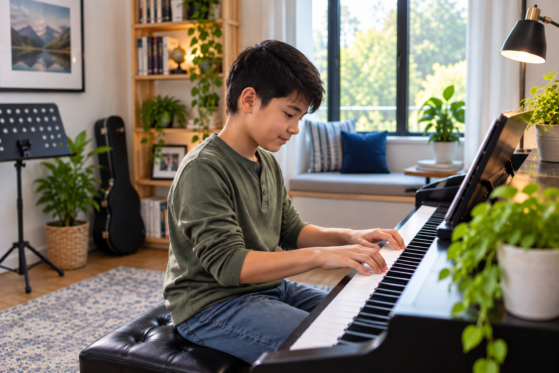
Choosing a Course as an Intermediate Pianist
Once you have moved beyond the basics, your learning needs begin to change.
At the intermediate level, simply learning where the notes are is no longer enough. You need to develop greater control, musicality, coordination, and confidence while gradually tackling more challenging pieces.
A suitable intermediate piano course may introduce advanced chord structures, scales, arpeggios, sight-reading, more complicated rhythms, and expressive playing. Depending on your interests, you might also explore improvisation, accompaniment patterns, pop piano, jazz techniques, or classical repertoire.
This is also the stage where students often benefit greatly from personalised feedback. A teacher can identify tension in your hands, inefficient fingering, timing issues, or weaknesses in technique that may not be obvious when you practise alone.
As a result, intermediate learners should consider courses that offer opportunities for regular teacher interaction rather than relying entirely on pre-recorded material.

The Right Piano Course for Advanced Piano Students
Advanced learners need a different kind of challenge. Repeating introductory exercises or learning simplified arrangements is unlikely to provide meaningful development.
Instead, advanced piano courses should allow you to refine your individual musicianship. Technical precision, interpretation, phrasing, dynamics, articulation, performance skills, and stylistic awareness become increasingly significant.
For classical pianists, the course might focus on repertoire, interpretation, sight-reading, technical exercises, and performance preparation. Someone interested in contemporary music may benefit more from lessons centred around chord voicings, improvisation, accompaniment, songwriting, or arranging.
At this stage, a personalised learning plan can make a significant difference. Rather than following exactly the same sequence as every other student, advanced learners often benefit from lessons designed around their strengths, weaknesses, and specific musical objectives.
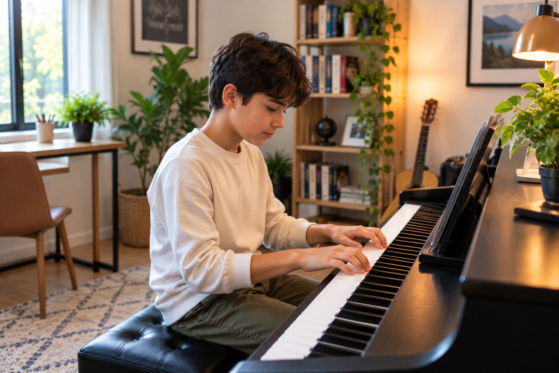
Consider What You Actually Want to Play
Your skill level is only one part of the decision. Your musical interests matter just as much.
Someone who dreams of playing Beethoven may want a very different course from a learner whose main goal is to accompany themselves while singing. Similarly, a student interested in worship music, pop songs, jazz, film music, or songwriting may require different techniques and repertoire.
Classical piano courses generally place greater emphasis on notation, technique, interpretation, repertoire, and formal musical development. Contemporary piano lessons may focus more heavily on chords, lead sheets, accompaniment patterns, improvisation, and playing by ear.
Neither approach is automatically better. The important question is whether the course supports your personal musical goals.
When lessons connect with the music you genuinely enjoy, practising becomes less of a task and more of something you look forward to.
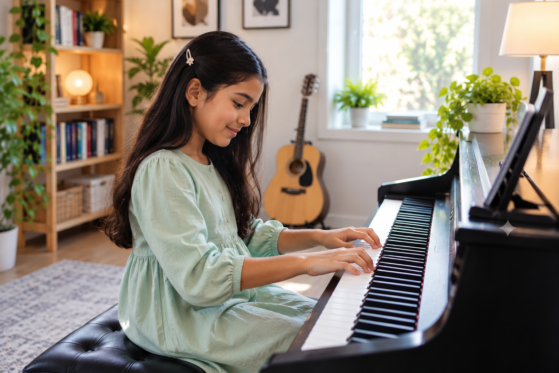
Look for a Structured Right Piano Course
A piano course should have a clear sense of progression.
Rather than jumping randomly from one song or exercise to another, structured lessons should gradually introduce new concepts while reinforcing what you have already learned. Each stage should prepare you for the next.
For example, a beginner might first learn simple rhythms and melodies before moving into two-hand coordination. Chords and scales can then be introduced as the student develops greater control. Eventually, those skills can be combined through more complex pieces and musical exercises.
This kind of progression prevents students from feeling lost. It also makes it easier to recognise improvement because every new skill builds upon something learned previously.
A well-designed course should therefore answer an important question: “Where will this lesson take me next?”
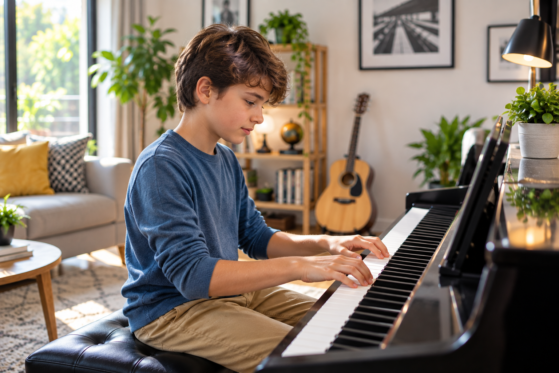
Teacher Guidance Can Make a Major Difference
Technology has made piano education more accessible than ever. Online lessons can connect students with teachers from different locations and make regular learning possible from the comfort of home.
However, the quality of guidance still matters.
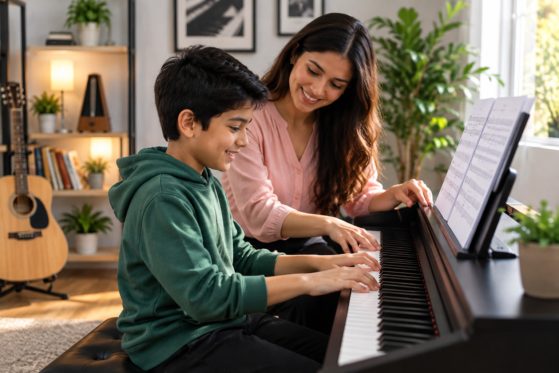
A teacher can listen to how you play, observe your technique, correct mistakes, adjust exercises, and explain difficult concepts according to your individual learning style. Those small corrections can prevent students from developing habits that later become difficult to change.
Personalised instruction is particularly valuable when students reach intermediate and advanced levels because progress becomes less about learning basic information and more about refining technique and musical expression.
For this reason, if you are choosing between a completely self-guided course and one that provides live teacher interaction, consider how much support you are likely to need to stay motivated and progress consistently.
Think About Your Learning Style
Not everyone learns music in exactly the same way.
Some students understand concepts quickly through written notation. Others learn better by watching demonstrations and copying what they see. Certain learners prefer listening and playing by ear, while others enjoy understanding the theory behind every chord and progression.
A good piano course should accommodate different learning preferences wherever possible.
If visual learning works best for you, look for clear demonstrations. Students who enjoy interaction may benefit from live one-on-one lessons. Those who need repetition can look for courses that provide recorded lessons or supplementary materials that can be revisited between classes.
Ultimately, the best course is one that makes difficult concepts easier for you to understand.
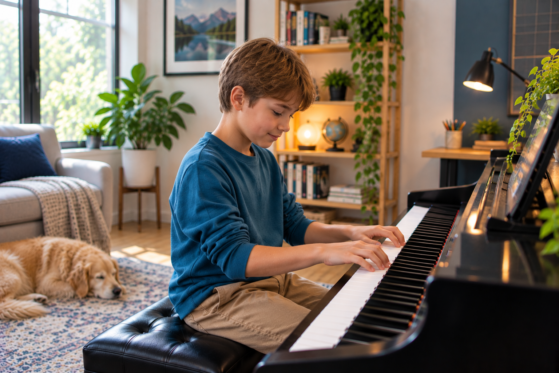
Practice Requirements for the Right Piano Course
Even the best piano course cannot replace regular practice.
Before enrolling, consider whether the course fits realistically into your schedule. A programme that expects several hours of practice every day may not be suitable for someone with a busy work or school routine.
Short, focused practice sessions can still be highly effective when they are consistent. Spending twenty or thirty minutes concentrating on technique, rhythm, repertoire, and revision can be more productive than practising for hours without a clear purpose.
A good teacher or course should also help you understand what to practise, rather than simply telling you to practise more.
That distinction can make learning much more efficient.
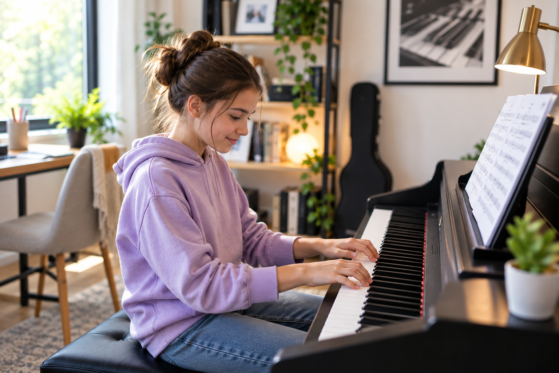
Check Whether the Course Offers Feedback and Progress Tracking
One of the biggest challenges of learning independently is not always knowing whether you are improving correctly.
Progress becomes easier to measure when a course includes regular assessments, teacher feedback, performance opportunities, or clearly defined levels.
For students working toward formal music examinations, this can be particularly useful. A structured programme can help learners understand what skills they need to develop before moving to the next grade.
Even if examinations are not your goal, regular feedback can keep your learning focused. Knowing what you are doing well and where you need improvement gives each practice session a clearer purpose.
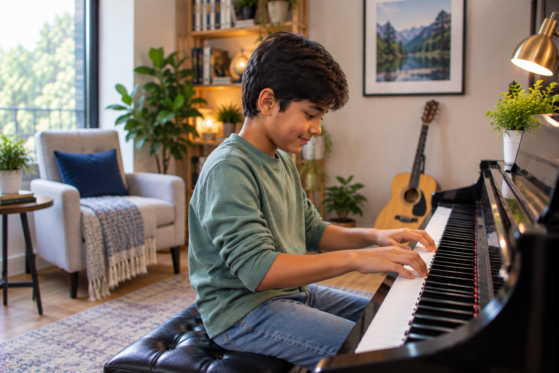
Online or In-Person | Choosing the Right Piano Course
Both online and in-person piano lessons can be effective, provided the teaching approach is strong.
In-person lessons offer the advantage of physical proximity, while online lessons provide flexibility and allow students to learn from teachers regardless of location. For many learners, online one-on-one lessons can also make it easier to fit music education around work, school, travel, and family commitments.
The key consideration is not simply the format. What matters more is the quality of instruction, consistency of lessons, personalised feedback, course structure, and the student’s willingness to practise.
A well-organised online piano course can provide a highly engaging learning experience when live instruction is combined with useful learning resources and regular practice.
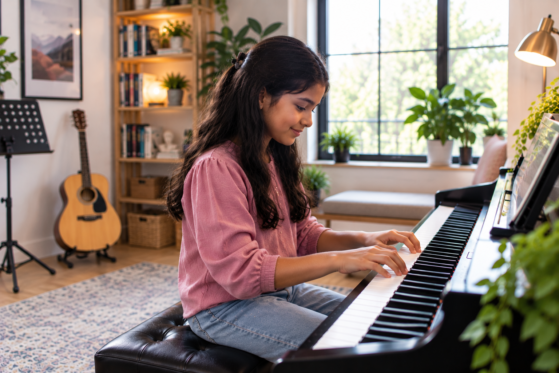
Don’t Choose a Course Based Only on Price
Cost naturally plays a role when selecting a piano course, but it should not be the only factor.
A cheaper course may appear attractive initially, yet it might offer limited guidance, little feedback, or an unclear learning structure. Meanwhile, a more comprehensive programme may provide personalised instruction, additional resources, and a progression plan that offers greater value over time.
Instead of asking only, “How much does this course cost?”, consider asking, “What am I receiving for that cost?”
Teacher experience, lesson duration, individual attention, supplementary materials, flexibility, feedback, and learning support can all influence the overall value of a programme.
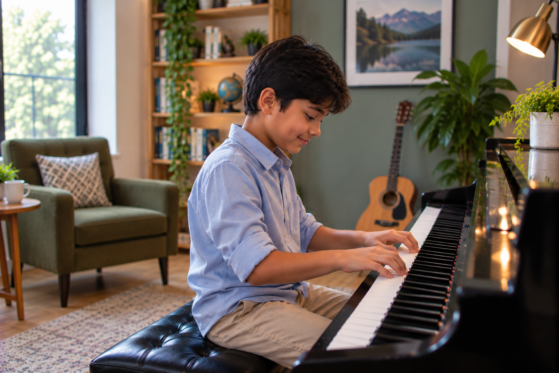
Signs the Right Piano Course May Not Be Right for You
Sometimes the problem is not your ability to learn piano. The course itself may simply be a poor match.
If lessons consistently feel far too easy, you may have chosen a level below your current ability. When the material is constantly overwhelming, moving to a slightly lower level can help you strengthen missing foundations.
A lack of feedback can also become a problem, particularly when you are trying to improve technique. Similarly, a course that focuses entirely on theory when your goal is to play songs may leave you feeling disconnected from your original motivation.
Perhaps the biggest warning sign is a lack of progress. If you have been following a course consistently but do not feel that you are developing new skills, it may be time to reassess the teaching method, course level, or learning structure.
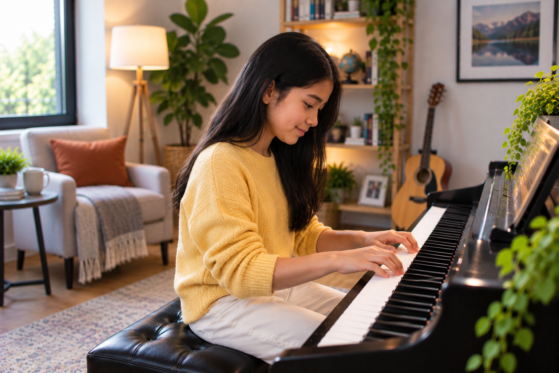
How to Know You Have Chosen the Right Course
The right piano course should make you feel challenged without making you feel defeated.
You should gradually become more comfortable at the keyboard, understand more about music, and notice improvements in your technique. Songs that once seemed difficult should begin to feel manageable, while new challenges should continue to keep you engaged.
Another positive sign is growing independence. Over time, you should need less help identifying notes, understanding rhythms, practising sections, and correcting simple mistakes.
Most importantly, you should enjoy the process. Piano learning is a long-term journey, and motivation becomes much easier to maintain when the lessons connect with the kind of musician you want to become.

A Simple Way to Choose the Right Piano Course
Before making your final decision, take a moment to answer a few questions:
Where am I right now?
Are you a complete beginner, returning learner, intermediate player, or advanced pianist?
What do I want to play?
Think about classical music, pop, jazz, worship music, film music, accompaniment, improvisation, or your own compositions.
What do I want to achieve?
Your goal could be playing for enjoyment, performing confidently, accompanying yourself, preparing for an examination, or developing professional-level skills.
How do I learn best?
Consider whether you need live guidance, visual demonstrations, repetition, theory, or practical playing.
How much time can I realistically practise?
Choose a course that fits your lifestyle rather than one that creates unrealistic expectations.
Once these questions are clear, comparing different courses becomes much easier.
Final Thoughts
Choosing the right piano course means finding one that matches your skill level, goals, and learning style. With consistent practice and personalised guidance, every lesson can bring you closer to becoming the pianist you want to be.
Whether you are a beginner or an experienced player, Piano Lessons Online offer a flexible way to learn. At The Mystic Keys, personalised online piano lessons help students develop their skills, explore their musical interests, and progress with confidence.
Start where you are, learn at your pace, and discover where your music can take you.
For more information and exciting resources about learning music, visit our website at The Mystic Keys. For more music content and exciting offers follow us on
Facebook, Instagram, YouTube, LinkedIn, Twitter, Pinterest, and Threads.