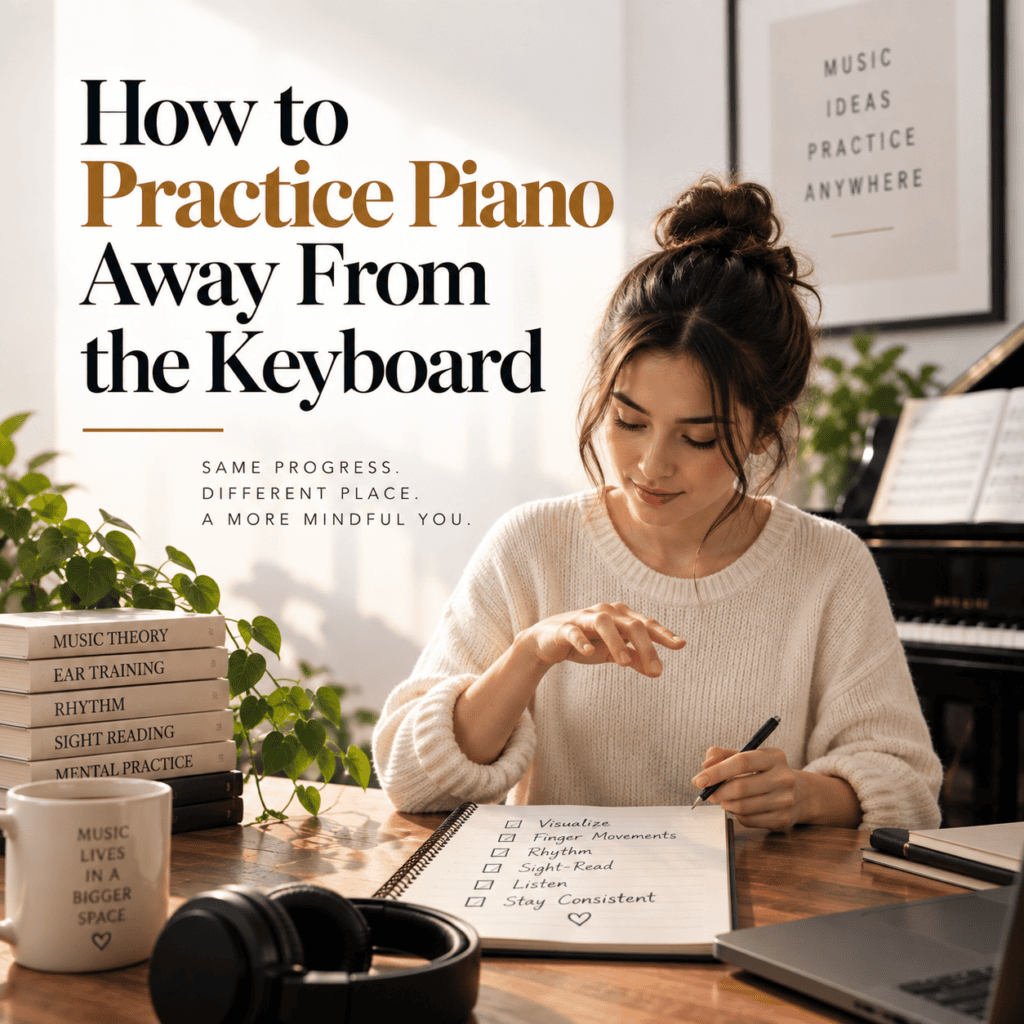
How to Practice Piano Away From the Keyboard
Learning piano doesn’t always require sitting at the instrument. While physical practice is essential for developing coordination, technique, and muscle memory, there are many useful ways to practice piano away from the keyboard. These methods allow you to strengthen your musical understanding, memory, rhythm, listening skills, and mental connection with the music even when a piano isn’t available.
This can be particularly useful for busy students. You may be travelling, sitting in a classroom, taking a break at work, or simply away from your instrument for a few hours. Instead of considering that time completely lost, you can use it to prepare your mind for your next piano session.
Away-from-the-keyboard practice doesn’t replace playing. It complements it.
When mental preparation and physical practice work together, your time at the piano can become more focused and productive.
Why Practice Piano Away From the Keyboard?
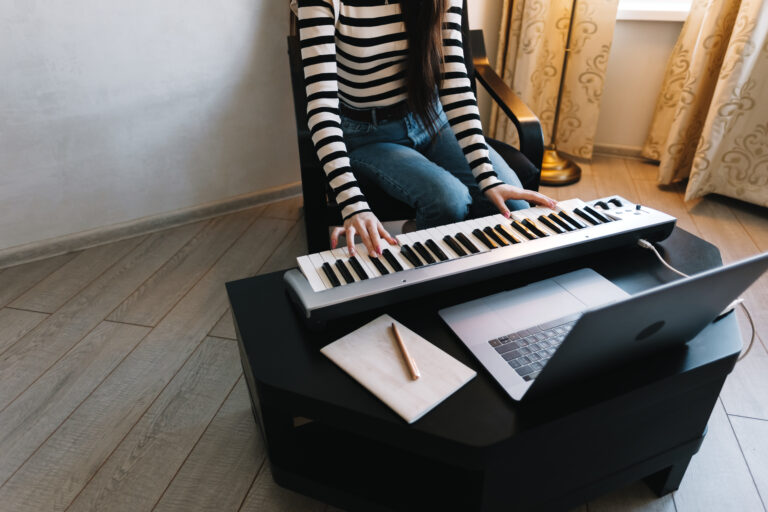
Piano playing involves much more than moving your fingers.
You need to understand rhythm, recognise patterns, remember melodies, read notation, anticipate chord changes, hear musical phrases, and make interpretive decisions.
Many of these skills can be developed without physically pressing a key.
In fact, constantly playing the same passage without thinking about what you are doing can sometimes make practice less effective. Stepping away from the instrument gives you an opportunity to analyse the music from a different perspective.
You can ask questions such as:
- What key is the piece in?
- What is the chord progression?
- Where does the melody repeat?
- Which section is most difficult?
- What rhythm appears repeatedly?
- Where does the music become louder?
- How does one section connect to the next?
When you return to the keyboard, you may already understand the passage more clearly.
Mental Practice Can Strengthen Musical Memory
One of the most useful ways to practice piano away from the keyboard is through mental practice.
Mental practice means imagining yourself playing without physically moving your fingers across the keys.
This may sound strange at first, but musicians can use mental rehearsal to reinforce their understanding of a piece.
Choose a short section that you already know reasonably well.
Close your eyes and imagine the keyboard.
Picture your hands moving through the passage.
Hear the melody in your mind.
Imagine the chord changes.
Try to remember the rhythm.
If you reach a point where your mental image becomes unclear, you have discovered something worth reviewing when you return to the piano.
This process can strengthen your familiarity with the piece without requiring physical playing.
Visualize the Keyboard
Keyboard visualization is another useful mental exercise.
You don’t necessarily need an actual keyboard in front of you to think about where notes are located.
For example, imagine middle C.
Then picture the notes around it.
Move mentally through a scale.
Imagine a chord shape.
Picture an octave.
The objective isn’t to replace physical practice. Instead, you are developing a stronger mental map of the instrument.
This can become particularly useful as you begin learning scales, chords, intervals, and key signatures.
Eventually, you want to be able to think about musical relationships rather than seeing the keyboard as a collection of unrelated keys.
Read Your Sheet Music Away From the Piano
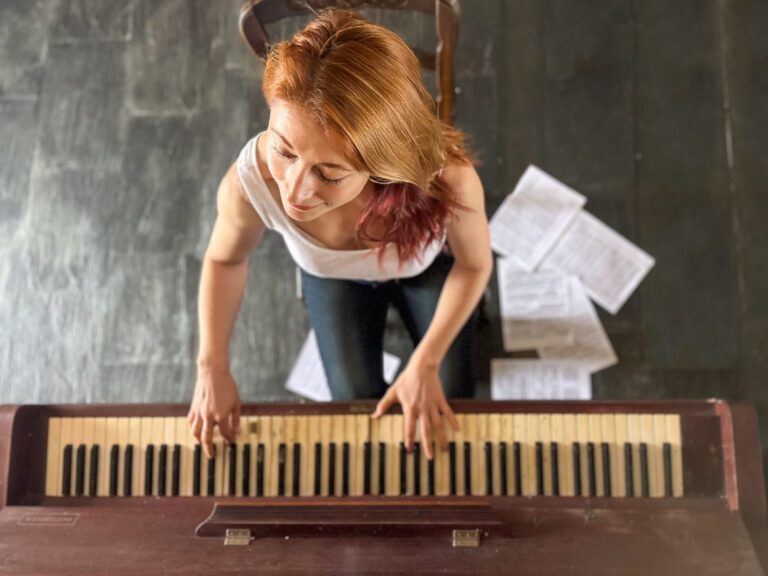
Sheet music can be studied without immediately playing it.
Take the score of your current piece and read through it carefully.
Look for patterns.
Identify the key signature.
Notice time-signature changes.
Look for repeated sections.
Observe dynamic markings.
Find articulations.
Study the phrasing.
You can even identify difficult passages before sitting at the keyboard.
This means that when you eventually practise the piece, you’re not encountering the music for the first time.
Your eyes and mind have already processed some of its structure.
Practise Rhythm Without Playing Notes
Rhythm is one of the easiest musical skills to practise away from the keyboard.
Take a difficult rhythm from your piece and clap it.
You can also tap it on a table or quietly count it aloud.
For example, count:
1-and-2-and-3-and-4-and
Then place the notes within that pulse.
If the rhythm is more complicated, break it into smaller units.
You can also use a metronome while clapping or tapping.
This can help separate the rhythmic problem from the physical challenge of playing the notes.
Once the rhythm feels comfortable away from the keyboard, returning to the piano may feel considerably easier.
Sing the Melody
Your voice can become a powerful practice tool.
If you’re learning a melody, try singing or humming it away from the piano.
You don’t need to be a trained vocalist.
The goal is to develop an internal understanding of the melodic shape.
Ask yourself:
Does the melody rise?
Does it fall?
Where does the phrase reach its highest point?
Where does it resolve?
Where would you naturally breathe?
Being able to hear the melody internally can help you play it more musically when you return to the instrument.
It also strengthens the connection between your ears and your hands.
Practise Music Theory in Everyday Situations
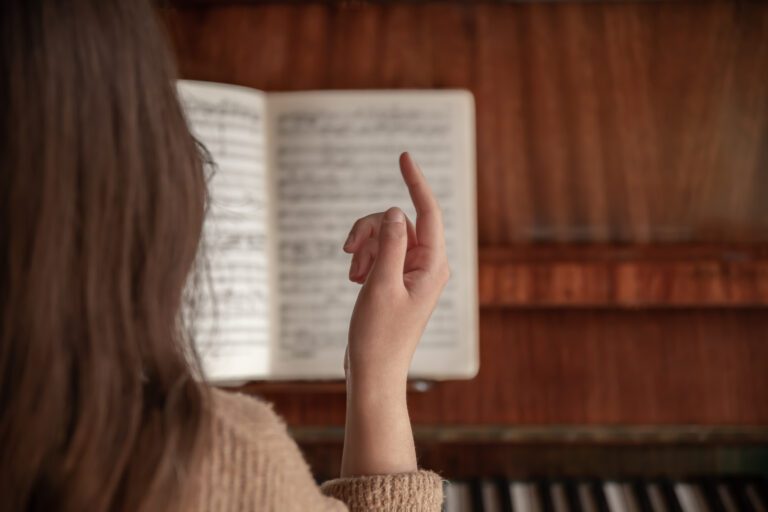
Music theory doesn’t require a piano.
You can review theory almost anywhere.
Take a key signature and name its scale.
Choose a note and identify intervals above it.
Name the notes in a chord.
Identify major and minor triads.
Think through common chord progressions.
For example, you might mentally work through a progression such as:
I – V – vi – IV
Then identify how that progression would appear in several different keys.
This type of mental exercise develops familiarity with harmony and can eventually make chord recognition at the piano faster.
Memorise Small Sections
If you’re trying to memorise a piece, don’t wait until you’re sitting at the piano to test your memory.
Away from the keyboard, see how much of the music you can recall.
Try remembering:
- The opening melody
- The chord progression
- The structure
- The next phrase
- The left-hand pattern
- The dynamic changes
- The ending
If you use sheet music, close it and mentally reconstruct a small section.
Then check the score.
Were you correct?
If not, identify what you forgot.
This makes memorisation an active process rather than simply repeating the piece at the keyboard.
Listen to the Piece Actively
Listening can also count as meaningful piano practice when done intentionally.
Put on a recording of the piece you’re learning.
But don’t simply listen in the background.
Choose one element to focus on.
First, listen to the melody.
Then listen to the bass.
Next, focus on the rhythm.
Then listen for dynamics.
Finally, listen to how the performer shapes phrases.
If possible, listen while following the score.
This can help you connect what you see on the page with what you hear in performance.
Study Another Pianist's Interpretation
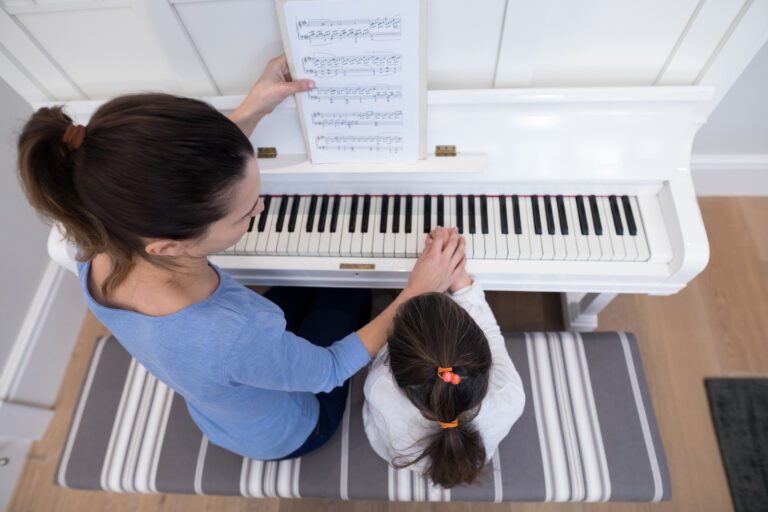
Listening to different performances can teach you about interpretation.
Two pianists may play the same composition while using different tempos, dynamics, articulation, or phrasing.
Instead of asking which performance is “correct,” listen for the choices being made.
Does one performer use more rubato?
Does another create stronger dynamic contrasts?
Is the melody more prominent in one interpretation?
Does the accompaniment sound lighter?
These observations can help you develop your own musical preferences.
Analyse the Structure of Your Piece
Another productive way to practice piano away from the keyboard is to analyse the structure of the piece you’re learning.
Identify the major sections.
For example:
Introduction → Verse → Chorus → Verse → Chorus → Bridge → Chorus
Or, in a classical piece:
Exposition → Development → Recapitulation
The exact structure depends on the repertoire.
Once you understand the architecture of the music, memorisation often becomes easier because you’re remembering relationships rather than isolated measures.
You can think of the piece almost like a story.
Each section has a purpose.
Think Through Fingerings
Fingerings are important because inefficient fingering can make a passage unnecessarily difficult.
If your teacher has given you specific fingerings, review them away from the keyboard.
Look at the passage and mentally follow the finger sequence.
You can even gently move your fingers in the air or on your leg to reinforce the pattern.
This isn’t a replacement for practising on the keys, but it can strengthen your familiarity with the movement.
When you return to the piano, your hands have already encountered the sequence mentally.
Practise Ear Training Without an Instrument
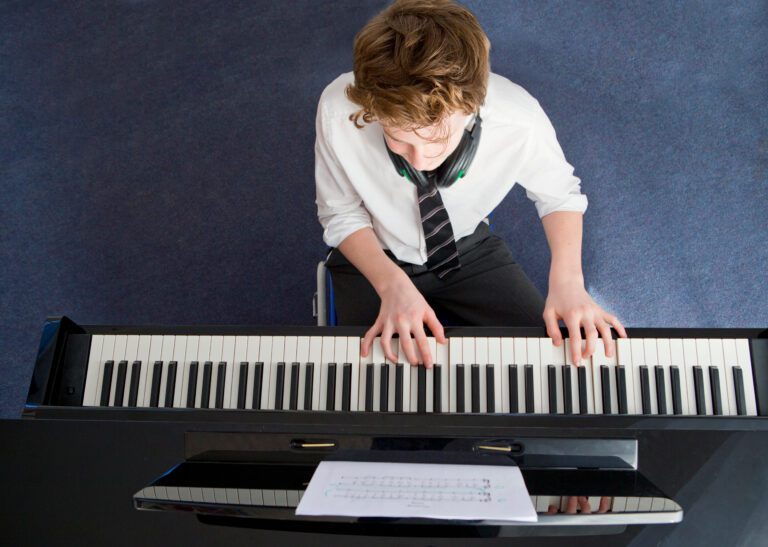
Ear training is one of the most valuable skills a pianist can develop.
You can practise it almost anywhere.
Listen to music and try to identify whether the melody moves upward or downward.
Try to recognise major and minor sounds.
Listen for repeated rhythmic patterns.
Try to identify when a chord changes.
If you are more advanced, challenge yourself to identify intervals or chord qualities.
The goal is to gradually reduce the distance between what you hear and what you understand.
Eventually, you want to hear a musical idea and have an instinctive sense of how it might appear on the keyboard.
Use Visualization Before a Performance
Mental rehearsal can also help before a performance.
Imagine yourself sitting at the piano.
Picture the beginning of the piece.
Hear the first phrase internally.
Imagine your hands moving into position.
Think through the difficult transition.
Visualize the ending.
This doesn’t guarantee a perfect performance, but it can reduce uncertainty.
The more familiar the performance feels mentally, the less unfamiliar the situation may feel physically.
Plan Your Next Practice Session
You can also use time away from the keyboard to decide exactly what you’ll do when you return.
Instead of sitting down and asking, “What should I practise today?”, make a plan beforehand.
For example:
10 minutes: Scales
15 minutes: Left-hand chord patterns
20 minutes: Difficult section of current piece
10 minutes: Sight-reading
10 minutes: Play something enjoyable
The exact timing can change according to your schedule.
The benefit is that you begin the session with a clear purpose.
This can prevent valuable practice time from disappearing into unfocused repetition.
Use Your Phone as a Learning Tool
Your phone can become useful for music study when you’re away from your piano.
You can:
- Listen to recordings
- Record yourself during practice
- Review lesson recordings
- Use a metronome
- Read digital sheet music
- Make practice notes
- Listen to performances
- Review theory exercises
For students taking online lessons, recorded classes can be particularly helpful.
If your teacher demonstrated a technique during a lesson, you can revisit the explanation away from the keyboard and mentally prepare for the next practice session.
Then, when you’re back at the piano, you can immediately apply what you reviewed.
Practice Imaginary Performance
Here’s a simple exercise that can be surprisingly effective.
Imagine that you’re performing your piece.
Without touching the piano, mentally play through it from beginning to end.
Try to hear the melody.
Imagine the chord changes.
Think about the dynamics.
Visualize the difficult passages.
If you forget a section, don’t immediately look at the music.
Try to work out what comes next.
Then check the score afterward.
This can reveal which parts of the piece you genuinely understand and which parts you have only memorised through repeated physical movements.
What You Shouldn’t Try to Replace
Although there are many ways to practice piano away from the keyboard, physical practice remains essential.
You cannot fully develop finger strength, coordination, touch, pedal technique, or physical accuracy without playing the instrument.
Mental practice is not a shortcut around these skills.
Instead, think of it as preparation.
Away-from-the-keyboard work helps develop your understanding.
Keyboard practice develops physical execution.
The two should support each other.
A useful approach is:
Understand away from the piano → Apply at the piano → Listen → Correct → Review away from the piano → Practise again.
This creates a continuous learning cycle.
A 15-Minute Away-From-the-Piano Practice Routine
If you have a short break during the day, you can still make it productive.
Minutes 1–3: Visualize
Picture the keyboard and mentally play a short section of your current piece.
Minutes 4–6: Rhythm
Clap or tap the rhythm of a difficult passage.
Minutes 7–9: Listen
Listen to the recording and focus on one musical element.
Minutes 10–12: Theory
Review the key, chords, intervals, or structure of the piece.
Minutes 13–15: Memory
Try to recall a section without looking at the music.
When you return to the piano later, test what you remembered.
You may be surprised by how much useful preparation can happen in only fifteen minutes.
Turn Waiting Time Into Music Time
One of the biggest advantages of away-from-the-keyboard practice is flexibility.
You don’t need a piano to think about music.
You can study a score while travelling.
You can listen to a recording during a break.
You can tap rhythms while walking.
You can mentally review chords before going to bed.
You can visualize a difficult passage while sitting somewhere without an instrument.
These activities may seem small individually, but they can keep you mentally connected to the music throughout the day.
Final Thoughts
piano lessons online is a combination of physical coordination, musical understanding, listening, memory, and concentration. While the keyboard is essential for developing technique, not every part of the learning process has to happen at the instrument.
Knowing how to practice piano away from the keyboard allows you to use your time more creatively. You can visualize difficult passages, study sheet music, practise rhythms, sing melodies, review theory, strengthen memory, analyse song structure, listen actively, and mentally rehearse performances.
The key is to remember that these activities complement—not replace—physical piano practice.
When you combine thoughtful preparation away from the instrument with focused practice at the keyboard, you can make your sessions more purposeful and potentially get more from the time you have available.
At The Mystic Keys, students can combine personalised online piano instruction with lesson recordings and structured practice, allowing them to review concepts and continue learning between classes. With consistent guidance and focused practice, even the time spent away from the piano can become part of your musical journey.
For more information and exciting resources about learning music, visit our website at The Mystic Keys. For more music content and exciting offers follow us on
Facebook, Instagram, YouTube, LinkedIn, Twitter, Pinterest, and Threads.