Piano vs Guitar | Which Is Harder?
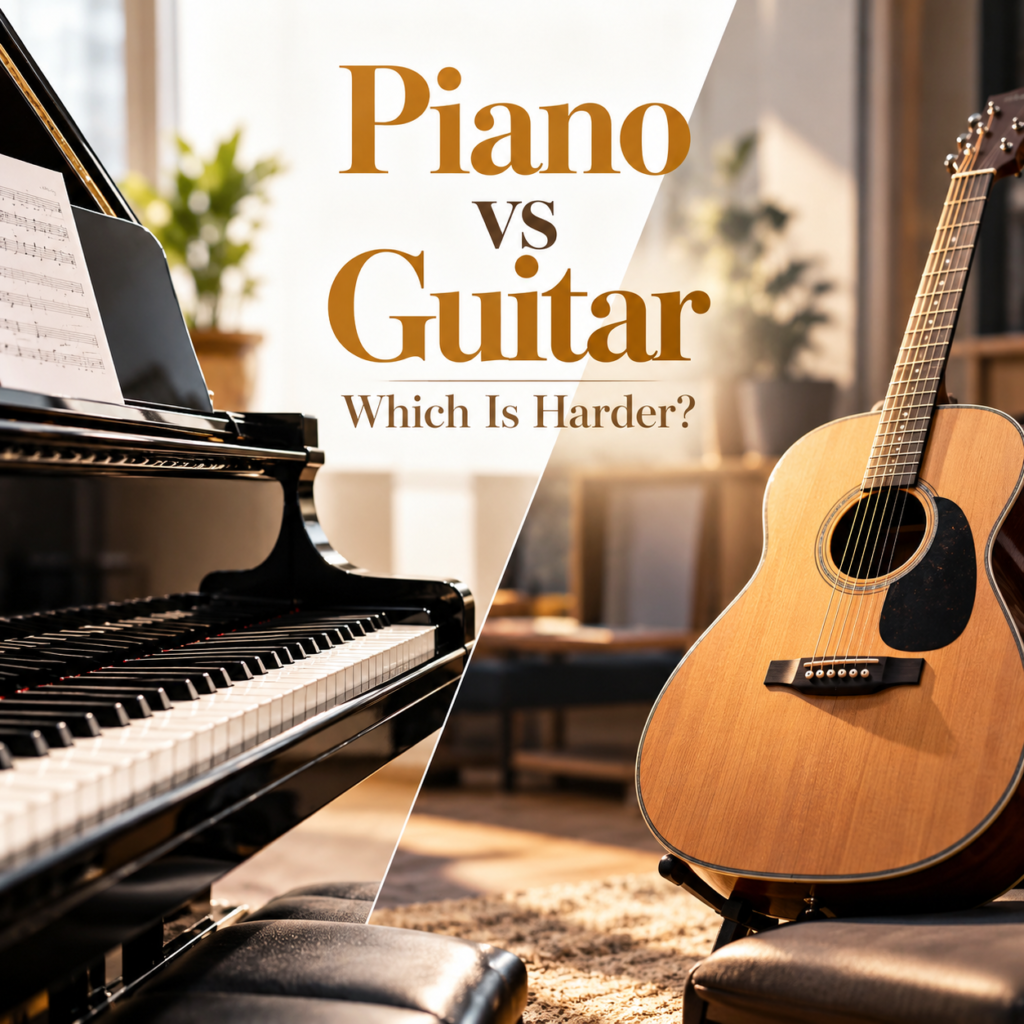
Choosing a musical instrument is an exciting step, but it often comes with one big question: Piano vs Guitar—which instrument is harder to learn? Both instruments have their own unique challenges, and the answer depends on factors such as your musical goals, coordination, practice habits, and previous experience. While the piano may feel more approachable at first, guitar can present its own set of challenges with chords, finger placement, and rhythm. Understanding these differences can help you decide which instrument suits your learning style and musical interests.
Both instruments have their own challenges, and neither can simply be labelled as “easy” or “difficult.” The experience depends on your musical background, coordination, practice habits, goals, and even the type of music you want to play.
A beginner may find piano more approachable at first because the notes are laid out in a clear, visual pattern. Guitar, meanwhile, can feel more physically demanding during the early stages because of finger placement, chords, and strumming. However, as you progress, both instruments introduce increasingly complex skills.
So, rather than asking which instrument is universally harder, it is more useful to understand what makes piano and guitar challenging at different stages of learning.

Getting Started | Piano vs Guitar
The first few weeks of learning can feel quite different on each instrument.
With a piano, the layout is relatively straightforward. The white and black keys follow a repeating pattern, making it easier for beginners to identify notes and understand basic musical relationships. Pressing a key also produces a clear, consistent sound, so beginners can immediately hear the result of their action.
Guitar presents a different kind of introduction. Before playing a clean note, beginners have to become comfortable holding the instrument, positioning their fingers correctly and pressing the strings with enough pressure. Strumming or picking also needs to be coordinated with the fretting hand.
That means the initial physical adjustment can sometimes make guitar feel harder during the first few lessons. Piano, on the other hand, may feel more intuitive at the beginning because producing a note requires relatively little physical effort.
However, this early advantage does not mean piano remains easier forever.
Is Piano Easier to Learn?
For many beginners, piano can feel easier during the early stages because the keyboard provides a visual map of the notes.
A learner can start with simple melodies using one hand and gradually introduce chords and two-hand coordination. Basic scales, rhythm patterns and melodies can also be introduced progressively, allowing students to build confidence without immediately dealing with complicated physical techniques.
The challenge becomes more noticeable when both hands start doing different things.
A pianist may need to play a melody with one hand while accompanying it with chords or another musical pattern with the other. Reading two musical lines at the same time can require considerable concentration, especially when the rhythm of each hand differs.
As the level increases, piano technique becomes much more demanding. Players work on finger independence, scales, arpeggios, dynamics, articulation, pedalling, sight-reading and increasingly complex pieces.
Therefore, piano may provide a smoother beginning, but advanced piano playing requires a high level of coordination and musical control.

Why Guitar Can Feel Difficult at First
Guitar has a very different learning curve.
One of the first challenges is simply getting comfortable with the strings. Beginners need to learn where to place their fingers, how firmly to press each string and how to avoid accidentally muting neighbouring strings.
Chord changes can be particularly frustrating in the beginning. A learner may know exactly which chord needs to be played, yet the fingers may not move quickly enough to reach the required positions.
Then comes the right hand.
Strumming patterns, picking techniques and rhythm need to work together with the left hand. Eventually, guitarists may also encounter techniques such as barre chords, slides, hammer-ons, pull-offs, bends, fingerpicking and alternate picking.
This is why guitar can feel physically challenging during the early stages. Fingers need time to develop strength, flexibility and coordination.
Fortunately, these difficulties become more manageable with consistent practice. Once basic chord shapes and rhythm patterns become familiar, many learners begin to feel much more comfortable.
The Challenge of Hand Coordination
Coordination is an important part of learning either instrument, although it works differently on each one.
Piano requires both hands to operate independently across the keyboard. A player might use the right hand for the melody while the left hand provides harmony or accompaniment. More advanced pieces can require both hands to perform completely different rhythms and musical patterns.
Guitar also requires two-hand coordination, but the roles are different. One hand generally controls the notes and chords on the fretboard while the other handles strumming, picking or fingerstyle patterns.
The difficulty therefore depends on the learner.
Someone who naturally enjoys repetitive chord patterns may find guitar comfortable, while another person may prefer the clear layout and visual structure of a piano keyboard. Neither coordination style is automatically easier for everyone.
Reading Music | Which One Is Harder?
Music reading introduces another interesting difference between the two instruments.
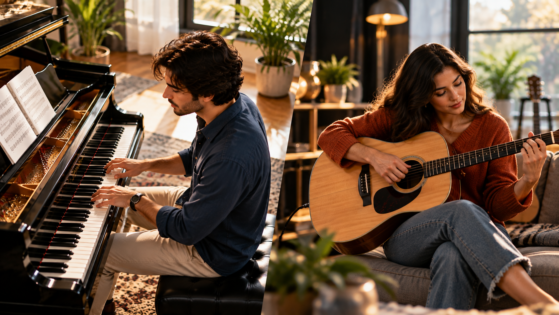
Piano is strongly connected with traditional staff notation. Pianists often read two clefs simultaneously, which can become challenging as the music becomes more advanced. Reading pitch, rhythm, articulation and dynamics while coordinating both hands requires concentration.
Guitarists can also read standard notation, but many beginners start with chord diagrams or tablature. These systems can make it possible to begin playing songs without immediately becoming fluent in traditional notation.
That convenience can make guitar feel easier for casual learners who mainly want to play popular songs.
Nevertheless, guitarists who want to develop strong musicianship can also learn standard notation, rhythm reading and more advanced theory. At that stage, the instrument can become just as intellectually demanding.
Chords and Harmony on Piano vs Guitar
When comparing Piano vs Guitar, both are excellent for learning chords and harmony, but they approach them differently. On piano, chords are easy to visualise because the notes are clearly laid out across the keyboard, helping learners understand major, minor and other chord structures. Guitar uses chord shapes and fretboard patterns, allowing familiar shapes to move along the neck to create different chords.
As musicians progress, both instruments introduce advanced concepts such as inversions, chord extensions and progressions. Ultimately, Piano vs Guitar offers two different but equally valuable ways to understand harmony.

Which Instrument Is Harder to Play Fast?
Speed is another area where the two instruments can become demanding.
A pianist needs precise finger movement and timing to play fast passages cleanly. Rapid scales, arpeggios and repeated notes require control rather than simply moving the fingers quickly.
Guitar speed depends heavily on technique. Fast alternate picking, intricate fingerpicking, rapid chord changes and lead guitar passages require highly coordinated movements between both hands.
Importantly, speed should not be confused with musical difficulty. A slow piece with complex rhythm, dynamics or phrasing can be more challenging than a fast piece with a simple repeating pattern.
Good technique is ultimately about control, accuracy and musical expression, not just playing as quickly as possible.
Piano vs Guitar | The Physical Side
Physical comfort is often overlooked when comparing the two instruments.
Piano generally does not require the same amount of finger pressure as guitar. The keys are pressed rather than held down against strings, so beginners may experience less discomfort during their first few sessions.
Guitar can initially be harder on the fingertips. Pressing strings repeatedly may cause soreness until the fingers gradually adapt. Barre chords can also require significant hand strength and positioning.
Posture matters for both instruments. Poor positioning can create unnecessary tension and make playing uncomfortable. Learning correct technique from the beginning helps reduce these problems and allows the player to develop more efficiently.
Which Is Harder for Beginners?
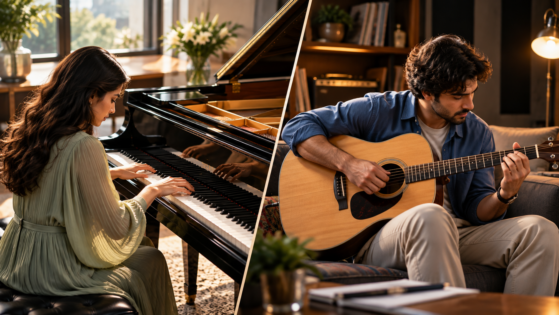
For a complete beginner, guitar may feel harder during the first stage, particularly because of chord shapes, finger pressure and hand coordination.
Piano often provides a more immediate sense of progress. A beginner can sit at the keyboard and produce clear notes within minutes, then gradually move toward simple melodies and chords.
That early accessibility can be encouraging.
Guitar, however, can quickly become rewarding once the basic physical challenges are overcome. Learning a few common chords may allow a beginner to accompany songs relatively early, which can provide strong motivation to continue.
So, while the first steps may feel different, both instruments can offer achievable milestones.
Which Becomes Harder at an Advanced Level?
The answer becomes much less straightforward as the learner progresses.
Advanced piano playing can involve complex sight-reading, polyrhythms, independent hand movements, rapid passages, intricate harmony and highly controlled dynamics. A pianist may have to coordinate several musical elements simultaneously.
Advanced guitar playing brings its own demands. Players may work on complicated chord voicings, fingerstyle arrangements, improvisation, fast lead passages, unusual rhythms and techniques that require considerable precision.
At a high level, both instruments are difficult in different ways.
The challenge is no longer simply producing the correct notes. It becomes about interpreting music, controlling tone, maintaining rhythm, expressing emotion and developing a personal style.
What About Learning Songs?
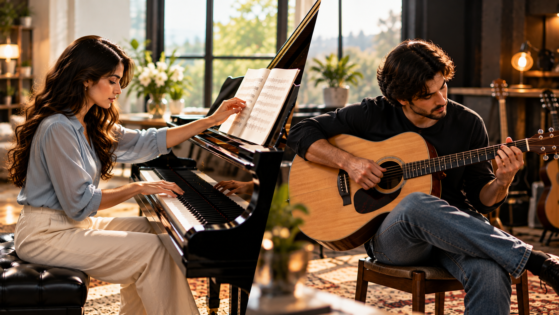
For people who want to learn their favourite songs, guitar can sometimes provide a quick route to playing familiar music. A small collection of common chords can be enough to accompany many songs, depending on the genre and arrangement.
Piano also allows beginners to learn recognisable melodies and simple chord progressions relatively quickly. Popular songs can often be simplified for beginners, making them accessible without requiring the learner to master the complete original arrangement.
The difficulty changes depending on what you want to achieve.
Playing a simplified version of a song is very different from performing the original arrangement exactly. Once learners aim for professional-level accuracy, both instruments demand significantly more technique and practice.
Does Your Musical Goal Matter?
Your goal can have a major impact on which instrument feels harder.
Someone interested in classical music may encounter a very different learning path from someone who simply wants to accompany songs. A learner interested in songwriting may value the ability to understand chords and harmony, while someone interested in performing lead melodies may focus more heavily on technique.
Piano can be particularly useful for developing a broad visual understanding of harmony and musical structure. Guitar can offer a natural connection to rhythm, chord-based accompaniment and a wide variety of popular and contemporary styles.
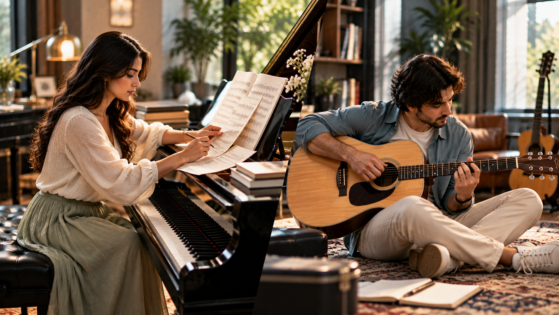
Neither choice limits a musician permanently. Many musicians eventually learn both instruments because the skills developed on one can complement the other.
Piano or Guitar | Which One Takes Longer to Learn?
There is no universal timeline for mastering either instrument.
A beginner can learn simple songs on both piano and guitar within a relatively short period with regular practice. Developing strong technique, musical understanding and performance ability, however, takes much longer.
Progress depends on practice consistency, lesson quality, personal goals and the complexity of the music being studied.
A student practising for fifteen minutes several times a week will naturally progress differently from someone practising for an hour every day. Structured guidance can also help learners avoid developing inefficient habits.
The important point is that learning an instrument is not a race. Every new chord, scale, melody or song adds another piece to your musical foundation.
So, Which Is Harder | Piano or Guitar?
The simplest answer is: neither instrument is universally harder.
Piano may feel easier at the beginning because producing clear notes and understanding the keyboard layout can be relatively intuitive. Its difficulty becomes increasingly apparent when learners move into independent hand coordination, advanced sight-reading and complex musical pieces.
Guitar can feel more challenging initially because of finger placement, string pressure and chord changes. Once those physical skills become familiar, however, the instrument opens up a huge range of musical possibilities and increasingly advanced techniques.
In the end, the “harder” instrument is often the one that demands skills you have not yet developed.
That is also what makes learning music so rewarding.
Final Thoughts
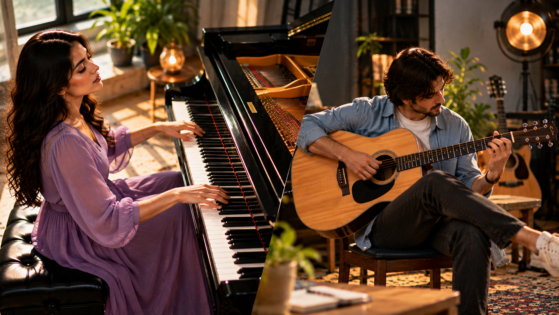
Piano and guitar each offer a unique musical journey. One gives you a beautifully organised keyboard where melody and harmony can be explored visually, while the other opens up a world of chords, rhythms and techniques across six strings.
Rather than focusing only on which instrument is harder, think about which one makes you want to sit down and play again tomorrow. With the right guidance and regular practice, Piano Lessons Online with The Mystic Keys can help you build your skills step by step while keeping learning enjoyable and flexible.
The first few weeks may test your patience, but every small improvement—from playing your first melody to completing your first song—builds confidence. Whether you choose the keys or the strings, the real challenge is staying curious, practising consistently and turning those first awkward notes into music.
For more information and exciting resources about learning music, visit our website at The Mystic Keys. For more music content and exciting offers follow us on
Facebook, Instagram, YouTube, LinkedIn, Twitter, Pinterest, and Threads.