Piano Man Piano Lessons | What Every Pianist Can Learn
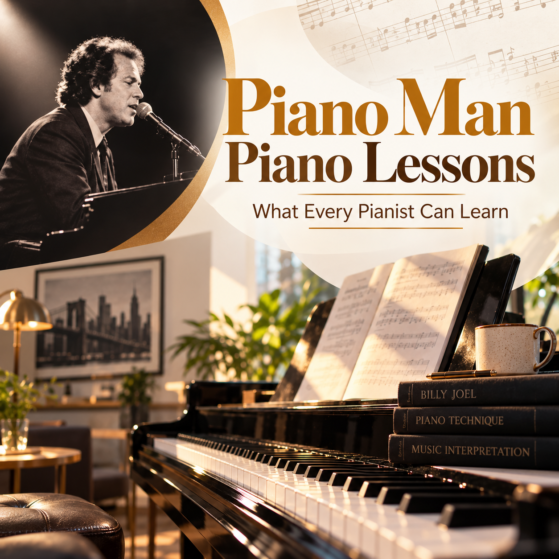
Some songs become more than just music. They become stories, memories, and emotions that listeners carry with them for years. “Piano Man” by Billy Joel is one such song, and learning it through Piano Man piano lessons can offer much more than simply learning a familiar melody. With its memorable tune, storytelling lyrics, and expressive piano accompaniment, the song has become a favourite among musicians and listeners across generations, while also offering pianists valuable lessons in rhythm, chords, phrasing, dynamics, and musical expression.
For pianists, however, Piano Man offers much more than an enjoyable song to learn. Beneath its familiar melody lies a valuable lesson in accompaniment, rhythm, chord movement, dynamics, phrasing, and musical storytelling. Whether you are a beginner learning your first complete song or an experienced pianist looking to strengthen your interpretation skills, studying Piano Man can reveal important aspects of becoming a more expressive musician.

Why “Piano Man” Is Such a Valuable Song for Pianists
At first, Piano Man may appear relatively straightforward. The melody is recognisable, the chord progression is accessible, and the piano part supports the vocal line without overwhelming it. Yet this apparent simplicity is precisely what makes the song such a useful learning experience.
A pianist has to do more than simply play the correct notes. The accompaniment needs to create the right atmosphere while leaving enough space for the singer and the story. Every chord, rhythmic figure, and change in intensity contributes to the character of the song.
That balance is an important skill for any pianist. Learning a technically complicated piece can certainly develop coordination, but a song like Piano Man teaches another equally important lesson: music does not have to be complicated to be expressive.
Piano Man Piano Lessons | Learning the Art of Accompaniment
One of the most important skills a pianist can develop through Piano Man is effective accompaniment. When accompanying a singer, another instrumentalist, or even your own voice, the piano should support the musical idea rather than compete with it.
The pianist therefore has to listen carefully. Chords need to be played with enough presence to establish the harmony, while the rhythmic patterns should remain controlled and consistent. Too much force can distract from the vocal melody, whereas playing too softly or mechanically can make the performance feel flat.
This kind of accompaniment develops musical awareness. Instead of thinking only about your own hands, you begin to consider the complete musical picture. That ability becomes useful far beyond one particular song.

Understanding Chords Beyond Memorisation
Piano Man can also be an excellent opportunity to understand chord progressions rather than simply memorising a sequence of shapes.
When students learn a song only by copying hand positions, they may be able to reproduce the piece but struggle when asked to play it in another key or adapt the accompaniment. Understanding the underlying harmony changes that experience. Once you recognise how the chords move and how they support the melody, the song becomes easier to analyse and adapt.
This is where practical music theory becomes meaningful. Instead of treating theory as a separate academic subject, pianists can see how chords function inside an actual song.
The same understanding can later help with other popular songs, accompaniment patterns, improvisation, songwriting, and arranging. In that sense, one song can become a doorway into a much broader understanding of the keyboard.
Rhythm Gives the Song Its Character
A strong melody can attract attention, but rhythm helps determine how that melody feels.
The piano accompaniment in Piano Man demonstrates how a consistent rhythmic foundation can carry a song while still allowing the performance to breathe. For students, this provides an opportunity to work on timing, coordination, and rhythmic stability.
Playing along with a metronome can help develop consistency, but rhythm should not become completely mechanical. Once the basic timing is secure, pianists can begin exploring how subtle changes in emphasis and articulation affect the overall feel.
That transition—from simply keeping time to actually feeling the rhythm—is an important stage in musical development.

Piano Man Piano Lessons | Exploring Dynamics and Expression
Another valuable lesson comes from dynamics. A performance becomes much more engaging when its intensity changes naturally.
If every chord and phrase is played at exactly the same volume, even a beautiful song can begin to sound predictable. Piano Man provides opportunities to explore softer accompaniment, stronger sections, gentle transitions, and moments where the piano needs to step back.
Dynamic control is not simply about playing loudly or quietly. It is about understanding what the music is trying to communicate at a particular moment.
For developing pianists, this can be a significant shift in thinking. Instead of asking, “Am I playing the right notes?” you begin asking, “How should this phrase make the listener feel?”
Learning to Tell a Story Through Music
Perhaps the greatest lesson Piano Man offers is storytelling.
The song paints a picture of people, conversations, loneliness, dreams, and everyday life. The piano accompaniment becomes part of that storytelling rather than existing independently from it.
A pianist therefore needs to think beyond technique. The way a chord is approached, the amount of space left between phrases, and the intensity used at different moments can all influence how the story is experienced.
This principle applies to almost every style of music. Whether you are performing classical repertoire, jazz, pop, worship music, film music, or a simple contemporary song, expressive playing comes from understanding the emotion behind the notes.

Piano Man Piano Lessons | Developing Better Phrasing
Phrasing is another area where studying Piano Man can help pianists grow.
A musical phrase should have direction. It needs to feel as though it is moving somewhere rather than consisting of a collection of unrelated notes and chords. The pianist can shape that movement through articulation, dynamics, timing, and emphasis.
Beginners often concentrate heavily on getting through a song from beginning to end. As they become more experienced, the focus gradually changes toward shaping individual musical ideas.
That is where a familiar song can become surprisingly educational. Playing the same progression repeatedly is not enough; the goal is to make each phrase feel intentional.
The Importance of Listening While Playing
Good pianists do not simply play—they listen.
While working on Piano Man, students can develop the habit of listening to their tone, balance, rhythm, chord changes, and interaction with the melody. If they are accompanying another vocalist, listening becomes even more important because the piano must respond to what is happening around it.
This creates a stronger connection between technique and musical awareness. Finger movement becomes only one part of the process, while the ears begin guiding the hands.
Over time, active listening can make performances more controlled, expressive, and confident.

Piano Man Piano Lessons for Beginners
For beginners, learning a recognisable song can be highly motivating. Instead of spending months practising isolated exercises without seeing how those skills connect to real music, students can apply techniques directly to a song they know.
Piano Man can introduce learners to chord changes, accompaniment patterns, rhythm, dynamics, coordination, and musical structure within one practical context.
At the same time, beginners should avoid rushing into the full performance before becoming comfortable with the foundations. Breaking the accompaniment into manageable sections, practising chord transitions slowly, and gradually increasing the tempo can make the learning process more productive.
The objective is not simply to finish the song. It is to understand what you are playing and why it works.
What Intermediate and Advanced Pianists Can Explore
More experienced pianists can take a different approach to the same song.
Rather than focusing mainly on learning the notes, they can experiment with voicings, inversions, rhythmic variations, articulation, dynamics, and accompaniment textures. These choices can transform a familiar arrangement while keeping its musical identity intact.
Improvisation is another interesting area to explore. Once the harmonic structure is understood, a pianist can experiment with fills and transitions while maintaining the character of the original piece.
Such experimentation encourages musicians to move from being performers of music toward becoming interpreters of music.

Why One Song Can Teach So Much
A useful song for learning piano does not necessarily need to be technically difficult. In fact, a relatively accessible piece can sometimes teach more practical musicianship because students can focus on expression, timing, harmony, and interaction.
Piano Man brings several important skills together. The pianist has to coordinate the hands, understand the chords, maintain the rhythm, support the melody, control dynamics, and communicate the mood.
These skills are transferable. Once developed, they can be applied to countless other songs and musical situations.
Consequently, learning one song thoughtfully can be far more valuable than rushing through several songs without understanding their musical structure.

Turning a Familiar Song Into a Complete Learning Experience
The most effective piano lessons often connect technique with real musical goals. A song such as Piano Man provides exactly that opportunity.
A teacher can use the piece to introduce chord theory, accompaniment techniques, rhythm exercises, ear training, phrasing, and performance skills. Students can then apply those concepts directly rather than treating each lesson as an isolated exercise.
With personalised guidance, the arrangement can also be adapted to the learner’s level. A beginner may work on a simpler chord-based accompaniment, while a more experienced pianist can explore richer voicings and stylistic variations.
This makes the learning experience both practical and progressive.
From Playing Notes to Making Music
There is an important difference between playing a song correctly and making it sound musical.
Accuracy is certainly essential. However, once the notes and chords are under control, the pianist has another challenge: creating expression.
Piano Man provides a wonderful example of how accompaniment can create atmosphere without dominating the song. Its value lies not only in the notes themselves but in how those notes support melody, rhythm, harmony, and storytelling.
That is a lesson every pianist can carry into their musical journey.

Final Thoughts on Piano Man Piano Lessons
Learning Piano Man can be much more than learning a popular song. It offers valuable lessons in chords, rhythm, accompaniment, dynamics, phrasing, and musical expression.
With Piano Lessons Online, learners can develop these skills through personalised guidance and flexible practice. At The Mystic Keys, online piano lessons help students build technique, confidence, and musicality—one song at a time.
For more information and exciting resources about learning music, visit our website at The Mystic Keys. For more music content and exciting offers follow us on
Facebook, Instagram, YouTube, LinkedIn, Twitter, Pinterest, and Threads.