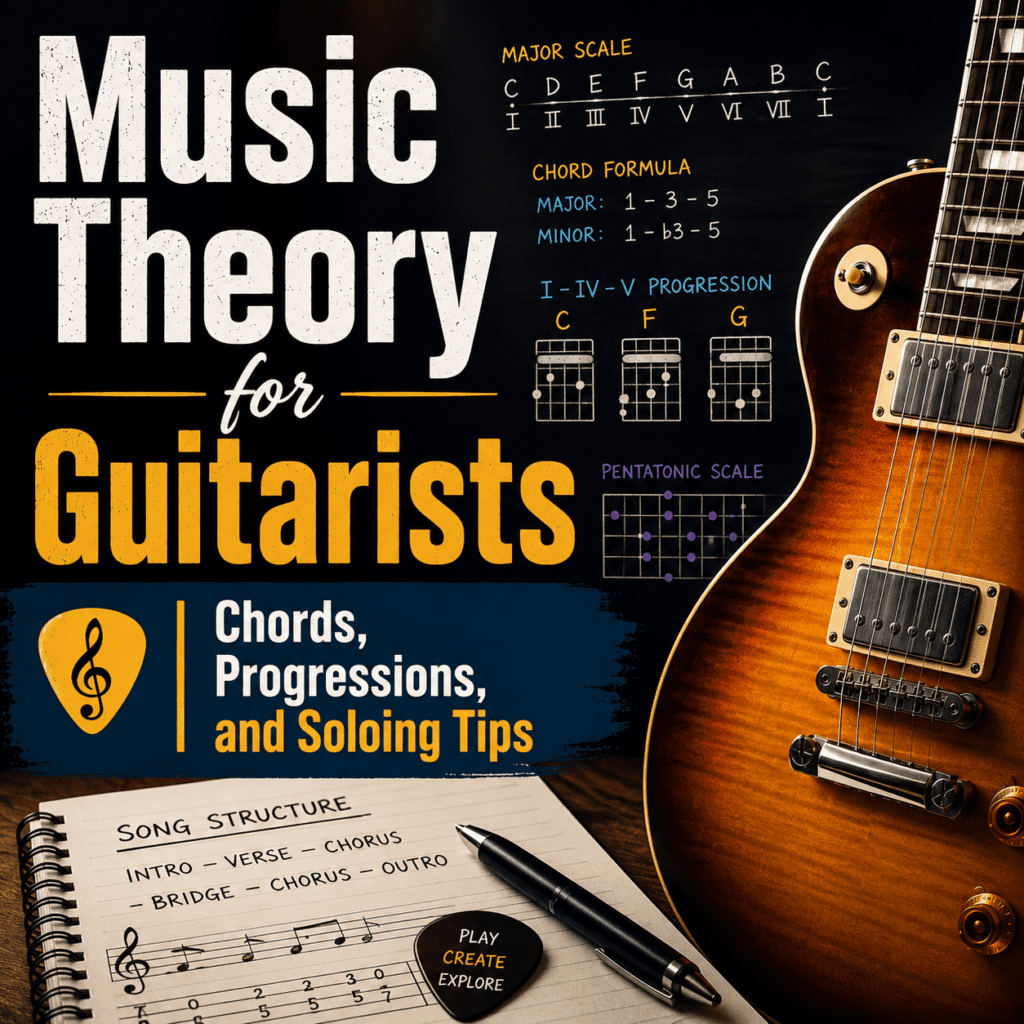
Music Theory for Guitarists | Chords, Progressions, and Soloing Tips
Music theory is often seen as complicated, but for guitarists, it is one of the most valuable tools for improving playing skills. Understanding music theory helps guitar players build chords, create better chord progressions, improvise confidently, and develop expressive solos. Whether you are a beginner or an advanced player, learning the basics of music theory can transform the way you approach the guitar.
In this guide, we’ll explore the essential concepts of Music Theory for Guitarists: Chords, Progressions, and Soloing Tips to help you become a more versatile musician.
1. Why Music Theory for Guitarists Matters
Many guitarists learn songs by memorizing chord shapes and tablature. While this approach can help you play songs quickly, music theory allows you to understand why certain notes and chords work together.
Benefits of learning music theory include:
- Faster learning and memorization
- Better improvisation skills
- Easier songwriting and composition
- Improved communication with other musicians
- Greater confidence when performing
By understanding theory, guitarists gain the freedom to create music rather than simply copy it.
2. Understanding Chords in Music Theory for Guitarists
Chords are the foundation of most guitar music. A chord is created by combining multiple notes from a scale.
The most common chord types include:
Major Chords
Major chords have a bright and happy sound. They are built using:
- Root
- Major Third
- Perfect Fifth
Example: C Major = C – E – G
Minor Chords
Minor chords create a darker and more emotional sound.
- Root
- Minor Third
- Perfect Fifth
Example: A Minor = A – C – E
Seventh Chords
Adding a seventh note creates richer harmony and is widely used in blues, jazz, worship, and pop music.
Learning chord construction helps guitarists understand the fretboard and create new chord voicings.
3. Learning Scales Through Music Theory for Guitarists
Scales provide the building blocks for melodies, solos, and chord creation.
Major Scale
The major scale forms the basis of Western music theory and helps players understand key signatures and chord relationships.
Minor Scale
The minor scale adds emotional depth and is frequently used in rock, blues, and worship music.
Pentatonic Scale
One of the most important scales for guitarists, the pentatonic scale is simple, versatile, and perfect for soloing.
Practicing scales regularly improves finger strength, fretboard knowledge, and improvisation skills.
4. Understanding Chord Progressions in Music Theory for Guitarists
A chord progression is a sequence of chords played in a specific order. Most popular songs are built around a few common progressions.
Popular examples include:
I–IV–V Progression
Used extensively in blues, rock, and country music.
I–V–vi–IV Progression
Found in countless pop and worship songs.
ii–V–I Progression
A fundamental progression in jazz music.
Understanding Roman numerals helps guitarists transpose songs into different keys while maintaining the same harmonic structure.
5. Soloing Tips Every Guitarist Should Know
Great solos are not just about speed—they are about melody, timing, and expression.
Effective soloing techniques include:
- Target chord tones while improvising
- Use scales that match the song’s key
- Create memorable melodic phrases
- Leave space between musical ideas
- Develop themes and repeat variations
Listening carefully to the backing chords helps solos sound more musical and connected.
6. Connecting Chords and Scales with Music Theory for Guitarists
One of the biggest breakthroughs for guitarists is understanding how chords and scales connect.
When you know which scale belongs to a chord progression, you can:
- Improvise confidently
- Build better solos
- Create harmonized melodies
- Navigate the fretboard more efficiently
For example, a progression in G Major can often be paired with the G Major Scale or G Major Pentatonic Scale for melodic ideas.
Practicing chord shapes and scale patterns together develops a stronger understanding of the instrument.
7. Practical Music Theory Exercises for Daily Practice
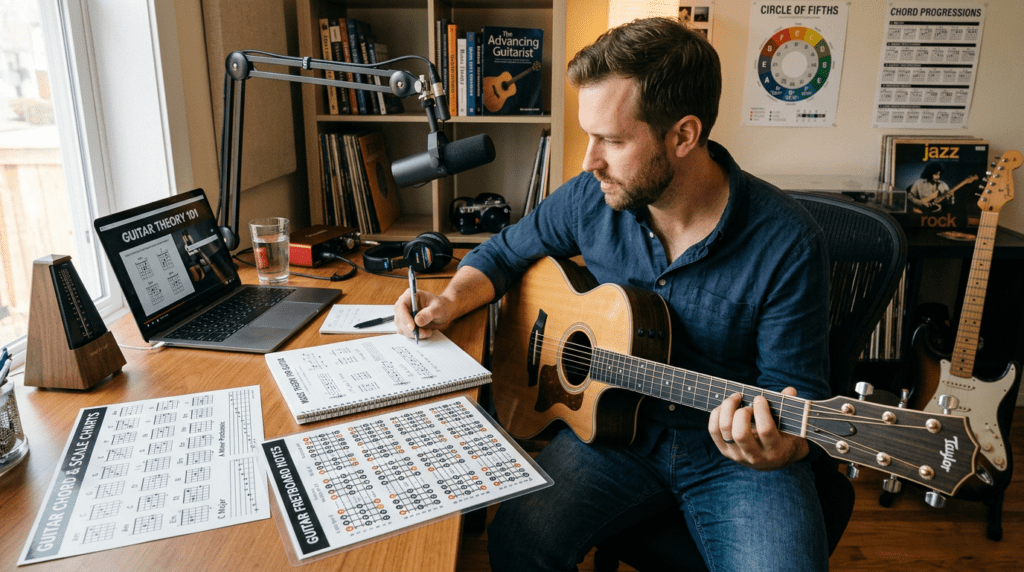
Consistent practice is the key to mastering music theory on guitar.
Try these exercises:
- Identify the notes in every chord you play.
- Practice major and minor scales in multiple positions.
- Analyze chord progressions from your favorite songs.
- Create simple solos using pentatonic scales.
- Transpose common progressions into different keys.
- Play arpeggios over backing tracks.
- Record yourself and evaluate your note choices.
Even 15–20 minutes of focused theory practice each day can lead to noticeable improvement.
Conclusion
Learning Music Theory for Guitarists: Chords, Progressions, and Soloing Tips is one of the best investments you can make in your musical journey. Music theory helps you understand how chords are built, how progressions create movement, and how scales can be used to craft expressive solos. With regular practice and a willingness to explore new concepts, you can become a more confident guitarist, songwriter, and performer.
Whether your goal is to play worship music, rock, blues, jazz, or contemporary songs, music theory provides the foundation needed to unlock your full potential on the guitar. If you’re looking to accelerate your progress, learn guitar lessons online with The Mystic Keys to receive expert guidance, structured training, and practical exercises that help you apply music theory effectively in real-world playing situations. The experienced instructors at The Mystic Keys can help you build a strong musical foundation while developing the skills needed to become a confident and versatile guitarist.
For more information and exciting resources about learning music, visit our website at The Mystic Keys. For more music content and exciting offers follow us on
Facebook, Instagram, YouTube, LinkedIn, Twitter, Pinterest, and Threads.