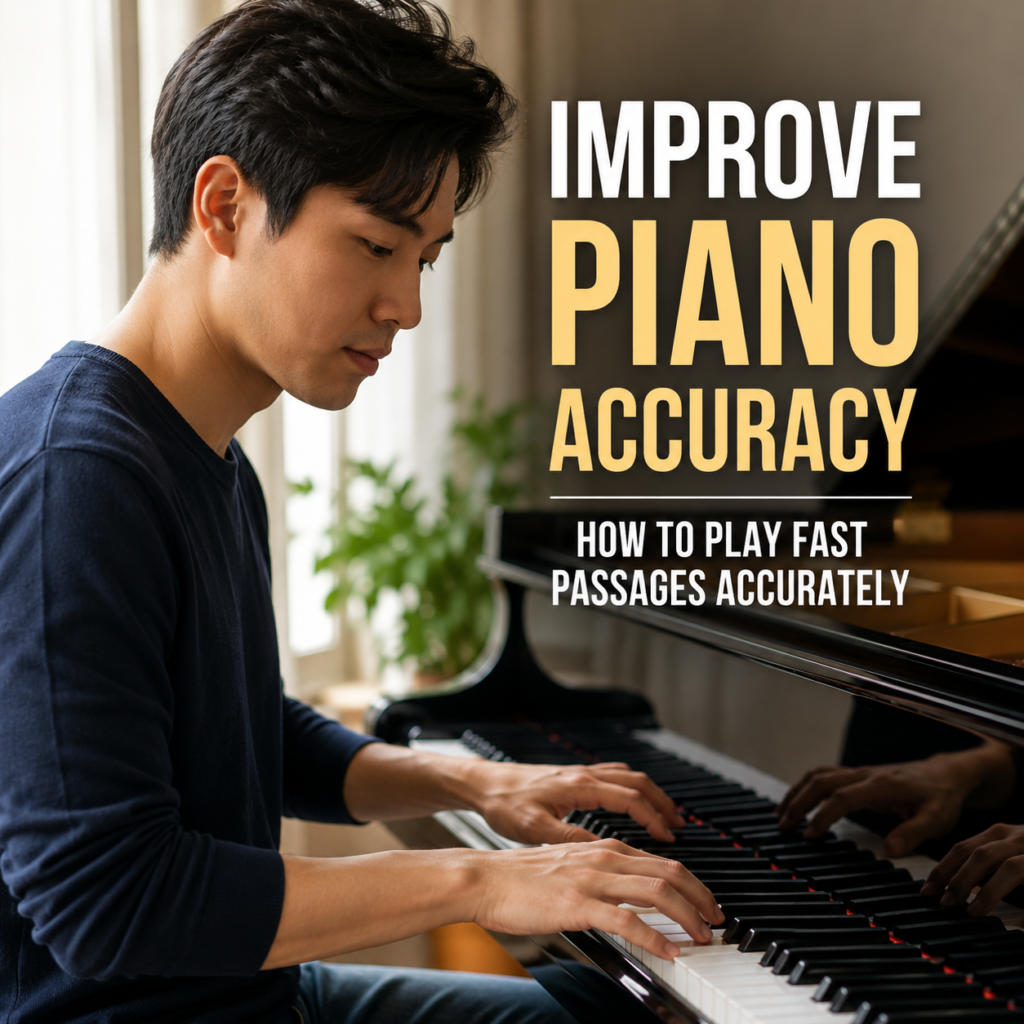
Improve Piano Accuracy | How to Play Fast Passages Accurately
Playing fast passages on the piano can be thrilling. When your fingers move quickly across the keys and every note sounds clear, even a technically demanding piece can feel effortless. However, speed without accuracy can quickly turn a beautiful performance into a blur of missed notes, uneven rhythms, and unnecessary tension. That is why learning how to improve piano accuracy is essential for developing speed, control, and confidence at the keyboard.
For many pianists, the natural response to a difficult fast passage is to play it repeatedly at full speed. Unfortunately, this often reinforces mistakes rather than fixing them. The key to playing fast passages accurately is not simply to move your fingers faster. Instead, you need to develop coordination, control, muscle memory, rhythmic stability, and careful listening.
Whether you are learning scales, arpeggios, classical runs, contemporary piano passages, or technically demanding sections from a performance piece, accuracy should always come before speed. Once your fingers know exactly what to do, increasing the tempo becomes much easier.
This guide explores practical ways to improve piano accuracy and learn fast passages without sacrificing clarity, musicality, or control.
Why Is Piano Accuracy So Important?
Accuracy is one of the foundations of good piano playing. A pianist may have impressive speed, but if notes are frequently missed or rhythms become inconsistent, the performance loses its musical impact. Fast playing magnifies small technical problems, which is why accuracy becomes even more important as the tempo increases.
When you play slowly and accurately, your brain has enough time to process the notes, fingering, rhythm, articulation, and movement between different positions. As the tempo gradually increases, these elements become more automatic. That is how reliable technique develops.
Moreover, accuracy allows you to concentrate on musical expression instead of worrying about which note comes next. Once a passage becomes secure, you can focus more naturally on dynamics, phrasing, articulation, tone, and musical character.
A fast passage should therefore feel controlled rather than rushed. The goal is not to make your fingers move as quickly as possible; it is to make every movement efficient enough that speed happens naturally.

Improve Piano Accuracy by Starting Slowly
One of the most effective ways to improve piano accuracy is surprisingly simple: slow down.
When learning a fast passage, begin at a tempo where you can play every note correctly without hesitation. This gives you an opportunity to understand the passage instead of merely trying to survive it. Slow practice also makes it easier to identify awkward finger movements, incorrect notes, uneven rhythms, and unnecessary tension.
For example, if a passage is eventually meant to be played at 120 beats per minute, you might begin around 50–60 beats per minute. At this tempo, listen carefully to every note. Make sure the fingering feels comfortable and that your hands remain relaxed.
Once you can play the passage several times accurately, increase the tempo gradually. Even a small increase of 5–10 beats per minute can be useful. If accuracy begins to disappear, return to the previous tempo rather than forcing yourself forward.
This approach may initially feel slower, but it actually saves time. Practising mistakes at high speed makes them harder to remove later, whereas slow and deliberate practice builds a more dependable technical foundation.
Divide the Passage Into Smaller Sections
A long fast passage can look intimidating when you try to learn it from beginning to end. Instead of treating it as one large movement, divide it into smaller, manageable sections.
You might work on four or eight notes at a time, depending on the complexity of the music. Once one small section feels comfortable, connect it to the next section. Gradually, these smaller pieces become one continuous musical phrase.
This method is particularly helpful when a passage contains difficult transitions. Sometimes the individual notes are not actually the problem. The real difficulty lies in moving from one position, chord, or fingering pattern to another.
Practising the transition separately can make a significant difference. Play the final few notes of one group together with the first few notes of the next group. Repeat that connection until the movement feels natural, then gradually extend the section.
As a result, your practice becomes more targeted. Instead of repeating an entire passage and hoping the difficult part improves, you are directly working on the movement that needs attention.

Improve Piano Accuracy With a Metronome
A metronome can be one of the most useful tools for developing accuracy in fast piano passages. It provides an external pulse and helps prevent your tempo from gradually speeding up or slowing down.
Start with a comfortable tempo where you can play the passage accurately. Once you feel secure, increase the metronome slightly. The objective is to maintain the same level of control at every stage.
However, avoid treating the metronome as a race. Increasing the tempo after every successful attempt can sometimes encourage tension and careless playing. Give yourself enough time to become comfortable at each tempo.
You can also practise difficult passages with different rhythmic approaches. For example, a sequence of evenly spaced notes can be practised using long-short and short-long rhythms. This changes the emphasis between notes and can help strengthen finger control.
Eventually, return to the original rhythm and notice whether the passage feels more secure. These variations can make repetitive practice more productive while helping your fingers become comfortable with different movement patterns.
Focus on Fingering
Correct fingering plays a major role in piano accuracy, especially when playing fast passages. An inefficient fingering pattern can make even a relatively simple passage feel unnecessarily difficult.
Before practising at speed, decide which fingers you are going to use. If the score provides fingering suggestions, consider them carefully, particularly in technically demanding passages. A fingering pattern that works well at a slow tempo may also help you maintain consistency when the speed increases.
Once you choose a fingering pattern, try to use it consistently. Frequently changing fingers because one note feels awkward can create confusion and make the passage less predictable.
At the same time, remember that fingering is not completely identical for every pianist. Hand size, flexibility, technique, and previous training can influence what feels comfortable. The best fingering is usually the one that allows you to move efficiently while keeping the hand relaxed and the notes even.
Keep Your Hands and Wrists Relaxed
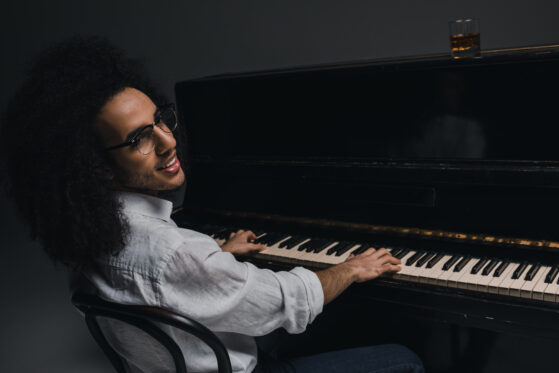
Tension is one of the biggest obstacles to playing fast passages accurately.
When pianists become nervous about making mistakes, they often tighten their fingers, wrists, forearms, or shoulders. Unfortunately, this tension can make movement slower rather than faster. The fingers become less flexible, and unnecessary effort is introduced into every note.
Pay attention to how your hands feel while practising. Your fingers should be active, but they should not feel rigid. The wrist should remain flexible enough to support natural movement rather than becoming locked in one position.
Take short pauses during practice and release any tension you notice. Shake your hands gently, relax your shoulders, take a breath, and begin again.
Interestingly, playing faster often requires less physical effort, not more. Efficient technique allows the hands to make smaller, better-coordinated movements. Instead of forcing every note, learn to let your fingers move with precision and economy.
Improve Piano Accuracy With Rhythmic Variations
Repeating the same pattern hundreds of times can sometimes lead to mindless practice. Rhythmic variations offer a useful way to challenge your fingers while strengthening control.
Suppose you have a rapid sequence of evenly spaced sixteenth notes. Rather than always playing them evenly, experiment with different rhythmic groupings. Play one note longer and the next one shorter, then reverse the pattern.
This technique brings attention to individual notes that may otherwise disappear within the larger passage. It can also reveal weak fingers or transitions that are not obvious when the passage is played normally.
After working with the variations, return to the original rhythm. The passage may feel more controlled because your fingers have received additional coordination practice.
Rhythmic variation is especially useful for scales, repeated-note patterns, arpeggios, and other technical exercises. It transforms a simple repetition into more focused practice.

Practise Hands Separately When Necessary
Playing both hands together is essential for learning a piece, but it is not always the best starting point for a difficult fast passage.
If both hands are struggling simultaneously, separate them temporarily. Practising the right hand alone allows you to focus on its fingering and movement without worrying about the left hand. The same applies when working on a demanding left-hand pattern.
Once each hand feels secure independently, bring them together slowly.
This approach is particularly useful when the two hands have different rhythms or technical patterns. A pianist may know the notes individually but still struggle with coordination when both hands are combined. Slow hands-together practice gives the brain time to establish the relationship between the parts.
The goal is not to avoid hands-together practice. Rather, hands-separate work should be used as a tool to solve specific problems before returning to the complete passage.

Improve Piano Accuracy With Small Bursts of Speed
One useful technique for developing speed is to practise short bursts rather than immediately attempting the entire passage at the final tempo.
Choose a small group of notes and play them quickly while remaining relaxed and accurate. Stop, reset, and repeat. Once that movement feels comfortable, connect it to the next group.
This teaches your fingers what the faster tempo feels like without requiring you to maintain that speed for an extended period.
Gradually, increase the length of the fast sections. Eventually, you can connect several bursts into a complete passage.
This method can be particularly effective when you have reached a technical plateau. Sometimes the fingers are capable of playing faster, but the pianist has not yet developed enough confidence to sustain the speed. Short bursts introduce the faster movement without overwhelming the hands.

Listen Carefully While You Practise
Piano accuracy is not only about where your fingers land. It is also about what you hear.
When playing a fast passage, it can be tempting to focus entirely on finger movement. However, careful listening is essential for identifying uneven notes, missing notes, accidental accents, unclear articulation, and unstable rhythm.
Try recording yourself occasionally. A passage may feel accurate while you are playing it, but the recording can reveal small inconsistencies that are difficult to notice in the moment.
Listen for whether every note has the same level of clarity required by the music. Pay attention to the rhythm as well. Are certain notes being rushed? Are transitions becoming uneven? Does the passage become louder simply because you are playing faster?
Developing this listening habit helps you become more independent as a pianist. Instead of relying only on your fingers to tell you whether something is correct, your ears become an active part of the learning process.

Improve Piano Accuracy by Using Accents
Accenting selected notes can be another useful practice technique for difficult fast passages.
For example, when practising a group of sixteenth notes, lightly emphasize every fourth note. After several repetitions, move the accent to a different position within the group.
This makes certain fingers work more actively and helps expose weaknesses in coordination. It also gives the hand a different rhythmic sensation, which can make repetitive technical practice more engaging.
Once you return to the normal dynamic level, the passage can feel more balanced and controlled.
The important point is to use accents as a temporary practice tool. The final performance should reflect the musical phrasing and dynamics written in the score rather than the exaggerated accents used during technical practice.
Avoid Practising Mistakes at Full Speed
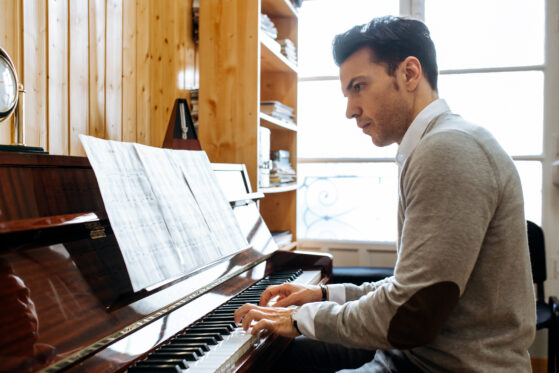
One of the most common mistakes pianists make is repeatedly playing a difficult passage incorrectly and hoping it will eventually improve.
Unfortunately, repetition alone does not guarantee improvement. Your brain and muscles learn whatever pattern you repeatedly practise. If you consistently miss the same note or use excessive tension during a particular movement, that pattern can become increasingly familiar.
Instead, stop when you notice a recurring mistake. Identify exactly what is going wrong and isolate that section.
Perhaps the problem is the fingering. Maybe your hand is moving too late, or the wrist is becoming tense. In some cases, the rhythm is causing the difficulty. Once you identify the cause, slow the passage down and practise the specific movement correctly.
Quality practice is far more valuable than simply accumulating repetitions.

Improve Piano Accuracy by Recognizing Movement Patterns
Fast piano passages often look more complicated than they actually are.
Many pieces contain repeated shapes, scales, broken chords, arpeggios, sequences, or familiar fingering patterns. Recognizing these structures can make a passage easier to understand and remember.
Instead of thinking about every individual note, look for groups and patterns. Ask yourself whether the notes form a scale, chord shape, arpeggio, sequence, or repeated musical idea.
This reduces the amount of information your brain has to process while playing. Rather than thinking, “I have to play these twelve individual notes,” you may begin to see them as one familiar pattern.
Pattern recognition becomes increasingly valuable as music becomes more advanced. Experienced pianists often appear to play difficult passages effortlessly because they are not consciously processing every note separately. Their knowledge of musical patterns allows them to anticipate movements and make faster decisions.
Practise the Passage Backward
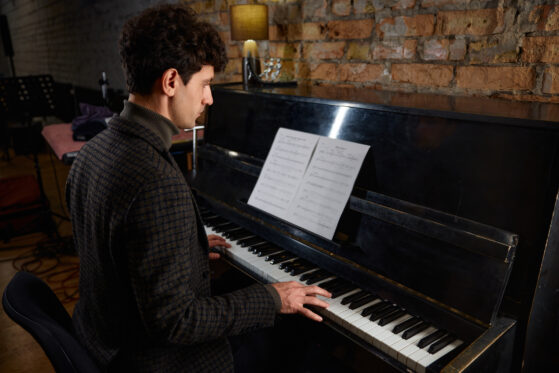
Another effective strategy is to practise difficult passages from the end toward the beginning.
Start with the final few notes and make sure they are secure. Then add the preceding group. Continue working backward until you eventually reach the beginning of the passage.
Why can this help? When pianists always practise from the beginning, they often become very comfortable with the first part while the final section remains less secure. Starting from the end gives the later portion additional attention.
It can also help you practise transitions more effectively. Connecting a newly learned section to a previously learned one creates a stronger sense of continuity.
You do not need to use this technique for every passage. However, it can be particularly useful when the ending of a run repeatedly falls apart during performance.

Gradually Increase the Tempo
Once you can play a passage comfortably and accurately at a slower tempo, begin increasing the speed gradually.
Small tempo increases are usually more effective than dramatic jumps. If a passage is secure at 70 BPM, moving immediately to 110 BPM may create unnecessary tension and mistakes. Increasing to 75 or 80 BPM gives your technique time to adapt.
At each stage, listen carefully. Accuracy should remain the priority.
If the passage becomes unstable at a particular tempo, do not interpret that as failure. Instead, treat it as useful information. That tempo has revealed the current limit of your coordination. Return to a slightly slower speed, reinforce the movement, and try again later.
With consistent practice, the point at which the passage begins to break down will gradually move upward.
Improve Piano Accuracy by Avoiding Rushing
Fast playing and rushed playing are not the same thing.
A fast performance still has a clear pulse, controlled rhythm, deliberate articulation, and musical direction. Rushed playing often loses these qualities because the pianist is trying to get through the passage rather than actively controlling it.
This distinction becomes especially important during performances. Nervousness can cause the tempo to accelerate unconsciously, particularly in technically demanding sections.
Practising with a metronome helps establish internal stability, while recording yourself can reveal whether your tempo remains consistent. Breathing also matters. A relaxed physical state makes it easier to maintain control when the music becomes demanding.
Think of speed as controlled energy rather than panic. The notes should move quickly, but your musical intention should remain calm.

Give Your Brain Time to Learn
Technical improvement does not happen entirely during the time you spend at the piano.
Your brain continues processing musical patterns after practice, which is one reason regular, focused sessions can be more effective than exhausting yourself with marathon repetitions.
If a passage is particularly difficult, practise it for a focused period and then move to something else. Returning to it later may reveal that the movement feels more natural than it did earlier.
Sleep and rest also play an important role in learning. Giving your brain time to consolidate new motor patterns can help transform conscious movements into more automatic ones.
Consequently, practising intelligently is often more productive than simply practising longer.
Practise With Musical Expression From the Beginning
Accuracy should not mean playing mechanically.
Even while practising slowly, try to maintain some sense of musical direction. Observe the dynamics, phrasing, articulation, and character of the passage. Doing so prevents you from developing a technically accurate version that later feels disconnected from the music.
As your tempo increases, gradually bring the musical expression with you.
A beautiful fast passage is not simply a collection of correct notes. It has shape, energy, contrast, and purpose. Technical control should support those musical qualities rather than replacing them.
This is particularly important when preparing for performances or examinations. Examiners and audiences are listening not only for correct notes but also for musical communication.

Improve Piano Accuracy With a Structured Practice Routine
A structured practice routine can make the process much more efficient.
Begin by playing the passage slowly enough to identify any technical problems. Work on fingering and hand position before increasing the tempo. Next, isolate the most difficult transitions and practise them separately.
After that, use a metronome and increase the speed gradually. Add rhythmic variations or accents if particular fingers or movements need additional strengthening. Once the passage becomes secure, play it at a slightly slower tempo than your maximum comfortable speed to reinforce consistency.
Finally, try the complete passage without stopping.
This combination of slow work, targeted practice, gradual speed development, and complete runs creates a much stronger foundation than simply repeating the passage from beginning to end.
What If You Keep Making the Same Mistake?
Repeated mistakes usually have a reason.
If you consistently miss one note, examine what happens immediately before it. The problem may not be the note itself. Your hand might be arriving late, your finger may be poorly positioned, or another movement may be creating tension.
Slow down significantly and isolate the movement. Try playing only the notes surrounding the mistake. Then gradually expand the section.
Another useful strategy is to change your starting point. If you always begin several measures earlier, your brain may associate the difficult moment with anxiety or anticipation. Starting directly from the problem area can help establish a new movement pattern.
Once the section is secure, place it back into the musical context.
The important thing is to solve the problem rather than repeatedly practising the symptom.

How Long Does It Take to Improve Piano Accuracy?
There is no universal timeline for developing speed and accuracy.
The time required depends on the complexity of the passage, your current technical level, the size of the tempo increase, your familiarity with the musical patterns, and how consistently you practise.
A beginner may need considerable time to develop basic finger coordination, while an experienced pianist may learn a similar passage much more quickly.
Progress can also happen unevenly. You might spend several days feeling as though nothing is changing, only to discover that the passage suddenly feels much easier.
Rather than measuring progress only by final tempo, look for smaller improvements. Are fewer notes being missed? Is your rhythm more stable? Are your hands more relaxed? Can you repeat the passage accurately several times in a row?
These are all signs that your technique is developing.

Common Mistakes to Avoid When Practising Fast Piano Passages
One major mistake is increasing the tempo too quickly. Another is practising continuously without identifying what is actually causing the difficulty. Both approaches can lead to frustration and unnecessary tension.
Ignoring fingering is another common problem. If your fingers keep changing positions unpredictably, maintaining accuracy at a high tempo becomes much harder.
Some pianists also focus exclusively on their hands while ignoring what they hear. That can allow small rhythmic and tonal inconsistencies to become habits.
Finally, avoid practising until your hands are exhausted. Fatigue reduces coordination and can encourage tension. Short, focused sessions with clear objectives are often more productive.
Improve Piano Accuracy and Build Greater Confidence
Confidence does not usually come before accuracy. It grows from accuracy.
When you know that your fingers can reliably execute a passage, you naturally feel more secure when playing it. That confidence then allows you to perform with greater freedom.
On the other hand, attempting to play faster than your technique can comfortably manage often creates anxiety. You start anticipating mistakes, which can increase tension and make those mistakes more likely.
Building speed gradually creates a different experience. Each successful tempo becomes evidence that the passage is becoming more secure.
Over time, the question changes from “Can I play this fast?” to “How musically can I play this fast?”
That is an important shift in a pianist’s development.

Final Thoughts | Accuracy First, Speed Second
Learning to play fast piano passages accurately is not about forcing your fingers to move faster. It requires efficient movement, coordination, strong listening, rhythmic stability, and confidence. With The Mystic Keys, students can build these fundamentals and approach challenging passages with greater control.
Start slowly, practise intentionally, and gradually increase the tempo. Break difficult sections into smaller parts, use a metronome, maintain relaxed hands, and focus on tricky transitions.
Most importantly, remember: speed should be the result of control, not the replacement for it. Consistent Piano Lessons Online can help you develop accuracy and technique step by step.
Don’t practise fast to become accurate. Practise accurately until fast becomes possible.
For more information and exciting resources about learning music, visit our website at The Mystic Keys. For more music content and exciting offers follow us on
Facebook, Instagram, YouTube, LinkedIn, Twitter, Pinterest, and Threads.