How Long Does It Take to Learn Guitar?
Introduction
Learning guitar is an exciting journey, but one of the first questions most beginners ask is, how long does it take to learn guitar? The answer depends on several factors, including how often you practice, your learning goals, the type of guitar you choose, and whether you receive structured guidance. Some beginners can play a few simple songs within their first few weeks, while developing advanced techniques may take months or years of consistent practice.
The good news is that you do not need to become an expert before you can enjoy playing music. With regular practice and realistic expectations, you can learn basic chords, strumming patterns, and familiar songs much sooner than you might expect.
In this guide, we will explore how long it takes to learn guitar, what you can achieve at different stages, which factors affect your progress, and how to build a practice routine that helps you improve.

How Long Does It Take to Learn Guitar as a Beginner?
For most beginners, learning guitar happens gradually. Your first goal should be to develop the basic skills needed to play simple music rather than trying to master everything at once.
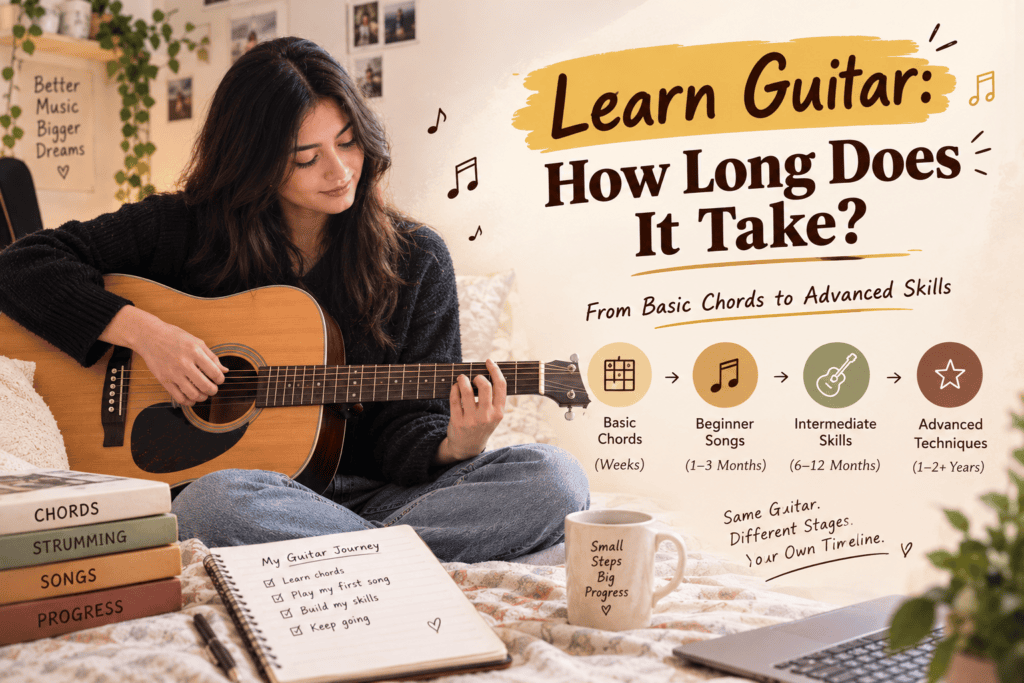
Here is a general timeline of what you may be able to achieve with consistent practice.
| Learning stage | Approximate timeline | What you may be able to do |
|---|---|---|
| First few weeks | 1–4 weeks | Learn basic guitar parts, hold the instrument correctly, and begin playing simple chords |
| Beginner level | 1–3 months | Change between common chords and play easy songs with basic strumming |
| Developing skills | 3–6 months | Improve rhythm, play more songs, and learn more chord shapes and patterns |
| Intermediate development | 6–12 months | Explore barre chords, more complex rhythms, and introductory fingerstyle techniques |
| Advanced development | 1–2+ years | Work toward more demanding songs, improved technique, and greater musical independence |
These are estimates, not strict deadlines. Your progress may be faster or slower depending on your practice habits, previous musical experience, and the skills you want to develop.
1. How Long Does It Take to Learn Basic Guitar Chords?
Estimated time: 1–4 weeks
Learning basic chords is one of the first milestones for a new guitarist. Open chords such as G major, C major, D major, E minor, and A minor appear in many popular songs, making them useful starting points.
During the first few weeks, you may find it difficult to position your fingers correctly or make every string ring clearly. This is completely normal. Your fingertips, finger coordination, and muscle memory need time to adapt.
What You Can Learn in the First Month of Guitar Practice
With regular practice, you can begin to:
Identify the main parts of the guitar.
Hold the guitar and pick comfortably.
Learn several basic open chords.
Strum simple rhythms.
Practice changing between two chords.
Play short chord progressions.
At first, you may need to pause between chord changes. Focus on producing clear sounds rather than playing quickly.
Practice tip: Spend five minutes reviewing chord shapes, five minutes changing between two chords, and five to ten minutes practicing a simple strumming pattern. Short, focused sessions can help you build a consistent routine.
2. How Long Does It Take to Play Your First Guitar Song?
Estimated time: 2–8 weeks
Many beginners can start playing simplified songs within their first few weeks. The exact timeline depends on how many chords the song uses and how complicated its rhythm is.
Songs with repeating progressions are usually easier to learn than songs requiring fast chord changes, intricate riffs, or advanced fingerpicking.
Easy Guitar Songs for Beginners
You could begin with simplified arrangements of songs such as:
“Riptide” by Vance Joy: Useful for practicing a small set of recurring chords.
“Knockin’ on Heaven’s Door” by Bob Dylan: Good for learning repeated chord progressions.
“Love Me Do” by The Beatles: Helps develop open-chord changes and steady strumming.
“Stand by Me” by Ben E. King: Useful for practicing consistent rhythm.
“Three Little Birds” by Bob Marley: Encourages relaxed playing and rhythmic control.
The chords and difficulty can vary depending on the arrangement, key, and capo position.
How to Learn Your First Guitar Song Faster
Choose a song you genuinely enjoy and divide it into small sections. Learn the chord progression first, then practice the strumming pattern separately. Once both feel comfortable, combine them.
Do not worry about matching the original recording immediately. Start slowly and build accuracy before increasing speed.
3. How Long Does It Take to Play Guitar Confidently?
Estimated time: 1–3 months
After a few months of consistent practice, many beginners can play several simple songs from beginning to end. You may also notice that your fingers move between familiar chords more naturally.
At this stage, your focus shifts from learning individual movements to combining them smoothly.
Skills You May Develop After Three Months of Learning Guitar
With regular practice, you may be able to:
Change between common open chords with fewer pauses.
Maintain a steady rhythm while strumming.
Play several beginner-friendly songs.
Recognize basic song structures.
Start playing along with recordings at a comfortable tempo.
Accompany your own singing, if that is one of your goals.
However, playing confidently does not mean every note will be perfect. Even experienced musicians continue working on timing, tone, and technique.
Practice tip: Record yourself playing one song every few weeks. Comparing recordings can help you notice improvements in rhythm, chord transitions, and overall confidence.
4. How Long Does It Take to Learn Intermediate Guitar Skills?
Estimated time: 6–12 months or longer
Intermediate guitar playing involves more than memorizing chords. You begin developing control over rhythm, dynamics, technique, and musical expression.
Your progress will depend on the style you want to learn. A guitarist who mainly plays pop songs may develop different skills from someone interested in fingerstyle, classical guitar, jazz, or lead guitar.
Guitar Skills You Can Develop at the Intermediate Stage
Barre chords: These chords require one finger to press down multiple strings. They can be challenging initially because they demand precise positioning and controlled pressure.
More complex strumming: You can explore syncopation, accents, rhythmic variations, and patterns suited to different genres.
Fingerstyle guitar: Fingerstyle playing allows you to combine bass notes, chords, and melody using your picking-hand fingers.
Playing with others: Learning to maintain tempo, listen to other musicians, and follow a shared arrangement helps you develop ensemble skills.
Basic music theory: Understanding keys, scales, chord progressions, and rhythm can help you learn songs more efficiently.
You do not need to master every technique to reach an intermediate level. Choose the skills that align with your musical goals and develop them progressively.

5. How Long Does It Take to Learn Advanced Guitar Techniques?
Estimated time: Several years of continued development
Advanced guitar techniques often require long-term practice, detailed feedback, and a deeper understanding of music.
Depending on your chosen style, advanced goals may include complex fingerstyle arrangements, fast lead guitar passages, improvisation, advanced fingerpicking, intricate rhythmic patterns, or sophisticated chord voicings.
What Affects the Time Needed to Master Guitar?
Advanced development depends on several factors:
The quality and consistency of your practice.
Your ability to identify and correct mistakes.
Your experience with rhythm and music theory.
Whether you receive useful feedback from a teacher.
How regularly you challenge yourself with new material.
There is no single point at which everyone becomes an advanced guitarist. Musical growth is an ongoing process, even for professionals.
6. How Many Minutes Should You Practice Guitar Every Day?
Your practice routine can make a significant difference to how quickly you improve. Consistency is generally more useful than practicing for a long time only occasionally.
Here is a practical starting guide.
| Daily practice time | How to use it |
|---|---|
| 10–15 minutes | Review chords, practice transitions, and play a short section of a song |
| 20–30 minutes | Combine chord practice, strumming, song learning, and rhythm exercises |
| 30–45 minutes | Add technique exercises, new songs, and focused work on difficult sections |
| 45–60 minutes | Explore a broader routine including technique, repertoire, theory, and musical expression |
These are flexible suggestions rather than requirements. Beginners can make progress with shorter sessions when they practice attentively and consistently.
A Simple 20-Minute Guitar Practice Routine
Try dividing a short session into four parts:
Five minutes – Chord practice: Review two or three chords and check that the notes ring clearly.
Five minutes – Chord transitions: Move between the chords used in your current song.
Five minutes – Rhythm and strumming: Practice with a metronome or steady beat.
Five minutes – Song practice: Play a section you already know, then work on a difficult passage.
As you improve, adjust the routine to focus on your biggest challenges.
7. What Factors Affect How Long It Takes to Learn Guitar?
There is no universal learning timeline because every guitarist starts with a different combination of experience, goals, and available practice time.
Practice Consistency
Practicing regularly helps reinforce muscle memory and coordination. Even a short daily session can help you retain what you learned previously.
Long gaps between sessions may make familiar movements feel difficult again, especially during the early stages.
Previous Musical Experience
If you already play piano, sing, read music, or understand rhythm, certain aspects of guitar learning may feel more familiar. However, you will still need to develop guitar-specific finger coordination and technique.
Type of Guitar
Acoustic, electric, and classical guitars have different characteristics. String tension, neck shape, string material, and instrument setup can affect how comfortable a guitar feels to play.
A well-maintained instrument with a suitable setup can make learning easier.
Learning Method
Self-study can work well for motivated learners, particularly when using structured lessons and reliable learning materials. A teacher can offer personalized feedback, help correct technique, and guide you toward appropriate exercises.
Your Musical Goals
Learning to accompany yourself with basic chords generally requires a different set of skills from playing advanced solos or performing complex fingerstyle arrangements.
Defining your goal helps you choose the right practice activities and measure progress realistically.
8. Is Acoustic or Electric Guitar Easier to Learn?
Both acoustic and electric guitar can be suitable for beginners. The better choice depends on the music you want to play and which instrument feels comfortable.
Learning Acoustic Guitar
Acoustic guitar is popular for singer-songwriter music, folk, pop, worship music, and simple solo arrangements.
Benefits include:
You can practice without an amplifier.
It works well for accompanying singing.
It encourages you to develop chord and strumming skills.
It is convenient for playing casually with friends.
Steel-string acoustic guitars can feel uncomfortable for some beginners if the strings are difficult to press. A suitable setup and comfortable string gauge can help.
Learning Electric Guitar
Electric guitar is useful for rock, blues, pop, jazz, and lead playing.
Benefits include:
It offers a wide range of tones and effects.
It is well suited to riffs, solos, and different playing techniques.
It can be comfortable for players interested in amplified music.
Electric guitar also requires additional equipment, such as an amplifier or suitable audio setup, depending on how you practice.
Which should you choose? Start with the type of guitar that best matches the music you want to play. You can develop strong fundamentals on either instrument.
9. Common Mistakes That Can Slow Down Guitar Learning
If your progress feels slower than expected, your practice approach may need a few adjustments.
Trying to Learn Too Many Songs at Once
Switching between several songs can make it difficult to develop consistent technique. Focus on one or two songs until you can play their main sections comfortably.
Playing Too Fast Too Soon
Speed can hide mistakes and make chord changes harder to control. Practice slowly, then increase the tempo in small steps.
Ignoring Rhythm
Knowing the correct chords is only part of playing a song. Work on keeping a steady beat and transitioning smoothly between sections.
Practicing With Poor Technique
Uncomfortable wrist positions, excessive tension, or pressing too hard can make playing more difficult. Keep your hands relaxed and seek guidance if a movement consistently feels uncomfortable.
Comparing Your Progress With Other Guitarists
People learn at different rates. Someone who practices daily with previous musical experience may progress differently from someone learning guitar for the first time with limited practice time.
Compare your current playing with your own earlier recordings instead.
10. How to Learn Guitar Faster Without Feeling Overwhelmed
Improving efficiently does not mean rushing. It means using your practice time in a focused way.
Set Small, Measurable Goals
Instead of setting a vague goal such as “get better at guitar,” choose a specific target:
Learn two new chords this week.
Change between G and D without stopping.
Play one verse at a steady tempo.
Practice a strumming pattern for five minutes.
Learn one complete beginner song this month.
Small goals help you see progress and stay motivated.
Use a Metronome
A metronome helps you develop timing and recognize when you are rushing or slowing down. Start at a comfortable tempo and increase it gradually as you gain control.
Repeat Difficult Sections
If a chord change or passage feels difficult, isolate it instead of repeatedly playing the entire song from beginning to end.
Practice the difficult movement slowly, repeat it several times, and then place it back into the song.
Learn Songs You Enjoy
Motivation matters. Choosing music you genuinely like makes it easier to return to practice and keep working through challenging sections.
Get Feedback When Needed
A qualified teacher can help identify issues you may not notice yourself, including unclear notes, inefficient finger movements, poor posture, or inconsistent rhythm.

11. A Six-Month Guitar Learning Roadmap
If you want a clearer idea of how to organize your learning, use this flexible roadmap. Adjust the pace to your experience and available practice time.
| Month | Main focus | Possible milestone |
|---|---|---|
| Month 1 | Guitar basics and open chords | Play simple chord shapes and practice basic strumming |
| Month 2 | Chord transitions and rhythm | Play short song sections with fewer pauses |
| Month 3 | Beginner songs | Play a few simplified songs from beginning to end |
| Month 4 | Strumming variations and timing | Maintain rhythm across more challenging progressions |
| Month 5 | New chord shapes and song styles | Expand your repertoire and improve transitions |
| Month 6 | Technique and musical expression | Play more comfortably and begin exploring your preferred style |
This roadmap is a guide, not a deadline. Some learners may reach these milestones earlier, while others may need more time. The important thing is to build a strong foundation rather than rush through each stage.
How The Mystic Keys Can Help You Learn Guitar
Understanding how long it takes to learn guitar is helpful, but having the right guidance can make the learning process more structured and enjoyable.
At The Mystic Keys, students can develop their guitar skills through personalized online lessons with internationally certified teachers. Lessons can help beginners learn chords, improve strumming and rhythm, develop proper technique, and gradually progress toward playing complete songs.
With guidance suited to your level and goals, you can work on the skills that matter most to you, whether you want to accompany your singing, play acoustic songs, explore worship guitar, or develop more advanced techniques.
Explore online guitar lessons at The Mystic Keys to begin building your musical skills with confidence.

Conclusion: How Long Does It Take to Learn Guitar?
So, how long does it take to learn guitar? You may begin playing simple chords within a few weeks and learn beginner-friendly songs within your first month or two. Developing more comfortable chord transitions, stronger rhythm, and a broader repertoire may take several months of consistent practice. Advanced techniques can require years of continued learning.
Your progress will depend on your goals, practice routine, musical background, and learning approach. Rather than focusing only on how quickly you can master the instrument, celebrate each milestone along the way.
Start with a few basic chords, choose a song you love, and practice regularly. With patience, consistency, and the right guidance, you can steadily become a more confident guitarist.
For more information and exciting resources about learning music, visit our website at The Mystic Keys. For more music content and exciting offers follow us on
Facebook, Instagram, YouTube, LinkedIn, Twitter, Pinterest, and Threads,