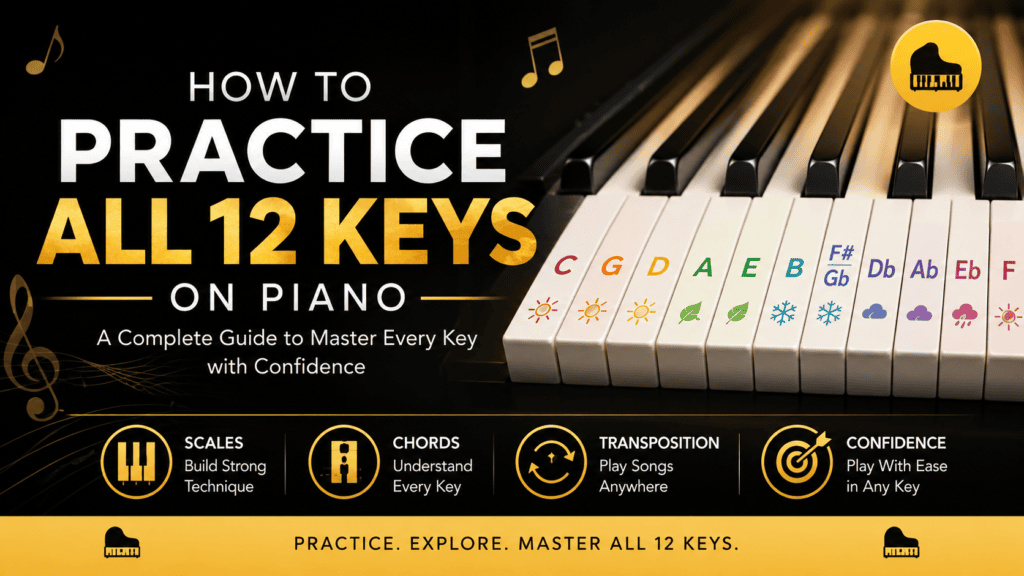
How to Practice All 12 Keys on Piano
Learning how to practice all 12 keys on piano is one of the most effective ways to improve your technique, musical understanding, and ability to play comfortably in different keys. Many beginners spend most of their practice time in familiar keys such as C major, but musicians eventually need to play in every major and minor key.
The 12 keys are:
C, G, D, A, E, B, F♯/G♭, D♭, A♭, E♭, B♭, and F.
Instead of trying to memorize everything at once, use a structured practice routine. Start with scales, then add chords, chord progressions, melodies, and transposition exercises.
Why Should You Practice All 12 Piano Keys?

Practicing every key helps you become more comfortable across the keyboard. It also develops your understanding of patterns rather than making you dependent on a single key.
Regular practice in all 12 keys can help you:
- Improve finger coordination and technique
- Understand scales and key signatures
- Recognize chord patterns more quickly
- Transpose songs more easily
- Improve improvisation skills
- Become more comfortable reading music
- Play accompaniment patterns in different keys
- Develop greater confidence when learning new pieces
The goal is not simply to play every scale from memory. You should gradually learn to recognize the relationships between notes, chords, scales, and musical patterns.
Start With the 12 Major Scales

A good way to begin practicing all 12 keys is with major scales. Learn one scale at a time and pay attention to its fingering and key signature.
A useful order is the circle of fifths:
- C major
- G major
- D major
- A major
- E major
- B major
- F♯ major
- D♭ major
- A♭ major
- E♭ major
- B♭ major
- F major
Start slowly and play each scale with both hands. Focus on consistent fingering, even tone, and relaxed movement.
Once you are comfortable, practice scales with a metronome. Begin at a manageable tempo and increase the speed gradually while maintaining accuracy.
Practice Chords in All 12 Keys

Scales are only one part of learning every key. Chords are equally important, especially if you play pop, worship, jazz, contemporary, or accompaniment-based music.
Begin with major, minor, diminished, and dominant seventh chords. For example, take a simple progression such as:
I – IV – V – I
In C major, this becomes:
C – F – G – C
Move the same progression through all 12 keys.
For example:
- C – F – G – C
- G – C – D – G
- D – G – A – D
- A – D – E – A
- E – A – B – E
Continue until you have played the progression in all 12 keys.
This approach teaches you to recognize the function of a chord rather than simply memorizing individual chord names.
Use Transposition to Practice Every Key

Transposition is one of the most practical ways to practice all 12 keys on piano.
Choose a simple melody, chord progression, or song that you already know. Play it in its original key first. Then move it to another key while maintaining the same musical relationships.
For example, if a melody uses the notes:
C – D – E – G
you can transpose the same pattern to another key by maintaining the same intervals.
Start by moving a musical idea into two or three additional keys. As your confidence improves, work toward all 12.
Transposition also prepares you for situations where a singer or another musician needs a song in a different key.
Practice All 12 Keys With a Daily Routine
You do not need to practice all 12 keys for a long time every day. A focused routine can be more effective than repeating scales without purpose.
Try this 30-minute practice routine:
5 minutes – Warm-up
Play simple five-finger patterns or technical exercises.
10 minutes – Scales
Practice two or three major scales with both hands.
5 minutes – Chords
Play I–IV–V–I and other common progressions in the selected keys.
5 minutes – Transposition
Take a short melody or progression and play it in another key.
5 minutes – Application
Use the key you practiced in a song, improvisation, or accompaniment pattern.
Rotate the keys throughout the week so that you gradually cover all 12.
Make Your Practice More Musical
Practicing scales alone can become repetitive. To make your practice more useful, connect technical exercises to real music.
After practicing a key, try playing:
- A familiar song in that key
- Common chord progressions
- Arpeggios
- Short melodies
- Improvisation patterns
- Left-hand accompaniment patterns
- Cadences
- Simple ear-training exercises
You can also practice the same musical phrase in several keys. This strengthens your ability to recognize patterns and makes the exercise more relevant to actual playing.
Avoid rushing through all 12 keys simply to say that you completed them. Accuracy, relaxation, and musical understanding are more important than speed.
How Long Does It Take to Learn All 12 Keys?
The time required depends on your current level, practice consistency, and musical goals. A beginner may need several weeks to become comfortable with the basic scales and chords, while an experienced pianist may already know many of them.
The important thing is to practice consistently.
A simple weekly approach could look like this:
| Day | Keys to Practice |
|---|---|
| Monday | C, G |
| Tuesday | D, A |
| Wednesday | E, B |
| Thursday | F♯/G♭, D♭ |
| Friday | A♭, E♭ |
| Saturday | B♭, F |
| Sunday | Review all 12 |
As you improve, increase the number of exercises you perform in each key rather than simply increasing the speed.
Learning how to practice all 12 keys on piano gives you a stronger technical and musical foundation. Start with major scales, add chords and progressions, and then apply each key to melodies, songs, improvisation, and transposition.
You do not have to master all 12 keys in a single practice session. Build your skills gradually and return to each key regularly. With consistent practice, the different key signatures and patterns will become increasingly familiar, making it easier to learn songs, accompany other musicians, improvise, and play with confidence.
If you want structured guidance while developing your piano skills, online piano lessons can provide personalized instruction, technique correction, and a practice plan suited to your level.
Intersted in learning music with us? Register now
For more information and exciting resources about learning music, visit our website at The Mystic Keys. For more music content and exciting offers follow us on
Facebook, Instagram, YouTube, LinkedIn, Twitter, Pinterest, and Threads.