How Tempo Influences the Mood of Worship Music
Worship music tempo plays an important role in shaping how a song feels and how a congregation experiences it. Tempo refers to the speed of the music, usually measured in beats per minute (BPM). A slower tempo can create space for reflection, prayer, and thoughtful singing, while a faster tempo can encourage joyful participation, movement, and celebration.
However, tempo does more than determine whether a song sounds slow or fast. It influences how comfortably people sing, how musicians shape musical phrases, and how naturally a song communicates its message. A familiar worship song played at different tempos can feel surprisingly different, even when the melody and lyrics remain unchanged.
Choosing the right tempo is therefore an important responsibility for worship leaders and musicians. The aim is not simply to make a song sound emotional or energetic, but to select a speed that supports the lyrics, musical character, and congregation.
Why Worship Music Tempo Matters

Tempo provides the foundation for the movement of a song. It influences the energy of the rhythm, the length of musical phrases, and the way singers and instrumentalists work together.
When a song is played too quickly, singers may struggle to pronounce the lyrics clearly or breathe comfortably. When it is too slow, the music may lose its natural movement, making phrases difficult to sustain or congregational singing less confident.
The appropriate tempo depends on the song itself, the arrangement, and the people singing it. A tempo that works well for a professional recording may not suit a particular congregation, especially if the arrangement contains complicated rhythms or long lyrical phrases.
Understanding tempo allows worship teams to make musical decisions that support participation rather than distract from it.
Slow Worship Music Tempo and Reflection
Slower songs are often associated with reflection, prayer, gratitude, and personal devotion. Their extended phrases give singers more time to communicate the lyrics and allow the congregation to consider the meaning of the words.
A slower tempo can be particularly suitable for songs about trust, surrender, hope, or God’s faithfulness. When performed thoughtfully, the music can create a sense of space without requiring elaborate instrumental arrangements.
However, slow does not automatically mean peaceful or meaningful. If the tempo is excessively slow, the melody may lose direction, breathing can become awkward, and the congregation may find it difficult to maintain the phrase.
The key is to preserve the natural flow of the music while giving the lyrics enough room to be expressed clearly.
Fast Worship Music Tempo and Celebration
Faster tempos can bring energy, momentum, and a sense of celebration to congregational singing. They are often effective for songs of praise, thanksgiving, victory, and joy.
A lively tempo can encourage people to sing with confidence and participate physically through clapping or movement where appropriate to the church tradition. It can also help a worship team establish an energetic opening to a service.
Nevertheless, speed should never come at the expense of clarity. If the tempo is too fast, the congregation may struggle to follow the melody, articulate the lyrics, or sing comfortably.
A successful arrangement balances energy with accessibility. The congregation should feel invited to participate rather than pressured to keep up with the musicians.
Choosing the Right Tempo for the Lyrics
The lyrics should be one of the main considerations when selecting a tempo.
A song containing long, reflective phrases may need a different pace from one built around short, rhythmic declarations of praise. The emotional character of the words can also influence how the music should move.
Before choosing a tempo, the worship leader should read the lyrics carefully and ask what the song is communicating. Is it an expression of celebration, confession, reassurance, thanksgiving, or quiet trust?
The tempo should support that message without forcing a particular emotional response.
A song about joy does not necessarily need to be extremely fast, just as a song about surrender does not always need to be slow. The musical style, melody, rhythm, and lyrical phrasing should all be considered together.
How Tempo Affects Congregational Singing

Congregational participation is one of the most important reasons to choose a suitable tempo.
A worship team may be comfortable performing a song at a particular speed, but the congregation may need a different tempo to sing the lyrics naturally. This is especially important when the song contains unfamiliar words, syncopated rhythms, or long phrases.
When the tempo is comfortable, people can follow the melody, breathe at appropriate points, and sing together with greater confidence.
If the music moves too quickly, some people may stop singing because they cannot keep up. If it moves too slowly, the rhythm may become difficult to maintain.
Worship leaders should therefore consider the congregation’s familiarity with the song, the complexity of the lyrics, and the natural phrasing of the melody before finalising the tempo.
Emotional Expression
Tempo influences the emotional character of music, but it works alongside other musical elements.
Dynamics, harmony, instrumentation, articulation, and vocal delivery all contribute to how a song feels. A moderate-tempo song can sound joyful when supported by bright instrumentation and rhythmic accents. The same tempo can feel reflective when played softly with sustained chords and gentle phrasing.
This means that worship musicians do not need to change the tempo every time they want to create a different mood.
Sometimes a change in dynamics or arrangement is enough. For example, a band can begin a song with a restrained accompaniment and gradually introduce fuller instrumentation while maintaining a steady tempo.
The result can feel increasingly powerful without becoming rushed.
How Worship Music Tempo Works With Dynamics
Tempo and dynamics often work together to shape musical intensity.
A gradual increase in volume can make a chorus feel more expansive, while a reduction in volume can create a more intimate moment. Changing the tempo at the same time may intensify the effect, but it can also make the music feel unstable if the change is not carefully planned.
For this reason, worship teams should understand which musical element needs to change.
If a chorus needs greater energy, the musicians might first increase the dynamic level while keeping the tempo steady. If the song genuinely requires a tempo change, the worship leader and band should agree on how it will happen.
Intentional decisions create a more cohesive musical experience than changing speed simply because the music is becoming more emotional.
Maintaining a Steady Tempo During Worship
Consistency helps singers and musicians remain connected.
A tempo that fluctuates unintentionally can make it difficult for the congregation to follow the music. The verses may begin at a comfortable pace, but the band may gradually accelerate during the chorus or slow down during quieter passages without intending to do so.
A drummer, pianist, guitarist, or other instrumentalist may help maintain the pulse, depending on the arrangement.
A metronome can be useful during rehearsal, especially when a song contains difficult rhythmic patterns. However, musicians should also learn to maintain a natural musical pulse without becoming mechanically rigid.
A steady tempo should support expression, not prevent it. Small, intentional changes may be appropriate when they serve the musical phrase and are coordinated by the team.
Worship Music Breathing

Tempo affects how singers manage their breathing.
At faster speeds, singers may have less time between phrases and need to plan their breaths carefully. At slower speeds, phrases may last longer, requiring controlled breath management and sustained vocal support.
Worship leaders and vocalists should identify natural breathing points during rehearsal rather than discovering them during the service.
If a song consistently leaves singers short of breath, the team should consider whether the tempo, key, phrasing, or arrangement needs adjustment.
The goal is to allow singers to communicate the lyrics clearly without forcing their voices or breaking musical phrases unnecessarily.
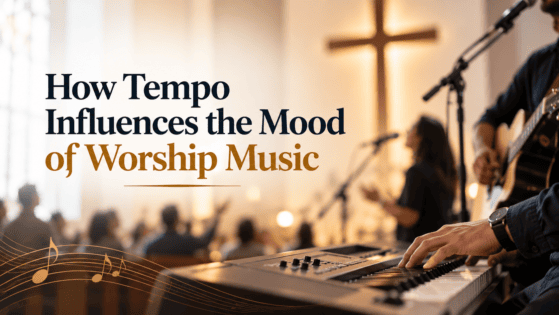
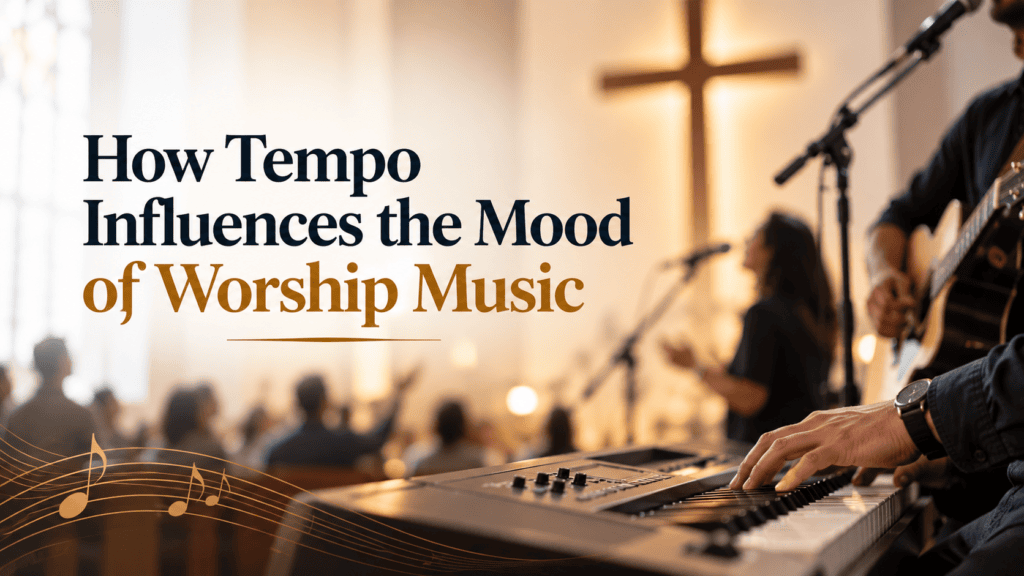
How the Piano and Guitar Support Tempo
Instrumentalists have an important role in establishing and maintaining the tempo of worship songs.
The piano can reinforce the pulse through chord patterns, rhythmic figures, and carefully timed transitions. The guitar can support the groove through strumming patterns, picking, and rhythmic accents.
Both instruments should adapt their playing to the selected tempo. A strumming pattern that works beautifully at a moderate pace may become crowded at a faster speed. Similarly, a piano accompaniment may need simpler voicings or fewer rhythmic movements to maintain clarity.
Musicians should avoid filling every space with notes. Sometimes a simple accompaniment creates a stronger sense of movement and gives the congregation more room to sing.
Changing Tempo Between Worship Songs

The tempo relationship between songs can influence how smoothly a worship set develops.
Moving from a lively praise song into a reflective worship song may require a clear musical transition. The change can be created through a final chord, a short instrumental passage, a pause, or a spoken introduction.
The team does not need to make every song connect seamlessly. A moment of silence can be appropriate when the next song serves a different purpose.
What matters is that the transition feels intentional. Musicians should know the next song’s tempo and starting cue so that the congregation is not left waiting while the team works out what comes next.
Common Tempo Mistakes in Worship Music
Several common problems can affect the effectiveness of a worship song.
Playing too fast: The congregation struggles to follow the lyrics or melody.
Playing too slowly: The music loses natural movement and the phrases become difficult to sustain.
Following recordings too closely: A recorded arrangement may not suit the live congregation.
Ignoring vocal comfort: Singers struggle to breathe or articulate words clearly.
Confusing tempo with intensity: Musicians increase speed when a change in dynamics would be more appropriate.
Failing to rehearse transitions: The band and singers begin the next song at different speeds or without a clear cue.
These issues can often be addressed by choosing a suitable starting tempo, rehearsing with the whole team, and listening carefully to how the music supports congregational singing.
How to Practise Worship Music Tempo Effectively
A practical approach to tempo begins with understanding the song before playing it at full speed.
First, identify the song’s natural rhythmic character and the demands of its lyrics. Next, choose a starting tempo that allows the musicians and singers to perform comfortably.
During rehearsal, use a metronome if necessary to establish consistency. Practise difficult sections separately, paying attention to rhythmic accuracy and transitions.
Then rehearse the song with the full team and listen to the congregation’s likely experience. Can the lyrics be understood? Are the phrases comfortable? Does the chorus maintain energy without feeling rushed?
Finally, practise the ending and any transitions into the next song. These details help the entire worship set feel organised and connected.
Final Thoughts on Worship Music Tempo
Worship music tempo influences the energy, emotional character, and accessibility of congregational singing. A thoughtful tempo can support joyful praise, quiet reflection, clear lyrical delivery, and a stronger sense of musical unity.
However, the best tempo is not always the fastest or slowest option. It is the one that suits the song, supports the singers, and allows the congregation to participate comfortably. Tempo should work together with dynamics, harmony, instrumentation, and phrasing to serve the overall purpose of the music.
At The Mystic Keys, worship musicians can develop their understanding of rhythm, accompaniment, dynamics, chord progressions, transitions, and ensemble playing through structured music education. These skills can help pianists, guitarists, singers, and worship leaders make more confident musical decisions.
By choosing tempos carefully and rehearsing with the congregation in mind, worship teams can create music that feels natural, expressive, and connected. Ultimately, tempo is not merely a technical setting on a metronome. It is one of the musical tools that helps a congregation sing together with clarity, confidence, and purpose.
For more information and exciting resources about learning music, visit our website at The Mystic Keys. For more music content and exciting offers follow us on
Facebook, Instagram, YouTube, LinkedIn, Twitter, Pinterest, and Threads.