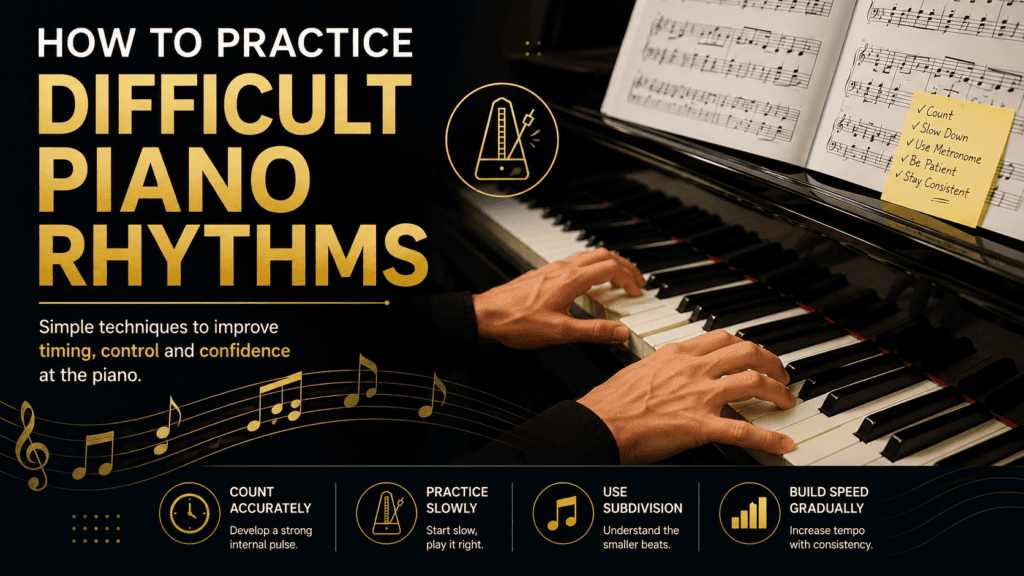
How to Practice Difficult Rhythms on the Piano
Learning the piano is not only about playing the correct notes. Difficult piano rhythms are one of the most important skills a pianist needs to develop, especially when playing complicated pieces, syncopated patterns, triplets, dotted rhythms, or changing time signatures.
Many students find difficult rhythms challenging because their fingers may know the notes, but their hands do not yet understand exactly when each note should be played. The good news is that rhythm can be trained with consistent and structured practice.
If you are wondering how to practice difficult rhythms on the piano, the key is to break complicated patterns into smaller sections, understand the subdivisions, practice slowly, and gradually build speed.
1. How to Understand Difficult Piano Rhythms

One of the biggest mistakes pianists make is immediately trying to play a difficult rhythm at full speed.
Before touching the keys, look carefully at the music. Identify the time signature, note values, rests, accents, ties, and syncopations.
For example, if a passage contains eighth notes and sixteenth notes, determine exactly how those notes fit within each beat.
Try saying the rhythm aloud before playing it. You can also clap the pattern while counting.
This helps your brain understand the rhythm independently of your fingers.
Try This Exercise
Look at one difficult measure and:
- Read the rhythm without playing.
- Count the beats aloud.
- Clap the rhythm.
- Tap the pulse with your foot.
- Play the notes slowly.
This simple process can make complicated rhythms much easier to understand.
2. Break Difficult Piano Rhythms Into Smaller Parts

When a rhythm feels overwhelming, do not practice the entire passage repeatedly.
Instead, divide it into small sections.
For example, take one measure and practice only the first two beats. Once those beats feel comfortable, add the remaining beats.
You can also isolate a single rhythmic pattern that keeps causing problems.
Breaking a difficult passage into smaller pieces allows you to focus on one problem at a time rather than trying to solve everything simultaneously.
3. Count Difficult Piano Rhythms Out Loud

Counting is one of the most effective ways to improve piano rhythm.
Depending on the piece, you might count:
1 – 2 – 3 – 4
For smaller subdivisions, try:
1 & 2 & 3 & 4 &
For sixteenth-note patterns, you can use:
1 e & a, 2 e & a, 3 e & a, 4 e & a
The exact counting system can vary depending on the musical context, but the important thing is to make the subdivisions clear.
Counting out loud prevents you from relying only on muscle memory and helps develop a stronger internal sense of pulse.
4. Practice Difficult Piano Rhythms With a Metronome

A metronome is one of the most useful tools for piano rhythm practice.
However, using a metronome effectively is more than simply turning it on and trying to play along.
Start at a tempo where you can play the passage accurately without stopping. If necessary, make the tempo extremely slow.
For example:
- Start at 50 BPM.
- Play the passage accurately several times.
- Increase to 55 BPM.
- Continue gradually increasing the tempo.
- Stop increasing the tempo if mistakes begin to appear.
The goal is not to play fast immediately. The goal is to develop consistent timing.
5. Practice Rhythm Without Playing the Piano

Sometimes the best way to improve a difficult rhythm is to temporarily remove the piano.
Clap the rhythm.
Tap it on your desk.
Speak the counting.
Tap your left hand on your leg while your right hand performs the rhythm.
These exercises separate the rhythmic challenge from the technical challenge of playing the notes.
Once your body understands the rhythm, transferring it to the piano becomes easier.
6. Practice Each Hand Separately
Difficult rhythms can become especially challenging when both hands have different patterns.
For example, the right hand may play steady eighth notes while the left hand plays a syncopated rhythm.
Instead of practicing both hands together immediately, practice each hand separately.
First, make sure the right hand can maintain its rhythm.
Then practice the left hand.
Finally, combine them at a very slow tempo.
When combining the hands, focus on where the notes line up. You can even identify specific beats where both hands play together.
This is particularly useful for difficult piano rhythms involving syncopation, polyrhythms, or contrasting patterns between the hands.
7. Use Subdivision to Master Complex Rhythms
Subdivision means dividing each beat into smaller equal parts.
For example, one quarter-note beat can be divided into:
- Two eighth notes
- Four sixteenth notes
- Three triplets
Understanding these smaller divisions makes complicated rhythms much easier to perform accurately.
Suppose a passage contains a syncopated note. Instead of thinking only about where the note begins, think about where it falls within the subdivision.
This gives you a precise rhythmic reference and improves your overall timing.
8. Learn to Feel the Pulse
Good rhythm is not only about counting. Eventually, you need to develop an internal sense of pulse.
Try tapping your foot gently while practicing.
The foot should maintain a steady beat while your hands perform the rhythm above it.
You can also listen to professional recordings of the piece and tap along with the pulse without playing.
Over time, this develops your internal timing and makes it easier to maintain rhythm without constantly thinking about every subdivision.
9. Practice Difficult Sections With Different Rhythmic Variations
If you are struggling with a repeated pattern, changing the way you practice it can help.
For example, when practicing a fast sixteenth-note passage, you can use different accents:
Strong – weak – weak – weak
Then:
Weak – strong – weak – weak
Then:
Weak – weak – strong – weak
This can improve control and help your fingers become more comfortable with the pattern.
Once the rhythm feels secure, return to the original musical accents.
10. Gradually Increase Your Speed
Speed should be the final stage of rhythm practice, not the first.
A useful approach is:
Accuracy → Consistency → Control → Speed
If you make repeated mistakes when increasing the tempo, slow down again.
Playing a difficult rhythm correctly at a slow tempo is much more productive than playing it incorrectly at a fast tempo.
Your goal is to teach your hands the correct rhythmic pattern through repetition.
A Simple Daily Rhythm Practice Routine
You can include the following routine in your regular piano practice:
5 minutes: Clap and count difficult rhythms.
5 minutes: Practice the rhythm away from the piano.
10 minutes: Practice each hand separately.
10 minutes: Combine both hands slowly.
10 minutes: Practice with a metronome.
5 minutes: Gradually increase the tempo while maintaining accuracy.
Even a short, focused routine can produce better results than repeatedly playing a difficult passage without a clear strategy.
Learning how to practice difficult rhythms on the piano requires patience, careful counting, and consistent practice. Instead of immediately trying to play a complicated passage at full speed, break it into smaller sections, count the subdivisions, use a metronome, practice each hand separately, and gradually increase the tempo. With structured Piano Lessons Online, students can receive expert guidance and learn effective techniques for improving rhythm and timing.
Remember that strong rhythm is a skill that develops over time. The more consistently you practice rhythmic patterns, the easier it becomes to maintain steady timing, coordinate both hands, and perform challenging piano pieces with confidence.
If you are learning piano, make rhythm practice a regular part of your routine—not something you focus on only when a difficult piece requires it. Piano Lessons Online can help you build strong rhythmic skills through guided practice, personalized feedback, and consistent instruction.
Intersted in learning music with us? Register now
For more information and exciting resources about learning music, visit our website at The Mystic Keys. For more music content and exciting offers follow us on
Facebook, Instagram, YouTube, LinkedIn, Twitter, Pinterest, and Threads.