
Choir Competition Tips | How to Deliver a Winning Performance
A choir competition is about much more than singing the right notes at the right time. These Choir Competition Tips can help you understand what truly makes a performance stand out. It is a chance for a group of voices to come together and create something powerful, expressive, and memorable. While vocal ability is important, winning performances are often distinguished by the way the choir communicates emotion, works as one ensemble, and connects with the audience.
From choosing the right repertoire to refining harmonies, stage presence, dynamics, and musical expression, every detail can make a difference. The strongest choirs understand that a successful performance is not simply about avoiding mistakes—it is about creating a musical experience that stays with the listeners.
Whether your choir is preparing for its first competition or aiming to take home the top prize, these choir competition tips can help you turn your preparation into a confident and compelling performance.

Choir Competition Tips | Start with the Right Song Choice
The foundation of a great competition performance begins with selecting the right repertoire. A technically difficult song may appear impressive, but complexity alone does not guarantee a winning performance. The piece should suit the choir’s vocal range, strengths, experience, and overall character.
Look for music that gives different sections of the choir an opportunity to contribute while allowing the group to demonstrate harmony, dynamics, rhythm, and expression. A well-chosen arrangement can highlight the choir’s unique sound instead of forcing singers into a style that does not suit them.
At the same time, consider the competition setting and the audience. A song with emotional depth, interesting harmonies, or a memorable musical journey can create a stronger impression than a piece chosen simply because it is popular. Once the repertoire is selected, the real work begins: transforming the notes on the page into a unified musical story.

Build Strong Vocal Foundations
Before focusing heavily on performance techniques, make sure the choir has a secure vocal foundation. Good breathing, accurate pitch, clear diction, healthy vocal production, and consistent tone are essential for ensemble singing.
Warm-ups should prepare both the individual singers and the choir as a whole. Gentle vocal exercises can help establish breath support and resonance, while pitch and harmony exercises encourage singers to listen carefully to one another.
This preparation becomes particularly important during challenging sections of the song. When singers have confidence in their technique, they can focus more freely on musical expression rather than worrying about whether they will reach a note or maintain their part.

Make Ensemble Unity a Priority
A choir can have excellent individual singers and still struggle as an ensemble. In a competition, the judges are listening not only to each voice but also to how those voices combine.
Uniform entrances and cut-offs can immediately make a choir sound more polished. Pay close attention to consonants, vowel shapes, breathing points, articulation, and the length of sustained notes. Even small differences between singers can affect the overall sound.
Listening is just as important as singing. Each member should be aware of the other sections rather than concentrating exclusively on their own part. When singers listen, adjust, and respond to one another, the choir begins to sound like one musical instrument rather than a collection of individual voices.

Choir Competition Tips | Go Beyond Singing the Notes
Once the notes and rhythms are secure, the choir needs to ask a more important question: What are we trying to communicate?
Music becomes memorable when it carries emotion. A beautiful melody can sound ordinary if it is performed without intention, while a relatively simple piece can become captivating when the singers understand its meaning.
Explore the story, mood, lyrics, and emotional journey of the composition. Identify moments that should feel joyful, dramatic, peaceful, mysterious, powerful, or intimate. Then shape the performance around those emotions.
This approach also helps prevent the performance from becoming mechanically perfect but emotionally flat. Accuracy earns attention, but expression creates connection.

Use Dynamics to Create Impact
Dynamics are one of the most effective tools a choir has for creating contrast. A performance that remains at the same volume and intensity from beginning to end can quickly lose the audience’s attention.
Instead, think about the musical journey. A soft opening can create anticipation before gradually building toward a powerful section. A sudden reduction in volume can make a following phrase feel even more dramatic. Carefully controlled crescendos and diminuendos can give the arrangement movement and depth.
However, louder does not automatically mean more powerful. True musical intensity comes from a combination of volume, tone, articulation, breath, and emotional commitment. Similarly, a quiet passage requires control and confidence rather than simply singing softly.

Pay Attention to Diction and Pronunciation
Clear diction allows the audience to understand the lyrics and experience the meaning of the song. This becomes especially important in a competition, where unclear words can weaken an otherwise strong performance.
Work together on vowel sounds and consonants so that the entire choir pronounces words consistently. Consonants should be coordinated without becoming harsh, while vowels should generally remain unified so that the harmony sounds clean.
For songs in unfamiliar languages, pronunciation deserves additional attention. Learning the correct sounds and practicing them slowly as a group can significantly improve both clarity and authenticity.

Choir Competition Tips | Develop Stage Presence
A choir performance begins before the first note is sung. The way singers walk onto the stage, stand, look at the audience, and prepare to perform can influence the audience’s first impression.
Confident posture is particularly important. Singers should stand naturally with an open, balanced posture that supports good breathing while avoiding unnecessary stiffness. Looking engaged and prepared helps communicate confidence.
Stage presence does not mean exaggerated movements. In fact, too much movement can distract from the music. Instead, focus on purposeful expression. Facial expressions, posture, and subtle physical responses can reinforce the emotion of the piece without overpowering the singing.

Use Movement with Purpose
Some songs benefit from carefully planned choreography or movement, while others are stronger when performed with minimal physical motion. The key is to make movement serve the music.
If choreography is included, every movement should have a reason. It could emphasize a change in mood, highlight a particular lyric, create visual symmetry, or add energy to a climactic section.
Rehearse movement just as seriously as you rehearse the music. Singers should know where to move, when to move, and how to return to their positions without affecting vocal support or ensemble concentration. When movement is coordinated naturally, it can make the performance more visually engaging without becoming a distraction.

Rehearse Like You Are Already on Stage
Regular practice is essential, but not every rehearsal should feel the same. Spending every session singing the piece from beginning to end may not address the moments that actually need improvement.
Break difficult passages down and work on them separately before putting everything back together. Once the choir is comfortable, begin running complete performances without stopping after every mistake.
This is where mock performances become extremely valuable. Perform in the same formation you expect to use during the competition and, when possible, practice in front of people who can provide honest feedback. Simulating the pressure of a real performance can help singers become more comfortable with nerves, entrances, stage movement, and concentration.

Learn to Perform Under Pressure
Competition day can feel very different from rehearsal day. Bright lights, unfamiliar surroundings, judges, an audience, and other competing choirs can create additional pressure.
The best way to manage those nerves is preparation. When singers know the music thoroughly, they have something reliable to fall back on when adrenaline takes over.
Breathing can also help the group settle before performing. A few calm, coordinated breaths can encourage focus and reduce unnecessary tension. Instead of thinking about winning, encourage the choir to focus on the immediate musical task: the opening phrase, the first harmony, the next breath, and the story being communicated.
That shift in focus can make the performance feel much more natural.

Choir Competition Tips | Record, Watch, and Improve
One of the most useful rehearsal techniques is also one of the simplest: record the choir.
A performance may sound very different from the perspective of the singers compared with what the audience hears. Recording rehearsals makes it easier to identify pitch problems, uneven entrances, unclear diction, balance issues, weak dynamics, or moments where the performance loses energy.
Watch the recording together and discuss what works as well as what needs improvement. Avoid focusing only on mistakes. Identifying successful moments helps the choir understand what it should preserve as the performance develops.
Gradually, these small adjustments can transform the overall quality of the performance.

Create Balance Between Sections
A choir should sound full and balanced, rather than allowing one section to overpower the others. Sopranos, altos, tenors, and basses each have an important role, and the ideal balance may change throughout the composition.
Certain passages may require a stronger melody line, while others depend on supporting harmonies being clearly audible. The conductor or choir leader can help determine which sections should come forward and which should blend into the overall texture.
Balance should also be considered within each section. A particularly powerful singer should not unintentionally dominate the voices around them. The goal is not for everyone to sing at exactly the same volume at all times, but for every voice to contribute appropriately to the musical structure.

Build a Strong Connection with the Audience
A winning choir performance should make people feel something. Technical precision is important, but emotional connection can turn a good performance into an unforgettable one.
Encourage singers to understand the lyrics rather than simply memorizing them. When the meaning of the words is reflected naturally in facial expression, tone, phrasing, and musical choices, the audience can sense the sincerity behind the performance.
Even when the audience cannot understand every word, emotion can still be communicated through musical expression. A choir that genuinely connects with its music is far more likely to connect with the people listening.

Choir Competition Tips | Work Closely with the Conductor
A choir competition performance depends heavily on communication between the choir and its conductor. The conductor provides more than tempo; their gestures help shape entrances, dynamics, phrasing, articulation, and transitions.
Singers should learn to watch the conductor without becoming visually dependent on them. Eye contact and awareness of conducting cues become particularly important during changes in tempo, unexpected transitions, pauses, and expressive moments.
Rehearsing these cues repeatedly allows the choir to respond instinctively. As a result, the performance feels coordinated rather than carefully controlled.
Prepare for the Practical Details
Musical preparation is only one part of competition readiness. Practical details can also influence confidence on the day.
Know the stage layout, performance order, arrival time, dress requirements, warm-up arrangements, and any rules provided by the organizers. Costumes or coordinated outfits should be comfortable enough to allow singers to breathe and move naturally.
Adequate rest and hydration are also important before performing. Avoid exhausting the voice with excessive singing immediately before the competition. A focused warm-up is generally more useful than repeatedly singing the entire repertoire at full intensity.
When the practical details are organized in advance, the choir can concentrate on what matters most: delivering its music.

Make the Opening and Ending Count
The beginning and ending of a performance often leave a particularly strong impression. A confident opening can immediately establish the choir’s presence, while a carefully controlled ending can leave the audience wanting more.
Spend time rehearsing the moment before the first note. The choir should already look focused and prepared when the conductor gives the opening cue.
Likewise, do not mentally switch off after the final note. Hold the final sound with intention, follow the conductor’s release, and remain composed for the final moment on stage. A polished ending is part of the performance, not an afterthought.
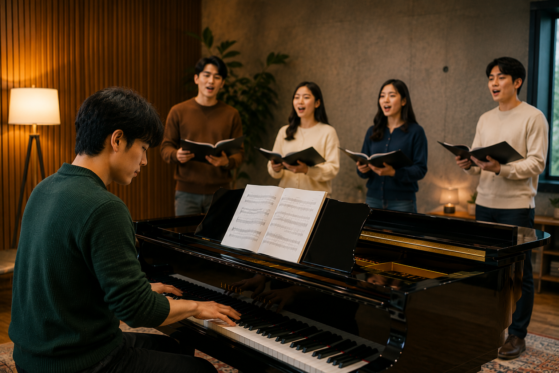
Choir Competition Tips | Refine, Don’t Overwork
As competition day approaches, it can be tempting to keep rehearsing harder and longer. However, excessive repetition can sometimes create fatigue, tension, or uncertainty.
The final rehearsals should focus on confidence and refinement rather than trying to rebuild the entire performance. Review the most important trouble spots, perform complete runs, and reinforce the artistic choices the choir has already made.
Trust the preparation. By this stage, singers should be thinking less about individual notes and more about communicating the music as an ensemble.

What Truly Makes a Choir Performance Stand Out?
A winning choir is not necessarily the one that sings the most difficult song or performs the loudest. It is the choir that combines technical accuracy, beautiful tone, ensemble unity, expressive interpretation, confident stage presence, and genuine emotional connection.
Every voice matters, but the greatest strength of a choir comes from what happens when those voices work together. The audience should hear harmony, but they should also feel unity.
Ultimately, a competition performance is an opportunity to tell a story through many voices. When preparation meets musicality, confidence, and authentic expression, the result can become far more than a technically successful performance—it can become a moment the audience remembers.

Final Thoughts
Preparing for a choir competition takes patience, teamwork, discipline, and creativity. Strong performances are built gradually through thoughtful repertoire selection, consistent rehearsals, careful listening, vocal preparation, and a clear understanding of the music. At The Mystic Keys, we believe that every voice has the potential to contribute something meaningful to a powerful ensemble performance.
At the same time, remember that perfection is not the only goal. A choir that sings with confidence, communicates its message, and genuinely enjoys performing can create a powerful connection with its audience. With the right guidance, regular practice, and a shared passion for music, each rehearsal can bring the choir one step closer to delivering its best performance.
So, as your competition approaches, focus on more than getting every note right. Sing together. Listen to one another. Tell the story. Own the stage. Most importantly, let the audience feel the music.
With the right preparation and musical guidance from The Mystic Keys, your choir can turn hard work into a performance that is confident, expressive, and memorable.
That is what can transform a choir performance into a truly winning performance.
For more information and exciting resources about learning music, visit our website at The Mystic Keys. For more music content and exciting offers follow us on
Facebook, Instagram, YouTube, LinkedIn, Twitter, Pinterest, and Threads.