
Billy Joel Piano Songs: What Pianists Can Learn From the Piano Man
Billy Joel piano songs are valuable for more than their memorable melodies. They give pianists a chance to study how chords, rhythm, melody, dynamics, and storytelling can work together.
Billy Joel’s music moves across pop, rock, ballads, jazz-influenced sounds, and classical influences. That variety makes his repertoire particularly useful for pianists who want to become more versatile.
Instead of simply learning the notes, listen to what the piano is doing within the entire song.
That is where some of the most useful lessons begin.
1. Learn to Make Simple Chords Sound Interesting

One of the first things pianists can learn from Billy Joel is that interesting piano playing doesn’t always require complicated harmony.
A basic chord progression can sound completely different depending on how you voice it.
Experiment with:
- Chord inversions
- Different registers
- Bass movement
- Added notes
- Broken chords
- Sustained tones
Rather than jumping between root-position chords, try finding the nearest version of the next chord.
This creates smoother movement and immediately makes an accompaniment feel more musical.
2. Let the Melody Lead Your Playing
Billy Joel’s songs are strongly driven by memorable melodies.
For pianists, this is an important reminder that accompaniment should support the musical idea rather than compete with it.
When playing a song, identify the main melodic phrase first.
Ask yourself:
- Where does the phrase begin?
- Where does it reach its peak?
- Where should it relax?
- Which notes need emphasis?
Even when you’re only playing chords, knowing the melody should influence your interpretation.
3. Rhythm Gives a Song Its Personality
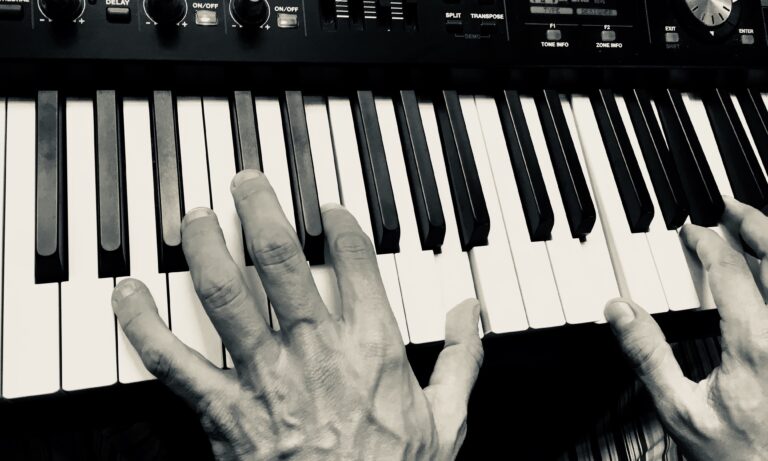
Different Billy Joel piano songs demonstrate how dramatically rhythm can change the character of a piece.
A ballad may use gentle, spacious accompaniment, while a rock-oriented song may rely on stronger rhythmic patterns.
For pianists, this means rhythm should be practised separately from the notes.
Try playing a chord progression with a metronome and experiment with different rhythmic patterns. Notice how the same harmony can suddenly feel completely different.
Good rhythm isn’t just about staying on the beat.
It is about creating movement.
4. Dynamics Can Tell the Story
A common beginner mistake is playing an entire song at almost the same volume.
Billy Joel’s music provides plenty of opportunities to study contrast.
A pianist can make a passage more expressive through:
- Gradual crescendos
- Softer accompaniment
- Stronger climaxes
- Controlled accents
- Sudden changes in intensity
- Moments of silence
The important lesson is that dynamics should have a purpose.
Don’t simply play louder because the music reaches a chorus. Think about what the section is trying to communicate.
5. The Piano Doesn't Always Need to Be Busy

One of the most useful lessons from studying popular piano music is learning when not to play.
Beginners sometimes believe that adding more notes makes an arrangement sound more advanced.
Often, the opposite is true.
A few carefully chosen notes can leave more space for the vocal, melody, and other instruments.
This is especially important when accompanying a singer.
The pianist’s job isn’t always to be the most noticeable musician in the room.
Sometimes the best playing is the playing that makes everyone else sound better.
6. Learn How to Accompany a Singer
Billy Joel’s music is particularly useful for pianists who want to develop accompaniment skills.
When playing with a vocalist, you need to listen constantly.
You may need to adjust:
- Volume
- Timing
- Chord voicings
- Rhythmic density
- Introductions
- Endings
- Transitions
A singer may slow down slightly at the end of a phrase. The pianist needs to respond.
That interaction is very different from playing alone with a metronome.
It teaches flexibility and musical awareness.
7. Study the Story Behind the Sound
Songs such as “Piano Man” demonstrate how closely piano accompaniment can be connected to storytelling.
The piano isn’t simply providing harmony.
It helps establish the atmosphere in which the story happens.
This gives pianists an important question to consider:
What is the music trying to communicate?
Once you start thinking this way, phrasing becomes more meaningful.
A chord is no longer just a chord.
A pause is no longer just a pause.
A dynamic change becomes part of the story.
8. Use Songs to Develop Your Ear
Don’t rely entirely on sheet music when studying Billy Joel.
Listen carefully to the original recording.
Try to identify:
- The bass movement
- Chord changes
- Repeated patterns
- Melodic phrases
- Rhythmic accents
- Dynamic changes
Then try to find some of these elements on the keyboard yourself.
This develops your ability to hear harmony and melody rather than simply reading them.
Over time, you may become better at working out songs by ear, which is an extremely useful skill for any pianist.
9. Don't Try to Copy Everything

When learning music from a famous pianist, it is natural to want to reproduce the original performance.
That’s a good starting point, but it shouldn’t be the final goal.
Once you’ve learned the basic arrangement, experiment.
Try a different chord voicing.
Change the accompaniment pattern.
Play the melody in another register.
Create your own introduction.
Adjust the dynamics.
This turns repertoire into a creative exercise rather than simply an imitation exercise.
What Billy Joel Can Teach Pianists Overall
The biggest lesson from studying Billy Joel piano songs is that strong piano playing isn’t only about technical difficulty.
It is about musical decisions.
A pianist needs to know:
- When to play
- When to simplify
- When to build intensity
- When to leave space
- How to support a melody
- How to shape a phrase
- How to use harmony creatively
- How to respond to other musicians
These skills apply far beyond Billy Joel’s music.
They can improve your playing whether you perform pop, rock, worship music, jazz, classical repertoire, or your own compositions.
Final Thoughts
Billy Joel’s music offers pianists a practical education in melody, harmony, rhythm, dynamics, accompaniment, and storytelling.
Instead of learning a song only to reproduce it, listen closely and ask what the piano is contributing to the music.
The goal isn’t to become a copy of Billy Joel.
It is to take the musical ideas you discover and use them to develop your own sound and expression at the piano.
With structured guidance and personalised feedback, Piano Lessons Online at The Mystic Keys can help you build those skills step by step—from learning songs you love to developing the musicianship needed to interpret them confidently.
For more information and exciting resources about learning music, visit our website at The Mystic Keys. For more music content and exciting offers follow us on
Facebook, Instagram, YouTube, LinkedIn, Twitter, Pinterest, and Threads.