

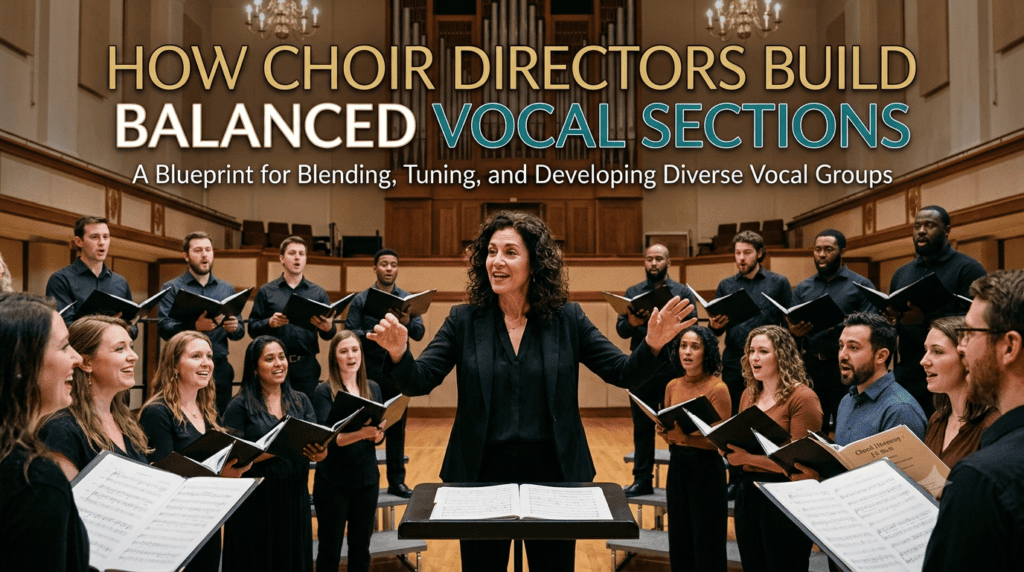
How Choir Directors Build Balanced Vocal Sections
Introduction
A great choir is more than a group of talented singers performing together. It is a team of voices that blend harmoniously, maintain balance, and work together to create a unified musical experience. One of the most important responsibilities of a choir director is learning how to build balanced vocal sections so that every voice contributes to the overall sound without overpowering the others.
Whether directing a church choir, a school ensemble, a community choir, or a professional vocal group, directors must understand vocal ranges, section sizes, tone quality, pitch accuracy, and musical dynamics. A well-balanced choir allows the melody and harmonies to remain clear while giving every section the opportunity to be heard.
In this guide, we will explore how choir directors build balanced vocal sections, assign singers to the right parts, improve vocal blending, and create a cohesive sound through effective rehearsal techniques.

1. Understand the Four Main Vocal Sections in a Choir
The first step in building balanced vocal sections is understanding the different voice parts and the role each one plays in a choral arrangement.
Traditional SATB choir arrangements divide singers into four sections: soprano, alto, tenor, and bass. Each section occupies a different vocal range and contributes a distinct musical layer.
Sopranos: Carrying the Higher Notes
Sopranos generally sing the highest vocal part in an SATB choir. Their melodies often stand out because of their higher register, making it important for directors to manage their volume and tone.
A strong soprano section should sound clear and focused without becoming excessively loud or sharp. Directors encourage singers to maintain healthy vocal production, accurate pitch, and consistent tone across their range.
Altos: Supporting the Harmony
Altos usually sing below the sopranos and frequently provide important inner harmonies. Their part helps fill out the chord structure and creates depth in the overall sound.
Because alto parts can be less prominent than the melody, directors should ensure that these singers maintain confidence, accurate pitch, and sufficient vocal presence without forcing their voices.
Tenors: Connecting the Upper and Lower Voices
Tenors typically sing in the higher male vocal range and often contribute melodic movement and harmonic support between the upper and lower sections.
A balanced tenor section helps the choir sound full and connected. Directors must consider both the singers’ comfortable ranges and their ability to maintain a consistent tone through register changes.
Basses: Providing the Musical Foundation
Basses generally sing the lowest vocal part in an SATB choir. Their notes support the harmonic foundation and help give the music depth and stability.
A bass section does not necessarily need to be the loudest section to be effective. Clear articulation, reliable pitch, and a steady tone are more valuable than excessive volume.
The goal is not to make every vocal section sound identical. It is to ensure that each section contributes appropriately to the complete choral sound.
2. How Choir Directors Build Balanced Vocal Sections Through Voice Placement
One of the most important decisions a choir director makes is assigning singers to suitable vocal sections.
A singer’s section should not be determined solely by how high or low they can sing. Directors also consider vocal comfort, tone quality, range consistency, and the part a singer can sustain without strain.
For example, a singer may be able to reach a high soprano note but struggle to sing comfortably in that register throughout a complete song. Another singer may have a naturally rich lower register that suits an alto or tenor part better.
During voice placement, directors can assess:
Comfortable vocal range: The notes a singer can produce consistently and comfortably.
Tessitura: The part of the vocal range where a singer can perform most comfortably for an extended period.
Tone quality: The natural character and clarity of the singer’s voice.
Pitch accuracy: The ability to sing notes accurately and maintain them during harmonies.
Vocal endurance: The ability to sustain the assigned part through rehearsals and performances.
Directors should avoid assigning singers to parts that consistently cause discomfort or strain. Vocal placement may also change as singers gain experience, develop their technique, or encounter different musical demands.
3. Choose the Right Number of Singers for Each Section
Balanced vocal sections do not always require equal numbers of singers. The ideal distribution depends on the arrangement, the choir’s overall size, the vocal characteristics of its members, and the desired sound.
For example, a choir with a strong soprano section and a smaller bass section may need different rehearsal strategies from a choir with an unusually prominent lower section.
Directors should consider the following factors when deciding how many singers each section needs.
Vocal Strength and Projection
Some singers naturally produce a more prominent sound, while others have a softer vocal quality. Directors should evaluate the collective sound of each section rather than relying on headcount alone.
A smaller section with confident, well-trained singers may balance effectively against a larger section with a softer sound.
Musical Arrangement
Certain compositions give the melody to the sopranos, while others feature the altos, tenors, or basses. The number and strength of singers in each section should support the musical demands of the repertoire.
Choir Size and Performance Space
A choir performing in a small room may require a different balance from one singing in a large church or concert hall. Room acoustics influence how clearly different sections can be heard.
Rehearsal Needs
A smaller or less experienced section may benefit from additional sectional rehearsals. Directors should consider whether the singers have sufficient support to learn and perform their assigned parts confidently.
Rather than following a fixed numerical ratio, directors should listen carefully and make adjustments based on the choir’s actual sound.

4. Develop Consistent Vocal Tone Within Each Section
Even when singers have accurate pitch and appropriate vocal ranges, a choir may sound unbalanced if individual voices differ significantly in tone, vowel shape, or vocal intensity.
Vocal blending helps singers sound like a unified section rather than a collection of unrelated voices.
To develop consistent tone, choir directors can focus on the following techniques.
Practise Matching Vowels
Different vowel shapes can make voices sound as though they belong to separate groups. Directors can help singers coordinate their vowel shapes, especially on sustained notes.
For example, the vowel in a word such as “love” may be pronounced differently by singers from different backgrounds. Agreeing on a consistent vowel shape improves clarity and blending.
Encourage Healthy, Consistent Tone
Singers should aim for a clear, comfortable tone rather than imitating another singer’s voice exactly. Directors can demonstrate the desired sound and guide the section toward a shared approach.
Listen for Individual Voices That Stand Out
A singer may unintentionally dominate a section because of excessive volume, a particularly bright tone, or inconsistent vowels.
Instead of immediately asking that singer to become quieter, the director should determine whether the issue comes from vocal technique, musical interpretation, or the surrounding section’s balance.
The aim is to improve the collective sound while preserving each singer’s healthy vocal production.
5. Strengthen Pitch Accuracy and Intonation
Pitch accuracy is essential for balanced vocal sections. Even a small difference in pitch can make a chord sound unstable, especially when several sections sing sustained harmonies together.
Choir directors can improve intonation by developing singers’ listening skills and helping them understand how their individual parts relate to the complete harmony.
Rehearse Difficult Intervals
Some singers find it challenging to maintain their pitch when moving between unfamiliar notes or singing intervals against another section.
Directors can isolate these passages, play the notes on a piano or keyboard, and practise the intervals slowly before returning to the full arrangement.
Use Reference Notes
Providing a starting note or playing each section’s part can help singers establish their pitch before singing independently.
As confidence improves, directors can gradually reduce the amount of instrumental support so singers learn to maintain their parts through active listening.
Practise Sustained Chords
Ask each section to hold its note while listening to the other voices. Encourage singers to recognise whether their pitch remains stable and whether the chord sounds settled.
This exercise develops harmonic awareness and helps singers understand that pitch accuracy is a shared responsibility.
6. Teach Singers to Listen Across Vocal Sections
One of the biggest challenges in choir singing is learning to hear the entire ensemble while concentrating on an individual part.
Singers may focus so strongly on their own notes that they become unaware of how their section fits into the harmony.
Choir directors can improve ensemble listening through structured exercises.
For example, ask the sopranos to sing their melody while the altos sing a sustained supporting note. Then add the tenors and basses one section at a time.
This process allows singers to hear how the harmonic layers interact.
Directors can also ask singers to listen specifically for:
The lower voices and whether they provide a stable foundation.
The inner harmonies and whether they can be heard without overpowering the melody.
The overall chord and whether the voices blend naturally.
Over time, singers become more aware of their musical surroundings and learn to adjust their own volume and tone in response to the ensemble.
7. Use Dynamics to Create a Balanced Choral Sound
Dynamics refer to changes in musical volume and intensity. They play an important role in shaping a choir’s sound and preventing one section from dominating throughout a performance.
A balanced choir does not sing every section at the same volume all the time. Instead, each section adjusts its intensity according to the musical arrangement.
For example, if the sopranos carry the main melody, the director may ask the alto, tenor, and bass sections to sing with a slightly lighter dynamic. When the melody shifts to the altos, the balance can change accordingly.
Practise Soft Singing With Good Support
Quiet singing requires control. Singers should not lose pitch, clarity, or vocal energy simply because they are singing softly.
Directors can practise gentle passages with each section, focusing on stable pitch and clear diction.
Build Crescendos Together
A crescendo is a gradual increase in volume. For the effect to sound unified, all sections need to increase their intensity in a coordinated way.
Directors can rehearse crescendos slowly, using clear conducting gestures to show when the sound should grow and when it should reach its peak.
Avoid Constantly Singing at Full Volume
If every section sings loudly throughout a song, the choir may lose its dynamic range and musical shape. Thoughtful contrast creates a more engaging performance while helping singers manage vocal fatigue.
8. Improve Diction and Consonant Coordination
Clear diction helps audiences understand the lyrics and contributes to a unified choral sound.
When singers pronounce consonants at different times or shape vowels inconsistently, the choir can sound less coordinated even when the pitches are correct.
Directors can improve diction by rehearsing words and phrases separately from the melody.
Ask singers to identify the important consonants in a phrase and coordinate when they begin and release them. Final consonants often need particular attention because different singers may release a word at different times.
At the same time, singers should avoid exaggerating every consonant. The goal is clarity without unnecessary tension or disruption to the musical line.
Consistent diction helps all vocal sections communicate the same message and makes the performance sound more polished.
9. Organise Effective Sectional Rehearsals
Full-choir rehearsals are essential, but they do not always provide enough time to address the individual needs of every vocal section.
Sectional rehearsals allow singers to focus on their assigned parts without competing with the other harmonies.
During these rehearsals, directors or section leaders can work on:
Learning the notes and rhythms accurately.
Improving breath planning and phrasing.
Matching vowels and consonants.
Building confidence in less familiar harmonies.
Practising dynamics and musical expression.
Once each section can perform its part independently, the director can bring the choir together and focus on balance, blending, and coordination.
Sectional rehearsals are particularly useful when preparing challenging arrangements or working with singers who have different levels of musical experience.

10. Use Strategic Seating and Singer Placement
The physical arrangement of a choir can affect how singers hear one another and how their voices project into the performance space.
There is no single seating arrangement that works for every choir. Directors should consider the room, the number of singers, the repertoire, and the needs of the ensemble.
Some choirs group singers by vocal section, making it easier to learn parts and follow section leaders. Others use mixed seating, placing singers from different sections near one another to encourage listening and independent part singing.
Both approaches can be useful.
Grouping by Vocal Section
This arrangement can help beginners learn their parts and receive support from nearby singers who sing the same notes.
Mixing Vocal Sections
Mixed seating can encourage singers to listen beyond their own section and strengthen their ability to maintain an independent line within the full harmony.
Positioning Stronger Singers Strategically
Confident singers can provide helpful musical support to less experienced members. However, directors should avoid relying entirely on a few strong singers to carry their sections.
The goal is to develop confidence and independence throughout the choir rather than making the performance dependent on a small number of individuals.
11. Evaluate Vocal Balance Through Recording and Feedback
A choir may sound different to its members than it does to an audience. Singers often hear their own voices clearly while missing imbalances elsewhere in the ensemble.
Recording rehearsals gives directors an opportunity to evaluate the overall sound more objectively.
When reviewing a recording, listen for:
Sections that consistently overpower the others.
Inner harmonies that are difficult to hear.
Unstable pitch during sustained chords.
Uneven vowel sounds or consonant releases.
Sections that enter or finish phrases at different times.
Changes in balance between verses, choruses, and climactic passages.
Directors should give singers specific, actionable feedback rather than general comments such as “sing better” or “blend more.”
For example, instead of saying, “The altos are too quiet,” a director might say, “Let’s bring out the alto harmony slightly in this phrase while keeping the soprano melody clear.”
Specific instructions help singers understand what needs to change and how their adjustments contribute to the ensemble.
12. Adapt Vocal Balance to Different Choir Styles
The principles of balanced vocal sections apply to many types of choirs, but the ideal sound depends on the musical style.
Church and Worship Choirs
Worship choirs often aim for a warm, unified sound that supports congregational singing. Directors may focus on clear lyrics, controlled dynamics, and a blend that complements the band without overpowering it.
Classical Choirs
Classical arrangements may require precise intonation, consistent vowel formation, detailed dynamic control, and careful balance across complex harmonies.
Gospel Choirs
Gospel choirs may use more pronounced rhythmic energy, expressive phrasing, and distinctive vocal colours. Balance remains important, but the desired sound may be fuller and more dynamic.
School and Community Choirs
These groups often include singers with different levels of training. Directors may prioritise confidence, healthy vocal habits, accurate part learning, and gradual development of ensemble skills.
Understanding the style helps directors decide when to encourage a fuller sound, when to prioritise subtle blending, and how to distribute musical emphasis across the sections.
How The Mystic Keys Can Help You Develop Your Choir Skills
Building balanced vocal sections requires a combination of musical knowledge, listening skills, rehearsal planning, and an understanding of healthy vocal technique.
At The Mystic Keys, students can develop their musical abilities through structured online lessons with internationally certified teachers. Whether you want to improve your singing, strengthen your understanding of harmony, or become more confident working with vocal arrangements, guided learning can help you build the skills needed for more effective musical collaboration.
With regular practice and thoughtful direction, singers and choir leaders can work towards a more balanced, expressive, and unified sound.
The Mystic Keys supports musical growth through personalised online training, including Worship Piano & Singing Lessons Online, helping learners develop their skills, confidence, and musical expression.

Conclusion
Building balanced vocal sections involves more than choosing the right number of singers. Choir directors must consider vocal range, tone, pitch, dynamics, diction, and ensemble listening. Through effective sectional rehearsals, thoughtful singer placement, and clear feedback, directors can help every voice contribute to a cohesive and expressive choral performance.
For more information and exciting resources about learning music, visit our website at The Mystic Keys. For more music content and exciting offers follow us on
Facebook, Instagram, YouTube, LinkedIn, Twitter, Pinterest, and Threads,