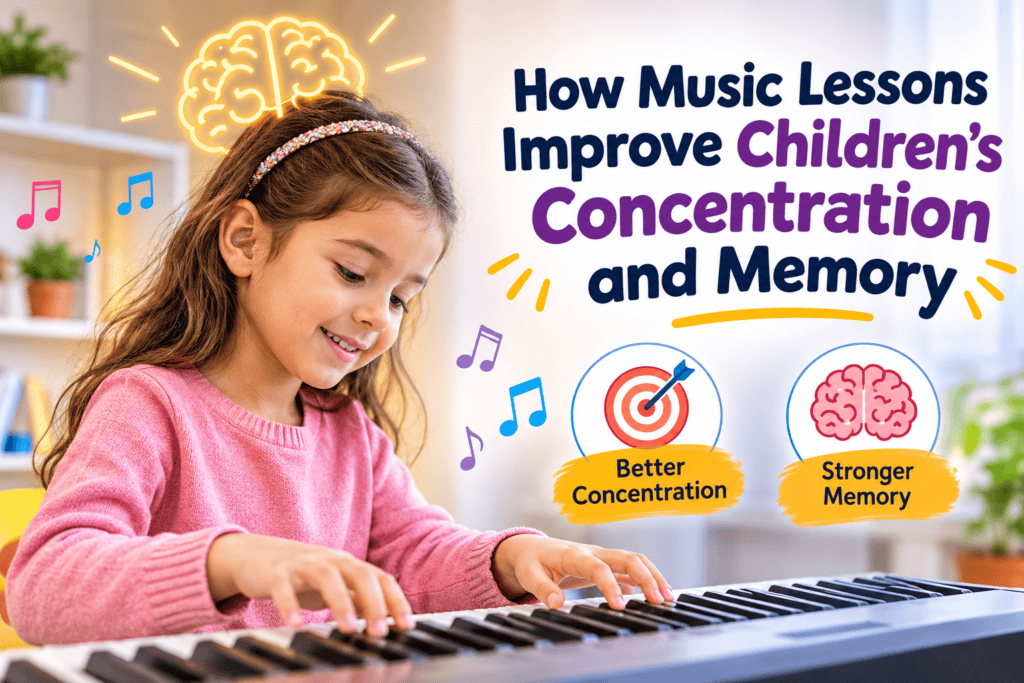
How Music Lessons Improve Children's Concentration and Memory
Introduction
Children’s Concentration is a way to learn new things every day, from understanding classroom lessons to developing social skills and exploring their interests. However, maintaining concentration, remembering information, and staying focused on tasks can sometimes be challenging. One enjoyable way to support these abilities is through music education. Regular music lessons for children provide opportunities to listen carefully, recognise patterns, follow instructions, and remember musical sequences.
Learning an instrument involves much more than pressing keys, strumming strings, or playing rhythms. Children need to coordinate their movements, pay attention to sounds, read notes, and recall what they have practised. These activities engage different mental processes and give children regular opportunities to develop their cognitive skills.
Whether a child is learning piano, guitar, violin, or drums, music lessons can become a valuable part of their learning experience. Let’s explore how music lessons can support children’s concentration, memory, and overall development.

1. How Music Lessons Improve Children’s Concentration
Concentration is the ability to direct attention towards a particular activity and maintain it over time. It is an important skill for classroom learning, homework, reading, and everyday problem-solving.
Music lessons encourage children to focus on several musical elements simultaneously.
For example, a child learning piano may need to read musical notes, follow a rhythm, coordinate both hands, and listen carefully to the sounds being produced. A young guitarist must pay attention to finger placement while maintaining a steady strumming pattern.
These activities encourage children to practise directing and maintaining their attention.
Piano Lessons and Children’s Concentration
When children practise an instrument, they learn to concentrate on a specific musical goal.
They may begin by learning a short melody, practising a chord transition, or repeating a particular rhythm. To complete the exercise correctly, they need to pay attention to instructions and avoid rushing through the activity.
With regular practice, children get opportunities to develop better task awareness and focused attention.
Music Lessons Encourage Children’s Concentration
Listening is an essential part of learning music. Children must recognise differences in pitch, rhythm, tempo, and volume.
For example, a piano teacher may play a short melody and ask the child to repeat it. The child needs to listen carefully, remember the sound, and reproduce it.
These listening activities encourage children to pay attention to details rather than simply hearing sounds passively.
Children’s Concentration In Music Lessons Helps Them Follow Instructions
Learning an instrument involves following a sequence of instructions.
Children may need to play specific notes, count beats, change hand positions, or repeat a musical section. As they become familiar with these instructions, they get opportunities to practise following directions in an organised way.
This experience can complement the attention skills they use in other learning environments.
2. How Music Lessons Improve Children’s Memory
Memory plays an important role in childhood development. Children use it to remember classroom information, instructions, experiences, and new skills.
Music education provides several opportunities to practise remembering and recalling information.
When children learn songs or instrumental pieces, they gradually become familiar with musical patterns, note sequences, rhythms, and melodies.
Children’s Concentration Helps In Learning Music Strengthens Auditory Memory
Auditory memory refers to the ability to remember information heard through listening.
During music lessons, children often listen to a melody or rhythm before attempting to reproduce it.
For example, a drum student may listen to a short beat and repeat the same pattern. Similarly, a young singer may learn to remember a melody by listening to their teacher.
These exercises give children opportunities to practise recognising, retaining, and recalling sounds.
Children’s Concentration Helps in Learning an Instrument Develops Musical Recall
As children progress, they begin remembering musical sequences without depending entirely on written notes or demonstrations.
They may recall the order of notes in a melody, the chords in a song, or the rhythm of a familiar composition.
This process involves storing musical information and retrieving it when needed.
Children’s Concentration Helps In Music Lessons Encourage Working Memory
Working memory allows us to temporarily hold and use information while completing a task.
Playing an instrument can involve using working memory in several ways. A child may need to remember a musical instruction, keep track of the rhythm, and prepare for the next set of notes while continuing to play.
For instance, a young pianist learning a two-hand piece needs to coordinate different note patterns while maintaining the overall rhythm.
Such activities provide opportunities to practise holding and using information during a task.
3. How Different Instruments Support Children’s Concentration
Music involves listening, movement, attention, memory, and coordination. Learning an instrument brings several of these activities together.
When children practise music, their brains process sounds, recognise patterns, and coordinate physical movements. Research on music training suggests that sustained musical learning can influence brain networks involved in auditory processing, attention, and motor coordination.
Children’s Concentration Helps In Music Encourages Pattern Recognition
Music is built around patterns. Children learn to recognise repeated notes, rhythms, scales, chords, and melodies.
For example, a child learning piano may notice that certain musical patterns repeat across different songs. A guitar student may recognise familiar chord progressions in several pieces.
Recognising these patterns encourages children to observe relationships between sounds and understand how musical elements fit together.
Children’s Concentration Helps In Music Connects Listening With Movement
Playing an instrument requires children to translate what they hear or read into physical actions.
A violin student must listen to the pitch while controlling the bow and adjusting finger placement. A drummer needs to coordinate hand and foot movements while maintaining a steady beat.
This connection between listening and movement makes instrumental learning an engaging mental and physical activity.
Children’s Concentration Helps In Music Encourages Mental Flexibility
Children’s Concentration often need to adjust their playing when they encounter a mistake or unfamiliar musical section.
They may slow down, repeat a passage, change their finger position, or try a different approach.
These experiences encourage them to adapt their actions and think about how to improve.
4. How Different Music Lessons Improve Children’s Concentration and Memory
Every musical instrument introduces different learning activities. Although all instruments can provide opportunities to practise attention and memory, the specific skills involved may vary.
Piano Lessons Improve Children’s Concentration and Musical Memory
Piano is a popular instrument for young beginners because its keyboard layout makes musical notes and patterns visible.
During piano lessons, children learn to:
Remember melodies and note sequences.
Coordinate both hands.
Read and interpret musical patterns.
As children progress, they may learn to play pieces that involve both hands independently. This encourages them to pay attention to different musical parts while remembering the structure of the composition.
Guitar Lessons Develop Listening and Recall
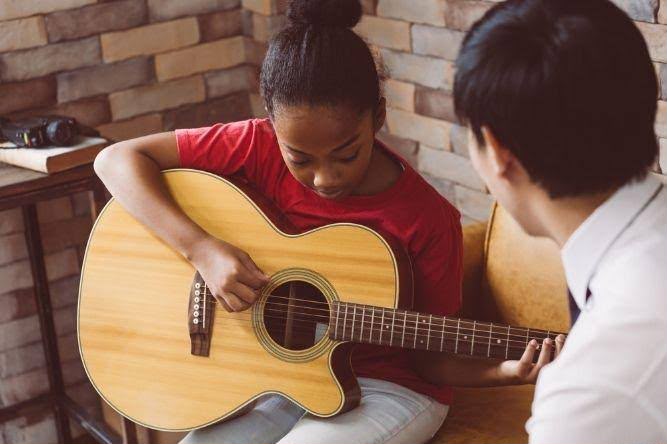
Guitar lessons introduce children to chords, strumming patterns, melodies, and finger placement.
Young learners gradually become familiar with different chord shapes and practise remembering the order in which they appear in a song.
They also learn to listen for changes in rhythm and timing.
These activities encourage musical recall, attention to detail, and coordination.
Violin Lessons Encourage Focus and Listening Accuracy
The violin requires careful attention to pitch, posture, bow movement, and finger placement.
Children need to listen closely to the sound they produce and make adjustments when a note does not sound accurate.
Learning short melodies and repeating musical passages also gives them opportunities to practise remembering note sequences.
Drum Lessons Strengthen Rhythmic Memory and Attention
Drumming involves recognising and reproducing rhythmic patterns.
Children learn to maintain a steady beat, remember different combinations of sounds, and coordinate their hands and feet.
For example, a beginner may start with a simple beat before progressing to more complicated rhythmic patterns.
Repeating these exercises encourages attention, timing, and the ability to recall sequences.
Singing Lessons Develop Listening and Memory Skills
Vocal lessons also provide valuable musical learning experiences.
Children learn to remember lyrics, follow melodies, recognise pitch, and maintain rhythm while singing.
They may practise repeating short musical phrases or remembering the sequence of notes in a song.
These activities encourage auditory attention and musical memory.
5. How Music Lessons Help Children Develop Better Learning Habits
The benefits of music lessons are not limited to playing an instrument. The learning process can also encourage habits that are useful in other areas of childhood development.
Regular Practice Encourages Consistency
Learning music requires repetition. Children need to revisit exercises and musical passages to become more comfortable with them.
A regular practice routine can help them understand the value of consistency and gradual improvement.
For example, practising for 15–20 minutes each day may be more manageable and productive than practising for a long period only once a week.
Music Teaches Children to Break Down Difficult Tasks
A complete musical composition may seem challenging to a beginner.
However, teachers often divide it into smaller sections so children can learn one part at a time.
This approach helps children understand that larger goals can be achieved through smaller, manageable steps.
They can apply a similar approach when completing homework, learning a new subject, or working on other activities.
Music Encourages Independent Learning
As children become more familiar with their instruments, they gradually learn how to practise independently.
They may identify a difficult section, repeat it slowly, and work towards playing it more accurately.
This process encourages them to take an active role in their own learning.
6. Can Music Lessons Improve Children’s Academic Performance?
Music education and academic learning involve several overlapping skills, including attention, listening, memory, pattern recognition, and practice.
Because of these connections, music lessons may support certain abilities that children also use in school.
However, it is important to understand that learning an instrument does not automatically guarantee higher grades or improved performance in every academic subject.
Instead, music can complement a child’s overall education by providing additional opportunities to practise useful learning skills.
Music and Mathematics
Music involves counting, timing, patterns, fractions, and sequences.
For example, children’s concentration helps them learn and understand beats, note durations, and time signatures. These concepts can introduce practical examples of mathematical relationships.
Music and Language Learning
Listening carefully to musical sounds, recognising patterns, and remembering sequences are also important in language learning.
Singing and learning songs can expose children to vocabulary, pronunciation, rhythm, and repetition.
Music and Classroom Attention
Instrumental lessons encourage children to follow instructions, listen to feedback, and concentrate on specific tasks.
These are skills that can also be useful during classroom activities.
Music should be considered a complementary learning experience rather than a replacement for academic instruction.
7. How Parents Can Use Music Lessons to Support Children’s Memory and Concentration
Parents play an important role in helping build children’s concentration and develop a positive relationship with music.
The goal should be to make learning enjoyable and consistent rather than turning practice into another source of pressure.
Here are some practical ways parents can support their child’s musical development.
Create a Regular Practice Schedule
Choose a convenient time for music practice and try to maintain a consistent routine.
Short, focused sessions are often more suitable for young beginners than long and tiring practice periods.
Listening Activities That Improve Children’s Concentration
Listening to different musical styles can help children become familiar with melodies, rhythms, and instruments.
Parents can encourage them to identify repeated patterns, recognise instruments, or clap along with a song.
Make Practice Enjoyable
Allow children to learn songs they enjoy alongside their regular exercises.
Familiar and interesting music can make practice feel more engaging and give them something exciting to work towards.
Avoid Putting Too Much Pressure on Performance
Every child learns at a different pace.
Some may remember melodies quickly, while others may need more repetition to understand a particular technique.
Encourage effort and progress instead of expecting perfect performance.
Celebrate Small Improvements
Recognise your child’s achievements, whether they have learned a new melody, remembered a difficult rhythm, or completed a practice exercise independently.
Positive encouragement can help children remain interested in their musical journey.
8. How Often Should Children Attend Music Lessons and Practise?
The ideal lesson frequency and practice duration depend on the child’s age, attention span, experience, and learning goals.
For beginners, one structured lesson each week combined with short practice sessions at home can provide a manageable starting point.
Here is an example of a simple practice routine:
| Practice activity | Suggested time |
|---|---|
| Warm-up exercises | 3–5 minutes |
| Note or rhythm practice | 5 minutes |
| Learning a musical passage | 5–10 minutes |
| Revising a familiar song | 5 minutes |
The schedule can be adjusted according to the child’s age and instrument.
Younger children may benefit from shorter sessions, while older or more experienced learners may be comfortable practising for longer.
The focus should remain on regular, attentive practice rather than simply spending more time with the instrument.
9. Why Choosing the Right Music Teacher Matters
A supportive music teacher can make a significant difference to a child’s learning experience.
Children need guidance that matches their age, interests, and current abilities. A good teacher understands how to introduce musical concepts gradually and make lessons engaging.
When choosing music lessons, parents should consider:
Teaching experience: Look for teachers who understand how to work with young learners.
Structured lessons: Classes should include technique, rhythm, musical understanding, and practical playing.
Personalised attention: Children should receive guidance based on their individual progress.
Encouraging feedback: Teachers should help children understand mistakes without discouraging them.
Age-appropriate activities: Exercises and songs should suit the child’s learning level.
The right learning environment can help children remain curious, motivated, and comfortable as they develop their musical abilities.

10. Why Choose The Mystic Keys for Children’s Music Lessons?
Starting music lessons at the right learning environment can help children develop a strong foundation and enjoy the process of learning.
At The Mystic Keys, children can explore their musical interests through online lessons with internationally certified teachers and personalised guidance.
Whether your child wants to learn piano, guitar, violin, drums, or develop their singing skills, structured lessons can help them improve their musical understanding and practical abilities.
With individual attention and flexible online learning, children can receive guidance from home while progressing at a comfortable pace.
Music education can become a meaningful part of their routine, giving them opportunities to explore creativity, practise concentration, and develop musical memory.
Conclusion
Music lessons offer children much more than the ability to play an instrument. They provide regular opportunities to practise concentration, strengthen musical memory, recognise patterns, and coordinate different actions.
Whether a child chooses piano, guitar, violin, drums, or singing, consistent music learning can support their development while giving them an enjoyable creative outlet.
Every child learns differently, but with patient guidance, regular practice, and encouragement, music can become a valuable part of their childhood.
For more information and exciting resources about learning music, visit our website at The Mystic Keys. For more music content and exciting offers follow us on
Facebook, Instagram, YouTube, LinkedIn, Twitter, Pinterest, and Threads,