How to Build Speed Without Losing Accuracy
Learning how to build speed without losing accuracy is an important part of becoming a confident and skilled musician. Whether you play piano, guitar, keyboard, violin, or another instrument, playing faster can make your performance more exciting, but speed should never come at the expense of clear notes, steady rhythm, and proper technique. Build speed without losing accuracy by developing control gradually, practicing difficult passages carefully, and using techniques that allow your hands and fingers to become faster without creating unnecessary tension or mistakes. The goal is not simply to play as many notes as possible in a short amount of time. True musical speed comes from efficient movement, strong coordination, rhythmic consistency, and repeated accurate practice. By following the right approach, musicians can improve playing speed while maintaining accuracy, control, and musical expression.
1. How to Build Speed Without Losing Accuracy: Start Slowly
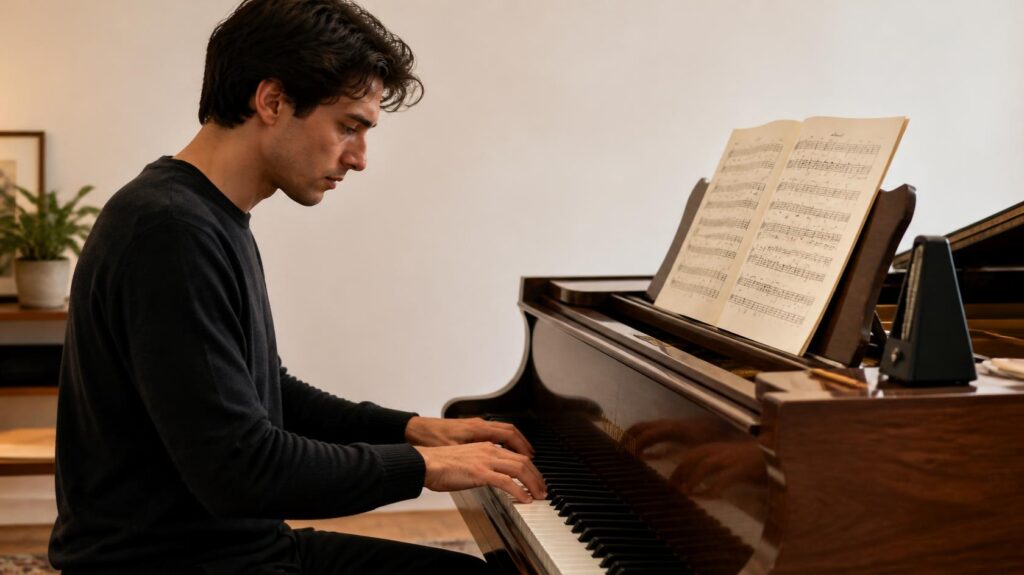
One of the most effective ways to improve playing speed is surprisingly simple: practice slowly before trying to play fast. Slow practice allows you to observe every movement, identify mistakes, and understand exactly how your fingers, hands, or other parts of your body are working. When you immediately attempt a difficult passage at a fast tempo, your brain has less time to process each movement, which can cause incorrect notes and inconsistent rhythm to become part of your playing. Once these mistakes become familiar through repetition, they can be much harder to correct.
Start by choosing a tempo at which you can play the passage comfortably and accurately. Use a metronome to maintain a consistent pulse and gradually increase the tempo only when you can perform the passage correctly several times in a row. This approach gives your brain the opportunity to establish reliable movement patterns before increasing the demands of speed. For students developing their technique, structured piano lessons can provide guidance on posture, fingering, coordination, and practice methods that support long-term technical development.
Slow practice should not feel like simply playing a fast piece at half speed. Instead, use the slower tempo to examine your technique. Are your fingers moving more than necessary? Are your wrists relaxed? Are you pressing harder than required? Are you maintaining an even rhythm? Answering these questions while practicing can help eliminate inefficient movements that may prevent you from reaching higher tempos later.
2. Use a Metronome to Build Speed Without Losing Accuracy
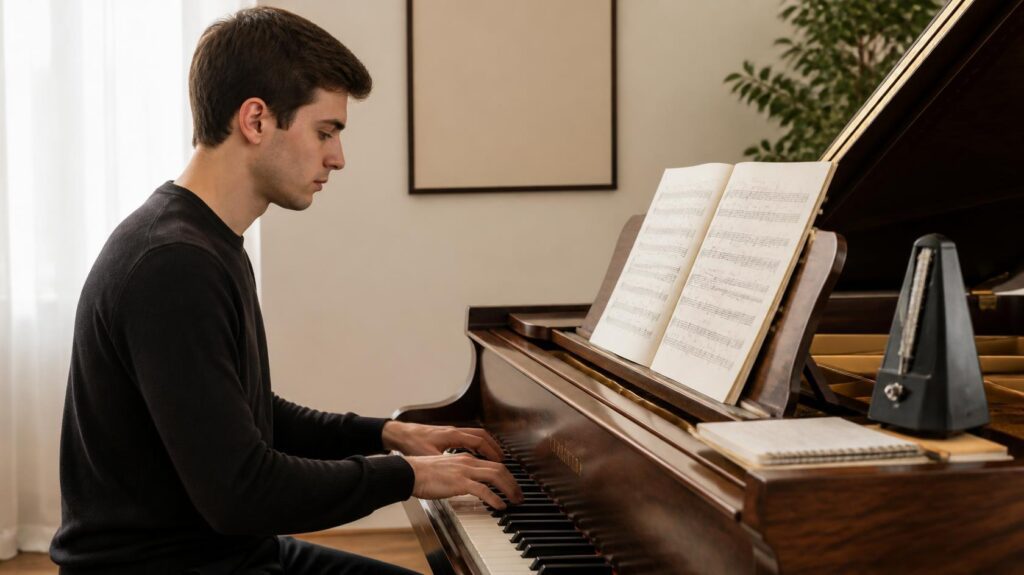
A metronome is one of the most useful tools for musicians who want to build speed without losing accuracy. It provides an objective reference for tempo and prevents you from gradually speeding up or slowing down without noticing. When practicing a difficult passage, choose a comfortable starting tempo and focus on playing every note evenly with the click. Once the passage feels controlled and consistent, increase the tempo by a small amount rather than making a large jump.
For example, if you can comfortably play a passage at 80 BPM, you might increase it to 84 or 88 BPM rather than immediately attempting 110 BPM. The smaller increase gives your coordination time to adapt to the new speed. If your accuracy begins to decline, return to the previous tempo and reinforce the movement pattern before trying again. This process may appear slow, but it creates much more dependable progress than constantly struggling at a tempo beyond your current ability.
You can also use different metronome practice patterns to challenge your control. Practice a passage normally, then increase the tempo slightly, return to the original tempo, and repeat the process. This can help your hands become comfortable with different levels of speed while keeping your rhythmic awareness stable. Strong rhythm and timing are essential foundations for playing faster, which is why combining technical practice with music theory and rhythmic training can make your overall development more effective.
3. Break Difficult Passages Into Smaller Sections

Trying to practice an entire song or exercise from beginning to end can make speed development unnecessarily difficult. Long passages contain different technical challenges, and some sections may require considerably more coordination than others. Instead of repeating the complete piece every time, identify the specific areas that cause hesitation, tension, or mistakes and work on them separately.
Break the passage into small sections, such as two to four beats, one measure, or a short musical phrase. Practice each section slowly until the notes feel comfortable, then gradually increase the tempo. Once individual sections become reliable, connect two sections together and continue expanding the passage. This method allows you to spend more practice time on the areas that actually need improvement instead of repeatedly playing sections you already know.
Another useful technique is to practice transitions separately. Sometimes the problem is not a particular note or chord but the movement between two positions. Isolating that transition can make practice much more efficient. For example, a pianist may struggle when moving from one chord shape to another, while a guitarist may find a particular position change difficult. Focusing directly on these movements can help develop the coordination required for fluent playing.
If you are working on a difficult piece, learning an instrument with structured one-to-one guidance can help you identify technical challenges and practice them more efficiently.
4. Build Speed Without Losing Accuracy Through Proper Technique

One of the biggest obstacles to playing faster is unnecessary physical tension. When musicians try to increase speed by using more force, they often create stiffness in their fingers, wrists, arms, shoulders, or other muscles. This can make movement less efficient and may eventually affect accuracy and endurance. Fast playing should generally feel controlled and economical rather than physically aggressive.
Pay attention to how much movement is actually necessary to produce the sound you want. Your fingers should not travel farther than necessary, and your hands should remain positioned efficiently for the passage you are playing. On piano and keyboard, excessive finger lifting can make rapid passages harder to execute. On guitar, unnecessary movement between fretting and picking positions can reduce efficiency. The specific technique differs between instruments, but the principle remains the same: the less unnecessary movement you make, the easier it becomes to develop controlled speed.
Relaxation does not mean allowing your technique to become loose or careless. Instead, it means removing unnecessary tension while maintaining enough control to produce accurate notes. If you notice that your shoulders are rising, your grip is becoming tighter, or your movements are becoming increasingly forceful as the tempo rises, slow down and reset your technique. Building speed should never require sacrificing healthy and efficient movement.
5. Practice With Rhythm, Accents, and Different Patterns

Repeating the same passage in exactly the same way is not always the most effective method for developing speed. Introducing controlled variations can help strengthen coordination and expose weaknesses that may remain hidden during normal repetition. One useful approach is to practice rhythmic variations, where long and short notes are alternated within a fast passage. This gives certain notes more time to settle while training your fingers to move efficiently between them.
You can also experiment with accents. For example, in a sequence of repeated notes, slightly emphasize every second, third, or fourth note. This can help you become more aware of groups of notes rather than treating every note as an isolated movement. Once you return to the original pattern, the passage may feel more organized and controlled.
Another valuable approach is burst practice. Instead of immediately trying to play an entire passage quickly, play a very small group of notes at your target speed, stop, relax, and repeat. Gradually increase the size of the group while maintaining accuracy. This introduces your muscles and brain to the sensation of faster movement without forcing the entire passage to remain at that speed.
For musicians who want to develop a stronger technical foundation, combining regular instrument practice with music theory and structured musical training can improve your understanding of rhythm, phrasing, timing, and musical structure.
6. Build Speed Through Consistent Practice, Not Pressure
Developing speed is a gradual process, and progress will not always happen at the same rate. Some days a passage may feel noticeably easier, while on other days your playing may feel slower or less coordinated. This is normal. What matters is maintaining a consistent practice routine and measuring improvement over time rather than expecting dramatic changes in every session.
A good practice session should include a balance of warm-up exercises, slow technical work, focused difficult passages, metronome practice, and musical playing. Avoid spending the entire session trying to reach your maximum speed. Instead, spend most of your time developing accuracy and control, with short periods dedicated to testing faster tempos. This allows speed to develop as a consequence of reliable technique.
It is also important to remember that playing faster is not always the same as playing better. A technically impressive performance should still communicate rhythm, phrasing, dynamics, expression, and musical intention. If increasing the tempo causes the music to sound rushed or unclear, the best solution may be to reduce the speed and rebuild control. The strongest musicians are not necessarily those who play the fastest, but those who can choose an appropriate tempo and perform with confidence, consistency, and musical expression.
Final Thoughts
Learning how to build speed without losing accuracy is ultimately about developing control. Start slowly, use a metronome, isolate difficult sections, reduce unnecessary movement, experiment with rhythmic practice, and increase your tempo gradually. Most importantly, give your technique enough time to develop naturally instead of forcing your hands or fingers to perform movements they are not yet prepared to execute.
With consistent and thoughtful practice, faster playing becomes less about rushing through notes and more about making efficient movements with confidence. Whether you are a beginner learning your first instrument or an experienced musician working toward more advanced repertoire, accuracy should remain the foundation on which speed is built.
If you want to develop stronger technique, timing, and confidence through personalized instruction, you can learn music online with experienced instructors and build a practice approach suited to your current level and musical goals.
For more information and exciting resources about learning music, visit our website at The Mystic Keys. For more music content and exciting offers follow us on
Facebook, Instagram, YouTube, LinkedIn, Twitter, Pinterest, and Threads.