
Music Improvement | Signs You’re Improving Faster
Learning music is rarely a straight line. Music improvement can happen gradually, with some days feeling incredibly rewarding while others make even a simple chord, scale, rhythm, or vocal exercise seem unexpectedly difficult. Because progress often happens in small, almost unnoticeable steps, musicians may not always realize just how much they have improved over time.
The interesting part is that musical growth is not always measured by how quickly you learn a new song. In fact, some of the most meaningful signs of improvement happen quietly. You may begin to hear mistakes more clearly, play with less effort, recover faster when something goes wrong, or understand music in a way that once seemed confusing.
So, how can you tell whether you are improving faster than you realize? Let’s look at some of the clearest signs.

You Make Fewer Mistakes Without Thinking About It
One of the earliest signs of musical improvement is that things begin to feel more automatic.
At first, playing a chord progression, finding the right piano keys, following a rhythm, or remembering lyrics may require intense concentration. You might consciously think about every finger movement or every note. However, with regular practice, those movements gradually become more natural.
You may suddenly notice that you are playing a familiar section without stopping to think about every individual note. Your fingers seem to know where to go, and your attention becomes available for other things.
That shift is important because it shows that your brain and body are building musical patterns. Instead of constantly thinking about how to play, you are beginning to focus on how the music should sound.

Music Improvement | You Can Hear Your Own Mistakes More Clearly
This might sound strange, but noticing more mistakes can actually be a sign of progress.
When you are just beginning, you may play a wrong note or sing slightly out of tune without realizing it. Your ears have not yet developed enough awareness to identify every difference between what you intended to produce and what actually happened.
As your musical ear improves, those differences become easier to recognize. You might suddenly notice that a chord sounds slightly wrong, your rhythm is rushing, your singing is a little sharp, or your guitar tone is not quite as clean as you expected.
Although this can sometimes feel frustrating, it is actually a major step forward. Your ears are becoming more accurate, and better listening is one of the foundations of becoming a stronger musician.

You Need Less Time to Learn Something You Have Already Practiced
Another powerful sign of improvement is faster learning.
Perhaps a particular rhythm took several practice sessions to understand a few months ago. Now, you may be able to pick up something similar within a much shorter time. A chord progression that once seemed complicated might now feel surprisingly familiar.
This happens because you are no longer starting from zero. Your previous practice has created patterns that your brain can recognize and reuse.
Consequently, every new piece of music becomes an opportunity to build on what you already know. Progress starts becoming cumulative rather than repetitive.
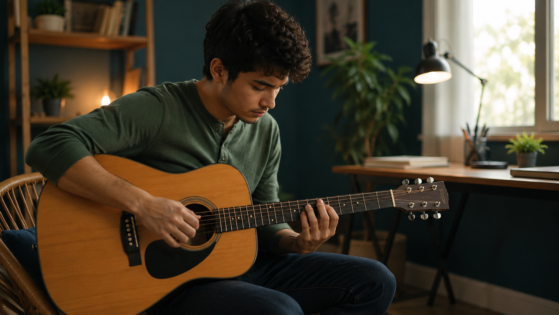
Music Improvement | You Recover Faster From Mistakes
Perfect performances are not the only sign of musical ability. Knowing what to do after making a mistake is equally important.
Imagine that you are playing a song and accidentally miss a chord. Earlier in your learning journey, you might have stopped completely, gone back to the beginning, and tried again. With improvement, however, you may continue playing and rejoin the music at the next opportunity.
That ability shows developing musical control.
More importantly, it means you are learning to stay connected to the rhythm instead of allowing one mistake to interrupt the entire performance. Eventually, you begin to understand that a mistake does not have to become a breakdown.

Music Improvement | Your Rhythm Feels More Natural
Rhythm is one of those musical skills that can improve gradually without you immediately noticing.
In the beginning, you may need to consciously count beats while playing. Keeping a steady tempo can feel difficult, especially when changing chords, playing unfamiliar patterns, or singing while accompanying yourself.
Over time, however, the beat begins to feel more natural. You may find yourself tapping along automatically, maintaining a steadier tempo, or playing a rhythmic pattern without constantly counting in your head.
That internal sense of timing is a significant milestone. It means the rhythm is moving from something you consciously calculate toward something you naturally feel.

Music Improvement | You Can Play and Listen at the Same Time
As musicians become more comfortable with their instrument, their attention becomes less divided.
Instead of concentrating entirely on getting the notes right, you can begin listening to the sound while you are playing. You notice whether the performance feels too fast, too loud, too soft, uneven, or emotionally flat.
This is where technique starts becoming musical expression.
For example, a pianist may begin noticing the difference between simply playing the correct notes and actually shaping a phrase. A guitarist may become more aware of dynamics and tone. A singer may start listening to pitch, breath, pronunciation, and emotional delivery simultaneously.
That kind of awareness is a strong indication that your musical skills are developing quickly.

You Understand Music Instead of Just Memorizing It
There is a big difference between remembering what to play and understanding why you are playing it.
Initially, you might memorize a song by remembering a sequence of movements. However, as your understanding grows, you begin recognizing patterns such as chord progressions, scales, intervals, rhythmic structures, song forms, and repeated musical ideas.
Suddenly, learning becomes easier because you can predict what is likely to come next.
For instance, once you understand common chord progressions, a new song may not feel completely unfamiliar. You start recognizing relationships instead of treating every song as an entirely new set of information.
That is a major form of musical growth because knowledge begins supporting technique.

You Are Becoming More Comfortable With Slow Practice
Fast playing can feel impressive, but slow practice often reveals real improvement.
When you are developing quickly, you may become more comfortable slowing a difficult section down rather than constantly trying to play it at full speed. This allows you to listen carefully, correct mistakes, improve coordination, and build consistency.
Eventually, you understand that playing slowly is not the opposite of progress. It is often one of the fastest ways to build reliable technique.
Once the movement becomes accurate and comfortable, increasing the tempo becomes much easier.

You Can Play Something Without Constantly Looking at Your Hands
For instrumentalists, this can be a particularly exciting milestone.
At the beginning, your eyes may constantly move between the instrument and your fingers. You need visual confirmation before making almost every movement.
With practice, your hands begin developing a stronger sense of position. You can find familiar chords, keys, or patterns with less visual assistance.
As a result, you can pay more attention to the music itself. You may even begin looking ahead at what comes next rather than watching every movement you make.
That growing independence between your eyes and hands is a clear sign that your technique is becoming more secure.

Music Improvement | You Become More Curious About Music
Improvement is not only about technical ability. Your relationship with music changes too.
You may start listening more carefully to songs you previously heard casually. Suddenly, you notice the bass line, harmony, vocal phrasing, guitar tone, drum patterns, or production choices.
Perhaps you begin wondering why one chord sounds emotional, why a particular rhythm makes a song feel energetic, or how a singer controls their voice.
That curiosity matters because it turns practice into exploration. Instead of simply completing exercises, you start wanting to understand music more deeply.

Music Improvement | You Feel Less Afraid of Difficult Sections
A challenging piece may still be difficult, but your reaction to difficulty can change dramatically.
Earlier, seeing a complicated passage might make you think, “I can’t play this.” After gaining experience, your first thought may become, “This is difficult, but I can break it down.”
That change in mindset is one of the strongest indicators of progress.
You begin dividing difficult music into smaller sections, slowing it down, identifying the specific problem, and working through it systematically. Rather than being intimidated by the entire piece, you know how to approach the challenge.
In other words, you are not only becoming a better musician; you are becoming better at learning music.

You Need Less Repetition to Remember Familiar Skills
Repetition is essential when learning music, but improvement changes the kind of repetition you need.
A beginner may need to repeat a chord progression many times before remembering it. Later, a similar pattern may become familiar after only a few attempts.
Your memory is becoming more efficient because your brain is connecting new information with previously learned patterns.
Therefore, if you notice that songs, scales, chords, or exercises are staying in your memory longer, do not overlook it. Stronger musical memory can significantly accelerate future learning.

Music Improvement | Your Playing Starts Sounding More Like You
Perhaps the most exciting sign of improvement is developing your own musical personality.
At first, your main goal is usually accuracy. You want to play the correct notes, chords, rhythms, and lyrics. Gradually, however, you start making choices about dynamics, phrasing, tone, timing, articulation, and expression.
Two musicians can play exactly the same song while making it sound completely different.
When your playing begins to reflect your own choices rather than simply reproducing instructions, you are moving beyond basic technique. You are developing musical identity.

You Notice Progress Even When You Are Not Practicing Every Skill Directly
One fascinating aspect of musical learning is that skills often transfer.
Practicing scales can improve finger control. Rhythm exercises can improve your playing in songs. Ear training can improve your ability to learn melodies. Chord knowledge can help you understand unfamiliar songs more quickly.
Because these skills are connected, improvement in one area can quietly strengthen another.
You might therefore find that something suddenly feels easier even though you have not practiced that exact skill recently. Your overall musical foundation is becoming stronger.

You Enjoy the Process More
Finally, one of the most meaningful signs of improvement is that practice starts feeling less like a task and more like an experience.
You may still have difficult days. You may still make mistakes, struggle with certain techniques, or feel frustrated by slow progress. However, there is a growing sense of satisfaction in figuring things out.
Instead of asking only, “How quickly can I finish this song?” you begin asking, “What can I discover from this?”
That change can make a huge difference because consistent improvement comes from staying engaged with the process.

Final Thoughts
At The Mystic Keys, we believe musical progress is not always obvious. Sometimes, it is hidden in small changes: recovering from mistakes faster, hearing pitch more accurately, understanding rhythms more naturally, remembering patterns more easily, or feeling less nervous when approaching something difficult.
You might not notice these changes from one practice session to the next. However, when you compare your playing with where you were a few months ago, the difference can become much clearer. Every practice session, lesson, and new challenge contributes to your overall musical growth.
Most importantly, do not measure improvement only by how many songs you can play. Listen to how you play them, how quickly you learn, how confidently you solve problems, and how naturally you respond to music. With the right guidance and consistent practice, even small improvements can gradually lead to a stronger and more confident musician.
If several of these signs sound familiar, there is a good chance you are improving faster than you think. Keep practicing, keep listening, and keep challenging yourself with The Mystic Keys—because sometimes the biggest musical breakthroughs happen quietly, before you even realize they are happening.
For more information and exciting resources about learning music, visit our website at The Mystic Keys. For more music content and exciting offers follow us on
Facebook, Instagram, YouTube, LinkedIn, Twitter, Pinterest, and Threads.