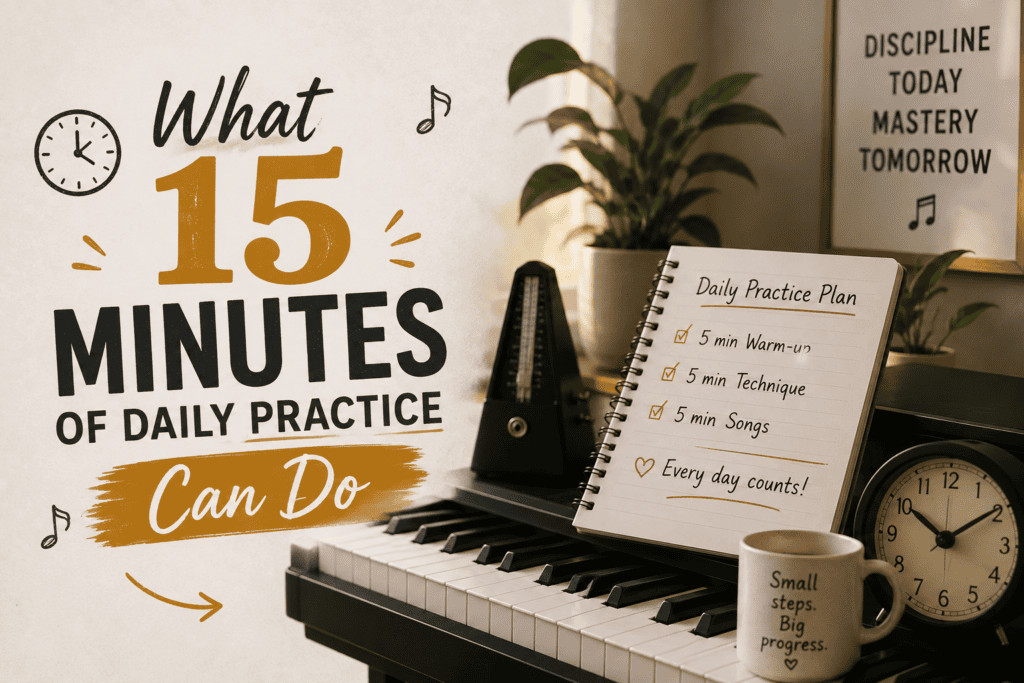
What 15 Minutes of Daily Practice Can Do
Many aspiring musicians believe they need an hour or more every day to make meaningful progress. While longer practice sessions can certainly be useful, they are not the only way to improve. 15 minutes of daily practice can create significant progress when those minutes are focused, consistent, and used intentionally. Whether you are learning piano, guitar, violin, ukulele, drums, or vocals, a short daily routine can help develop stronger habits and keep your musical skills moving forward.
The biggest advantage of a short practice session is consistency. Practicing for fifteen minutes every day gives your brain and body frequent opportunities to repeat important musical movements. Instead of allowing several days to pass between practice sessions, you continually reinforce what you have learned. Over time, these small sessions can add up to hours of purposeful practice without feeling overwhelming.
A fifteen-minute routine will not replace every type of extended practice, especially when preparing for performances or working on advanced repertoire. However, it can be an extremely effective foundation for beginners, busy adults, students, and anyone who struggles to find large blocks of free time.
Why 15 Minutes of Daily Practice Matters

The most important part of practice is not always its duration. The quality and frequency of practice matter enormously.
A short session gives you a manageable target. Instead of thinking, “I need to practice for an hour,” you can simply tell yourself that you need to focus for fifteen minutes.
This makes it easier to begin.
Consistency Builds Musical Habits
When practice becomes part of your daily routine, you no longer need to rely entirely on motivation.
You begin to associate a particular time or part of your day with music.
That habit can become one of your greatest advantages as a musician.
Even when you are busy, fifteen minutes feels achievable.
Small Sessions Strengthen Muscle Memory
Musical movements become more natural through repetition.
A pianist repeats finger patterns. A guitarist practices chord changes. A violinist works on bow control. A drummer repeats rhythmic movements. A singer coordinates breathing, pitch, and vocal placement.
Frequent repetition helps these movements become increasingly familiar.
Repetition Makes Technique More Automatic
When you practice a skill regularly, your brain becomes better at recalling the movement.
This does not mean that every repetition is automatically productive. Practicing incorrectly can reinforce poor habits.
The goal is to use your short sessions for accurate, controlled repetition.
Fifteen Minutes Can Improve Your Technique
A short session can be dedicated entirely to one technical goal.
For example, a pianist might spend fifteen minutes working on scales and finger independence.
A guitarist might practice chord transitions.
A violinist might focus on bowing.
A drummer could work on a basic sticking pattern.
A vocalist might practice breathing and pitch exercises.
15 Minutes of Daily Practice Focus on One Technical Skill
You do not need to practice everything in every session.
Choosing one specific technical goal allows you to concentrate more deeply.
Over several days, you can rotate through different skills while continuing to make progress.
Daily Practice Improves Rhythm
Rhythm is fundamental to almost every form of music.
Even a short daily session can help improve your sense of timing.
Use a metronome or backing track and practice simple rhythmic patterns.
Focus on keeping the beat steady rather than trying to play complicated patterns immediately.
A Steady Beat Builds Confidence
When your internal sense of timing becomes stronger, you feel more comfortable playing with other musicians.
You also become less dependent on stopping and restarting when something goes wrong.
Short Practice Can Improve Musical Memory
Regular repetition helps you remember songs, scales, chord progressions, melodies, and exercises.
If you learn something on Monday and do not return to it until the following weekend, you may spend much of your practice time remembering what you previously learned.
Daily practice reduces that gap.
Frequent Review Strengthens Recall
Even a few minutes spent reviewing yesterday’s material can help keep it fresh.
This is particularly useful when learning longer pieces.
Instead of waiting until you forget a section, revisit it regularly.
Fifteen Minutes Can Improve Finger Coordination
Coordination is one of the biggest challenges for beginners.
Playing an instrument often requires different parts of the body to perform different movements simultaneously.
Short, focused sessions allow you to work on these movements without becoming physically or mentally exhausted.
15 Minutes of Daily Practice Start Slowly
If a coordination exercise is difficult, slow it down.
Accuracy should come before speed.
Fifteen minutes of careful practice can be more valuable than an hour of rushed repetition.
Short Practice Sessions Reduce Overwhelm

One reason people avoid practicing is that the idea of a long session feels intimidating.
A large practice goal can create procrastination.
A fifteen-minute goal feels much more manageable.
Make Practice Easy to Start
Tell yourself that you only need to practice for fifteen minutes.
Once you begin, you may naturally continue if you have the time and energy.
But even if you stop after fifteen minutes, you have still completed your daily goal.
This approach removes much of the psychological resistance surrounding practice.
Use the First Few Minutes for Review
A short practice session should have a clear structure.
The first few minutes can be used to review something you already know.
Play a familiar scale.
Review yesterday’s chords.
Sing a familiar warm-up.
Play a simple rhythm.
This gives your hands and mind time to settle into the instrument.
Review Creates Continuity
Starting with familiar material connects today’s session with previous practice.
It also gives you an opportunity to notice whether something has become easier.
Spend the Middle of the Session on One Challenge
After warming up, use the majority of your practice time for the area that needs the most attention.
Perhaps there is one difficult measure in your piano piece.
Maybe one guitar chord transition keeps causing problems.
Perhaps a particular vocal phrase is consistently out of tune.
Work specifically on that challenge.
Target the Problem Instead of Repeating the Whole Piece
You do not always need to play an entire song from beginning to end.
Sometimes the fastest way to improve is to isolate the difficult section and repeat it correctly.
Focused practice makes short sessions much more productive.
End With Something You Enjoy

The final few minutes can be dedicated to something enjoyable.
Play a favorite song.
Review a familiar melody.
Improvise.
Sing along with your instrument.
Experiment with a rhythm.
This helps create a positive association with practice.
Enjoyment Encourages Consistency
Music should not feel like a punishment.
When you finish your practice session feeling satisfied, you are more likely to return to the instrument the next day.
Fifteen Minutes Can Build Confidence
Confidence develops through evidence.
Every time you successfully complete a practice goal, you prove to yourself that you can improve.
Maybe you finally play a chord transition without stopping.
Maybe you perform a scale more smoothly.
Maybe you remember a melody without looking at the music.
These small victories matter.
Progress Becomes Visible Over Time
The improvement from one fifteen-minute session may seem tiny.
But after several weeks, the difference can become noticeable.
This is why consistency is so powerful.
Practice Is More Effective When It Has a Goal
Simply sitting with an instrument for fifteen minutes does not guarantee improvement.
You need to know what you are trying to accomplish.
Before beginning, choose one or two realistic goals.
For example:
- Improve one chord transition.
- Practice one scale.
- Learn four measures.
- Improve one rhythm pattern.
- Practice one difficult vocal phrase.
Clear Goals Keep You Focused
A specific goal prevents your practice from becoming random.
It also makes it easier to measure progress.
Use a Metronome When Appropriate

A metronome can make short sessions especially effective.
It provides a steady pulse and helps you identify whether you are rushing or slowing down.
Start at a comfortable tempo.
Once the passage becomes accurate, increase the speed gradually.
Do Not Chase Speed
Playing faster is not always the same as playing better.
Your first goal should be control.
Speed can develop naturally once the movement becomes reliable.
Record Your Progress
Recording yourself occasionally is another useful way to make short practice sessions meaningful.
You may not notice small improvements from day to day.
A recording gives you an objective reference.
Listen for Specific Changes
Rather than simply asking whether you sound “good,” listen for measurable improvements.
Is your rhythm steadier?
Are your transitions smoother?
Is your tone clearer?
Are you making fewer mistakes?
Are you playing with greater confidence?
These observations can help guide future practice.
Fifteen Minutes Is Especially Useful for Busy Musicians
Students, working adults, parents, and other busy learners may not have an hour available every day.
That does not mean music needs to disappear from their routine.
A short practice session can fit before work, after school, during a break, or in the evening.
Consistency Beats Waiting for the Perfect Time
If you constantly wait for a completely free hour, practice may become irregular.
Fifteen minutes gives you a realistic alternative.
The goal is to keep music moving forward, even during busy periods.
What 15 Minutes Can Become Over Time
Fifteen minutes may sound small, but daily practice adds up.
In one week, fifteen minutes each day becomes more than an hour and a half of focused practice.
Over a month, it becomes several hours of consistent musical work.
The real value is not only the total number of minutes. It is the repeated contact with your instrument.
Small Efforts Create Long-Term Results
A musician who practices briefly but consistently can develop stronger habits than someone who practices for a long time only occasionally.
The important question is not, “How long can I practice today?”
It is, “What useful improvement can I make today?”
A Simple 15-Minute Practice Routine
A practical routine could look like this:
Minutes 1–3: Warm up and review something familiar.
Minutes 4–10: Focus on one specific technical or musical challenge.
Minutes 11–13: Apply the skill to a song or exercise.
Minutes 14–15: Play something enjoyable and review what improved.
This structure can be adapted to almost any instrument.
Adjust the Routine to Your Goals
A vocalist may spend more time warming up.
A drummer may focus on rhythmic coordination.
A pianist may work on a difficult passage.
A guitarist may practice chord transitions.
The structure should support your current needs rather than follow a rigid formula.
Don't Underestimate the Power of Consistency
There will also be days when you struggle.
That is normal.
The goal is not to make every session perfect.
The goal is to maintain the habit.
Keep Showing Up
Musical growth is the result of many practice sessions working together.
One day may improve your rhythm.
Another may improve your technique.
Another may strengthen your memory.
Eventually, these improvements combine to create a much more confident musician.
Conclusion
15 minutes of daily practice may seem like a small commitment, but it can have a meaningful impact when used consistently and purposefully. Short sessions can strengthen muscle memory, improve rhythm, reinforce musical memory, develop coordination, build confidence, and help you maintain a regular connection with your instrument.
The key is not to spend those fifteen minutes playing randomly. Set a clear goal, focus on one important skill, practice slowly and accurately, and finish with something enjoyable. Over time, these small daily sessions become a powerful habit that supports long-term musical growth.
You do not need to wait until you have an entire afternoon available to become a better musician. Sometimes, fifteen focused minutes are enough to move your playing forward.
At The Mystic Keys, our personalized Music Lessons Online help students develop effective practice routines alongside technique, rhythm, musical expression, and performance skills. With one-on-one guidance from experienced teachers, you can learn how to make every practice session count and build steady progress toward your musical goals.
For more information and exciting resources about learning music, visit our website at The Mystic Keys. For more music content and exciting offers follow us on
Facebook, Instagram, YouTube, LinkedIn, Twitter, Pinterest, and Threads.