
Role of Harmonium in Hindustani Vocal Practice
Hindustani classical music is a deeply nuanced tradition in which the voice remains the primary instrument of expression. Within this rich framework, the role of the harmonium becomes especially significant as a quiet yet dependable companion that supports learning, stability, and musical understanding. For generations of students and performers, the instrument has served not merely as an accompaniment tool but as a reliable guide that strengthens listening ability, refines intonation, and deepens awareness of raga structure during daily practice.
Understanding how the harmonium contributes to vocal training reveals why it continues to occupy such a central place in Hindustani pedagogy today.
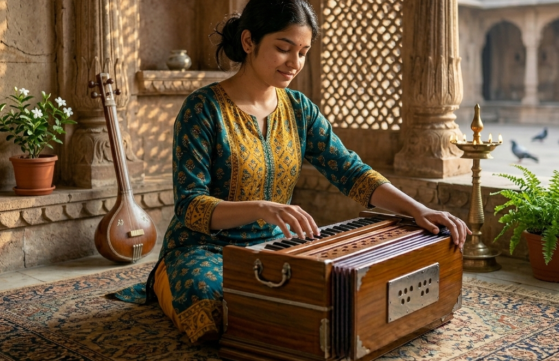
A Bridge Between Pitch Awareness and Vocal Stability
Accurate pitch forms the backbone of Hindustani vocal music. Without a dependable sense of sur, even expressive singing cannot achieve its full impact. The harmonium provides a steady tonal reference that helps learners internalize pitch relationships in a practical and immediate way.
During early training, students often struggle to identify whether they are singing exactly in tune. Unlike abstract theoretical explanations, the harmonium offers a direct auditory anchor. Repeated exposure to correct notes gradually strengthens the ear, allowing singers to recognize subtle variations between shuddha, komal, and teevra swaras more confidently. Over time, this reinforcement develops into instinctive pitch accuracy rather than mechanical correction.
As learners begin to trust their listening ability, their voices naturally settle into a more stable tonal center.
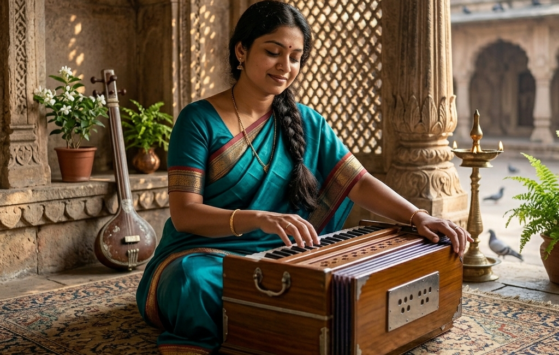
Role of Harmonium in Understanding Raga Structure
Each raga carries a unique identity shaped by specific note patterns, movements, and emotional shades. While theoretical descriptions explain these features, practical familiarity emerges only through repeated guided exploration.
The harmonium helps vocalists visualize the structure of a raga in real time. Instead of imagining ascending and descending note sequences, students can immediately hear and follow them while singing. This interaction strengthens memory retention and clarifies the relationship between important phrases such as pakad, aroha, and avaroha.
Gradually, the singer begins to anticipate melodic movement rather than simply reacting to it. That transition marks an important milestone in serious raga training.

Role of Harmonium in Supporting Consistent Riyaz
Daily riyaz requires patience, discipline, and continuity. Maintaining accuracy during long practice sessions can be challenging, especially for beginners who are still developing vocal control. The harmonium provides a dependable support system that keeps practice structured and focused.
Instead of relying entirely on memory, singers can return repeatedly to the keyboard for reassurance and correction. This process allows practice sessions to remain productive even without the constant presence of a teacher. Over time, consistency in such guided repetition strengthens both confidence and independence.
Regular interaction with the harmonium also encourages singers to stay attentive to tonal precision throughout their exercises.
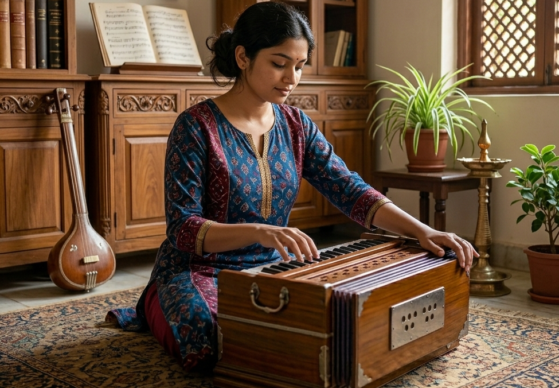
Role of Harmonium in Voice Culture and Scale Practice
Voice training in Hindustani music involves careful work on scales, alankars, and note transitions across multiple registers. Such exercises demand clarity and accuracy at every stage.
The harmonium becomes especially useful here because it provides an immediate comparison between intended and produced notes. While practicing sargam patterns or moving between mandra, madhya, and taar saptak, students can check alignment continuously. This habit helps prevent the formation of inaccurate vocal tendencies during early training.
As a result, singers develop stronger control over pitch placement, smoother transitions between registers, and a more balanced tonal quality overall.

Strengthening Listening Skills Alongside Singing Ability
Hindustani music places enormous importance on attentive listening. A singer who listens carefully learns faster, absorbs stylistic nuances more effectively, and develops greater expressive depth.
The harmonium naturally encourages active listening because each note played becomes a reference point for comparison. Instead of singing mechanically, the student begins responding consciously to tonal relationships. Over time, this process sharpens musical sensitivity and enhances responsiveness during both solo practice and ensemble interaction.
Such listening habits eventually influence improvisational confidence as well.
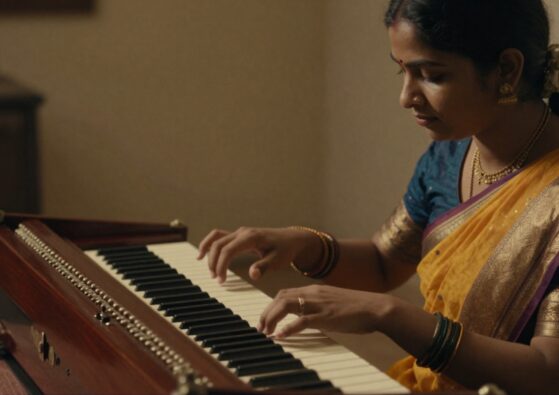
Providing Reliable Support During Early Stage Accompaniment
Before singers become comfortable performing independently, they often rely on harmonium accompaniment during lessons and small presentations. This support reduces uncertainty and helps maintain continuity while navigating unfamiliar compositions.
With the harmonium outlining the melodic framework, students can concentrate more fully on voice production, expression, and rhythmic awareness. Gradually, dependence decreases as internal pitch stability improves. Nevertheless, the instrument continues to remain a reassuring presence throughout the learning journey.
That balance between support and independence makes the harmonium especially valuable in foundational training.
Role of Harmonium in Clarifying Ornamentation and Note Movement
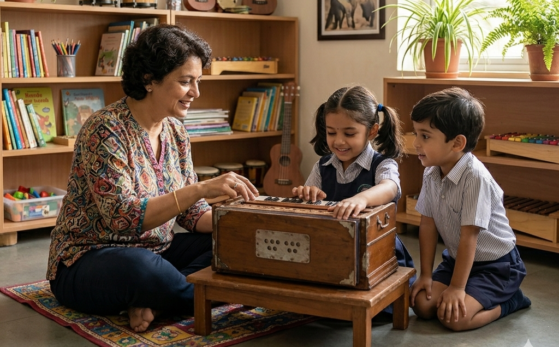
Hindustani vocal music includes subtle ornaments such as meend, kan swar, and gamak, which shape the emotional character of a raga. Understanding where these movements begin and end often requires repeated demonstration.
Although the harmonium cannot reproduce every vocal nuance perfectly, it still helps illustrate directional movement between notes. Students can trace melodic pathways more clearly when they hear anchor points along the phrase. This clarity strengthens their ability to interpret ornamentation thoughtfully rather than mechanically.
As familiarity grows, singers learn to adapt these movements more naturally within their own vocal expression.

Encouraging Independent Musical Exploration
One of the most rewarding aspects of learning music is discovering personal confidence in exploration. The harmonium quietly supports this process by allowing students to experiment with note combinations, scale variations, and melodic ideas without hesitation.
Instead of waiting for correction at every step, learners begin testing their understanding through guided self-practice. This independence nurtures curiosity and strengthens long-term engagement with the art form. Over time, experimentation supported by the harmonium often leads to deeper musical insight.
Such moments frequently become turning points in a student’s relationship with classical music.

Maintaining Its Relevance in Contemporary Vocal Training
Despite evolving teaching methods and the availability of digital tools, the harmonium continues to remain central to Hindustani vocal education. Its accessibility, clarity, and adaptability make it suitable for learners across age groups and experience levels.
Modern students often combine electronic tanpura apps with harmonium practice to create a balanced learning environment. Even within this blended approach, the harmonium retains its role as a practical guide for note accuracy and melodic understanding.
Its enduring presence reflects its effectiveness rather than tradition alone.
Conclusion | The Continuing Role of Harmonium in Hindustani Vocal Practice
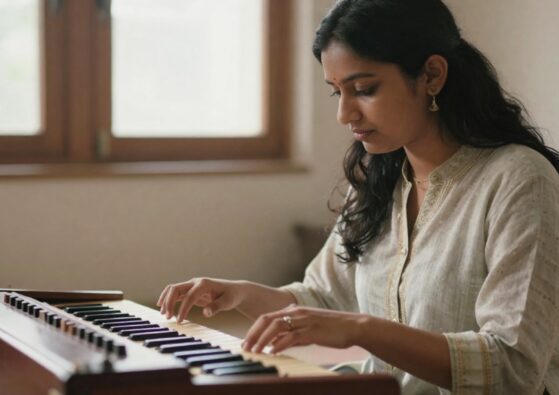
The harmonium occupies a unique position in Hindustani vocal practice because it supports both technical development and musical understanding simultaneously. Through consistent interaction with the instrument, singers strengthen pitch awareness, internalize raga structures, refine listening ability, and gradually build confidence in independent practice. At The Mystic Keys, this supportive role of the harmonium is thoughtfully integrated into our Hindustani Vocal Lessons Online, helping learners experience structured guidance even while practicing from home.
Although the voice ultimately becomes the primary vehicle of expression, the harmonium often shapes the journey that leads there. For many learners, it remains a trusted companion from the earliest lessons to advanced stages of musical growth—a quiet partner that helps transform effort into artistry while making the learning process both accessible and deeply rewarding.
For more information and exciting resources about learning music, visit our website at The Mystic Keys. For more music content and exciting offers follow us on
Facebook, Instagram, YouTube, LinkedIn, Twitter, Pinterest, and Threads.