
Why Piano Students Should Learn to Improvise
Piano improvisation skills help students move beyond playing music exactly as written and begin creating their own musical ideas. Learning to read notes, practise scales, and play familiar pieces is important, but piano education can become much more rewarding when students also learn to experiment with melodies, chords, rhythms, and musical patterns.
Improvisation does not mean playing random notes without direction. It involves understanding musical relationships and using that knowledge to create something new. A beginner might start by changing the rhythm of a simple melody, while an advanced student might explore chord substitutions, melodic variations, or spontaneous musical passages.
Learning to improvise encourages students to listen carefully, make musical decisions, and become more independent. It can also make practice more enjoyable because students are not always reproducing someone else’s music; they are discovering what they can create themselves.
Build Musical Creativity

One of the biggest benefits of improvisation is the opportunity to develop creativity.
When students learn a piece from sheet music, they generally follow instructions about which notes to play, when to play them, and how the music should be performed. Improvisation introduces a different challenge: students decide what to play.
They might create a short melody using five notes, experiment with different rhythms, or play a familiar chord progression in several ways. These small activities encourage exploration without requiring advanced technical ability.
Over time, students become more comfortable experimenting with musical ideas. They learn that a melody can change, a rhythm can be varied, and a chord progression can inspire many different musical possibilities.
Improve Music Theory
Music theory becomes easier to understand when students apply it directly to the instrument.
Learning about scales, chords, intervals, and harmony can sometimes feel abstract when students only memorise definitions. Improvisation gives them a practical way to explore these concepts.
For example, a student learning the C major scale can use its notes to create a short melody over a C major chord. Later, the student can introduce F major and G major chords and notice how different notes sound over each harmony.
This process helps connect theoretical knowledge with listening and playing.
Rather than learning chords only as shapes to memorise, students begin to understand how chords relate to melodies and how musical choices affect the sound.
Strengthen Ear Training

Improvisation encourages students to listen to the music they create.
When experimenting with a melody, they must decide whether the notes sound connected, whether the rhythm feels natural, and whether the phrase reaches a satisfying ending.
They also begin recognising relationships between notes and chords. A student may discover that certain notes create a feeling of resolution, while others create tension that seems to invite another musical idea.
These experiences can support ear training by encouraging students to listen actively rather than concentrating exclusively on finger movements.
A useful exercise is to play a short melody, listen carefully, and then try to reproduce it without looking at the keyboard. Students can gradually make the melodies longer as their confidence grows.
Improvisation Helps Piano Students Understand Chords
Chords are an important foundation for improvisation.
Students who understand basic triads and common chord progressions have a starting point for creating melodies and accompaniments. They can experiment with different chord inversions, rhythmic patterns, and melodic notes while maintaining a clear harmonic structure.
For example, a beginner could play a simple C–G–Am–F progression and create a melody using notes from the C major scale. The same progression can support many different melodies depending on the rhythm, phrasing, and note choices.
This approach also helps students recognise that chords are not limited to the pieces they are currently learning. They can use the same musical knowledge in pop songs, worship music, songwriting, and other styles.
Piano Improvisation Skills Build Confidence

Some piano students become nervous when they are asked to play something without sheet music.
They may worry about choosing the wrong notes or making mistakes. Improvisation helps them become more comfortable making musical decisions without needing every detail written down.
Students can begin with simple exercises in which there are no complicated expectations. Playing a few notes over a steady chord, creating a short ending, or changing the rhythm of a familiar melody can provide a manageable starting point.
The aim is not to produce a perfect performance. It is to learn through experimentation.
As students gain experience, they may become more willing to try unfamiliar music, accompany other singers, or contribute ideas during group playing.
Improvisation Makes Piano Practice More Enjoyable
Technical exercises and repertoire practice remain important, but repeating the same material can sometimes feel monotonous.
Improvisation offers a way to introduce variety while still developing useful musical skills.
After practising scales, students might use those notes to create a short musical phrase. After learning a chord progression, they could experiment with different accompaniment patterns. After completing a familiar piece, they could change its rhythm or create a new ending.
These activities allow students to apply what they have learned in a playful and creative way.
Improvisation should complement structured practice rather than replace it. A balanced routine can include technique, repertoire, music reading, theory, and time for musical exploration.
Piano Improvisation Skills Help Students Play by Ear

Playing by ear involves listening to music and reproducing it without relying entirely on written notation.
Improvisation can support this ability because students repeatedly experiment with melodies, chords, and musical patterns while listening to the results.
They may begin by identifying the notes of a familiar tune, finding a simple bass line, or reproducing a short rhythmic pattern. As their skills develop, they can use these patterns as starting points for their own musical ideas.
This is especially useful for students who want to play contemporary music, accompany singers, or learn songs that do not have readily available sheet music.
Although improvisation and playing by ear are different skills, they can strengthen one another when practised together.
Improvisation Encourages Independent Piano Playing
A student who depends entirely on sheet music may find it difficult to continue playing when the written notes are unavailable.
Improvisation encourages greater independence by teaching students how to use their musical knowledge to make decisions.
If they understand a song’s key, chord progression, and rhythmic style, they may be able to create an accompaniment, introduce a melody, or fill a short musical gap without needing a fully written arrangement.
This independence can be valuable in rehearsals, informal performances, accompaniment, and collaborative music-making.
Students also begin to understand that learning a piece is not only about reproducing the notes correctly. It is about understanding the musical ideas behind those notes.
Piano Improvisation Skills Support Different Musical Styles

Improvisation is useful across many musical traditions, although the techniques and conventions differ.
In pop music, students might create melodies over repeated chord progressions. In jazz, they may explore swing rhythms, extended chords, and melodic variations. In worship music, improvisation can involve instrumental introductions, transitions, chord-based accompaniment, and musical responses that support congregational singing.
Classical musicians can also benefit from improvisation through ornamentation, variation, and exploration of musical motifs.
Students do not need to master every style. They can begin with the type of music they enjoy and gradually expand their musical vocabulary.
Understanding the conventions of a style helps improvisation sound intentional rather than random.
Simple Piano Improvisation Exercises for Beginners
Beginners can start improvising without needing advanced theory or fast fingers.
Try these exercises:
Five-note melodies: Choose five notes from a comfortable position and create short phrases using different rhythms.
Rhythm changes: Take a familiar melody and change its rhythm while keeping the notes mostly the same.
Question and answer: Play a short phrase, pause, and create another phrase that sounds like a response.
Dynamic experiments: Play the same idea softly, loudly, and with a gradual change in intensity.
Different endings: Create two or three possible endings for a simple melody.
Start slowly and listen to the results. There is no need to use complicated chords or play quickly to make improvisation worthwhile.
Overcoming the Fear of Playing Wrong Notes
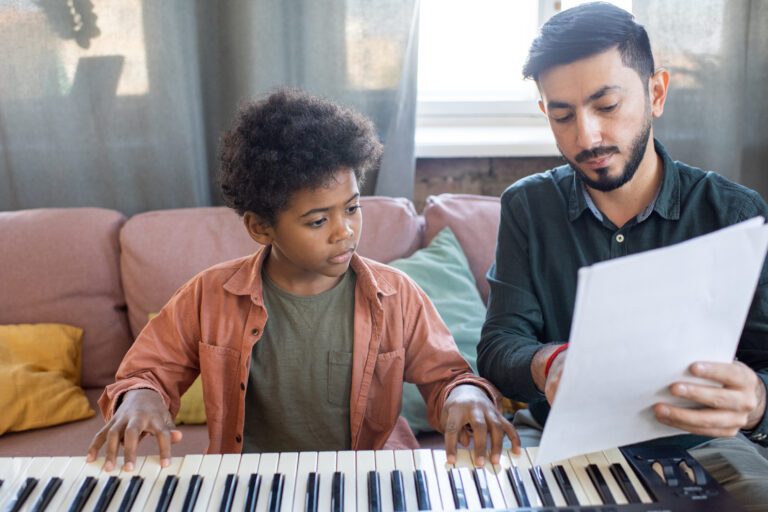
One of the biggest barriers to improvisation is the fear of making mistakes.
Students who are accustomed to reading sheet music may feel uncomfortable when there is no single correct sequence of notes to follow.
It helps to begin with clear limitations. For instance, choose a small group of notes that work well together and improvise using only those notes. Add a simple chord progression and a steady rhythm.
These boundaries make the task less overwhelming while still allowing creativity.
If a note sounds unexpected, listen to how it relates to the surrounding music. You may decide to repeat it, resolve it, or choose a different note next time.
Improvisation develops through exploration, listening, and reflection. Mistakes are part of that process.
How Teachers Can Develop Piano Improvisation Skills
Teachers can introduce improvisation gradually according to each student’s level.
Beginners may start with rhythm games, simple melodies, and black-key improvisation. Intermediate students can explore scales, triads, chord progressions, and basic accompaniment patterns. Advanced students may study modal improvisation, extended harmony, stylistic phrasing, and more complex melodic development.
A teacher can also connect improvisation to the repertoire a student is already learning. For example, after studying a piece in a particular key, the student might create a short melody using the same scale or experiment with a different accompaniment pattern.
This makes improvisation relevant to the student’s existing musical knowledge and avoids making it feel like an unrelated subject.
Final Thoughts on Piano Improvisation Skills

Piano improvisation skills help students become more creative, confident, and independent musicians. They support music theory, ear training, chord understanding, playing by ear, and the ability to explore different musical styles.
Students do not need to wait until they are advanced pianists to begin. Even a beginner can create a simple melody, experiment with a few chords, or change the rhythm of a familiar tune.
The most effective approach is to combine improvisation with structured learning. Technique, repertoire, reading, and theory provide essential foundations, while improvisation helps students apply those skills in their own way.
At The Mystic Keys, students can develop their piano abilities through structured online lessons that support technique, musical understanding, and creative expression. With suitable guidance and regular practice, learners can gradually become more comfortable exploring musical ideas and creating their own sounds.
Whether your goal is to play songs by ear, accompany singers, explore worship music, or simply enjoy greater creative freedom at the piano, improvisation is a valuable skill to develop alongside traditional piano training.
For more information and exciting resources about learning music, visit our website at The Mystic Keys. For more music content and exciting offers follow us on
Facebook, Instagram, YouTube, LinkedIn, Twitter, Pinterest, and Threads.