



Finding the best online music academy in Ireland is not just about choosing any platform—it’s about finding the right place that offers quality teaching, flexibility, and real musical growth.
With so many options available, students need an academy that provides structured learning, expert guidance, and a supportive environment. This is where The Mystic Keys stands out as a leading choice for online music education.
To identify the best online music academy in Ireland, you need to look for:
The Mystic Keys combines all of these elements to create a complete and effective learning experience.

When it comes to choosing the best online music academy in Ireland, The Mystic Keys offers a unique advantage through its student-focused approach.
✔ Personalized One-on-One Learning
Every student receives individual attention through live 1:1 sessions. This helps:
✔ Structured Curriculum for All Levels
The Mystic Keys provides a clear learning path for:
Each lesson is designed to build skills step-by-step, ensuring consistent progress.
✔ Flexible Scheduling
Students can:
This flexibility makes it ideal for learners across Ireland.

✔ Expert Teachers
At The Mystic Keys, students learn from:
This ensures high-quality learning.
The Mystic Keys creates an engaging and effective learning environment.
Students benefit from:
This makes learning more practical and enjoyable.
As the best online music academy in Ireland, The Mystic Keys offers:
Students can explore different areas of music based on their interests.
Online learning becomes highly effective when done correctly.
The Mystic Keys ensures:
This makes online music education as effective as in-person learning.
❌ Lack of guidance → ✔ Personalized teaching
❌ Inconsistent practice → ✔ Structured plans
❌ Low confidence → ✔ Performance training
❌ Slow progress → ✔ Step-by-step curriculum
The Mystic Keys addresses these challenges effectively.
When selecting the best online music academy in Ireland, always check:
The Mystic Keys meets all these criteria, making it a reliable choice
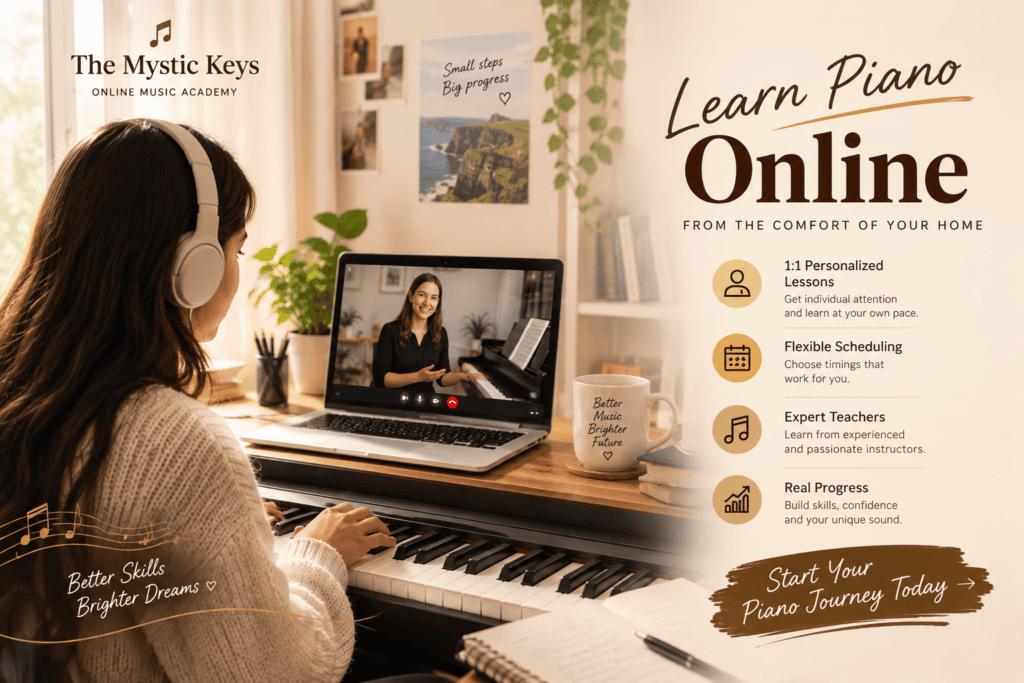
Students prefer The Mystic Keys because it offers:
This combination makes it one of the most trusted online academies.
👉 Visit our page, Piano Lessons Online to explore more about our piano curriculum.
Finding the best online music academy in Ireland comes down to choosing a platform that supports your growth, builds your confidence, and helps you enjoy learning music.
The Mystic Keys stands out by offering personalized lessons, expert guidance, and a structured approach that helps students succeed.
👉 If you’re looking for real progress and a supportive learning experience, The Mystic Keys is the right choice.
For more information and exciting resources about learning music, visit our website at The Mystic Keys. For more music content and exciting offers follow us on
Facebook, Instagram, YouTube, LinkedIn, Twitter, Pinterest, and Threads.

Learning music has become more accessible than ever. Students no longer need to live near a music school, travel across the city for every lesson, or follow a rigid classroom schedule. With the growth of online music education, students across Canada can now connect with music teachers from different locations and learn from home. An Online Music Academy in Canada can provide this flexibility while offering structured lessons, personalised guidance, and access to experienced music educators without the need for in-person travel..
However, having many options also creates a new challenge: How do you find the right online music academy in Canada?
The answer is not simply about choosing the academy with the most courses or the lowest price. A good online music academy should match the student’s goals, learning style, schedule, preferred instrument, and expectations from the lessons.
Whether you are looking for music lessons for yourself, searching for classes for your child, preparing for a music examination, or simply hoping to develop your skills, knowing what to look for can make the decision much easier.

An online music academy is a music education platform that provides lessons through digital communication tools such as video conferencing. Instead of attending a physical music school, students participate in live lessons from their home or another convenient location.
Depending on the academy, students may be able to learn instruments such as piano, guitar, violin, drums, ukulele, keyboard, or vocals. Some academies also provide music theory, ear training, examination preparation, songwriting, or other areas of musical development.
The biggest difference between online academies is not necessarily the technology they use. It is how the learning experience is structured.
Some platforms may focus mainly on recorded lessons, while others offer live classes with a teacher. Certain academies may provide group sessions, whereas others focus on one-on-one instruction. Understanding these differences is important before enrolling.
Canada has a diverse population spread across large cities, suburbs, and smaller communities. For some students, finding a suitable teacher nearby can be difficult, particularly when they are looking for a specific instrument, teaching style, genre, or level of expertise.
Online learning can remove some of these geographical limitations.
A student can attend a lesson without spending time travelling to and from a music school. Parents can also avoid arranging transportation for every lesson, while adult learners can fit music education more easily around work and family responsibilities.
Another advantage is flexibility. Many online academies work with students across different locations and may offer lesson timings that are more adaptable than traditional music schools.
At the same time, convenience should not become the only reason for choosing an academy. The quality and structure of the lessons still matter.

Before comparing different online music academies, it helps to understand why you want to learn music.
A beginner who wants to learn piano for personal enjoyment may need a very different learning approach from a student preparing for an ABRSM, Trinity College London, or Rockschool examination.
Similarly, someone interested in Western vocals may be looking for a different teaching style from a student who wants to learn Hindustani or Carnatic music.
Your goal could be learning an instrument from scratch, improving existing skills, preparing for examinations, developing music theory knowledge, learning to sing confidently, or simply making music part of your routine.
Once that goal is clear, it becomes easier to evaluate whether an academy’s teaching approach is actually suitable.
The range of courses is another important factor to consider.
A well-structured online music academy may offer various instruments and musical disciplines. This gives students more choices based on their interests. Courses may include piano, keyboard, guitar, violin, drums, ukulele, Western vocals, Indian classical vocals, and other specialised areas.
However, a long course list does not always mean better teaching.
Instead of asking only, “How many courses do they offer?”, check the teachers available for your chosen course. Their experience and expertise should match your learning goals.
For example, vocal students should look for teachers who understand vocal technique, musicality, pronunciation, repertoire, and performance development. Simply offering singing as a course is not enough.

One of the most important questions to ask is whether the lessons are live, recorded, or a combination of both.
Recorded videos can be useful for revision and independent practice, but they cannot completely replace interaction with a teacher. During a live lesson, the teacher can listen to the student’s playing or singing, identify mistakes, demonstrate techniques, answer questions, and adjust the lesson according to the student’s progress.
One-on-one live classes can provide an even more personalised learning experience.
Instead of following exactly the same lesson as every other student, the teacher can spend more time on areas where the individual needs support. That can be particularly valuable for beginners who may need additional explanation and encouragement during the early stages.
The teacher is one of the most important parts of any music-learning experience.
An academy may have an attractive website, modern technology, and a large selection of courses, but the actual learning experience ultimately depends heavily on the teacher.
When researching an online music academy in Canada, look at the qualifications and experience of its instructors. Depending on the course, relevant certifications could include Trinity College London, ABRSM, Rockschool, university-level music education, performance qualifications, or other recognised training.
Experience also matters.
A teacher who regularly works with beginners may approach a first lesson very differently from a teacher who primarily prepares advanced performers. Likewise, teaching children requires patience, communication, and lesson planning that may differ from teaching adults.
Therefore, it is worth looking beyond the qualification itself and considering whether the teacher’s experience matches the student’s needs.

Every student learns differently.
Some may understand concepts quickly but struggle with rhythm. Others may have good technique but need more confidence. Beginners may need extra practice, while advanced students may focus on specific skills.
Personalised lessons allow teachers to address these individual needs.
A good online music academy should adapt lessons to the student’s level, progress, interests, and goals. This makes learning more engaging and avoids a one-size-fits-all approach.
For children, personalised instruction can include suitable songs and activities while building strong musical foundations.
If an academy offers a trial or demo lesson, it can be an excellent opportunity to understand how the learning experience actually works.
A website can tell you about teachers, courses, technology, and pricing, but a live lesson gives you a better idea of the teacher’s communication style and the overall learning environment.
During a demo, pay attention to whether the teacher explains concepts clearly, listens to the student, encourages questions, and adjusts the lesson according to the student’s level.
The experience should feel like a genuine learning session rather than simply a sales conversation.
Online music lessons depend on technology, so the academy should have a clear and practical system for conducting classes.
Ask which platforms are used for lessons. Common options include Zoom and Google Meet, although the specific platform matters less than whether the lessons are stable and easy to access.
It is also useful to understand how lesson recordings and supplementary learning materials are handled.
For instance, recordings can allow students to revisit difficult sections after class, while notes, exercises, sheet music, or other materials can support independent practice between lessons.
A straightforward technical setup can make online learning considerably more comfortable, particularly for younger students and parents.

For many Canadian students, scheduling is an important consideration.
School, university, work, extracurricular activities, family commitments, and changing routines can make fixed lesson timings difficult to maintain.
An online academy that considers teacher availability alongside the student’s schedule can provide greater flexibility.
However, flexibility does not mean that students should treat lessons casually. Consistent attendance and regular practice remain important for musical progress. The ideal arrangement is one that provides reasonable scheduling flexibility while still encouraging a steady learning routine.
Cost is naturally an important part of the decision, but it should not be the only deciding factor.
A lower-priced lesson may seem attractive initially, but the actual value depends on what the student receives in return. Teacher expertise, lesson duration, individual attention, learning materials, recordings, examination support, and scheduling flexibility can all influence the overall experience.
Rather than comparing prices alone, compare what is included in the learning experience.
A slightly different fee may make sense if the student receives personalised instruction, qualified teaching, structured progression, and additional academic or examination support.

Students who want to pursue formal music examinations should check whether the academy provides appropriate preparation.
Examination systems such as Trinity College London, ABRSM, and Rockschool have specific requirements relating to repertoire, technique, theory, performance, and musical understanding.
An academy experienced in examination preparation can help students understand those requirements and prepare systematically.
That does not mean every student needs examination training. For someone learning purely for enjoyment, a performance-focused or recreational approach may be more appropriate.
The important point is to choose an academy that aligns with the student’s long-term objective.
Reviews can offer useful insight into an online music academy. Look beyond the star rating and read what students and parents say about teaching quality, communication, scheduling, and support.
Choose reviews that match your needs. For example, a parent seeking piano lessons for a child may find feedback from other parents more relevant.
Remember that reviews reflect individual experiences. Consider them alongside teacher qualifications, course structure, and a trial lesson.

The right online music academy can look different for a six-year-old beginner, a teenager preparing for examinations, and an adult learning music after work.
Young students often benefit from teachers who can maintain attention, introduce concepts creatively, and communicate clearly with both the child and parent.
Teenagers may need a balance between structured learning and their own musical interests. Adult students, meanwhile, often appreciate flexibility and lessons that connect directly with their personal goals.
Learning style matters as well.
Some students prefer structured progression, while others enjoy learning through songs and practical application. Identifying these preferences can help you find a teacher and academy that feel like a natural fit.
A short conversation with the academy can answer many questions before you make a commitment.
You might ask about the teacher’s qualifications, lesson duration, class frequency, scheduling, course structure, examination preparation, recordings, learning materials, and what happens if a class needs to be rescheduled.
It is also worth asking how the academy evaluates student progress.
A clear answer can indicate whether the academy has a structured approach to learning rather than simply conducting individual lessons without a broader progression plan.

Ultimately, finding the right online music academy in Canada comes down to fit.
The academy should offer suitable courses, qualified teachers, interactive lessons, an accessible learning system, and an approach that matches the student’s goals. Personal attention and consistent communication can make the online experience feel much more engaging than simply watching instructional videos.
A strong academy should also make the learning journey practical. Students need a system that works with their schedules, technology that is easy to use, and resources that help them continue practising between lessons.
Most importantly, the student should feel that the lessons are helping them move forward.
Online music education is no longer simply an alternative for people who cannot attend a physical music school.
With live instruction, personalised lesson planning, qualified teachers, digital resources, and flexible scheduling, online learning can provide a structured musical education from the comfort of home.
For students in Canada, this can open up access to teachers and learning opportunities that may not be available within their immediate neighbourhood.
The key is to choose thoughtfully rather than simply selecting the first academy that appears in a search result.

Finding the right Online Music Academy in Canada starts with understanding your musical goals. Consider the teachers, course structure, personalised attention, flexibility, learning resources, and overall experience before enrolling.
For those looking for Piano Lessons Online or other personalised music classes, The Mystic Keys offers live, one-on-one online lessons designed around different levels, goals, and schedules.
Ultimately, the right academy is one that makes learning music structured, flexible, engaging, and enjoyable.
For more information and exciting resources about learning music, visit our website at The Mystic Keys. For more music content and exciting offers follow us on Facebook, Instagram, YouTube, LinkedIn,
Twitter, Pinterest, and Threads.

Music has always been more than a form of entertainment. It is a way to express emotions, develop creativity, build discipline, and connect with people across cultures. As music education continues to evolve, students no longer need to depend entirely on traditional classrooms or local music schools. With the growth of online learning, finding a Music Academy USA students can learn from has become easier, more flexible, and more accessible.
For beginners, choosing the right online academy can feel overwhelming. There are numerous platforms, instructors, courses, and learning formats available, but not every option provides the same quality of instruction or level of personalization. A good online music academy should offer more than video lessons or pre-recorded tutorials. It should create a structured learning experience where students receive guidance, practice consistently, understand their progress, and gradually develop confidence.
That is where choosing the right online music academy in USA becomes important.
The way people learn music has changed significantly. Students today may have busy school schedules, professional commitments, family responsibilities, or other activities that make attending regular classes at a physical academy difficult.
Online music lessons offer an alternative that fits more naturally into different lifestyles. Students can attend lessons from home without spending time travelling to and from a music school. This convenience can be particularly useful for families looking for lessons for children, as well as adults who want to learn music alongside work or other responsibilities.
More importantly, online education has developed beyond simply watching instructional videos. Live one-on-one lessons allow students to interact directly with an instructor, ask questions, receive immediate feedback, and work on areas that require additional attention.
As a result, an online Music Academy USA can provide an engaging learning environment without requiring students to be physically present in a traditional classroom.

Choosing a music academy should not be based only on the number of courses listed on its website. The actual learning experience matters just as much.
A useful starting point is to understand how the academy conducts its lessons. Live instruction, personalized feedback, structured practice, and regular interaction can make a considerable difference, particularly when students are learning an instrument or developing vocal technique.
The instructor also plays an important role. An experienced teacher should understand that every student learns differently. Someone completely new to piano may need a very different approach from an intermediate student preparing for an examination or working on performance skills.
Therefore, while comparing an online music academy, consider the teaching methodology, instructor qualifications, course options, lesson structure, flexibility, and opportunities for assessment.
One of the biggest advantages of online music education is the possibility of personalized instruction.
In a one-on-one lesson, the instructor can focus entirely on one student’s development. Instead of following the exact same pace as a group, the student can spend more time on challenging concepts and move forward when they are ready.
For example, a beginner learning piano may initially need help with posture, hand position, rhythm, reading notation, and basic coordination. Once those foundations become comfortable, lessons can gradually introduce scales, chords, repertoire, improvisation, or more advanced techniques.
Similarly, vocal students may need individualized guidance with breathing, pitch, pronunciation, tone, and vocal control. Personalized attention allows the instructor to identify these areas and adapt lessons accordingly.
This approach can make online learning feel much closer to having a private music teacher rather than simply following an online course.

Another factor worth considering is the variety of courses available through an academy.
Students may begin their musical journey with one instrument and later become interested in another. A learner who starts with piano, for instance, may eventually want to explore singing, guitar, or music theory. Having multiple learning options under one academy can make that transition easier.
A comprehensive online music academy may offer courses such as piano, keyboard, guitar, violin, drums, ukulele, Western vocals, Hindustani vocals, Carnatic music, and music-related performance skills.
However, variety should not come at the expense of quality. An academy offering numerous courses should still maintain appropriate standards for instructors and provide a clear learning structure for each subject.
The goal is not simply to find an academy with the longest course list. Instead, students should look for an institution where the available courses are supported by suitable instructors and meaningful lesson plans.
The quality of a music lesson is closely connected to the instructor delivering it.
A qualified instructor brings more than technical knowledge. Good teachers know how to explain difficult concepts in an understandable way, identify mistakes, encourage consistent practice, and adapt their teaching style to different learners.
For students interested in formal music education, instructor experience with recognized examination systems can also be valuable. Depending on the student’s goals, preparation for programs such as Trinity College London, ABRSM, or Rockschool may be an important consideration.
At the same time, certification should not be the only factor. Teaching experience, communication skills, musical versatility, and the ability to work with different age groups can also contribute significantly to the learning experience.

One common concern about online music education is whether students can receive enough personal interaction through a screen.
Modern video-conferencing platforms have made live music lessons much more interactive than many people might expect. Students can communicate directly with instructors, demonstrate their playing or singing, receive corrections, and work through exercises during the lesson.
For instruments such as piano, guitar, violin, and ukulele, instructors can demonstrate techniques while observing the student’s hand position and playing. Vocal instructors can listen closely to pitch, rhythm, pronunciation, and technique during live sessions.
Technology therefore becomes a bridge rather than a barrier when the academy has designed its lessons around interaction and feedback.
A student’s schedule can change from week to week. School examinations, work commitments, family activities, travel, and other responsibilities may affect availability.
For that reason, flexibility is another important consideration when selecting an online music academy in USA.
Instead of forcing every learner into a fixed classroom timetable, a flexible academy can coordinate lessons according to instructor availability and the student’s schedule. This can make regular attendance easier and reduce the chances of music lessons becoming another source of stress.
Consistency remains important, of course. Flexible scheduling works best when students still maintain a regular practice and lesson routine.

Convenience alone does not guarantee progress.
A student can attend online lessons every week and still struggle to improve if there is no clear direction. Effective music education generally requires a progression—from fundamental concepts to increasingly complex skills.
A structured approach helps students understand what they are learning and why they are learning it. Beginners can build a strong foundation before moving into advanced techniques, while experienced musicians can focus on specific areas that match their goals.
Progress can also be easier to understand when instructors regularly review previous work and introduce new challenges at an appropriate pace.
In this way, the best online learning experience is not simply about attending individual classes. It is about creating a continuous musical journey.
A strong online academy should be able to accommodate different age groups and learning objectives.
Children often benefit from lessons that combine structure with creativity. Keeping lessons engaging while gradually developing technical skills can help young learners build a positive relationship with music.
Adults, on the other hand, may approach music education with very different goals. Some may want to learn an instrument they have always admired, while others may wish to return to music after years away from it. Certain learners may even be preparing for examinations or developing skills for personal performance.
Because these learners have different expectations, personalized teaching becomes particularly valuable.
An online Music Academy USA that works with both children and adults can provide a broader learning environment while still tailoring instruction to individual needs.
Lessons provide guidance, but improvement also happens between classes.
Students need opportunities to review what they learned, practice techniques, and revisit difficult sections. Supplementary learning resources can therefore strengthen the experience.
Recorded lessons can be useful because students can revisit instructions after class. Practice materials, exercises, sheet music, and other resources can also help reinforce concepts introduced during lessons.
This creates a connection between the live class and independent practice. Rather than treating each lesson as an isolated session, students can continue working on their skills throughout the week.

For some learners, music is primarily about enjoyment and personal expression. Others prefer working toward a specific academic or performance milestone.
Music examinations can provide that additional structure. Recognized examination boards such as Trinity College London and ABRSM offer graded pathways that allow students to work toward defined levels of musical development.
An academy experienced in examination preparation can help students understand the requirements, select suitable repertoire, develop technical skills, and prepare systematically.
Still, examinations are not essential for every student. The right learning path should depend on the student’s interests and objectives rather than treating certification as the only measure of progress.
One of the most interesting developments in online music education is how easily geographical boundaries can be crossed.
A student in the USA does not necessarily have to restrict their choices to music teachers located in the same neighborhood or city. Online platforms can connect learners with instructors from different musical backgrounds and locations.
This can be particularly valuable for students interested in specific musical traditions. Someone exploring Indian classical music, for example, may want an instructor with specialized knowledge of Hindustani or Carnatic traditions. Another student might prefer Western classical training, contemporary vocals, or popular music.
Online learning can therefore broaden access to specialized instruction while allowing students to remain in their own environment.
Before enrolling, it is helpful to compare academies based on factors that directly affect the learning experience.
Start by understanding whether lessons are live or pre-recorded. Next, examine the instructor profiles and their qualifications. Course options, lesson duration, scheduling flexibility, communication methods, learning resources, and examination support can then be considered.
It is also worth understanding how the academy communicates with students between lessons. Clear scheduling, reliable communication, access to recordings or supplementary materials, and responsive support can make the overall experience smoother.
Price is naturally another consideration, but it should be viewed alongside the quality and structure of the education being offered.
Ultimately, the right choice depends on the student’s age, current ability, musical interests, schedule, and long-term goals.
Online music education has moved far beyond the idea that learning requires sitting inside a traditional classroom.
With live instruction, individual attention, digital resources, flexible scheduling, and qualified instructors, students can build meaningful musical skills from the comfort of home.
For beginners, this can mean developing a strong foundation without feeling overwhelmed. Intermediate learners can concentrate on technique and repertoire, while advanced students can work toward examinations, performance goals, or more specialized areas of music.
The effectiveness of the experience, however, depends on how thoughtfully the academy combines technology with teaching. A video call by itself does not create quality music education. The combination of a skilled instructor, personalized guidance, structured learning, consistent practice, and student engagement is what makes the difference.
Finding a suitable Music Academy USA means choosing an environment where learning feels structured, flexible, and enjoyable.
An online academy can provide personalized instruction, qualified instructors, flexible scheduling, and useful learning resources. The Mystic Keys offers one-on-one online music lessons, making it easier for students to learn from home while receiving individual guidance. For those looking for Piano Lessons Online, this approach can help develop technique, musical understanding, and confidence through live instruction.
Before choosing an academy, consider the instructor’s experience, lesson structure, scheduling options, feedback, and available learning resources. These factors can make a significant difference in a student’s progress.
For learners searching for an online music academy in USA, a personalized approach with experienced instructors and flexible online lessons can provide a practical foundation for a rewarding musical journey.
For more information and exciting resources about learning music, visit our website at The Mystic Keys. For more music content and exciting offers follow us on Facebook, Instagram, YouTube, LinkedIn,
Twitter, Pinterest, and Threads.

Music education has changed significantly over the years. Traditional academies and conservatories remain popular across Europe. However, a Music Academy in Europe can now offer flexible online learning with professional teachers from around the world.
For learners in Europe, online music academies offer greater flexibility. Students can access specialised teachers and enjoy personalised one-on-one lessons without travelling to a physical classroom.
However, choosing the right online music academy involves more than searching for “music lessons online.” Teacher experience, lesson structure, flexibility, course options, and certification support all matter
So, how do you find an academy that truly matches your musical goals? Let’s explore the key factors to consider.

Europe has a rich musical heritage. It is known for classical music, contemporary performance, vocal training, and music education. Students can find music schools and academies across the continent. However, attending in-person classes is not always practical.
Busy schedules, long distances, travel, work, school, and family commitments can make regular classes difficult. Online music lessons reduce this pressure. Students can learn from home while staying connected with their teacher.
Online learning also does not mean learning alone. With live video lessons, students can interact directly with their instructor. They can ask questions, receive instant feedback, demonstrate techniques, and practise exercises in real time.
This makes one-on-one online learning ideal for students who prefer personal attention and flexible learning over fixed group classes.
Not every online music academy offers the same quality of education. A professional-looking website or a long list of courses does not automatically indicate strong teaching standards.
A good academy should begin with qualified and experienced teachers. The instructor plays a central role in a student’s progress, so understanding the teacher’s musical background, teaching experience, qualifications, and ability to work with different age groups and skill levels is important.
At the same time, teaching should be personalised. A beginner learning piano for the first time will have very different needs from an intermediate guitarist preparing for an examination. Effective lessons therefore need to adapt to the student’s current ability, learning pace, interests, and objectives.
Another important factor is consistency. Students benefit from a clear lesson structure, regular feedback, practice guidance, and appropriate supplementary resources. When these elements work together, online learning can become much more than a series of video calls—it can become a structured learning journey.

One of the biggest differences between online music academies is the way lessons are conducted. Some platforms focus on group classes, while others provide individual instruction.
For students looking for personalised learning, one-on-one lessons can offer a significant advantage. The teacher can focus entirely on one learner during the session, identify specific difficulties, adjust exercises, and move forward according to the student’s progress.
This individual approach can also be useful for students who feel hesitant about learning in front of others. Beginners can work on fundamentals at their own pace, while experienced musicians can spend more time refining particular techniques or preparing for specific musical goals.
That said, the right format ultimately depends on the learner. Students should consider whether they learn better through individual attention or enjoy the collaborative nature of group instruction before choosing an academy.
Once you decide to explore online learning, the next step is choosing the right instrument or subject. For students looking for a music academy in Europe, having access to a wide range of courses makes it easier to find lessons that match their interests, skill level, and musical goals.
A comprehensive online academy may offer piano, keyboard, guitar, violin, drums, ukulele, and vocals, along with specialised options such as worship music, Hindustani, and Carnatic music. This variety allows learners to explore different areas of music while choosing a course that aligns with their individual interests.
However, variety alone is not enough. Flexible courses and personalised instruction can make the learning experience more effective by allowing students to progress at a comfortable pace and receive guidance suited to their abilities and goals.

For beginners in Europe, starting an instrument can feel exciting yet overwhelming, particularly when they are unsure about what to practise or how to develop the right fundamentals. Choosing a reliable music academy in Europe can make those early stages much more structured and enjoyable.
A good online music academy should make learning approachable from the very first lesson. Beginners need clear explanations, suitable exercises, regular guidance, and patient correction so they can build proper techniques instead of developing habits that may become difficult to change later.
For instance, a beginner learning piano may gradually work through posture, hand position, basic notation, rhythm, scales, chords, and simple pieces. Similarly, guitar students can begin with holding the instrument correctly, learning basic chords and strumming patterns, and gradually developing rhythm, coordination, and more advanced techniques.
With one-on-one online lessons, students can receive individual attention throughout this process. The teacher can observe their playing, identify areas that need improvement, and provide immediate corrections and guidance. As a result, learners can build their musical foundation with greater clarity and confidence while enjoying the convenience of learning from home in Europe.
Online music education is not limited to beginners. Experienced students can also benefit from personalised instruction, particularly when they are looking to improve specific areas of their musical development.
An advanced learner may need help with technique, repertoire, interpretation, improvisation, musical expression, or examination preparation. Instead of spending lesson time covering material the student already understands, personalised instruction allows the teacher to concentrate on areas that require further development.
This becomes especially valuable when a student has a specific objective, such as preparing for a music examination, improving performance technique, or developing greater confidence with a particular genre.
As the student’s abilities develop, the lesson structure can evolve with them.

For some students, learning music is primarily about enjoyment. Others may want formal recognition of their musical progress.
If certification is part of your goal, check whether the academy provides preparation for recognised examination boards such as Trinity College London, ABRSM, or Rockschool.
Examination preparation can involve more than simply learning pieces. Students may need support with technical exercises, sight-reading, theory, rhythm, performance, and understanding examination requirements.
An academy with teachers familiar with these systems can help students prepare in a more organised way. However, it is still important to understand exactly what the academy provides—whether it offers preparation, guidance, certification support, or examination registration assistance.
One of the strongest advantages of choosing an online music academy in Europe is the flexibility it can offer. With Europe spanning multiple countries and time zones, students have different schedules, routines, and learning needs. A school student may prefer lessons after classes, while a working professional may only have time in the evening. Families, meanwhile, may need lessons that fit comfortably around school, work, travel, and other commitments.
Online music lessons make this easier by allowing students to learn from home without spending additional time travelling to and from a physical academy. This can be particularly valuable for learners who want access to quality music education while maintaining a busy lifestyle.
At the same time, flexibility should not come at the expense of structure. A well-organised online music academy should combine convenient scheduling with regular lessons, personalised guidance, and clear learning goals. Students can therefore look for academies that coordinate teacher availability with their preferred timings while maintaining consistency throughout their musical journey.

An online platform is only as effective as the teaching experience it provides.
Before enrolling, take some time to understand how the academy selects its teachers. Look for relevant qualifications, musical experience, teaching background, communication skills, and experience with the particular instrument or course you want to study.
Teacher compatibility also matters. A technically skilled musician may not necessarily be the right teacher for every learner. Some students need a highly structured approach, while others respond better to encouragement, creativity, and experimentation.
This is why a personalised teacher-student relationship is so important in music education. Progress often depends not only on what is taught, but also on how effectively it is communicated.
Technology plays an important supporting role in online music education.
Platforms such as Zoom and Google Meet can allow teachers and students to conduct live lessons from their respective locations. Depending on the academy, students may also receive lesson recordings, practice materials, notes, or other supplementary resources.
These resources can be particularly useful between lessons. A student can revisit an explanation, review an exercise, or practise along with material discussed during the session.
Nevertheless, technology should remain a tool rather than becoming the centre of the learning experience. The primary focus should still be effective teaching, interaction, feedback, and musical development.

Before making a decision, explore the academy’s website and course details. Check its teaching approach, instructors, lesson format, scheduling, fees, and learning resources.
Student reviews can also offer useful insights. Look for feedback on teacher quality, communication, flexibility, and the overall learning experience. However, don’t rely on reviews alone.
It is also helpful to ask questions before enrolling. Find out whether lessons are one-on-one or group-based. Check how teachers are assigned and whether trial or introductory sessions are available. Also, understand the scheduling process and the policy for rescheduled lessons.
Convenience is one of the biggest reasons students choose online learning, but it should not come at the expense of educational quality.
An inexpensive course may seem attractive initially, but if the lessons lack personal attention or experienced instruction, the student may struggle to make meaningful progress. On the other hand, a premium service may not necessarily be suitable if its teaching approach does not match the learner’s needs.
The goal should therefore be to find an academy that offers the right combination of experienced instruction, personalised learning, flexibility, structured lessons, and appropriate resources.
Once these factors are considered together, comparing different academies becomes much easier.

There is sometimes a misconception that learning music online cannot provide the same level of interaction as learning in person. Modern video-based lessons, however, allow teachers and students to communicate face-to-face in real time.
The effectiveness of the experience ultimately depends on the teacher, lesson structure, student’s practice habits, and quality of interaction.
For motivated learners, online one-on-one instruction can provide a practical way to access experienced teachers without being restricted by geographical location. A student in Europe can learn from a teacher who may be based in another country, while still receiving live, personalised guidance.
That geographical flexibility is one of the defining advantages of online music education.
For students seeking an online music academy, The Mystic Keys offers live, one-on-one music lessons. Each lesson is designed around the student’s individual needs and goals.
The academy offers a wide range of courses. These include piano and keyboard, guitar, vocals, violin, drums, ukulele, and Indian classical music. Students can learn from home through live online sessions with experienced teachers.
The academy also supports students preparing for recognised music examinations. These include Trinity College London, ABRSM, and Rockschool, depending on the course and teacher.
For learners in Europe, online lessons offer added convenience. Students can learn from home while enjoying direct, personalised guidance from a music instructor.

Finding the right music academy in Europe does not necessarily mean finding a physical school nearby. With online music education becoming more accessible, students can learn beyond geographical boundaries.
The key is to look beyond the course list. Consider teacher quality, personalised instruction, flexibility, structured lessons, learning resources, and certification support. These factors can shape the overall learning experience and help students progress with confidence.
Whether you are learning an instrument for the first time, returning to music after a break, preparing for an examination, or developing an existing skill, The Mystic Keys offers flexible, one-on-one online music lessons for learners worldwide.
From piano lessons online to guitar, vocals, violin, drums, ukulele, and more, students can learn from home with personalised guidance from experienced teachers.
With the right teacher, consistent practice, and a learning approach that suits your goals, your location does not have to limit your access to quality music education.
For more information and exciting resources about learning music, visit our website at The Mystic Keys. For more music content and exciting offers follow us on
Facebook, Instagram, YouTube, LinkedIn, Twitter, Pinterest, and Threads.

Learning music has become more accessible than ever. Whether you are living in Dubai, Abu Dhabi, Sharjah, Ajman, or another part of the UAE, you no longer need to travel to a music school several times a week to receive structured musical training. With an online music academy in the UAE, students can now learn an instrument or develop their voice from the comfort of home while connecting with experienced instructors through live online classes.
However, having more choices also means that finding the right academy requires some thought. Not every online music class follows the same teaching method, offers the same level of personal attention, or provides the same opportunities for structured learning.
So, how do you choose an online music academy that genuinely suits your goals, schedule, learning style, and level of experience?
Let’s explore what you should look for before making your choice.

The UAE is known for its fast-paced lifestyle. Between school, university, work, family responsibilities, and daily commitments, finding time for regular activities can sometimes be challenging. Music learning should add something positive to your routine rather than create another logistical difficulty.
That is where online music education can make a meaningful difference.
Instead of spending time travelling to and from a physical academy, students can attend lessons from home. A suitable time slot can be arranged around their existing schedule, making it easier to maintain consistency.
For families, this can be particularly convenient. Parents do not necessarily have to spend time travelling with students for every lesson. Adults who have always wanted to learn piano, guitar, vocals, or another instrument can also fit lessons into their working schedules more easily.
More importantly, online learning is no longer limited to watching recorded tutorials. Modern online music education can include live interaction, real-time feedback, demonstrations, guided practice, and personalised instruction.
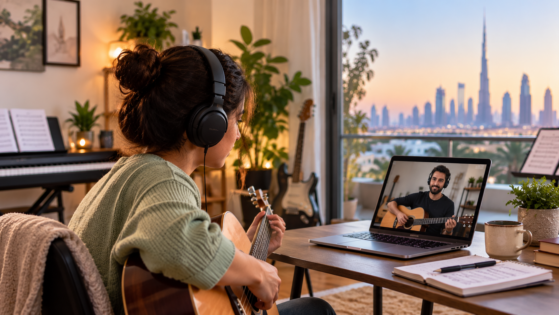
Once you decide that online learning is suitable for you, the next question becomes more important: which academy should you choose?
The answer depends largely on what you want from your musical journey. Someone learning piano as a hobby may have very different requirements from a student preparing for a graded examination. Similarly, a beginner learning guitar will have different needs from an experienced vocalist looking to improve technique.
Therefore, instead of choosing an academy simply because it offers a particular instrument, look at the overall learning experience.
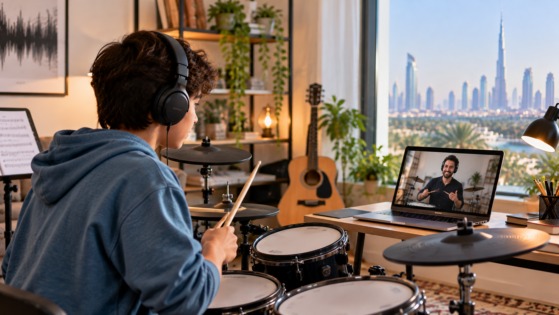
Music is not a subject where every student progresses in exactly the same way.
Two students may begin learning piano at the same age and level, yet one may progress faster with notation while another may need more time with coordination and rhythm. A vocalist may require specific exercises for pitch and breath control, while a guitarist may need additional guidance with chord transitions and technique.
This is why personalised learning can be so valuable.
One-on-one online music lessons allow the instructor to concentrate on the individual student, observe their progress, identify areas that need improvement, and adapt lessons accordingly.
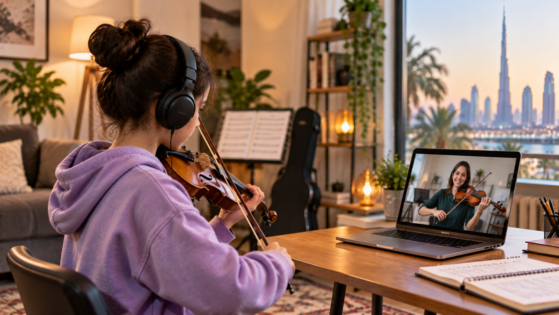
Another important consideration is the range of courses available.
Perhaps you are interested in piano today but may eventually want to explore music theory, vocals, guitar, or another area of music. Having access to different disciplines through the same online music academy can make the learning journey more convenient.
Depending on the academy, students may find courses ranging from piano and keyboard to acoustic and electric guitar, Western vocals, Hindustani and Carnatic vocals, violin, drums, ukulele, music theory, and other specialised areas.
The Mystic Keys offers a broad range of online music courses, including piano, keyboard, acoustic guitar, electric guitar, Western vocals, Hindustani vocals, Carnatic vocals, violin, drums, ukulele and singing, worship piano and singing, and music theory.
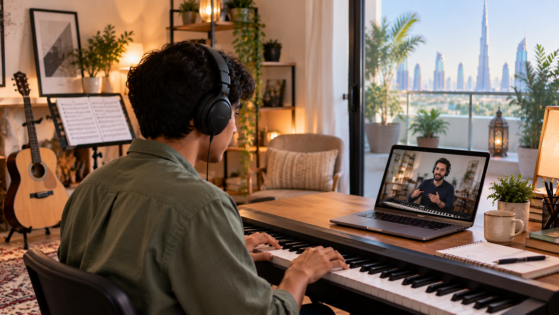
An online platform is only as effective as the teaching experience it provides.
A beautifully designed website or a large course catalogue cannot replace a good teacher. Before enrolling, find out who will actually teach you, what their musical background is, and whether they have experience working with students at your level.
For beginners, patience and the ability to explain fundamental concepts clearly are extremely important. More advanced learners may require an instructor who understands technique, performance, theory, improvisation, or examination requirements in greater depth.
If certification is part of your goal, teacher expertise becomes even more relevant. The Mystic Keys provides preparation for graded music examinations, including Trinity College London, with training that can cover practical and theory requirements depending on the student’s level and goals.

A good music-learning routine needs consistency.
At the same time, life in the UAE can be busy. School timings, office hours, family commitments, holidays, travel, and other responsibilities can make a rigid class schedule difficult to maintain.
This is one of the major advantages of online music education.
An academy that offers flexible scheduling can make it easier for students to select suitable lesson times around their existing commitments. The Mystic Keys offers flexible online learning options designed to accommodate students’ availability and time zones.
For working adults, this flexibility can make the difference between an enjoyable long-term learning routine and a course that is difficult to continue.

Flexibility does not mean that learning should be unstructured.
A good online music academy should provide a clear learning path. Students need to know what they are learning, why they are learning it, and how one skill connects to the next.
For example, a beginner pianist may start with basic posture, hand position, rhythm, simple notation, and introductory exercises before progressing towards chords, scales, repertoire, and more advanced techniques.
Similarly, vocal training may gradually introduce pitch, breathing, vocal exercises, pronunciation, repertoire, and performance-related skills.
A structured curriculum gives students a sense of direction and makes progress easier to observe.
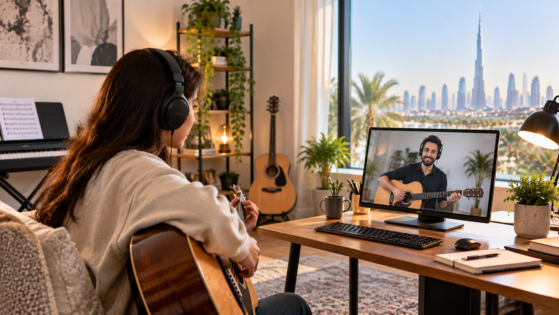
Perhaps the most useful question to ask yourself is simple:
Why do I want to learn music?
Your answer can help you determine what kind of academy and course you need.
You may want to learn an instrument simply because you love music. Perhaps you have always wanted to play your favourite songs on the piano or guitar. Another student may want to improve vocal technique, develop music theory knowledge, or prepare for a graded examination.
Some learners may already have musical experience and want to progress to a more advanced level. Others may be starting completely from scratch.
There is no single correct reason to learn music. What matters is that the academy understands your objective and can shape the learning experience accordingly.
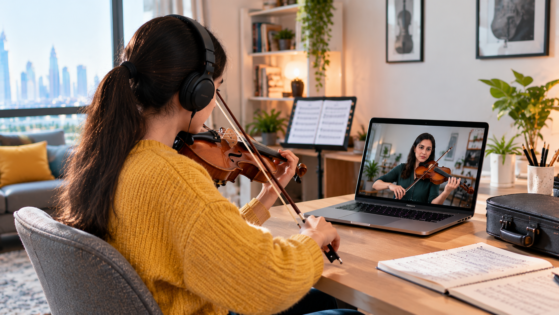
A common misconception is that online music education simply means connecting to a video call once a week.
A quality online music programme should go beyond that.
The lesson itself is important, but so are the learning resources, practice guidance, feedback, and continuity between sessions. Students need opportunities to revisit concepts, practise what they have learned, and gradually build upon previous lessons.
Session recordings can also be useful in this regard, allowing students to revisit parts of a lesson when practising between classes, depending on the academy’s system.

For some learners, music is more than a hobby.
Students who want formal recognition of their skills may eventually consider graded music examinations. In such cases, it is worth choosing an academy that understands the requirements of recognised examination systems and can prepare students appropriately.
The Mystic Keys provides preparation for Trinity College London graded examinations, including practical and theory preparation depending on the student’s level.
If certification is one of your goals, ask the academy about the examination board, preparation methodology, expected level, and whether examination support is included in the learning programme.

Absolutely — provided the programme is designed appropriately.
You do not need to already know how to read music or play an instrument before beginning many online music courses. Beginners can start with fundamental concepts and gradually develop their skills.
In fact, starting from the basics can be beneficial because students learn proper techniques instead of developing habits that may later be difficult to correct.
The Mystic Keys offers courses that allow beginners to start from foundational levels, while certain advanced subjects may require prior knowledge.
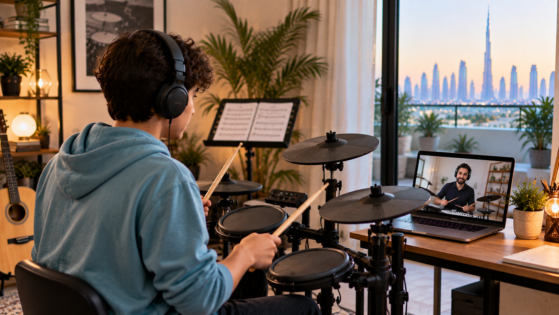
Music education is not limited to a particular age group.
Children can benefit from developing rhythm, listening skills, coordination, creativity, and musical awareness. Adults, meanwhile, may approach music with different motivations — perhaps learning an instrument they always wanted to play or returning to music after several years.
An online academy that teaches different age groups can therefore accommodate a wider range of learners.
For parents, it is worth discussing the learner’s age, attention span, previous experience, and goals with the academy before selecting a course.
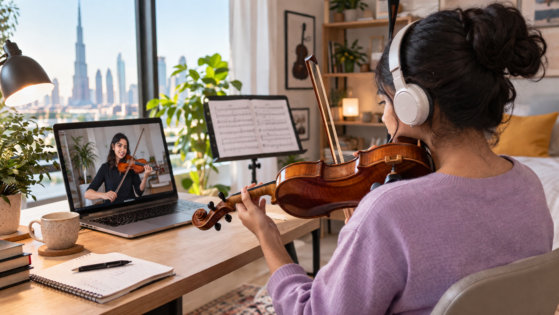
Group learning can be enjoyable, but individual instruction offers a different kind of experience.
During a one-on-one lesson, the instructor can focus entirely on one student’s playing or singing. Mistakes can be addressed immediately, exercises can be adjusted, and the pace can be changed according to the learner’s progress.
This can be especially helpful when learning an instrument because small technical issues can become difficult habits if they are not corrected early.
For students who already have some experience, personalised lessons can also prevent unnecessary repetition. Instead of spending considerable time on skills they already understand, learners can focus on areas where they need further development.
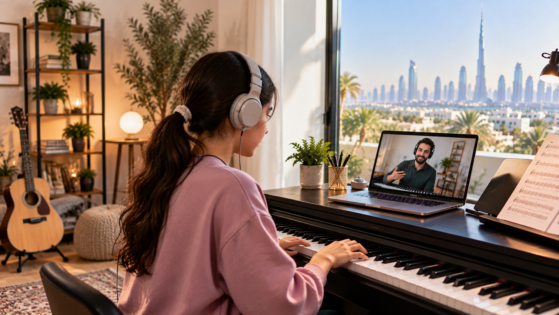
Choosing an online music academy is not simply about finding the lowest fee or the largest number of courses.
Think about the complete experience.
Does the academy offer the instrument or vocal style you want? Are the lessons live and interactive? Can the schedule fit comfortably into your routine? Will you receive individual attention? Are qualified and experienced teachers available? Is there a structured curriculum? Can the academy support your goals if you eventually want to prepare for graded examinations?
Once you have answers to these questions, comparing different academies becomes much easier.
It is also useful to speak with the academy before enrolling. Ask about the course structure, lesson duration, teacher experience, scheduling, practice expectations, and what happens after the initial lessons.
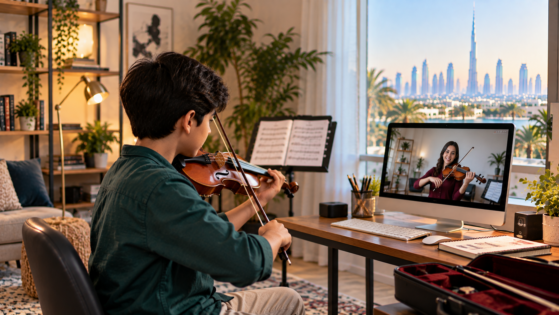
For students in the UAE looking specifically for an online music academy, The Mystic Keys offers a learning model built around online instruction, individual attention, flexible scheduling, and a broad selection of music courses.
Its online music education platform serves students internationally, allowing learners to attend lessons from home rather than travelling to a physical music centre. The academy offers courses across instruments, vocals, music theory, and related areas, with options for beginners and more advanced learners.
The approach is particularly suited to learners who value personalised instruction and flexibility. Students can work towards different objectives — whether that means learning for enjoyment, developing technical skills, improving musical understanding, or preparing for recognised graded examinations.
The academy was founded with the aim of making music education accessible from home, and its online model continues that approach for students across different locations.

Traditional music education often means travelling to an academy, attending fixed classes, and following a set schedule.
Technology has changed that.
Today, your living room can become your practice space. Your laptop can connect you with a music instructor anywhere in the world. Lessons can fit around your routine, with structured guidance and personalised feedback.
For learners in the UAE, an online music academy offers a convenient way to make music part of everyday life. It also reduces travel and scheduling challenges.
The key is to choose thoughtfully. Look at the teachers, teaching approach, flexibility, curriculum, individual attention, and learning resources. Most importantly, consider your musical goals.
The right music academy is not just about learning an instrument.
It is about learning, practising, and growing as a musician.
If you are looking for an online music academy in the UAE, The Mystic Keys offers personalised online music education across a wide range of instruments and vocal disciplines. With flexible learning options, students can learn at their own pace and work towards their musical goals.
For more information and exciting resources about learning music, visit our website at The Mystic Keys. For more music content and exciting offers follow us on
Facebook, Instagram, YouTube, LinkedIn, Twitter, Pinterest, and Threads.
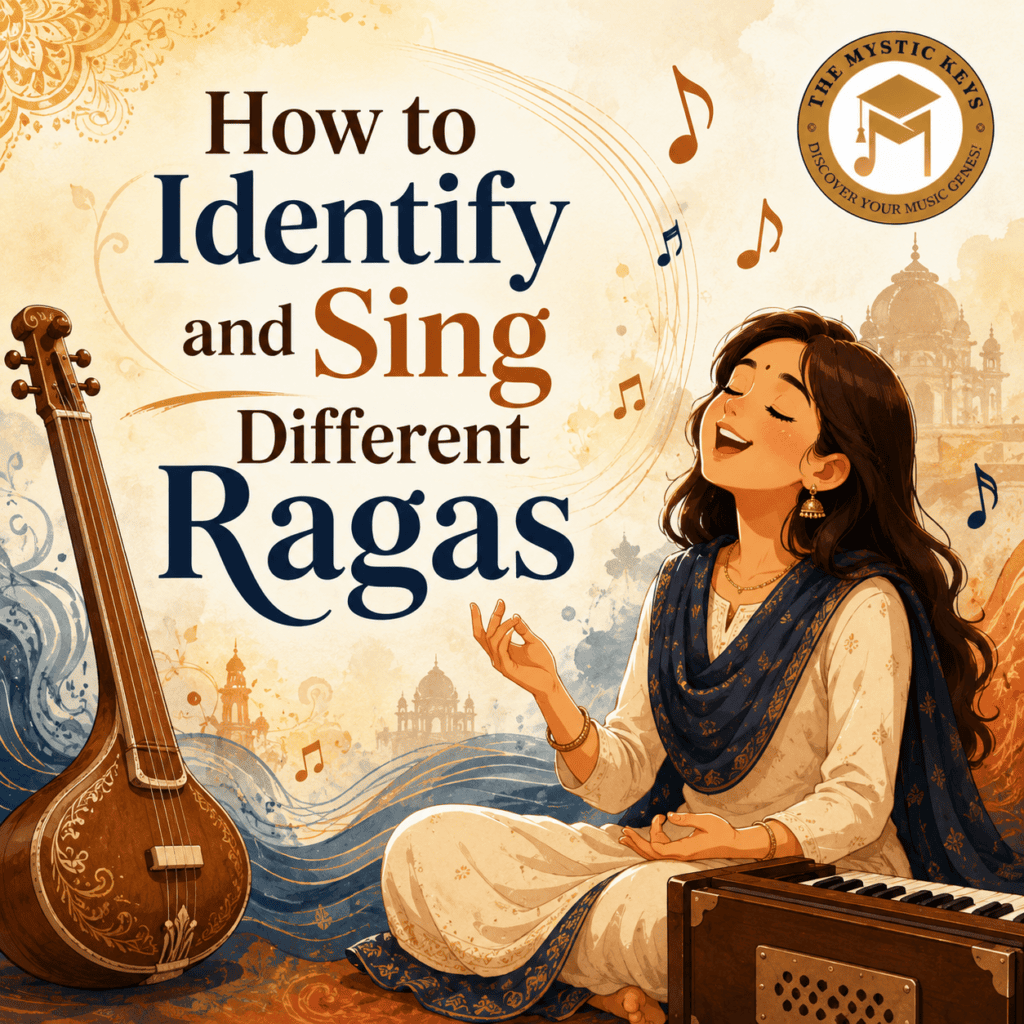
Learning how to identify and sing different ragas is an important part of developing a strong foundation in Indian classical music. A raga is much more than a collection of notes; its identity comes from characteristic phrases, note movements, emphasis, ornamentation, and melodic expression. When students learn to identify and sing different ragas, they develop stronger pitch awareness, listening skills, musical memory, and vocal control.
For a beginner, different ragas can initially sound similar. Several ragas may use overlapping swaras, but their melodic treatment can be completely different. Understanding these subtle differences is what makes raga training both challenging and rewarding.
The reason is simple: a raga is much more than a collection of notes.
The way notes are approached, emphasized, connected, repeated, and ornamented gives every raga its distinctive identity. Learning to identify and sing different ragas therefore requires both theoretical understanding and extensive listening.

Before attempting to identify and sing different ragas, singers should develop a strong understanding of swaras. Sa provides the tonal reference, while the other swaras create different melodic relationships around it.
Practice singing individual swaras and simple patterns while returning frequently to Sa. This helps your ear become familiar with pitch relationships and prepares you to recognize the melodic characteristics of different ragas.
Do not listen only for individual notes. When you identify and sing different ragas, pay attention to how the notes move toward and away from one another.
Ask yourself:
These details are often more useful than simply memorizing the scale.
Characteristic phrases are among the strongest clues when learning to recognize a raga. Instead of memorizing only its arohana and avarohana, learn the phrases that give the raga its distinctive personality.
Choose two or three important phrases and sing them slowly. Repeat them until the movement feels natural.
Then try singing them without listening to the recording.
As you become familiar with these phrases, you will find it easier to identify and sing different ragas because your ear begins to recognize their characteristic melodic language.

Active listening is essential if you want to identify and sing different ragas confidently.
Listen to experienced singers and instrumentalists and pay attention to how they approach important swaras, create melodic tension, and return to resting notes.
One of the best ways to identify and sing different ragas is to compare ragas that share similar swaras.
Listen to them one after another and look for:
Repeated comparison gradually makes subtle differences easier to hear.
A tanpura provides a continuous tonal foundation and helps singers hear their relationship with Sa.
Begin by establishing Sa clearly. Then practice the important swaras and characteristic phrases of the raga.
When learning to identify and sing different ragas, avoid rushing through phrases.
Slow singing allows you to hear the movement between notes and reproduce ornamentation more accurately. Gradually increase your fluency as the raga becomes familiar.

The movement between notes can be just as important as the notes themselves. Meend, gamaka, and other forms of ornamentation can strongly influence how a raga sounds.
Do not add an ornament simply because it sounds attractive. Different ragas have different approaches to melodic movement.
Learning these details correctly is essential when you want to identify and sing different ragas authentically.
A nyas swara is a note on which a melodic phrase can rest or settle.
Listen for notes that feel particularly stable at the end of phrases.
Try singing short phrases and ending on different swaras.
Notice how some endings feel complete while others feel unfinished.
This exercise develops your understanding of the raga’s internal sense of movement and resolution.

Raga singing is not simply about singing straight notes.
Ornamentation and the movement between notes can be essential to a raga’s identity.
In Hindustani music, meend involves a glide between notes. Other forms of ornamentation also contribute to melodic expression.
Carnatic music has its own highly developed approach to gamakas and other forms of melodic ornamentation.
The exact treatment depends on the raga and musical tradition.
An ornament that sounds appropriate in one raga may not be appropriate in another.
Learn how characteristic phrases are sung within the specific raga you are studying rather than adding ornaments simply because they sound impressive.
Comparing similar ragas is one of the best ways to sharpen your listening skills.
Choose two ragas with overlapping swaras and listen to them carefully.
Ask:
The differences may initially seem very subtle, but repeated comparison trains your ear to recognize them.

A tanpura provides a continuous tonal foundation that helps singers maintain awareness of the relationship between their voice and the tonic.
Begin your practice by establishing Sa.
Sing important swaras slowly.
Return to Sa.
Then practice the characteristic phrases of the raga.
This develops pitch stability while strengthening your awareness of the raga’s tonal framework.
Call-and-response practice is highly effective for raga learning.
Listen to a short phrase.
Pause.
Try to reproduce it with your voice.
Then listen to the original again and compare.
Repeat until your version closely follows the melodic movement.
This develops the connection between hearing and singing, which is essential for raga-based music.

Trying to learn many ragas simultaneously can become overwhelming.
Spend enough time with one raga to become familiar with:
Once the raga feels familiar, introduce another and begin comparing them.
Many ragas are associated with particular moods, times, or expressive qualities depending on the musical tradition.
It can be useful to think about the mood of a raga, but avoid reducing it to labels such as “happy,” “sad,” or “peaceful.”
Its character comes from its complete melodic language.
The emotional quality emerges through the combination of notes, movements, ornamentation, rhythm, and expression.
You do not need several hours every day to begin developing your raga awareness.
A focused routine can be highly effective.
5 minutes: Establish Sa and practice basic swaras.
10 minutes: Practice characteristic phrases.
10 minutes: Sing along with a recording.
5 minutes: Listen to an excerpt and identify its phrases.
As your skills develop, you can gradually increase the complexity and duration.
Raga identification is fundamentally an ear-training skill.
Listen to short excerpts without looking at the title. Try to determine the raga based on its phrases, swaras, note movements, and overall character.
If you identify a raga incorrectly, find out what caused the confusion.
Perhaps the two ragas share several swaras. Maybe you missed a characteristic phrase.
Every mistake gives you another opportunity to improve your ability to identify and sing different ragas.
Learning to identify and sing different ragas takes time, attentive listening, and consistent vocal practice. Memorizing scales provides a useful starting point, but true raga recognition comes from understanding characteristic phrases, important swaras, melodic movement, resting points, and ornamentation.
Start with one raga at a time. Listen to several performances, practice with a tanpura, sing characteristic phrases slowly, and compare similar ragas carefully. With regular practice, your ear will gradually become more sensitive to the subtle details that distinguish one raga from another.
At The Mystic Keys, personalized Carnatic Vocals Lessons Online help students develop swara awareness, raga understanding, pitch control, voice technique, ear training, and musical expression. With individual guidance from experienced teachers, learners can build a strong foundation and develop greater confidence in identifying and singing different ragas.
For more information and exciting resources about learning music, visit our website at The Mystic Keys. For more music content and exciting offers follow us on
Facebook, Instagram, YouTube, LinkedIn, Twitter, Pinterest, and Threads.
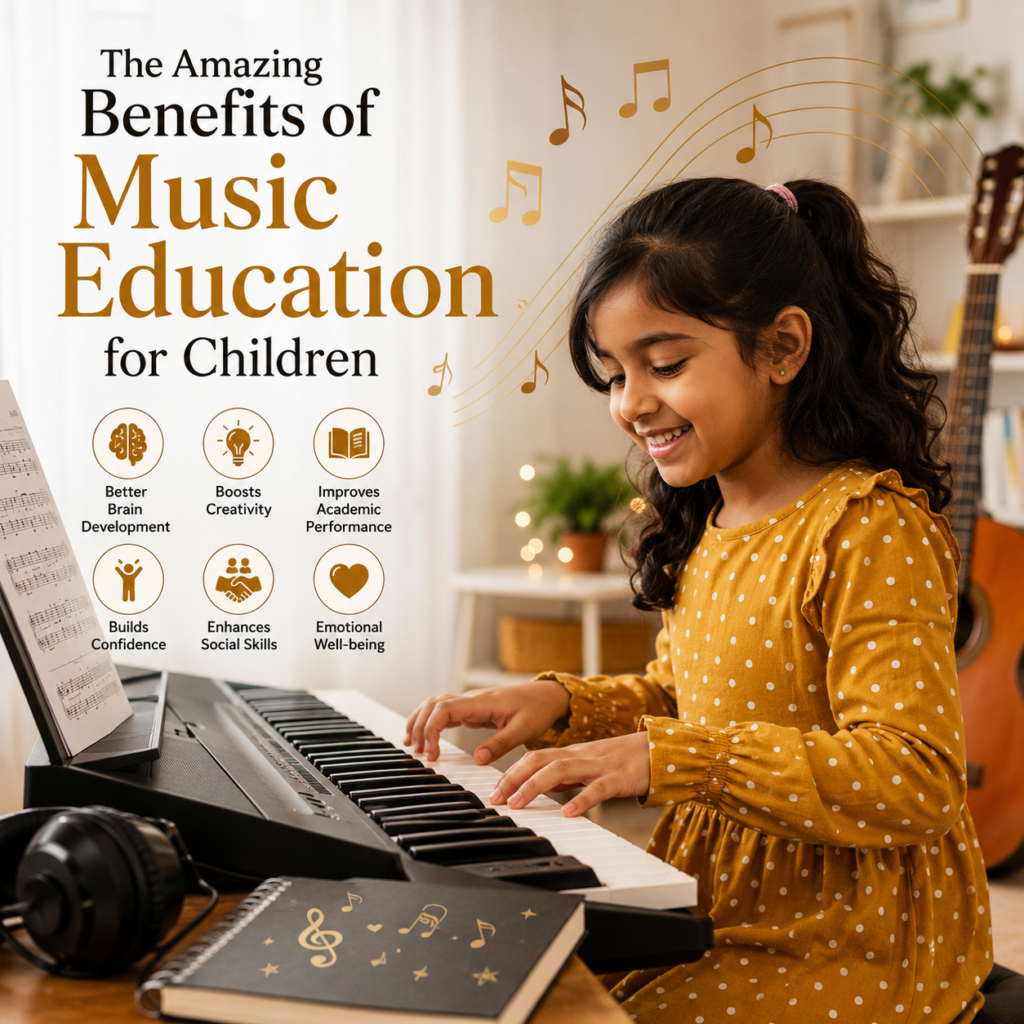
Parents often look for activities that help their children grow academically, socially, and emotionally. Among the many options available, music education for children stands out as one of the most rewarding experiences. Learning music is much more than singing songs or playing an instrument—it develops important life skills that benefit children throughout their lives.
Whether a child learns piano, guitar, violin, drums, vocals, or another instrument, music encourages creativity, discipline, patience, and confidence. Numerous studies have also shown that children who participate in music education often perform better in school and develop stronger communication and problem-solving skills.
If you’re wondering whether music lessons are worth the investment, this guide explores the many ways music education for children supports healthy growth and lifelong success.

Childhood is the ideal time to develop new skills. During these early years, the brain is highly adaptable and capable of learning quickly.
Music education for children provides opportunities to strengthen memory, coordination, listening skills, and emotional expression while making learning enjoyable. Instead of focusing only on musical ability, children also develop habits that help them succeed in academics and everyday life.
Music becomes a valuable part of their overall development rather than just another extracurricular activity.
One of the greatest advantages of learning music is its positive impact on brain development.
When children learn an instrument or practice singing, they use multiple parts of the brain simultaneously. Reading notes, listening carefully, coordinating movements, and maintaining rhythm require constant mental activity.
As a result, music education for children helps improve:
These cognitive benefits often extend into classroom learning as well.

Many parents notice improvements in their children’s academic performance after starting music lessons.
Learning music encourages children to:
Because music combines logic with creativity, children often become more confident learners across different school subjects.
Confidence grows when children accomplish new goals.
Learning a new song, mastering a difficult rhythm, or performing in front of family members gives children a sense of achievement. Each small success motivates them to continue learning.
Over time, music education for children helps reduce fear of making mistakes and encourages them to face new challenges with confidence.

Music gives children the freedom to express themselves creatively.
Whether they are composing simple melodies, experimenting with rhythms, or interpreting a song differently, children learn to think beyond fixed answers.
Creative thinking developed through music often benefits art, writing, storytelling, and problem-solving in other areas of life.
Success in music does not happen overnight.
Children gradually learn that improvement comes through:
These habits become valuable life skills that support academic achievement, sports, and future careers.

Listening is one of the most important musical abilities.
Students learn to:
These listening skills improve classroom participation, conversations, and teamwork.
Music requires children to remember lyrics, melodies, rhythms, finger positions, and musical symbols.
This continuous mental exercise strengthens both short-term and long-term memory.
Children who participate in music education for children often develop better attention spans and improved concentration during learning activities.
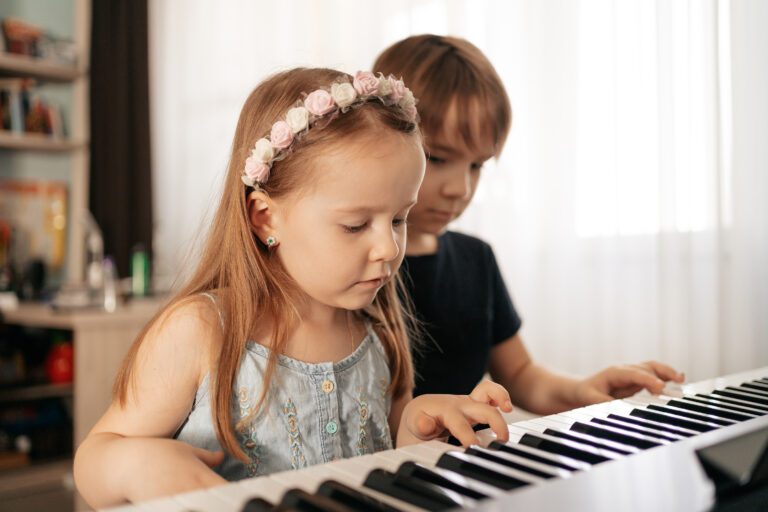
Playing many musical instruments involves precise hand movements.
Children learning piano, violin, guitar, or drums improve:
These skills also support handwriting, drawing, and other daily activities.
Music provides children with healthy ways to understand and express emotions.
Instead of keeping feelings inside, children often communicate through singing or playing an instrument.
This emotional expression helps reduce stress while encouraging self-awareness and empathy.

Every musician experiences challenges.
Children quickly learn that difficult songs become easier through regular practice.
This lesson teaches perseverance and helps them understand that success comes from consistent effort rather than instant results.
Many music programs include:
Working together teaches children how to communicate, cooperate, and respect others.
These experiences help build friendships and improve teamwork.

Performing music encourages children to communicate both verbally and non-verbally.
They become more comfortable speaking in front of others, sharing ideas, and expressing emotions.
These communication skills benefit presentations, interviews, and future leadership opportunities.
Children also experience stress from school, exams, and daily responsibilities.
Music provides a relaxing outlet that helps them:
Many parents notice that music lessons become one of their child’s favorite weekly activities.

Music introduces children to traditions from around the world.
Whether learning Western classical music, Carnatic music, Hindustani music, or contemporary styles, students gain a deeper appreciation for different cultures and artistic traditions.
This broadens their understanding of the world.
As students become more confident, they often take leadership roles during performances and group rehearsals.
Leading warm-ups, helping classmates, or performing solos encourages responsibility and decision-making.
These experiences build leadership qualities from an early age.

Although children can explore music independently, structured lessons provide faster and more consistent progress.
Experienced teachers help students:
Personalized instruction ensures that children continue progressing while enjoying the learning process.
Parents play an important role in encouraging musical growth.
Simple ways to support children include:
Positive encouragement helps children remain motivated and enjoy learning.
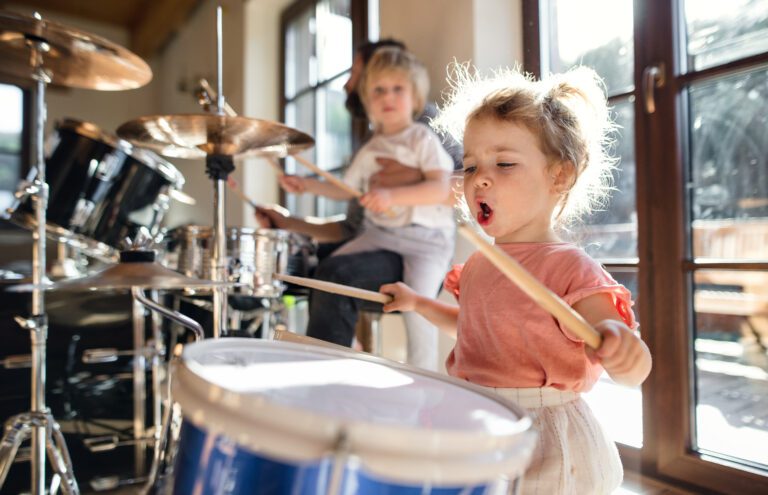
Many children begin learning music between the ages of four and seven.
However, there is no perfect age.
The best time to begin music education for children is whenever a child shows curiosity and interest. With the right teacher and learning approach, children of different ages can successfully develop musical skills.
The lessons learned through music extend far beyond the classroom.
Children develop confidence, discipline, creativity, resilience, communication, and emotional intelligence—qualities that continue benefiting them throughout adulthood.
Even if they never become professional musicians, the experiences gained through music positively shape their personal and academic lives.
The benefits of music education for children reach far beyond learning an instrument or singing songs. Music strengthens the mind, nurtures creativity, builds confidence, teaches discipline, and develops valuable life skills that support success in school and beyond.
Every lesson gives children an opportunity to grow, express themselves, and discover their unique potential. With consistent practice and expert guidance, music becomes a lifelong companion that inspires learning, confidence, and personal development.
At The Mystic Keys, we offer personalized one-on-one online music lessons for children in piano, guitar, violin, vocals, drums, ukulele, and Indian classical music. Our experienced instructors create engaging lessons that help every child develop strong musical skills while building confidence and a lifelong love for music.
For more information and exciting resources about learning music, visit our website at The Mystic Keys. For more music content and exciting offers follow us on
Facebook, Instagram, YouTube, LinkedIn, Twitter, Pinterest, and Threads.

Hitting high notes in choral music can feel challenging for many singers, especially those who are new to choir singing. High notes often require greater breath control, vocal support, and confidence than lower notes. In a choir setting, singers must not only reach these notes but also maintain balance with the rest of the group while producing a clear and controlled sound.
Choir music often includes dynamic vocal ranges, and sopranos and tenors frequently encounter passages that require sustained high notes. Learning effective techniques for hitting high notes in choral music helps singers maintain vocal health, improve tone quality, and perform with confidence.
Whether you sing in a church choir, school choir, or professional vocal ensemble, mastering high notes can greatly enhance your overall vocal performance.
High notes can be difficult because they require a combination of proper breath support, vocal placement, and relaxed vocal muscles. Many singers struggle with tension when attempting to reach higher pitches.
Common reasons singers struggle with high notes include:
– Insufficient breath support
– Tight throat muscles
– Poor vocal technique
– Lack of vocal warm-ups
– Fear or nervousness while singing
Understanding these challenges is the first step toward improving your ability in hitting high notes in choral music.
Breathing plays a crucial role in singing high notes successfully. Without adequate breath support, the voice may sound strained or weak when reaching higher pitches.
Good breathing technique involves using the diaphragm rather than shallow chest breathing. When singers breathe deeply, they provide the airflow necessary to sustain high notes smoothly.
To improve breathing for choir singing:
– Take slow, deep breaths before phrases
– Allow your abdomen to expand when inhaling
– Maintain steady airflow while singing
Strong breath support helps singers maintain control and stability while hitting high notes in choral music.

Warm-ups prepare the vocal cords for singing and help prevent strain when reaching higher notes.
Before rehearsals or performances, singers should spend time warming up with exercises that gradually extend the vocal range.
Effective warm-up exercises include:
– Lip trills
– Humming scales
– Gentle sirens (gliding from low to high notes)
– Vocal scales moving upward step by step
These exercises help relax the voice and prepare singers for hitting high notes in choral music safely.
Tension is one of the biggest obstacles when trying to sing high notes. Many singers tighten their throat muscles when approaching difficult pitches.
However, high notes actually require relaxation rather than force.
To reduce tension:
– Keep your jaw relaxed
– Avoid clenching your teeth
– Maintain an open throat position
Relaxed vocal muscles allow the voice to move freely into higher registers.

Vocal placement refers to where the sound resonates in the body. For high notes, singers often benefit from focusing resonance toward the head rather than pushing sound from the throat.
Head resonance helps produce a lighter and clearer tone that is ideal for choir singing.
When practicing hitting high notes in choral music, imagine the sound lifting upward and resonating in the facial area.
This technique allows singers to reach high notes with less strain and greater clarity.
Posture significantly affects vocal production. Poor posture restricts breathing and limits vocal freedom.
Choir singers should maintain an upright and relaxed posture while singing.
Good singing posture includes:
– Standing tall with shoulders relaxed
– Keeping the head balanced over the spine
– Allowing the chest to remain open
Proper posture allows the lungs and diaphragm to function efficiently, supporting strong high notes.

As singers move higher in their vocal range, vowel sounds may need slight adjustments.
Certain vowels become difficult to sustain at high pitches if they are too wide or tight.
For example, singers may modify vowels slightly to allow the voice to resonate more freely. This technique helps maintain smooth tone while hitting high notes in choral music.
Choir directors often guide singers on how to adjust vowels to blend better within the choir.
Improving high notes requires patience and consistent practice.
Singers should avoid forcing their voice beyond its natural limits. Instead, gradually extend the vocal range through regular exercises.
Daily practice may include:
– Singing scales that move higher each day
– Practicing short passages from choir music
– Recording practice sessions to monitor progress
Over time, these exercises help strengthen the voice and increase comfort with higher notes.
In choral music, individual singers must blend their voices with the group. High notes should sound unified rather than overpowering.
When singing high notes in a choir:
– Listen carefully to other singers in your section
– Match vowel shapes and tone
– Maintain balanced volume
Blending well ensures that hitting high notes in choral music contributes to the overall harmony rather than standing out excessively.
Vocal health is essential for singers who regularly perform high notes.
Hydration keeps the vocal cords flexible and reduces strain. Singers should drink water regularly and avoid excessive caffeine or dehydration before performances.
Additional vocal care tips include:
– Getting adequate rest
– Avoiding shouting or overusing the voice
– Warming up before singing and cooling down afterward
Healthy vocal habits make it easier to reach high notes consistently.

Confidence plays a major role in vocal performance. Fear or hesitation can cause tension that makes high notes harder to achieve.
Choir singers can build confidence by:
– Practicing challenging sections repeatedly
– Singing with supportive vocal groups
– Trusting their training and preparation
With experience, singers become more comfortable with hitting high notes in choral music during rehearsals and performances.
The Mystic Keys is an online music academy dedicated to helping students grow as confident and skilled musicians. Through personalized one-on-one lessons, students receive structured guidance in Piano Lessons Online, Guitar Lessons Online, vocals, drums, Hindustani music, and more.
The academy focuses on building strong musical foundations while encouraging creativity and expression. Students benefit from recorded lessons, professional teaching methods, and a supportive learning environment.
Many students at The Mystic Keys also prepare for internationally recognized music certifications from Trinity College London, helping them achieve important milestones in their musical journey.
Mastering the art of hitting high notes in choral music requires patience, proper technique, and consistent practice. By focusing on breathing, relaxation, posture, and vocal placement, singers can develop the control needed to reach higher pitches with clarity and confidence.
Choir singing is not only about individual performance but also about blending voices to create beautiful harmonies. When singers apply the right techniques and maintain healthy vocal habits, high notes become an opportunity to enhance the emotional impact of choral music.
With dedication and proper training, any choir singer can improve their range and contribute powerfully to the choir’s overall sound.
For more information and exciting resources about learning music, visit our website at The Mystic Keys. For more music content and exciting offers follow us on
Facebook, Instagram, YouTube, LinkedIn, Twitter, Pinterest, and Threads.
Easy chord progressions for worship guitar are the foundation of many modern worship songs played in churches around the world. Worship music often focuses on creating a peaceful and uplifting atmosphere that allows the congregation to sing and connect with the message of the song. Because of this, guitarists rely on simple yet powerful chord patterns that are easy to play and sound beautiful when combined with vocals and other instruments.
Many worship songs use similar chord progressions because they create a familiar and emotionally engaging sound. When guitarists learn easy chord progressions for worship guitar, they gain the ability to play a wide range of worship songs without needing to memorize every individual arrangement. These progressions also help beginners build confidence and develop rhythm skills while supporting the worship team effectively.
Understanding these chord patterns can make a huge difference for anyone who wants to serve in a worship band or simply enjoy playing worship music at home.
Chord progressions form the harmonic structure of a song. In worship music, they guide the melody and help create emotional movement within the music.
When worship guitarists understand chord progressions, they can:
– Play many songs using familiar patterns
– Support the worship leader more confidently
– Adjust songs to different keys when needed
– Focus more on musical expression instead of memorizing chords
Learning easy chord progressions for worship guitar allows musicians to develop flexibility and become more comfortable during live worship settings.

Worship chord progressions often share several common characteristics.
First, they tend to be simple and repetitive. This repetition makes it easier for the congregation to follow along and sing confidently.
Second, they usually include major chords and minor chords that create a balance between uplifting and reflective emotions.
Third, worship chord progressions often build gradually, allowing the music to move from quiet verses to powerful choruses.
Because of these characteristics, even beginner guitarists can learn to play meaningful worship music with just a few basic chords.
Before exploring chord progressions, it is helpful to understand the keys that are commonly used in worship songs.
Many worship songs are written in keys that are comfortable for singers and guitarists. Some of the most common keys include:
– Key of G
– Key of C
– Key of D
– Key of A
These keys allow guitarists to use open chords, which are easier to play and produce a fuller sound on acoustic guitars.
Once guitarists understand these keys, learning easy chord progressions for worship guitar becomes much easier.
One of the most popular chord progressions in modern music—and especially in worship songs—is the I–V–vi–IV progression.
In the key of G, this progression looks like:
G – D – Em – C
This progression creates a balanced and uplifting sound that works well for both verses and choruses.
Many worship songs rely on this pattern because it provides emotional movement while remaining simple enough for congregational singing.
Practicing this progression helps guitarists become comfortable with chord transitions and rhythm patterns.
Another classic progression used in worship music is the I–IV–V progression.
In the key of C, this progression is:
C – F – G
This progression has been used in countless songs across many genres. Its simplicity makes it perfect for beginner guitarists who are just learning to play worship music.
Despite being simple, this progression creates a strong musical foundation that supports both melody and vocals.
Learning this pattern is an important step in mastering easy chord progressions for worship guitar.

This progression is very common in modern worship songs because it creates a reflective and emotional atmosphere.
In the key of G, the progression looks like:
Em – C – G – D
The minor chord at the beginning adds emotional depth, making it suitable for slower and more contemplative worship songs.
Guitarists often use gentle strumming patterns with this progression to create a peaceful and expressive sound.
This progression is slightly different from the traditional I–IV–V pattern but works beautifully in worship music.
In the key of D, the progression would be:
D – A – G
This chord pattern is simple yet powerful. It works well for upbeat worship songs that encourage participation from the congregation.
Because it uses only three chords, beginners can learn it quickly and start playing worship songs with confidence.

Learning chord progressions is only the first step. Guitarists must also practice them regularly to develop smooth transitions and steady rhythm.
Here are a few tips that can help worship musicians improve their playing.
Practice Slow Chord Changes
Beginners should practice moving between chords slowly at first. This helps build muscle memory and accuracy.
Use a Metronome
Playing with a steady rhythm is essential for worship music. Practicing with a metronome improves timing and consistency.
Experiment with Strumming Patterns
Different strumming patterns can completely change the feel of a chord progression. Guitarists should experiment with soft and energetic patterns depending on the song.
Listening carefully to worship music helps musicians understand how chord progressions are used in real songs.
When playing with a worship band, the guitarist must listen carefully to the entire group.
The goal is not to play loudly or stand out but to support the overall sound of the band.
This means paying attention to:
– The rhythm of the drums
– The melody of the vocals
– The harmony of the keyboard or piano
By blending well with the band, guitarists can create a fuller and more balanced musical experience.
Understanding easy chord progressions for worship guitar makes it easier to adapt during rehearsals and live performances.
Many musicians feel nervous when they first begin playing in a worship team. However, confidence grows with experience and preparation.
Practicing chord progressions regularly helps guitarists become more comfortable and reliable during services.
Over time, musicians develop better listening skills, stronger rhythm control, and the ability to adjust their playing to match the flow of the worship set.
Consistency and dedication are key to becoming a confident worship guitarist.
Learning easy chord progressions for worship guitar is one of the most effective ways to begin playing worship music confidently. These simple chord patterns form the backbone of many worship songs and allow guitarists to focus on musical expression rather than complex techniques.
By practicing common progressions, improving rhythm skills, and listening carefully to the worship band, musicians can create a meaningful musical atmosphere that supports the congregation and enhances the worship experience.
With dedication, patience, and consistent practice, even beginner guitarists can become valuable members of a worship team and contribute to powerful moments of music and worship.
The Mystic Keys is an online music academy dedicated to helping students develop strong musical skills through structured and personalized lessons. Students receive one-on-one guidance from experienced teachers and gain access to recorded lessons that help them review and practice effectively.
The academy offers lessons in Piano Lessons Online, Guitar Lessons Online, vocals, drums, Hindustani music, and more. Through a professional learning approach, students build confidence, improve technique, and develop a deeper understanding of music.
Students at The Mystic Keys also have the opportunity to prepare for internationally recognized certifications from Trinity College London, helping them achieve important milestones in their musical journey.
For more information and exciting resources about learning music, visit our website at The Mystic Keys. For more music content and exciting offers follow us on
Facebook, Instagram, YouTube, LinkedIn, Twitter, Pinterest, and Threads.

Best guitars for worship musicians are not simply instruments that sound good—they are tools that help create a meaningful musical atmosphere during worship services. In church music, the guitar often plays a central role in supporting vocals, guiding the congregation, and building emotional connection through sound. Whether leading worship or playing as part of a band, selecting the right guitar can influence tone, comfort, and musical expression.
Many worship musicians spend hours practicing, rehearsing with bands, and performing during services. Because of this, choosing from the best guitars for worship musicians becomes important not only for sound quality but also for reliability and playability. A well-chosen guitar helps musicians focus on the music rather than worrying about technical limitations.
Worship music styles vary widely. Some churches prefer acoustic and simple arrangements, while others use full bands with electric guitars, keyboards, and drums. Understanding how different guitars fit into these styles helps musicians make informed decisions when selecting an instrument.

The guitar has become one of the most widely used instruments in modern worship music. Its versatility allows it to support both simple and complex musical arrangements.
In many churches, guitars are used for:
– Leading congregational singing
– Supporting vocal melodies
– Adding rhythm and harmony
– Creating atmospheric musical textures
– Enhancing emotional moments during worship
Because of these roles, worship musicians must consider tone, clarity, and versatility when choosing an instrument.
The best guitars for worship musicians are those that blend naturally with vocals and other instruments rather than overpowering them. Worship music is not about technical display—it is about creating a musical environment that encourages participation and reflection.

Tone is one of the most important factors when choosing a guitar for worship music.
In church settings, the guitar must blend smoothly with vocals and other instruments. A guitar that is too bright or too aggressive may distract from the overall musical balance.
Worship musicians typically prefer guitars that produce:
– Warm and balanced tones
– Clear chord definition
– Smooth sustain
– Dynamic response to playing style
The ability to control tone through picking strength and hand position also helps musicians shape the sound to fit different songs.
Comfort is often overlooked when choosing a guitar, but it becomes very important during long worship services or rehearsals.
Musicians who play regularly need an instrument that feels natural and easy to handle. Neck shape, body size, and string action all contribute to playability.
A guitar that is difficult to play may cause fatigue and limit performance quality. On the other hand, a comfortable instrument allows musicians to focus on the music and worship experience.
When considering the best guitars for worship musicians, comfort should always be a top priority.
Church musicians rely on their instruments week after week. Because of this, durability is another key factor.
Guitars used in worship environments must handle:
– Frequent rehearsals
– Transportation to church
– Changes in temperature and humidity
– Regular performances
Reliable construction ensures that the guitar maintains its tone and tuning stability over time.
A dependable instrument reduces the risk of technical issues during live performances.

Even the best guitar cannot replace proper practice and musical preparation.
Worship musicians must develop several skills to support their role effectively.
These include:
– Smooth chord transitions
– Consistent rhythm
– Listening and blending with the band
– Dynamic control during songs
Practicing regularly helps musicians maintain confidence and accuracy during services.
Musicians who dedicate time to practice also develop stronger musical awareness, allowing them to adapt easily during live worship moments.
In modern worship settings, guitars often play alongside other instruments such as piano, drums, bass, and vocals.
Because of this, collaboration becomes essential.
Guitarists must listen carefully to the entire band rather than focusing only on their own part. Sometimes the guitar should lead the rhythm, while at other times it should remain subtle in the background.
Understanding how to support the band is just as important as choosing the best guitars for worship musicians.
A good worship guitarist prioritizes the overall sound of the band rather than personal performance.
One of the most important qualities of worship musicians is sensitivity to the musical and spiritual atmosphere of the service.
Guitarists should pay attention to:
– The mood of the song
– The pace of the worship set
– The direction given by the worship leader
Rather than playing continuously, skilled musicians know when to play and when to remain silent.
This awareness allows the guitar to contribute meaningfully to the overall worship experience.
Many musicians begin learning guitar specifically to participate in church worship teams.
For beginners, focusing on foundational skills is important.
These include:
– Basic chords
– Strumming patterns
– Rhythm consistency
– Listening to the band
Over time, musicians can expand their skills to include more advanced techniques and musical understanding.
Learning gradually ensures steady progress and confidence.
Choosing the best guitars for worship musicians involves more than selecting a popular instrument. The right guitar should support the style of worship music, provide reliable performance, and allow musicians to play comfortably during services.
Acoustic guitars offer warmth and simplicity, while electric guitars provide versatility and expressive tone. Both instruments play valuable roles in worship settings, and many musicians learn to use them together to create balanced and engaging musical arrangements.
Ultimately, the most important element is not the instrument itself but the heart and dedication of the musician. When worship guitarists focus on serving the music and supporting the congregation, their playing becomes more meaningful and impactful.
With the right instrument, consistent practice, and a genuine passion for music, worship musicians can contribute to powerful musical experiences that inspire and uplift those who listen.
The Mystic Keys is an online music academy dedicated to helping students develop strong musical skills through structured and personalized lessons. Students receive one-on-one guidance, recorded sessions for practice review, and a clear learning path designed to build both technique and musical confidence.
The academy offers lessons in Piano Lessons Online, Guitar Lessons Online, vocals, drums, Hindustani music, and more. instruments. allowing students to explore different areas of music education. With experienced teachers and a supportive learning environment, students can grow steadily and achieve important musical milestones.
Many students at The Mystic Keys also prepare for internationally recognized music certifications from Trinity College London, giving them opportunities to develop professionally and academically through music.
For more information and exciting resources about learning music, visit our website at The Mystic Keys. For more music content and exciting offers follow us on
Facebook, Instagram, YouTube, LinkedIn, Twitter, Pinterest, and Threads.