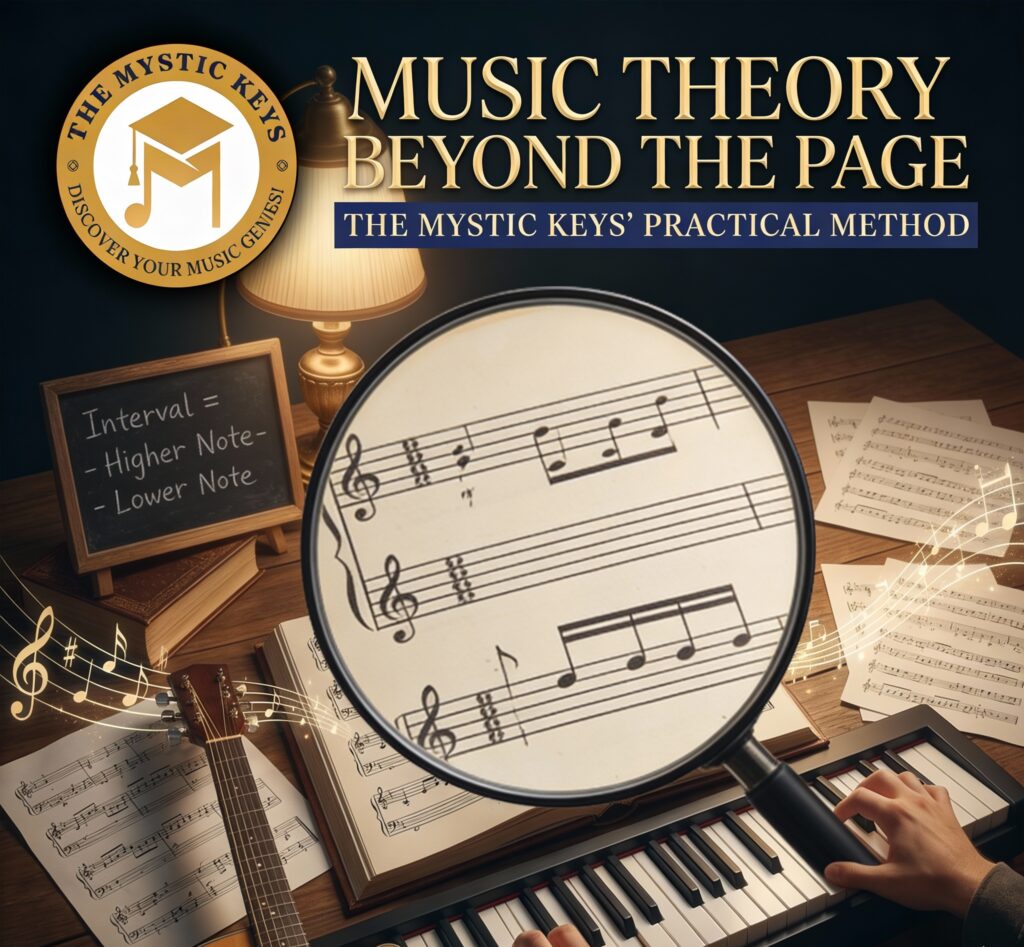
Music Theory Beyond the Page | The Mystic Keys’ Practical Method
Music theory has long carried a reputation for being intimidating, with dense textbooks, abstract symbols, and rigid rules that feel detached from the living, breathing experience of music itself. Many learners end up memorizing theory instead of embodying it. Yet music never belonged solely on paper. It emerged from vibration, movement, emotion, and instinct.
This is where The Mystic Keys’ Practical Method steps in—not as a rejection of theory, but as its liberation. By taking music theory beyond the page and into sound, sensation, and creativity, this approach transforms understanding into intuition and knowledge into expression.

Why Traditional Music Theory Often Feels Incomplete
Conventional music education often begins with notation, scales, intervals, and harmonic rules. Although these elements matter deeply, educators frequently introduce them in isolation, removing them from real musical experience. Students study what something is long before they discover why it holds meaning in music.
As a result, theory often exists as a separate subject instead of functioning as a living musical language. Learners may recognize the name of a chord yet hesitate to use it creatively or intellectually grasp a scale while struggling to apply it in performance or composition. Over time, this divide between knowledge and expression fosters frustration and stifles creative growth.
The Mystic Keys’ method recognizes this disconnect and confronts it at its source by reversing the traditional order of learning.
The Core Philosophy of The Mystic Keys’ Method
At the heart of The Mystic Keys’ approach lies a simple yet profound belief: music theory must arise from sound rather than come before it. Instead of starting with written explanations, the method guides learners to hear, feel, and play musical concepts first.
In this process, theory becomes a mirror that reflects what the hands, ears, and heart already understand. This shift transforms theory from a set of external rules into an internalized awareness. Rather than controlling creativity, theory now supports it—clarifying and enriching musical expression.
By anchoring learning in direct musical experience, The Mystic Keys’ method keeps theory alive, meaningful, and deeply emotionally resonant.

Learning Through the Body, Not Just the Mind
One of the defining features of The Mystic Keys’ Practical Method lies in its strong emphasis on physical engagement. Music does not exist only in the intellect; it lives in the body. Finger movement, breath, timing, and touch actively shape how musicians form, experience, and remember musical ideas.
Instead of using instruments merely to execute theoretical concepts, this approach positions them as active teachers. The hands discover patterns, repeated shapes build familiarity, and tactile experience opens direct pathways to understanding harmony and melody. With consistent practice, the body learns to anticipate sound even before the mind assigns it a name.
This embodied approach builds genuine confidence. Musicians no longer pause to calculate each decision; they respond instinctively, allowing the music to move forward with ease and natural flow.

Ear Training as the Foundation of Music Theory
In many traditional systems, ear training is treated as a supplementary skill. The Mystic Keys’ method places it at the very center of learning. Hearing relationships—between notes, chords, and progressions—is what transforms theory from static knowledge into living awareness.
By consistently linking sound to action, learners develop a strong internal sense of pitch, tension, and resolution. Chords are no longer symbols on a staff; they become emotional colors. Scales stop being exercises and start feeling like landscapes with distinct moods and directions.
As listening becomes more intentional, theory begins to make intuitive sense—almost as if the ears are teaching the mind.

From Patterns to Principles | Understanding Without Overthinking
Instead of overwhelming learners with exhaustive explanations, The Mystic Keys’ Practical Method introduces theory through recurring musical patterns. These patterns serve as anchors, helping students recognize relationships naturally before formally naming them.
As familiarity develops, the method reveals theoretical principles as clarifications rather than obligations. This timing plays a crucial role: when learners encounter theory after experience, they experience validation instead of restriction. Concepts such as harmony, modulation, or chord function emerge as answers to questions the music itself has already posed.
Through this process, the approach cultivates curiosity rather than fear, replacing overanalysis with clarity.

Creativity as a Measure of Understanding
In The Mystic Keys’ philosophy, true understanding is demonstrated through creativity. If a student can improvise, compose, or adapt a musical idea freely, theory has done its job. Memorization alone is never the goal; expression is.
By encouraging exploration early on, the method ensures that learners associate theory with freedom rather than limitation. Mistakes are reframed as discoveries, and experimentation becomes part of the learning process. Over time, musicians develop a personal relationship with theory—using it as a guide rather than a rulebook.
This creative emphasis nurtures confidence and individuality, allowing each musician’s voice to emerge authentically.

Bridging the Gap Between Classical Knowledge and Modern Music
Another strength of The Mystic Keys’ Practical Method is its adaptability. By emphasizing universal musical relationships rather than rigid stylistic rules, the method actively bridges classical theory and contemporary genres.
Whether a learner explores classical piano, film scoring, jazz, pop, or experimental soundscapes, the method makes the underlying principles immediately accessible. Theory functions as a flexible language, one that explains both Bach and modern songwriting with equal clarity.
This versatility frees learners from the boundaries of a single musical tradition and equips them to move confidently across many musical worlds.

Music Theory as a Living Practice
Ultimately, Music Theory Beyond the Page restores balance rather than abandoning structure. The Mystic Keys’ Practical Method reminds us that theory exists to serve music, not to overshadow it.
When musicians learn theory through sound, movement, and creativity, they turn it into a living practice—one that evolves alongside them. This approach deepens listening, sharpens expression, and strengthens the connection to music’s emotional core.
By stepping beyond the page, learners retain rigor while gaining meaning. In doing so, they rediscover music theory as it was always meant to be: a guide that helps them understand the magic they already hear.
For more information and exciting resources about learning music, visit our website at The Mystic Keys. For more music content and exciting offers follow us on
Facebook, Instagram, YouTube, LinkedIn, Twitter, Pinterest, and Threads.