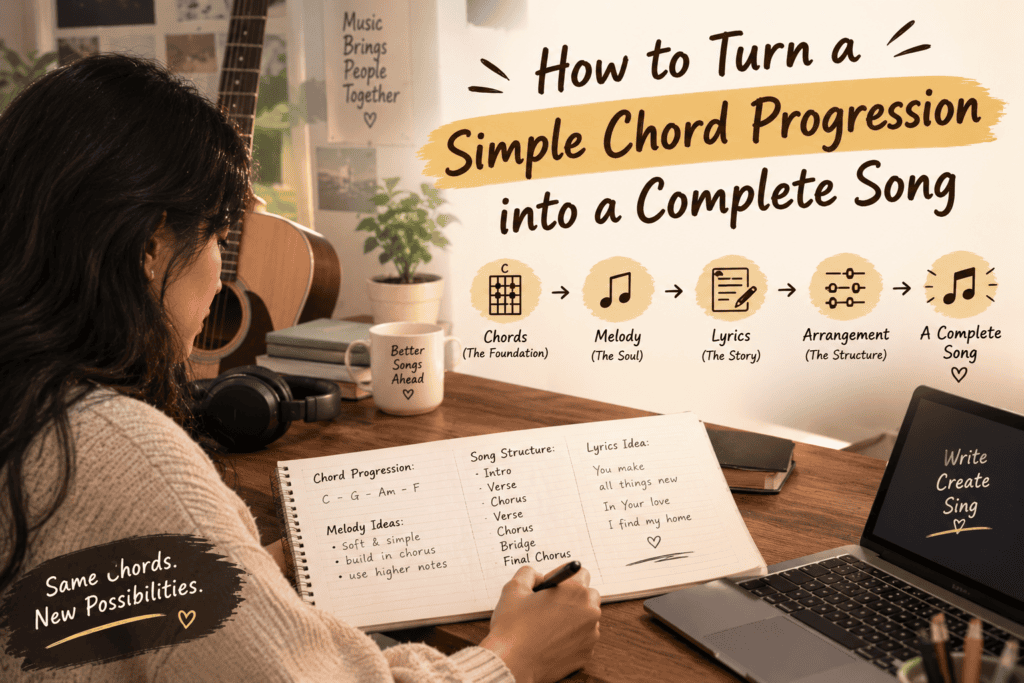
How to Turn a Simple Chord Progression into a Complete Song
Introduction
Learning how to turn a simple chord progression into a complete song is an important step for beginner musicians, guitarists, pianists, and aspiring songwriters. You may already know a few chords that sound good together, but turning them into a full song requires melody, rhythm, structure, lyrics, and musical expression.
The good news is that you do not need advanced music theory or complicated chords to write your first song. A simple progression can become the foundation for a memorable piece when you build on it creatively.
In this guide, we will explore how to develop a basic chord progression into a complete song, from choosing a progression and creating a melody to writing lyrics and arranging the final structure.

How to Turn a Simple Chord Progression into a Complete Song
The first step in learning how to turn a simple chord progression into a complete song is to understand that chords provide the harmonic foundation, not the entire composition.
For example, try this common four-chord progression in C major:
C – G – Am – F
These chords can work well for pop, acoustic, worship, and singer-songwriter styles. Play them slowly on a guitar or piano and listen to how they create movement and emotion.
Once you are comfortable with the progression, begin experimenting with rhythm, melody, and arrangement. You can keep the same chords throughout the song while changing how they are played in different sections.
1. Choose a Simple Chord Progression for Your Song
A strong song can begin with just three or four chords. Instead of searching for a complicated progression, choose one that feels natural and inspires a musical idea.
Here are three progressions to try:
C – G – Am – F: A versatile progression for pop and acoustic songs.
G – D – Em – C: A comfortable option for many guitar-based songs.
Am – F – C – G: A progression that can create a more reflective or emotional mood, depending on the melody and arrangement.
Play each progression several times and notice which one matches the feeling you want to communicate.
You can also experiment with tempo, strumming patterns, and chord inversions to give a familiar progression your own character.
2. Create a Memorable Melody Over Your Chords
Once you have chosen your progression, the next step is to develop a melody.
A melody is the sequence of notes that listeners often remember and sing after hearing a song. It can be created with your voice, guitar, piano, or another instrument.
To begin:
Hum different notes over the chords.
Record any short musical ideas you like.
Repeat a phrase and change its ending.
Experiment with higher and lower notes to create contrast.
You do not need to create a complicated melody. A simple phrase with a clear rhythmic pattern can be memorable when it fits the harmony and communicates the intended emotion.
Tip: Record your humming on your phone. This allows you to revisit ideas before you forget them.
3. Turn a Chord Progression into a Verse and Chorus
A complete song usually needs some form of structure. The verse introduces ideas, while the chorus often contains the main musical or lyrical message.
A beginner-friendly structure is:
Intro
Verse 1
Chorus
Verse 2
Chorus
Bridge
Final chorus
Outro
You do not have to use every section. Short songs can work well with just a verse and chorus.
To create contrast, try playing the same chord progression differently in each section. For example, use gentle picking in the verse and fuller strumming in the chorus.
The harmony can remain the same while the song develops through changes in melody, rhythm, dynamics, and instrumentation.
4. Write Lyrics That Match the Chord Progression
If you want to write a song with lyrics, begin with a central idea or emotion.
Your song might be about love, hope, friendship, personal growth, faith, or a meaningful experience. Choosing one main theme helps the lyrics feel connected rather than random.
Try this simple process:
Write one sentence describing what the song is about.
Turn that sentence into a short lyrical phrase.
Sing the phrase over your chord progression.
Adjust the words to fit the rhythm naturally.
Develop the verse and chorus around the central idea.
The verse can tell a story or describe a situation, while the chorus communicates the main message.
Avoid forcing too many words into a musical phrase. Natural phrasing and clear language often make lyrics more effective.
5. Develop the Rhythm and Groove
The same chords can sound completely different when played with different rhythms.
For example, a C–G–Am–F progression could become a gentle acoustic ballad, an upbeat pop song, or a contemporary worship arrangement simply by changing the tempo and rhythmic feel.
Experiment with:
Fingerpicking patterns.
Syncopated rhythms.
Piano arpeggios.
Rhythmic accents on selected beats.
Start with one pattern that feels comfortable. Once the song begins to take shape, decide whether a different rhythm would improve a particular section.
Consistency is useful, but small rhythmic variations can keep the arrangement interesting.

6. Add Dynamics to Make Your Song More Expressive
Dynamics refer to changes in musical intensity and volume. They help prevent a song from sounding the same from beginning to end.
Try building your arrangement gradually:
Intro: Start with a single instrument or a soft version of the progression.
Verse: Keep the arrangement relatively simple so the melody and lyrics remain clear.
Chorus: Add stronger strumming, fuller chords, or additional instruments.
Bridge: Change the intensity, texture, or harmonic movement to create contrast.
Final chorus: Bring the main musical idea back with a suitable sense of resolution.
Outro: End with a clear final phrase or a gentle fade in the arrangement.
These are suggestions, not fixed rules. Choose dynamics that support the mood of your song.
7. Add a Bass Line and Supporting Instruments
After establishing the chords, melody, and structure, you can begin arranging the song.
The bass line often reinforces the harmonic foundation and connects the rhythm section. Drums or percussion can establish the groove, while piano, guitar, pads, or other instruments add texture.
If you are working alone, you can build the arrangement one part at a time.
For example:
Guitar or piano plays the chords.
Bass follows the harmonic movement.
Percussion adds a steady pulse.
A second instrument adds melodic fills.
Background vocals support selected phrases.
Start with only the parts that improve the song. Adding too many instruments can make the arrangement crowded, especially while the core melody is still developing.
8. Use a Bridge to Add Variety
A bridge can introduce a new perspective, create tension, or prepare the listener for the final chorus.
It does not always need completely different chords. You could use a different progression, change the rhythm, introduce a new melody, or reduce the arrangement before building back up.
For example, if your verses and choruses use C–G–Am–F, you could experiment with Am–F–C–G in the bridge. This changes the harmonic starting point while retaining familiar chords.
Listen to whether the bridge adds something meaningful. If it interrupts the song without improving it, a shorter bridge—or no bridge at all—may work better.
9. Record a Demo and Refine Your Song
Once you have a basic structure, record a rough demo. You do not need professional recording equipment to get started.
A phone recording or a simple music production application can help you evaluate the song as a whole.
When listening back, ask yourself:
Is the melody easy to remember?
Does the chorus feel distinct from the verse?
Do the lyrics sound natural?
Is the tempo appropriate?
Are any sections too repetitive?
Does every instrument contribute something useful?
Make a few focused changes at a time rather than trying to perfect everything immediately.
A simple demo helps you identify problems that may be difficult to notice while playing.
Common Mistakes to Avoid When Turning Chords into a Song
When learning how to develop a progression into a complete composition, avoid these common mistakes:
Repeating the same section without variation: Introduce contrast through melody, rhythm, dynamics, or instrumentation.
Adding too many chords too soon: Focus on developing a strong musical idea before making the harmony more complex.
Ignoring the melody: Chords alone may not provide the memorable hook that makes a song stand out.
Writing lyrics that do not fit the rhythm: Adjust the words to suit the natural phrasing of the melody.
Overcomplicating the arrangement: Give each instrument a clear purpose.
Skipping the recording stage: A demo can reveal issues that are easy to miss during practice.
Remember that songwriting is a process. Your first version does not need to be perfect.
A Simple Practice Exercise for Beginner Songwriters
Use this exercise to put the steps into practice.
Step 1: Choose the progression C–G–Am–F.
Step 2: Play it four times using a comfortable rhythm.
Step 3: Hum a short melody over the progression and record it.
Step 4: Create a verse using a quieter playing style.
Step 5: Develop a chorus with a more memorable melody and fuller dynamics.
Step 6: Write a few lines of lyrics based on one central idea.
Step 7: Record the complete draft and listen for sections that need improvement.
By completing this exercise, you can begin turning a basic harmonic idea into an original musical composition.

How The Mystic Keys Helps You Develop Your Musical Creativity
At The Mystic Keys, students can develop the instrumental skills and musical understanding that support songwriting. Learning piano or guitar can help musicians explore chord progressions, rhythm patterns, melodies, and accompaniment techniques.
With structured guidance and consistent practice, learners can become more confident experimenting with musical ideas and developing their own compositions.
Explore online guitar lessons at The Mystic Keys to build your guitar skills and musical confidence.
Conclusion
Learning how to turn a simple chord progression into a complete song starts with a few chords and a willingness to experiment. By adding a memorable melody, meaningful lyrics, a clear structure, and thoughtful dynamics, you can transform a basic musical idea into a complete composition.
You do not need advanced theory or complicated arrangements to begin writing. Start with a progression you enjoy, record your ideas, and improve your song one section at a time.
A great song does not need complicated chords. It needs a musical idea worth sharing.
For more information and exciting resources about learning music, visit our website at The Mystic Keys. For more music content and exciting offers follow us on
Facebook, Instagram, YouTube, LinkedIn, Twitter, Pinterest, and Threads