Trinity Grade 1 Exam: Syllabus, Pieces & Preparation Guide
Introduction
The Trinity Grade 1 Piano Exam is an exciting milestone for beginners who have developed their basic piano skills and are ready to take their first graded music examination. It helps students build confidence, improve their playing technique, and develop a stronger understanding of music through structured learning and performance.
At this level, students begin exploring a wider range of piano pieces while developing essential skills such as finger coordination, rhythm, note recognition, and musical expression. Preparing for the examination involves more than learning a few compositions. Students must also practise scales, broken chords, technical exercises, and supporting musical activities.
Whether you are a young piano learner, an adult beginner, or a parent helping your child prepare, understanding the syllabus can make the learning process much easier.
This guide covers the Trinity Grade 1 Piano Exam syllabus, repertoire choices, technical requirements, supporting tests, marking structure, and practical preparation tips to help students approach their examination with confidence.
1. Understanding the Trinity Grade 1 Exam
Trinity College London offers graded piano examinations that allow students to measure their musical development through practical performance and technical assessment.
Grade 1 follows the Initial level and introduces students to more structured piano playing. At this stage, learners are expected to demonstrate basic musical control, accurate rhythm, familiarity with notation, and the ability to perform prepared pieces confidently.
The face-to-face Trinity Grade 1 Piano Exam includes three main components:
Three prepared piano pieces.
Technical work, including scales, broken chords, and exercises.
Two supporting tests selected by the candidate.
The face-to-face examination lasts approximately 11 minutes.
Students do not need to be advanced pianists to take this examination. It is designed to recognise developing musical abilities and encourage learners to continue progressing through their piano education.
2. Trinity Grade 1 Exam Syllabus: What Students Need to Prepare
Understanding the syllabus is the first step towards effective examination preparation.
The face-to-face examination assesses three important areas.
A. Three Prepared Piano Pieces
Students must perform three pieces selected from the official Trinity Grade 1 repertoire list.
The repertoire includes music from different composers and musical styles, allowing beginners to explore different rhythms, melodies, and performance techniques.
Students may choose a maximum of one duet as part of their programme. They can also perform their own composition instead of one listed piece, provided it meets Trinity’s requirements.
B. Technical Work
Technical work helps students develop the fundamental skills needed to play piano pieces accurately and confidently.
For Grade 1, students must prepare:
Scales.
Broken chords.
Three technical exercises, one from each group.
Candidates should prepare all the required sections because the examiner selects the scales and broken chords during the examination.
C. Supporting Tests
Students must choose two supporting tests from the following four options:
Sight reading.
Aural.
Improvisation.
Musical knowledge.
These tests help assess a student’s understanding of music beyond memorised performances.
3. Trinity Grade 1 Exam Pieces: Choosing the Right Repertoire
Repertoire is an important part of the examination because it allows students to demonstrate their developing piano skills through prepared performances.
The official Grade 1 repertoire list offers a variety of pieces from classical music, contemporary compositions, popular songs, and other musical styles.
Examples of Grade 1 Piano Pieces
Here are some examples from Trinity’s published Grade 1 repertoire list:
| Composer | Piece |
|---|---|
| Barbara Arens | Grumpy Gorilla |
| Barbara Arens | Hug a Pug |
| Mike Batt, arr. Amit Anand | Nine Million Bicycles |
| Ludwig van Beethoven | Russian Folk Song |
| Melody Bober | Stealth Mode |
| Jeremiah Clarke | King William’s March |
| Sam Cleaver | Railbird Rag |
| Anton Diabelli | Bagatelle |
| José Fernández Diaz, arr. Alex Wilson | Guajira Guantanamera |
| Sia, arr. Chris Hussey | Titanium |
These are examples rather than a complete list. Students should consult Trinity’s official Grade 1 repertoire page to explore all available selections and check the correct editions.
How to Choose the Best Piano Pieces for Grade 1
Selecting suitable pieces can make preparation more enjoyable and productive.
1. Choose pieces that match your current ability
Beginners should select compositions that are challenging enough to encourage improvement without being too difficult to manage.
2. Explore different musical styles
Choose pieces with contrasting moods and rhythms. This helps students demonstrate versatility and become familiar with different musical characteristics.
3. Focus on rhythm and accuracy
At Grade 1, maintaining a steady beat and playing the correct notes are essential. Choose pieces that allow you to develop these skills.
4. Select music you enjoy
Enjoyment makes regular practice more motivating. Students are often more enthusiastic when they connect with the music they are learning.
5. Discuss your choices with your teacher
A piano teacher can help you select suitable repertoire based on your technical ability, learning progress, and musical interests.
Can Students Perform Their Own Composition?
Yes. Trinity allows Grade 1 candidates to perform their own composition instead of one listed repertoire piece.
The composition should last approximately one minute and demonstrate a level of technical and musical difficulty comparable to the official Grade 1 pieces.
Suitable musical features include:
Dynamic contrast.
Use of keys included in the Grade 1 technical syllabus.
This option gives students an opportunity to explore their creativity while demonstrating their understanding of basic musical ideas.
4. Trinity Grade 1 Exam Scales
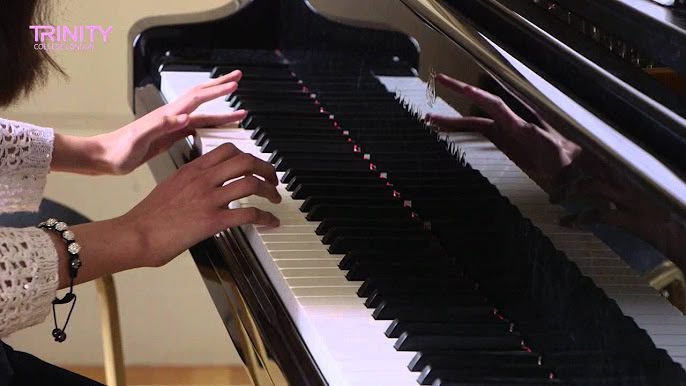
Scales are an essential part of the Trinity Grade 1 Piano Exam. They help beginners develop finger independence, familiarity with different keys, and better control over their instruments.
Students must prepare the following scales:
F major.
G major.
D minor (natural, harmonic, or melodic).
E minor (natural, harmonic, or melodic).
Chromatic scale in contrary motion starting on D.
C major contrary motion scale.
Scale Requirements
| Scale | Hands | Range |
|---|---|---|
| F and G major | Separately | One octave |
| D and E minor | Separately | One octave |
| Chromatic scale starting on D | Together | One octave |
| C major contrary motion | Together | One octave |
The required scales are performed:
From memory.
Legato.
At a minimum tempo of crotchet = 70.
At mezzo-forte.
For the D and E minor scales, students can choose either natural, harmonic, or melodic minor.
How to Practise Grade 1 Scales
Scales may seem challenging when students first begin learning them, but regular practice can make them easier.
Here are some useful tips:
Learn the correct fingering for each scale.
Practise slowly before increasing speed.
Keep your fingers relaxed.
Focus on playing each note clearly.
Practise hands separately where required.
Repeat difficult sections until the movement feels comfortable.
Students should aim for accuracy and consistency rather than trying to play as quickly as possible.
5. Trinity Grade 1 Exam Broken Chords
Along with scales, students must prepare broken chords as part of their technical work.
Broken chords involve playing the notes of a chord individually rather than simultaneously. They help students understand basic harmony and develop finger coordination.
Required Broken Chords
Students must prepare:
F major.
G major.
D minor.
E minor.
Broken Chord Requirements
The Grade 1 broken chords are performed:
From memory.
For one octave.
Hands separately.
Legato.
At mezzo-forte.
At a minimum tempo of dotted crotchet = 50.
Using triplet patterns.
The examiner selects the required broken chord during the examination.
Tips for Practising Broken Chords
Students can improve their broken chord technique by:
Learning the notes that form each chord.
Practising the movement slowly.
Maintaining an even rhythm between notes.
Using the correct fingering.
Paying attention to smooth transitions.
Gradually increasing speed while maintaining accuracy.
Understanding broken chords also helps students recognise chord patterns when learning new piano pieces.
6. Technical Exercises for the Trinity Grade 1 Exam
Students must also prepare three technical exercises, with one selected from each of the three groups.
These exercises focus on different aspects of piano playing and help develop the physical and musical skills needed for performance.
Group 1: Tone, Balance and Voicing
This group focuses on developing control over sound quality and balance between musical notes.
The available exercises are:
Sunny Afternoon.
Good Morning.
Wanderer.
Stepladder.
Students learn to produce an even tone and understand how different notes can be played with appropriate emphasis.
Group 2: Coordination
Coordination exercises help students develop better control over their hands and fingers.
The available exercises are:
Walk and Whistle.
Country Estate.
Ironing Out.
Footsteps.
These exercises encourage learners to maintain steady timing and coordinate different movements while playing.
Group 3: Finger and Wrist Strength and Flexibility
This group focuses on developing comfortable hand movement, finger strength, and wrist flexibility.
The available exercises are:
Thoughtful Mood.
At the Market.
Echo Chamber.
Snakes and Ladders.
Students should focus on relaxed movement, accurate notes, and consistent playing.
How Are Technical Exercises Assessed?
Students prepare one exercise from each group.
During the examination, candidates choose one exercise to perform first. The examiner then selects one of the remaining two prepared exercises.
This means students should practise all three groups rather than concentrating on only one favourite exercise.
7. Supporting Tests in the Trinity Grade 1 Exam
Supporting tests assess musical skills beyond prepared repertoire and technical work.
At Grade 1, students choose two from four available options.
A. Sight Reading
Sight reading involves performing a short piece of music that the student has not practised beforehand.
Candidates receive 30 seconds of preparation time before performing an unfamiliar musical extract at a level below the examination grade.
Students should focus on:
Recognising notes on the musical staff.
Identifying the time signature.
Understanding simple rhythms.
Observing the direction of the melody.
Maintaining a steady beat.
Continuing confidently if a small mistake occurs.
Regular sight-reading practice helps students become more comfortable with unfamiliar music and improves their ability to read musical notation.
B. Aural Tests
Aural tests assess a student’s ability to listen carefully and recognise musical characteristics.
For Grade 1, students may be asked to complete activities involving:
Pulse and rhythm: Listen to a short melody and clap the pulse while emphasising the strong beat.
Dynamics: Identify whether the music is played forte or piano.
Articulation: Recognise whether the notes are played legato or staccato.
Pitch recognition: Identify whether the final note is higher or lower than the first note.
Musical changes: Listen to a melody played twice and identify where a change in pitch or rhythm occurs.
Students can develop these skills by listening to different types of music and practising simple rhythm and pitch recognition activities.
C. Improvisation
Improvisation allows students to create their own music in response to a musical idea provided during the examination.
Candidates can choose from three approaches:
Stylistic improvisation.
Motivic improvisation.
Harmonic improvisation.
At Grade 1, students should be able to respond to a simple musical stimulus using both hands.
They can practise by creating short melodies, experimenting with rhythms, and exploring simple musical patterns.
Improvisation encourages creativity and helps students become more confident when exploring music independently.
D. Musical Knowledge
Musical knowledge assesses how well students understand their prepared pieces and basic musical notation.
Questions are based on the pieces performed during the examination.
Students should become familiar with:
Note names.
Musical symbols.
Notes and rests.
Basic time signatures.
Dynamics.
Musical terms and signs.
Notes on ledger lines.
For example, students may be asked to identify a note value, explain the meaning of a time signature, or describe a musical instruction such as da capo.
Understanding these concepts helps students become more independent musicians.
8. How the Trinity Grade 1 Exam Is Marked
Understanding the marking structure can help students prepare more effectively and understand the importance of each examination component.
The face-to-face Grade 1 examination is marked out of 100.
| Examination component | Maximum marks |
|---|---|
| Piano piece 1 | 22 |
| Piano piece 2 | 22 |
| Piano piece 3 | 22 |
| Technical work | 14 |
| Two supporting tests | 20 |
| Total | 100 |
Each prepared piece contributes 22 marks, making repertoire performance a significant part of the final result.
The technical work is worth 14 marks, while the two supporting tests share 20 marks.
Students should therefore avoid concentrating only on their prepared pieces. Regular practice across all examination components can help create a balanced performance.
What Do Examiners Look For?
Examiners assess different aspects of a student’s performance, including:
Accuracy of notes.
Rhythm and timing.
Appropriate tempo.
Finger control.
Consistency.
Musical expression.
Understanding of dynamics.
Confidence and continuity.
At Grade 1, students are still developing their musical abilities. The goal is to demonstrate a clear understanding of the music and perform with confidence.
9. How to Prepare for the Trinity Grade 1 Exam
A structured preparation routine can make learning easier and help students feel more confident as the examination approaches.
Step 1: Understand the Complete Syllabus
Begin by reviewing the official Grade 1 syllabus.
Make a checklist of the three repertoire pieces, scales, broken chords, technical exercises, and supporting tests.
This helps students understand what needs to be prepared and prevents important sections from being overlooked.
Step 2: Create a Daily Practice Routine
Avoid practising only the prepared pieces. Divide practice time between different areas of the syllabus.
For example:
| Practice activity | Suggested time |
|---|---|
| Repertoire pieces | 15 minutes |
| Scales and broken chords | 10 minutes |
| Technical exercises | 10 minutes |
| Supporting tests | 10 minutes |
| Revising difficult sections | 5 minutes |
This is a flexible example. Practice duration can be adjusted depending on the student’s age, concentration, and progress.
Step 3: Practise Difficult Sections Separately
Some passages may require more attention than others.
Instead of repeatedly playing an entire composition, identify the difficult sections and practise them slowly.
Focus on:
Correct notes.
Fingering.
Rhythm.
Hand coordination.
Dynamics.
Smooth transitions.
Once these passages become easier, practise connecting them with the rest of the piece.
Step 4: Develop Musical Expression
Students should learn to play their pieces with appropriate musical expression.
Pay attention to dynamics, articulation, phrasing, and the overall mood of each composition.
Understanding these elements helps students move beyond simply playing the correct notes.
Step 5: Practise Supporting Tests Regularly
Sight reading, aural skills, improvisation, and musical knowledge should be part of the preparation routine.
Students should practise their chosen supporting tests consistently rather than leaving them until the final weeks.
Step 6: Arrange Mock Examinations
Mock examinations help students become familiar with the examination process.
Ask your teacher to organise practice sessions that include:
Performing all three prepared pieces.
Completing scales and broken chords.
Performing technical exercises.
Completing the two selected supporting tests.
This helps students develop confidence and become more comfortable performing under examination conditions.
10. Common Mistakes to Avoid During Grade 1 Exam Preparation
Beginners sometimes make mistakes that can affect their progress and confidence.
Here are some common issues to avoid.
1. Practising only the prepared pieces
Repertoire is important, but technical work and supporting tests also contribute to the final result.
2. Rushing through scales
Playing scales too quickly without correct fingering can lead to mistakes. Begin slowly and focus on accuracy.
3. Ignoring musical notation
Students should understand the notes, rhythms, and musical symbols in their pieces rather than relying entirely on memorisation.
4. Leaving supporting tests until the last minute
Sight reading, aural skills, improvisation, and musical knowledge require regular practice.
5. Practising without a routine
A structured schedule helps students manage their time and make steady progress.
6. Avoiding feedback
A piano teacher can identify mistakes, explain difficult concepts, and recommend ways to improve technique and performance.
Avoiding these habits can make preparation more productive and enjoyable.
11. How Long Does It Take to Prepare for Trinity Grade 1 Exam?
The time required to prepare for the Trinity Grade 1 Piano Exam varies depending on the student’s previous experience, practice routine, and learning speed.
Trinity’s published guidance gives Grade 1 an estimated total qualification time of 60 hours, including:
12 guided learning hours.
48 independent learning hours.
These figures are general learning estimates rather than a fixed preparation period.
Some students may become comfortable with the syllabus more quickly, while others may need additional time to develop their technical skills and performance confidence.
The most important factor is regular, focused practice rather than rushing to complete the examination.
12. Face-to-Face and Digital Trinity Grade 1 Exams
Trinity offers different examination formats, allowing candidates to choose an assessment option that suits their learning and performance preferences.
Face-to-Face Examination
In the face-to-face format, students perform directly for an examiner.
The examination includes:
Three prepared pieces.
Technical work.
Two supporting tests selected by the candidate.
This format gives students the opportunity to experience performing in an examination environment.
Digital Technical Work Pathway
The digital technical work pathway involves submitting a recorded performance of the required repertoire and technical work.
Candidates prepare either Set A or Set B of the scales and broken chords, along with the required technical exercises. The detailed requirements should be checked in the digital syllabus.
Digital Repertoire-only Pathway
Students who prefer to focus entirely on performance can choose the Repertoire-only pathway.
This pathway requires four prepared pieces instead of the usual three-piece face-to-face programme. It does not include the separate technical work and supporting tests used in the face-to-face examination.
Students should review the current digital examination instructions before selecting their preferred format.
How The Mystic Keys Helps Students Prepare for the Trinity Grade 1 Piano Exam
At The Mystic Keys, we believe that every student’s musical journey should begin with the right guidance and encouragement. Our online piano lessons help beginners develop essential skills such as note reading, finger coordination, rhythm, scales, and musical expression. With personalised instruction from experienced music educators, students receive structured guidance on learning examination pieces, practising technical exercises, and developing confidence in their performance. Whether you are preparing for the Trinity Grade 1 Piano Exam or taking your first steps towards learning the piano, The Mystic Keys provides a supportive learning environment that encourages consistent progress and a genuine love for music.
Conclusion
The Trinity Grade 1 Piano Exam is an excellent opportunity for beginners to demonstrate their developing musical skills and build confidence as pianists.
From selecting suitable repertoire to learning scales, broken chords, technical exercises, and supporting tests, every part of the syllabus contributes to a stronger musical foundation.
The key to successful preparation is consistency, patience, and a clear understanding of the examination requirements. Students should practise regularly, work closely with their teachers, and focus on improving one skill at a time.
With the right guidance and preparation, Grade 1 can become a rewarding first step towards further musical development.
For more information and exciting resources about learning music, visit our website at The Mystic Keys. For more music content and exciting offers follow us on
Facebook, Instagram, YouTube, LinkedIn, Twitter, Pinterest, and Threads,