

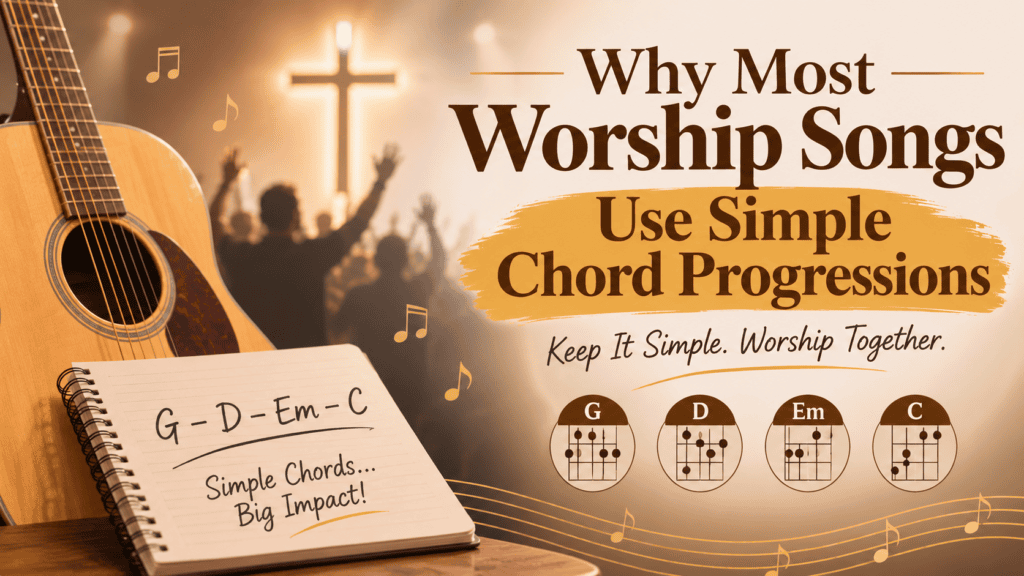
Why Most Worship Songs Use Simple Chord Progressions
Introduction
Worship music is often recognised for its powerful lyrics, emotional melodies, and ability to bring people together. One interesting feature of many popular worship songs is their use of simple chord progressions. Whether it is a quiet acoustic worship song or a powerful congregational anthem, many worship songs rely on a small number of chords repeated throughout the composition.
But why do worship songs use simple chord progressions when musicians have access to countless chords, complex harmonies, and advanced musical techniques?
The answer goes beyond musical convenience. Simple chord progressions make worship music easier to follow, sing, play, and connect with emotionally. They allow musicians and congregations to focus on the message of the song rather than getting distracted by complicated musical arrangements.
In this blog, we will explore why simple chord progressions are so common in worship music, how they support congregational singing, and how musicians can use them creatively without making their arrangements sound repetitive.

1. Simple Chord Progressions Make Congregational Singing Easier
One of the primary purposes of worship music is to encourage people to sing together. Unlike a solo performance, congregational worship involves people with different musical backgrounds, vocal abilities, and levels of confidence.
Simple chord progressions in worship songs create a predictable musical foundation that helps people follow the melody and lyrics.
When the harmony remains relatively consistent, singers can concentrate on expressing the words instead of trying to navigate unexpected musical changes. This makes songs more accessible, especially for people who do not have formal musical training.
For example, a progression such as G–D–Em–C is widely used in contemporary worship music because it creates a familiar and pleasant harmonic movement. Once musicians and singers become comfortable with it, they can focus more on the message and emotional delivery of the song.
2. Simple Chord Progressions Help Keep the Focus on the Lyrics
Worship songs are often written around meaningful lyrics that communicate faith, gratitude, hope, surrender, and devotion.
In this context, the music serves the message. While complex harmonies can be beautiful, excessive musical changes may sometimes draw attention away from the words being sung.
Simple chord progressions provide a stable musical background that allows lyrics to remain at the centre of the experience.
For example, during a reflective worship song, repeating a gentle four-chord progression can create space for the congregation to absorb the meaning of each line. The arrangement does not need constant harmonic changes to create an emotional impact.
This does not mean worship music should lack musical depth. Instead, it demonstrates how thoughtful simplicity can make a song more meaningful.
3. Familiar Chord Progressions Create an Emotional Connection
Music has a powerful relationship with human emotions. Certain chord movements can create feelings of anticipation, comfort, resolution, and excitement.
Many worship songs use familiar harmonic patterns because listeners can connect with them naturally. Progressions such as I–V–vi–IV and vi–IV–I–V appear frequently in contemporary popular music, including worship arrangements.
In the key of C major, the I–V–vi–IV progression becomes:
C major (I)
G major (V)
A minor (vi)
F major (IV)
This progression moves between moments of stability and emotional tension before returning to a familiar harmonic centre.
Because listeners often recognise these patterns, the music can feel accessible and inviting. The emotional connection comes not only from the chords themselves but also from the melody, lyrics, dynamics, tempo, and arrangement.

4. Simple Chord Progressions Make Worship Music Easier to Learn
Worship teams often include musicians with different levels of experience. Some may have years of musical training, while others may still be learning basic chords and rhythms.
Using simple chord progressions makes it easier for beginners to participate in a worship team.
A pianist learning basic triads, a guitarist practising open chords, or a beginner bassist learning root notes can all contribute to a song built around a straightforward harmonic structure.
For example, a beginner guitarist may start by learning G, D, Em, and C. With these four chords, they can accompany many contemporary worship arrangements.
As their skills develop, they can explore:
Chord inversions
Arpeggios and broken chords
Passing chords
More expressive rhythmic patterns
The simplicity of the progression provides a starting point, not a limitation.
5. Repetition Helps Create a Strong Worship Atmosphere
Repetition is a common feature of worship music. Many songs repeat a chorus, bridge, or particular lyrical phrase to allow the congregation to engage more deeply with the message.
Simple chord progressions support this structure by providing a consistent harmonic foundation.
When a progression repeats, musicians can gradually build the arrangement through changes in dynamics and instrumentation rather than introducing new chords every few bars.
For instance, a worship band might begin a song with soft piano chords, introduce acoustic guitar during the verse, and bring in drums and electric guitar during the chorus.
The chords may remain the same, but the musical experience becomes more powerful as the arrangement develops.
Repetition also helps worship leaders extend a section naturally when the congregation is engaged, without requiring complicated musical transitions.
6. Simple Chord Progressions Allow More Room for Musical Expression
A common misconception is that simple chords automatically result in simple music. In reality, a basic chord progression can support a surprisingly expressive arrangement.
When musicians are not occupied with constantly changing chords, they have more freedom to explore other musical elements.
Here are some ways to create variation while keeping the same progression:
Dynamics: Begin softly and gradually increase the intensity as the song develops.
Rhythm: Change from sustained chords to rhythmic strumming or syncopated patterns.
Melody: Add melodic fills between vocal phrases without interrupting the singer.
Instrumentation: Introduce piano, acoustic guitar, electric guitar, bass, and drums at different points.
Texture: Use chord inversions, arpeggios, and different playing techniques to create a fuller sound.
For example, a pianist can play simple block chords during the verse and switch to flowing arpeggios during the chorus. Similarly, a guitarist can use gentle picking in the introduction and fuller strumming when the song reaches its climax.
The progression stays familiar, but the arrangement continues to evolve.

7. Simple Progressions Help Worship Teams Stay Together
A worship band needs to work as a unit. The piano, guitar, bass, drums, and vocals must complement one another while maintaining a consistent tempo and musical direction.
Simple chord progressions make coordination easier, particularly when a team includes musicians with different levels of experience.
A clear harmonic structure allows each musician to understand where the song is going and anticipate upcoming changes.
For example:
The guitarist can add rhythmic support and atmospheric textures.
The bassist can follow the chord roots and create a steady foundation.
The drummer can support the song’s energy through carefully controlled rhythms.
The vocalist can focus on melody, phrasing, and lyrical expression.
When everyone understands the progression, the team can concentrate on listening to one another and creating a unified musical experience.
8. The Most Common Chord Progressions Used in Worship Music
Many contemporary worship songs use a small selection of familiar chord progressions. Understanding these patterns can help beginner musicians recognise how worship music is structured.
Here are four common examples:
I–V–vi–IV: A Popular Contemporary Progression
This progression is frequently heard in contemporary pop and worship music.
In the key of C major:
C – G – Am – F
It creates a familiar sense of movement and works well for verses and choruses.
vi–IV–I–V: A More Reflective Progression
In the key of C major:
Am – F – C – G
Beginning on the relative minor chord gives this progression a slightly different emotional character while retaining a familiar sound.
I–IV–V: A Classic and Straightforward Progression
In the key of G major:
G – C – D
This progression is simple, strong, and easy for beginners to understand. It is useful for learning basic harmonic movement and accompanying straightforward worship songs.
I–V–IV: A Simple Progression for Strong Melodies
In the key of G major:
G – D – C
This progression offers a direct harmonic foundation that can support memorable melodies and uncomplicated arrangements.
Note: These are common musical patterns, not rules that every worship song follows. Actual songs may use different keys, chord variations, and additional harmonic elements.
9. Do Simple Chord Progressions Make Worship Music Less Creative?
Not at all. Musical creativity is not measured by the number of chords in a song.
A composition can use only three or four chords and still sound beautiful, memorable, and emotionally powerful. Creativity often comes from how musicians arrange those chords and use other musical elements.
Consider two guitarists playing the same four-chord progression. One may use basic down-strumming throughout the song, while the other may incorporate fingerpicking, rhythmic variations, chord inversions, and melodic fills.
Although both musicians are playing the same chords, their arrangements can sound completely different.
The same principle applies to piano, drums, bass, and vocals. Musical expression comes from the choices musicians make, not simply from harmonic complexity.
10. How to Make Simple Worship Chord Progressions Sound More Interesting
If you are a worship musician, learning basic chord progressions is only the beginning. The next step is understanding how to make them sound more expressive while maintaining the simplicity of the original song.
Here are some practical techniques you can try:
Experiment with Chord Inversions
Instead of always playing chords in their root position, experiment with different inversions. This creates smoother transitions between chords and can make piano or guitar arrangements sound more polished.
Use Arpeggios Instead of Playing Every Chord Together
An arpeggio involves playing the individual notes of a chord one after another rather than simultaneously.
Pianists can use arpeggios during quieter sections, while guitarists can use fingerpicking patterns to create a softer atmosphere.
Pay Attention to Dynamics
Avoid playing every section at the same volume. Use softer dynamics during verses and gradually build intensity during choruses or bridges.
A well-controlled dynamic progression can make a simple arrangement feel powerful without adding unnecessary complexity.
Add Melodic Fills Carefully
Instrumental fills can add character between vocal phrases. Guitarists and pianists can introduce short melodic ideas that complement the melody.
However, avoid playing too much while someone is singing. The purpose of a fill is to support the song, not compete with the vocalist.
Listen to the Other Musicians
Good worship musicians understand the importance of space. If the piano is playing a busy pattern, the guitar can simplify its part. If the drums are building energy, the bass can provide a steady foundation.
Every instrument does not need to play continuously. Sometimes, playing less creates a stronger musical result.
11. Why Every Worship Musician Should Understand Basic Chord Progressions
Whether you play the piano, guitar, bass, or another instrument, understanding chord progressions is an essential musical skill.
It helps you recognise song structures, accompany singers, communicate with other musicians, and learn new songs more efficiently.
For beginner musicians, starting with simple progressions builds confidence and develops a strong understanding of harmony. More experienced musicians can use the same progressions as a foundation for exploring inversions, extended chords, transitions, and creative arrangements.
Most importantly, learning to play worship music is not only about reproducing chords. It is about understanding how music supports the message and atmosphere of a song.
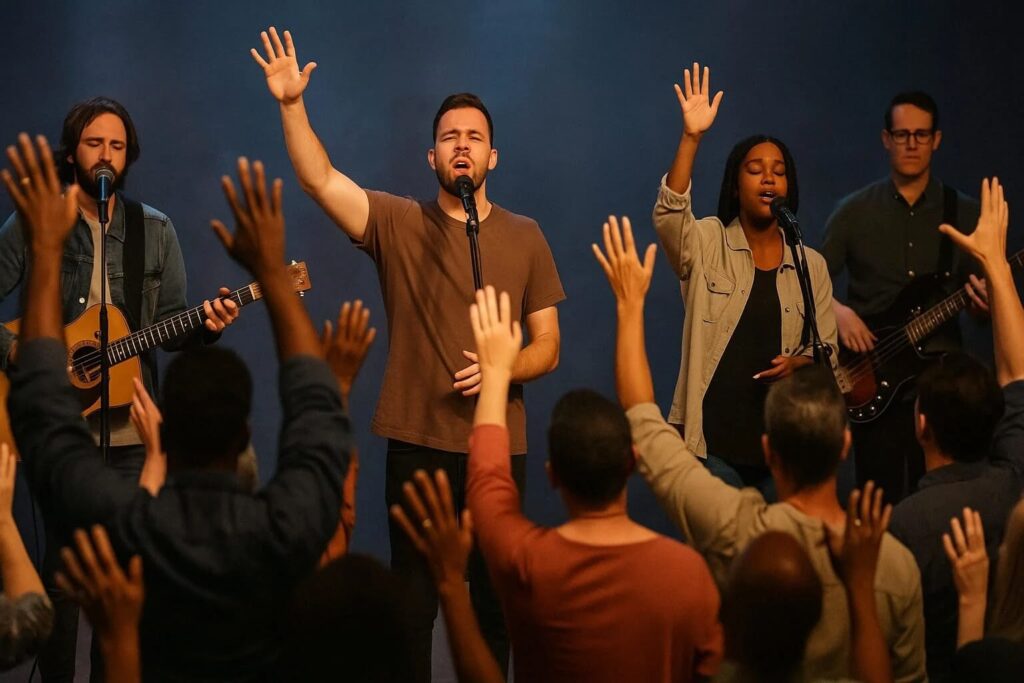
Learn Worship Music with The Mystic Keys
Understanding why worship songs use simple chord progressions can transform the way you approach playing in a worship band. Once you understand the foundation, you can begin exploring different rhythms, chord variations, dynamics, and arrangements.
At The Mystic Keys, students can develop their musical skills through structured online lessons designed around their learning goals. With guidance from internationally certified teachers, students can build a strong foundation in piano, keyboard, guitar, vocals, and other musical disciplines.
Whether you are a beginner learning your first worship chords or an experienced musician looking to improve your arrangements, developing a deeper understanding of music can help you become a more confident and expressive performer.
Start learning, practise consistently, and discover how even the simplest chords can create a meaningful musical experience.
The Mystic Keys supports musical growth through personalised online training, including Worship Piano & Singing Lessons Online, helping learners develop their skills, confidence, and musical expression.
Conclusion
Simple chord progressions are an essential part of what makes worship music accessible, meaningful, and engaging. They allow congregations to sing together, help musicians of different skill levels participate, and keep the focus on the message behind the music.
However, simplicity does not mean a lack of creativity. With thoughtful use of dynamics, rhythm, chord inversions, arpeggios, and instrumentation, musicians can transform even a basic progression into a beautiful and expressive arrangement.
Whether you are learning your first worship song or playing regularly with a worship band, understanding simple chord progressions can strengthen your musical foundation and improve the way you approach worship music.
Remember, great worship music is not about how many complicated chords you can play. It is about how effectively you use music to support the message, connect with others, and create a meaningful musical experience.
For more information and exciting resources about learning music, visit our website at The Mystic Keys. For more music content and exciting offers follow us on
Facebook, Instagram, YouTube, LinkedIn, Twitter, Pinterest, and Threads,