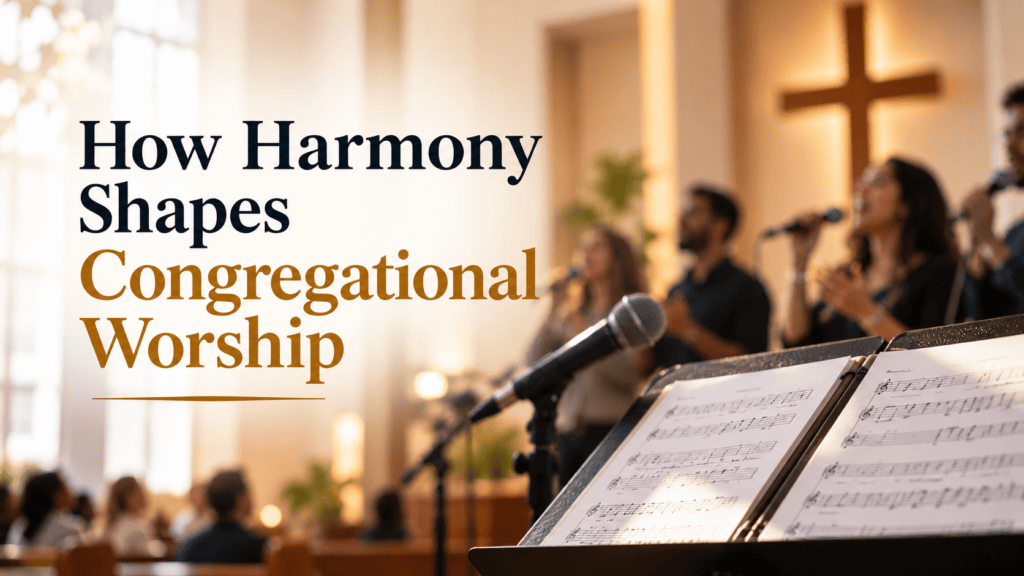
How Harmony Shapes Congregational Worship
Congregational worship harmony is the musical blending of different vocal parts to support a unified sound during church singing. While melody gives a song its familiar tune, harmony adds depth, warmth, and emotional colour. When singers and musicians work together thoughtfully, harmony can make familiar worship songs more meaningful without taking attention away from the message.
In a church setting, harmony is not simply about singing different notes correctly. It involves listening to one another, balancing vocal parts, understanding the song’s structure, and supporting the congregation’s ability to participate. Whether a church uses a simple melody, two-part singing, or a full choir arrangement, harmony can help create a shared musical experience.
The purpose is not to make every song complicated. Sometimes a simple melody is the most effective way to encourage congregational singing. The real value of harmony lies in how it supports the message, strengthens musical unity, and helps the congregation sing together.
How Congregational Worship Harmony Creates Unity

One of the most valuable qualities of congregational singing is that people with different voices, musical abilities, and backgrounds can participate in the same song.
Harmony reflects this unity musically. Different vocal parts may sing different notes, but they work together to support the same melody and message.
For example, a choir might divide into soprano, alto, tenor, and bass sections. Each section contributes its own part while remaining connected to the others. When these parts are balanced, the result is a unified sound rather than several independent performances.
This principle also applies to the congregation. Not everyone needs to sing harmony to participate meaningfully. A clear melody supported by appropriate instrumental and vocal arrangements can bring the whole church together.
The Role of Melody in Congregational Worship Harmony
Melody is usually the musical line that people recognise and sing most easily. Harmony supports that melody by adding complementary notes and creating a fuller musical texture.
For congregational singing, the melody must remain accessible. If harmony becomes too prominent or the arrangement is too complex, less experienced singers may struggle to follow the song.
Worship leaders should therefore make sure that the main melody remains clear, especially when introducing a new song.
Choirs and backing vocalists can support the melody by singing harmony in appropriate sections rather than competing with the congregation throughout the entire song.
How Harmony Adds Emotional Depth to Worship Songs

Harmony can influence how listeners experience a musical phrase.
A simple melody may sound intimate and reflective when supported by gentle chords. Fuller harmonies can create a sense of warmth, anticipation, or celebration. Changes in chord progression can also make a familiar lyric feel more expressive.
However, harmony should serve the meaning of the song rather than becoming a display of musical complexity.
A reflective song may benefit from a restrained arrangement, while a joyful congregational song may support a fuller vocal and instrumental sound. The choice depends on the lyrics, musical style, congregation, and purpose of the service.
Choosing the Right Harmony for Congregational Singing
Not every worship song needs multiple vocal parts.
When selecting a harmony arrangement, consider the congregation’s familiarity with the song, the skill level of the singers, the size of the choir, and the musical resources available.
A simple two-part harmony may be appropriate for a small worship team. A larger choir with experienced singers may be able to manage four-part arrangements.
The key is to choose an arrangement that enhances the song without making it difficult for the congregation to participate.
For unfamiliar songs, it may be better to begin with a clear melody and introduce additional harmony after the congregation becomes comfortable with the tune.
Congregational Worship Harmony and Vocal Balance

Good harmony depends on balance between the vocal parts.
If one section sings significantly louder than the others, the overall sound can become uneven. If every singer tries to dominate, the arrangement may lose clarity.
Singers should learn to listen beyond their own part. They need to hear the melody, recognise the other harmony lines, and adjust their volume to support the ensemble.
For example, alto singers may need to reduce their volume when their notes occupy a prominent part of the middle register. Bass singers may need to maintain a steady foundation without overpowering the other voices.
The objective is not for every part to sound equally loud at every moment. It is for each part to contribute appropriately to the musical whole.
How Choirs Support Congregational Worship Harmony
Church choirs can help strengthen congregational singing by providing a reliable musical foundation.
A choir can demonstrate the melody, support unfamiliar phrases, reinforce important lyrics, and add harmony during selected sections. Choir members can also help maintain confidence when the congregation is learning a new song.
However, the choir should remain aware of its role. If the arrangement becomes too elaborate, congregational participation may decrease.
The most effective choir arrangements often combine clear melodic leadership with carefully chosen harmony that enriches the music without overwhelming it.
The Importance of Listening When Singing Harmony

Singing harmony requires more than learning the correct notes.
A singer must listen to the other parts while maintaining their own pitch and rhythm. This can be challenging because another singer’s melody may be more familiar or easier to hear than the harmony line.
Regular listening exercises can help.
Singers can practise their individual parts with a piano, listen to recordings of the full arrangement, and gradually learn to maintain their notes while other parts are heard around them.
Rehearsing in small groups can also help singers develop independence and confidence.
How Musicians Support Vocal Harmony
Instrumentalists also influence the effectiveness of vocal harmony.
The piano, keyboard, guitar, and other instruments provide harmonic support through chords, rhythm, and musical transitions. Their role is to complement the singers rather than compete with them.
Keyboard players can choose chord voicings that leave space for the vocal parts. Guitarists can simplify strumming patterns when the lyrics need greater clarity. Drummers can adjust dynamics to support the congregation without making the arrangement feel overpowering.
Good musical support requires listening and flexibility. The musicians should respond to the singers and the needs of the congregation rather than playing at maximum intensity throughout the song.
Using Chord Progressions to Strengthen Worship Harmony

Chord progressions provide the harmonic foundation of most worship songs.
Common progressions can create a sense of stability, movement, anticipation, or resolution. Understanding these patterns helps singers and musicians recognise how the music develops.
For example, a familiar progression may support a verse, while a different progression introduces a chorus or bridge. The harmonic movement can help distinguish the sections and reinforce the song’s emotional direction.
Worship musicians should understand the chords being played, but they should also pay attention to how those chords support the melody.
More complicated chords are not automatically better. The most appropriate progression is the one that supports the song’s character and allows the congregation to sing comfortably.
Musical Dynamics
Harmony becomes more expressive when combined with thoughtful dynamics.
A song might begin with a single voice or a simple melody, gradually introduce additional vocal parts, and then move into a fuller chorus. Later, the arrangement may become quieter to create space for reflection.
These changes can help shape the musical experience without requiring complicated arrangements.
Worship leaders should plan dynamic changes with the singers and musicians so that everyone understands when to build, reduce intensity, or return to a simpler texture.
The result should feel natural and connected to the message of the song.
Common Mistakes When Arranging Worship Harmony

Several common mistakes can reduce the effectiveness of harmony in congregational singing.
Overcomplicating the arrangement: Too many vocal parts can make a song difficult for the congregation to follow.
Ignoring vocal ranges: Singers may struggle when their parts consistently sit too high or too low.
Poor balance: One section may overpower the others.
Insufficient rehearsal: Singers may become uncertain about entrances, notes, and transitions.
Weak melodic clarity: The congregation may lose track of the main tune.
Excessive instrumental volume: Instruments may make the lyrics and vocal parts difficult to hear.
Avoiding these problems begins with thoughtful song selection, suitable arrangements, and regular practice.
How to Practise Congregational Worship Harmony Effectively
A structured rehearsal approach can help singers develop confidence and accuracy.
Begin by learning the melody and understanding the lyrics. Next, practise the assigned harmony part slowly, using a piano or suitable reference recording where helpful.
Once the individual parts are comfortable, rehearse them together. Listen for pitch accuracy, rhythm, diction, and balance.
It is also useful to practise entrances and endings separately. These moments often require close coordination between singers and musicians.
Record rehearsals occasionally and listen to the overall sound. This can reveal balance issues or sections that need additional attention.
Most importantly, rehearse with the congregation in mind. The purpose of the arrangement is to support shared singing, not simply to demonstrate technical ability.
The Spiritual Purpose of Harmony in Congregational Worship

Music in worship serves more than an artistic purpose. It can help a congregation express shared faith, reflect on Scripture, and participate together in prayer and praise.
Harmony can reinforce this sense of togetherness by allowing different voices to contribute to one musical expression. Yet musical excellence alone does not define the value of worship.
The lyrics, intention, preparation, and attitude of the people leading the music all matter. Singers and musicians should approach their roles with humility, care, and respect for the congregation.
When musical decisions support the message rather than distract from it, harmony can become a meaningful part of the worship experience.
Final Thoughts
Worship harmony can enrich church singing by supporting the melody, creating musical depth, strengthening ensemble unity, and helping worship teams serve their congregations more effectively.
Its success does not depend on the number of vocal parts or the complexity of the arrangement. It depends on thoughtful song selection, clear melodic leadership, balanced voices, attentive listening, suitable dynamics, and a shared understanding of the song’s purpose.
At The Mystic Keys, singers and worship musicians can develop the practical skills needed for effective worship music, including vocal technique, harmony, chord knowledge, listening, ensemble coordination, and musical expression.
With regular practice and the right guidance, worship teams can learn to use harmony in ways that support congregational participation and create a more unified musical experience.
The most meaningful harmony is not simply a collection of notes that sound good together. It is music that brings different voices together in service of a shared message.
For more information and exciting resources about learning music, visit our website at The Mystic Keys. For more music content and exciting offers follow us on
Facebook, Instagram, YouTube, LinkedIn, Twitter, Pinterest, and Threads.