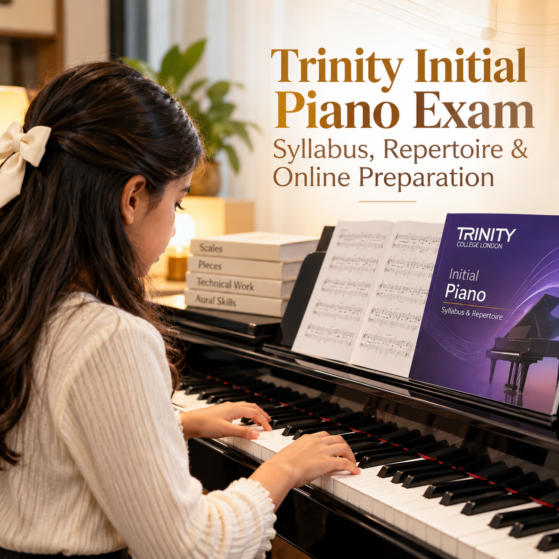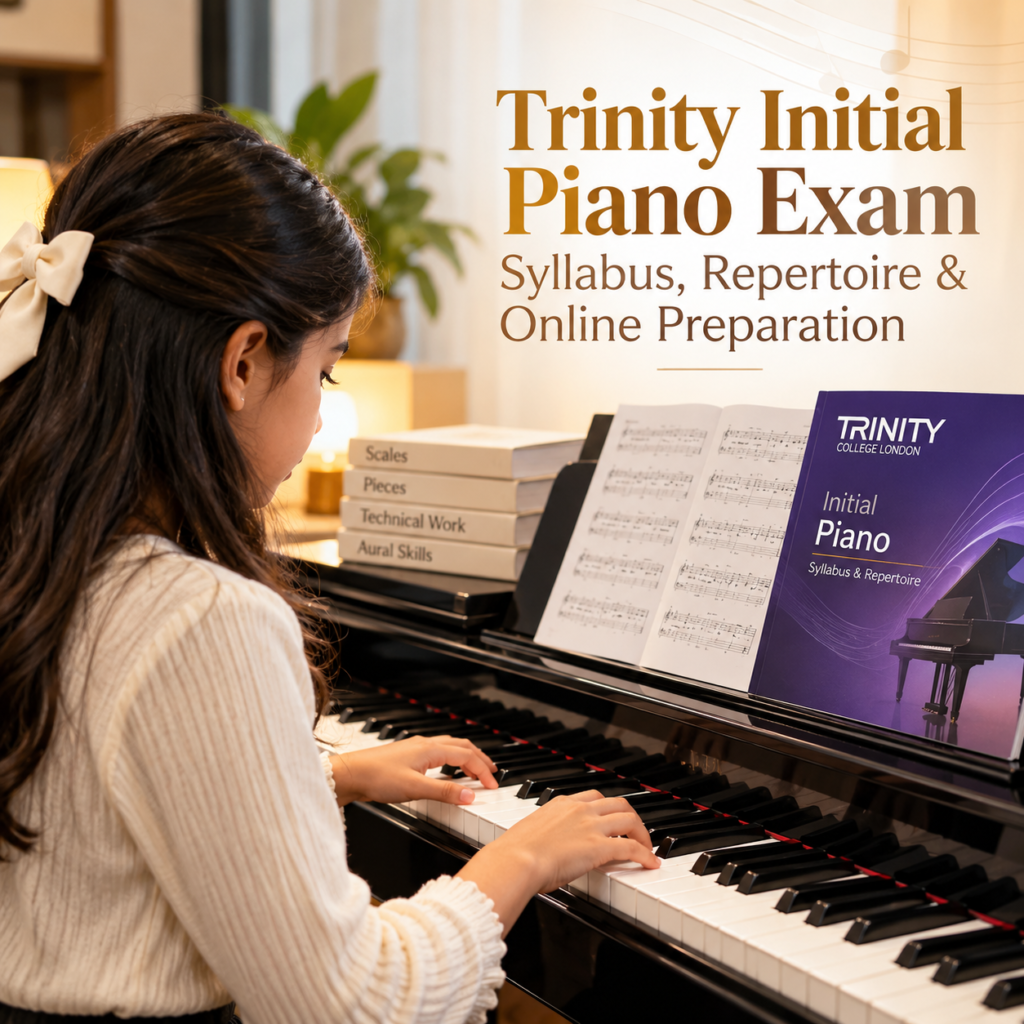
Trinity Initial Piano Exam | Syllabus, Repertoire & Online Prep
Starting a piano exam journey can feel like a big step, especially for a beginner. The Trinity Initial Piano exam gives new learners a structured and accessible introduction to graded music assessment. It allows students to demonstrate basic technique, musical understanding and performance skills in a supportive format.
The Initial level also gives beginners a clear goal. However, preparation involves more than memorising a few pieces. Students build good playing habits, develop confidence and learn how different musical elements work together.
Trinity College London offers a wide range of repertoire at the early levels. Students can explore different styles, including classical, contemporary, jazz, stage, screen and global influences. This variety keeps learning engaging while helping students develop a broader musical understanding.
With one-to-one online piano lessons, students can prepare for the exam from home. A teacher can provide personalised guidance, monitor progress and help each learner work towards the required skills at a comfortable pace.
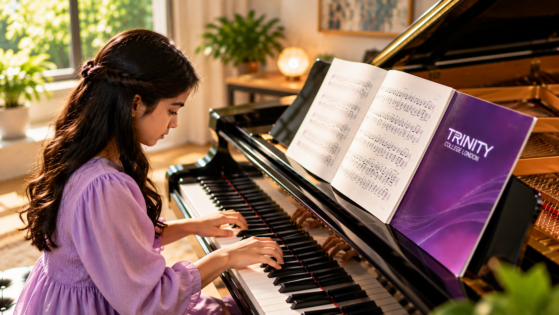
What Is the Trinity Initial Piano Exam?
The Trinity Initial Piano exam marks the starting point of Trinity’s graded piano pathway. It gives beginners an opportunity to work towards their first formal piano assessment while building essential playing skills.
At this level, students learn repertoire, scales, broken triads and technical exercises. The exam checks how well they can demonstrate the basic skills required at this stage. It does not expect advanced musicianship.
The Initial level also gives beginners a structured way to develop their musical abilities. Alongside learning pieces, students build skills in rhythm, articulation, dynamics, coordination and musical expression.
Trinity offers both face-to-face and digital assessment options. However, each format follows different technical requirements. Students should therefore identify their chosen assessment route early and prepare according to its specific requirements.
Understanding the Trinity Initial Piano Syllabus
The Initial syllabus brings together several elements of piano playing rather than focusing only on performance pieces. This approach helps students develop a more rounded foundation.
For the current face-to-face Initial assessment, candidates perform three pieces selected from the Trinity Initial repertoire list. Students may also choose to perform an own composition instead of one listed piece, provided it meets the relevant requirements.
Technical work forms another important part of the preparation. Students work on basic scales, broken triads and exercises that develop coordination, tone, balance and control.
This combination is useful because technical exercises are not taught simply as isolated drills. Trinity explains that its piano technical work is designed to connect areas such as tone, balance, voicing, coordination, finger and wrist strength and flexibility directly with their application in repertoire.
As a result, the Initial exam can help a beginner understand that playing the piano involves much more than pressing the correct keys.
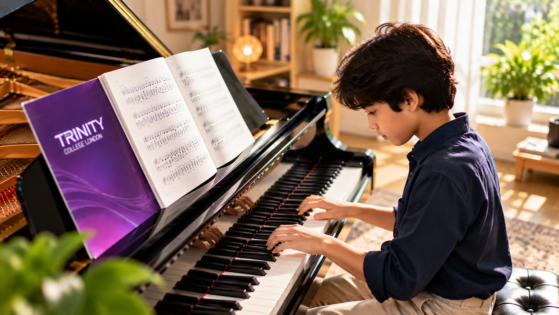
Trinity Initial Piano Repertoire | What Can Students Play?
One of the most enjoyable parts of the Trinity Initial exam is its wide range of repertoire.
The current Initial list features pieces such as The Sleeping Doll by K. Akimov, Canon by Henk Badings, Dialogue and Imitation and Inversion by Béla Bartók, Conversation by Nathalie Béra-Tagrine, Diversion 7 by Juan Cabeza, Tickery Tockery by Kay Charlton and Autumn Waltz by Seána Davey.
This variety gives teachers plenty of scope when selecting pieces. They can consider the student’s ability, musical interests, strengths and areas for improvement.
For instance, a student may enjoy a lively rhythmic piece. Another learner may prefer a slower and more lyrical work. When students enjoy their repertoire, they often approach practice with greater interest and consistency.
At the same time, teachers should aim for a balanced selection. The easiest three pieces may not provide enough musical variety. Instead, the chosen repertoire should challenge the student appropriately while helping them develop different aspects of piano playing.
Why Repertoire Selection Matters
Choosing the right pieces can make a significant difference to the preparation process.
A beginner may be tempted to select a piece simply because it sounds easy. However, a piece that appears simple on the page can still present challenges involving rhythm, coordination, articulation, dynamics or musical expression.
A good teacher therefore looks beyond the number of notes. The selection should allow the student to demonstrate control while also giving enough opportunity to develop musically.
Furthermore, Trinity permits candidates to perform an own composition in place of one listed piece. At Initial level, an own composition should have a comparable technical and musical demand to the listed repertoire and may include features such as different rhythmic values, a clear melodic line and use of the keys associated with Initial technical work.
For students who enjoy creating their own music, this can add a particularly personal element to the examination experience.

Scales and Technical Work at Initial Level
Technical preparation plays an important role in learning the piano, even at the beginner level.
The current Initial syllabus includes C major and A minor, along with broken triads in both keys. For the digital technical pathway, candidates can choose Set A or Set B. Each set assigns the hands differently. Students play the scales for one octave at a minimum tempo of ♩ = 60, following the required dynamics and articulation.
These exercises may look simple, but they build essential piano skills.
Students develop finger control, hand coordination and a steady sense of pulse. They also practise playing from memory when the syllabus requires it. These skills support progress at higher piano grades.
For this reason, students should practise technical work regularly rather than only before the exam. Even a few focused minutes during each practice session can improve control and make the movements more natural.
Technical Exercises | Building Control and Coordination
Alongside scales and broken triads, Trinity Initial preparation includes technical exercises. These exercises are intended to develop practical playing skills that students can apply directly to their repertoire.
A beginner might initially focus on simply playing the correct notes. As preparation progresses, attention shifts towards how those notes are played.
The student begins to develop better finger coordination, control of tone, hand independence and musical balance. These improvements can then become noticeable in the repertoire pieces as well.
This connection between technique and performance is one of the valuable aspects of a structured exam syllabus. Instead of learning technique separately from music, students gradually learn to use technical skills to make their performances more controlled and expressive.

What Does a Student Need to Know Before the Exam?
A student preparing for Trinity Initial should ideally feel comfortable with more than simply playing the notes of the selected pieces.
The learner should be able to maintain a steady pulse, recognise basic musical markings and follow the score with increasing independence. Dynamics, articulation and phrasing should also become part of the performance rather than being added at the very end.
Memory and confidence matter too, particularly for technical work that is required from memory. However, preparation should be gradual rather than based on pressure or last-minute repetition.
This is where regular teacher feedback becomes especially valuable. Small issues with fingering, rhythm or posture can be corrected early, before they become habits that are difficult to change.
How Online Piano Lessons Can Prepare Students for Trinity Initial
Online piano learning can work particularly well for exam preparation when lessons are structured around the student’s individual needs.
With one-to-one online lessons, the teacher can observe the student’s playing, identify specific challenges and adjust the lesson accordingly. A student struggling with a particular scale can spend additional time on that skill, while another learner who is already comfortable with scales can dedicate more lesson time to musical expression.
The flexibility of online learning can also make regular practice easier to incorporate into a student’s routine. Instead of travelling to a physical classroom, learners can attend their scheduled lesson from home using platforms such as Zoom or Google Meet.
However, successful online preparation still depends on consistent practice between lessons. The lesson provides direction and feedback, while regular independent practice helps turn that guidance into reliable playing.
A Step-by-Step Approach to Online Exam Preparation
A structured preparation plan can make the entire process much less stressful.
Start With the Fundamentals
The first stage should focus on posture, hand position, finger coordination, rhythm and basic note reading. At this point, the emphasis should be on building correct habits rather than rushing towards the exam.
Once these foundations become comfortable, the teacher can introduce appropriate Initial-level repertoire and technical work.
Build the Repertoire Gradually
Instead of trying to perfect all three pieces simultaneously, students can first become familiar with the notes, rhythm and fingering of each piece.
After the basic notes become secure, musical elements such as dynamics, articulation, phrasing and expression can be developed. This gradual progression helps prevent the student from becoming overwhelmed.
Add Technical Work to Regular Practice
Scales, broken triads and exercises can be included in short, focused practice sessions.
Because technical work requires accuracy and consistency, practising for a few concentrated minutes regularly is often more productive than attempting a long technical session immediately before a lesson.
Move Towards Performance Practice
Once the pieces are reasonably secure, preparation can shift from learning to performing.
Students can practise playing a complete piece without stopping, even if a small mistake occurs. This teaches them an important performance skill: continuing confidently instead of losing concentration after an error.
Introduce Mock Exam Practice
As the examination approaches, online lessons can include mock performances. The student can play the repertoire and technical work in an exam-like sequence while the teacher observes.
This helps identify practical issues that may not be obvious during ordinary practice. It also gives the student an opportunity to become comfortable performing while being observed through a camera.
How Much Should a Beginner Practise?
There is no single practice duration that works for every learner.
Age, previous musical experience, concentration level and the amount of time available during the week all influence an effective practice routine. For a beginner, consistent and focused practice is generally more useful than occasional long sessions.
A student might divide practice into small sections: technical work first, followed by repertoire and then a short performance run-through. As the exam approaches, more time can gradually be devoted to complete performances.
Parents can also help by creating a predictable practice routine without turning every session into a stressful activity. Encouragement, patience and consistency can make a considerable difference, especially for younger learners.
Common Challenges During Trinity Initial Preparation
One of the most common challenges is learning the notes accurately but overlooking the musical details.
A student may be able to play every note correctly while still needing improvement in rhythm, dynamics, articulation or phrasing. This is why preparation should move beyond simple note memorisation.
Another challenge is inconsistency. A piece might sound excellent during one practice session and fall apart during another. Regular repetition, slower practice and occasional performance-style run-throughs can gradually improve reliability.
Technical work can also feel repetitive to beginners. Connecting scales and exercises to the actual pieces they are learning can make the purpose clearer and help students understand why these skills matter.
Preparing for a Digital Trinity Piano Exam
For a digital assessment, students should practise the recording setup in advance.
The current Initial technical pathway requires either Scale Set A or Set B, followed by the required exercises.
Students should practise playing in front of a camera. They should keep the piano or keyboard clearly visible. The setup should also capture clear audio.
Teachers can include mock recording sessions in online lessons. These sessions help students get comfortable with the format. They also make the actual assessment feel more familiar.
Most importantly, students should check the latest Trinity syllabus and assessment requirements before taking the exam. Trinity recommends using the current syllabus as the main reference for exam requirements.
How Teachers Support Students During Online Preparation
A teacher’s role extends well beyond correcting wrong notes.
During an online lesson, the teacher can help the student understand why a particular fingering works, how to approach a difficult rhythm or how to shape a musical phrase. The teacher can also identify whether a piece is genuinely ready for performance or needs additional preparation.
Personalised feedback becomes especially valuable because beginners progress at different rates. One student may need additional support with reading music, while another may need more work on coordination or expression.
Regular guidance also helps prevent inefficient practice. Rather than repeatedly playing a difficult passage incorrectly, the student learns how to isolate the problem, slow it down, practise it correctly and gradually bring it back up to performance speed.
Making the Trinity Initial Exam a Positive Experience
An exam should not become the only reason a student plays piano.
The most valuable outcome of Initial preparation is the collection of skills the learner carries forward: reading music, maintaining rhythm, controlling dynamics, understanding basic technique and performing with greater confidence.
That is why preparation should include moments of enjoyment alongside focused technical work. Students can continue playing music outside the syllabus, experiment with sounds and explore pieces they personally enjoy.
When exam preparation is approached as part of a broader musical journey, the assessment becomes an opportunity to demonstrate progress rather than simply a test to get through.
Trinity Initial Piano Exam | A Foundation for Future Grades
The Initial level is only the beginning of a much longer musical journey.
The skills introduced at this stage become building blocks for future grades. Basic scales develop into more extensive technical work, simple pieces lead towards increasingly varied repertoire, and early performance habits become important as musical demands grow.
Trinity’s current piano pathway provides repertoire across the levels with a wide variety of musical styles and genres, allowing students to continue exploring different kinds of music as their ability develops.
Therefore, the real value of Initial preparation lies not only in completing one examination. It is about giving a beginner the confidence and musical foundation needed to continue learning.
Begin Your Trinity Initial Piano Journey Online
Preparing for a Trinity Initial Piano exam does not require students to travel to a music school or follow a fixed routine. With personalised one-to-one online piano lessons, students can follow the syllabus at a pace that matches their learning needs.
Teachers can guide students through every stage of preparation. They can help students select suitable repertoire, practise technical exercises, improve musical expression and build confidence through mock performances.
At The Mystic Keys, teachers tailor online piano lessons to each learner’s goals, current ability and pace. Regular guidance and consistent practice help beginners prepare for their Trinity Initial exam while building strong piano skills for the future.
Ready to begin your piano journey? Explore personalised online piano lessons and start preparing for your Trinity Initial exam from the comfort of your home.
For more information and exciting resources about learning music, visit our website at The Mystic Keys. For more music content and exciting offers follow us on Facebook, Instagram, YouTube, LinkedIn,
Twitter, Pinterest, and Threads.