Trinity Grade 8 Piano Syllabus | Exam Guide & Preparation
Reaching Trinity Grade 8 Piano is a significant milestone in a pianist’s musical journey. By this stage, students are expected to move beyond simply playing notes accurately. They need to demonstrate control, musical expression, technical confidence, stylistic awareness, and the ability to communicate the character of a piece through performance.
Trinity College London’s Grade 8 Piano examination is designed to assess these advanced skills through a combination of repertoire, technical work, and supporting musicianship skills. The syllabus also offers a broad choice of repertoire, allowing pianists to select music that suits their strengths and musical interests.
For students preparing for the examination, however, Grade 8 can feel considerably more demanding than earlier levels. Pieces require greater musical maturity, technical passages need consistency and control, and supporting tests demand a deeper understanding of rhythm, harmony, style, and musical communication.
The good news is that effective preparation can make the process much more manageable. With the right repertoire, a structured practice routine, and guidance from an experienced teacher, Grade 8 preparation can become an opportunity to develop as a complete musician rather than simply prepare for an examination.
Understanding the Trinity Grade 8 Piano Syllabus and Examination
Before beginning preparation, it is important to understand what the examination actually assesses. Trinity’s current Classical & Jazz Piano graded structure for Grades 6–8 includes three performance pieces, technical work, sight-reading, and one additional supporting test chosen between aural and improvisation for face-to-face examinations.
The examination is therefore not based entirely on repertoire. While the three pieces form a substantial part of the assessment, technical ability and musicianship also play an important role.
For candidates choosing the digital Technical Work pathway, the structure is slightly different. Students perform three pieces, technical work, and are assessed on their overall performance rather than taking the separate supporting tests used in a face-to-face examination. Trinity also offers a Repertoire-only digital pathway, in which candidates perform four pieces from the relevant repertoire list.
Understanding these options early helps students and teachers build a preparation plan around the exact examination route they intend to take.
What Makes Grade 8 Different?
At earlier grades, much of the focus may be on developing basic technique, reading ability, coordination, and musical expression. By Grade 8, these skills are expected to be much more established.
Instead, the pianist needs to demonstrate musical independence.
A technically correct performance is not necessarily enough. The examiner is also listening for phrasing, articulation, dynamics, tone quality, balance between voices, rhythmic stability, stylistic understanding, and the ability to shape a complete musical argument.
This is why Grade 8 preparation often requires a different mindset. Rather than practising a difficult passage repeatedly until the fingers can play it, students need to understand why the passage sounds the way it does and how it contributes to the overall character of the composition.
That shift from playing accurately to performing convincingly is one of the most important developments at this level.
Trinity Grade 8 Piano Syllabus Repertoire
One of the most appealing aspects of Trinity’s Piano syllabus is the breadth of repertoire available to candidates. The current syllabus includes music from different periods, styles, and musical traditions, giving students considerable choice when selecting their examination pieces. Trinity describes its Piano syllabus as offering a wide selection spanning Western classical music, 20th-century repertoire, jazz, Latin standards, global popular music, and music from stage, screen, and video games.
At Grade 8, this variety becomes particularly valuable because the right repertoire can allow a student to demonstrate their individual strengths.
For example, one pianist may excel at expressive Romantic repertoire, while another may have strong rhythmic control and enjoy contemporary or jazz-influenced pieces. Rather than selecting pieces solely because they appear difficult, students should consider whether the repertoire allows them to demonstrate musicality, technical control, stylistic understanding, and performance confidence.
The current Grade 8 repertoire includes composers and artists such as J. S. Bach, Béla Bartók, Ludwig van Beethoven, Chris Caine, and Rob Colley, among many others.
The repertoire list should always be checked against the current Trinity syllabus, because examination requirements and available repertoire can change over time. Trinity itself advises candidates and teachers to use the current syllabus as the primary source when selecting examination material.
Choosing Pieces from the Trinity Grade 8 Piano Syllabus
Choosing repertoire is one of the earliest and most important decisions in Grade 8 preparation.
A piece may sound impressive, but that does not automatically make it the right choice for a particular pianist. Technical difficulty is only one part of the equation. The student’s ability to communicate the music convincingly should be considered as well.
A good repertoire selection should ideally provide a balance of contrasting styles and musical characteristics. One piece may highlight lyrical playing and tone control, another may demonstrate rhythmic precision and technical agility, while a third can reveal the student’s ability to handle complex textures and dramatic expression.
It is also worth considering how naturally the music fits the pianist’s strengths. A technically challenging piece that remains uncomfortable after months of practice may consume valuable preparation time without producing the strongest performance.
For this reason, teachers often assess a student’s technique, musical personality, reading ability, and previous repertoire before finalising the Grade 8 selection.
Technical Work in the Trinity Grade 8 Piano Syllabus
Technical work is essential for Grade 8 preparation. Scales and arpeggios go beyond finger exercises. They build the control needed for advanced repertoire.
For the current Grade 8 Piano syllabus, candidates on the technical-work route prepare either Set A or Set B of scales and arpeggios from memory. Each set includes specific requirements for articulation, dynamics, motion, range, and tempo. Candidates also prepare exercises from the Grade 8 exercise groups.
These exercises develop key skills such as tone, balance, voicing, coordination, and finger and wrist flexibility.
Technical practice should focus on control, not just speed. A student may play a scale quickly but still struggle with evenness or dynamics. Practising with relaxed movements and clear control helps build stronger technique.
Developing Strong Technique Through Practice
Technical exercises become far more effective when they are integrated into everyday practice rather than treated as a separate task just before the examination.
A student can begin slowly, paying close attention to finger movement, posture, wrist flexibility, articulation, and sound quality. Once the movement becomes reliable, tempo can gradually increase without sacrificing control.
This approach is particularly useful for Grade 8 because difficult repertoire often contains fast passages that demand the same underlying skills developed through scales and arpeggios.
Over time, technical practice should become less about getting through the exercise and more about developing a dependable physical technique that supports expressive playing.
Sight-Reading in the Trinity Grade 8 Piano Syllabus
Sight-reading can strongly affect a candidate’s overall performance. At Grade 8, students must approach unfamiliar music with confidence and keep the music flowing.
Good sight-reading requires steady rhythm and hand coordination. Students should also recognise patterns, intervals, chords, scales, and common musical structures quickly.
Regular practice works better than last-minute preparation. Spend a few minutes each day reading unfamiliar music without stopping to fix every mistake.
Focus on keeping the rhythm steady and maintaining musical continuity. With practice, students learn to recognise patterns instead of processing every note individually.
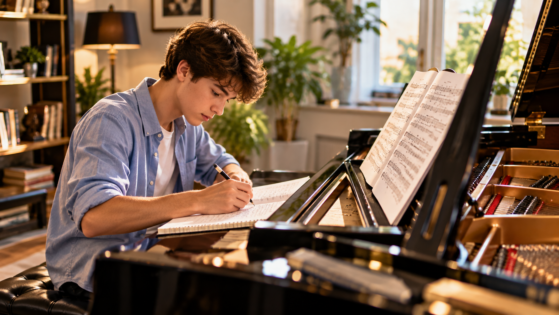
Aural Skills and Improvisation
For face-to-face Grade 8 examinations, the supporting tests include sight-reading and a choice between aural or improvisation.
These areas test musicianship in a different way from prepared repertoire.
Aural preparation, for instance, requires the student to listen carefully to musical details such as dynamics, articulation, texture, and style. Improvisation, on the other hand, requires the pianist to respond creatively to a musical stimulus while maintaining an appropriate sense of harmony, rhythm, and style.
Both skills can initially feel unfamiliar to students who are accustomed to practising only written music. However, regular exposure can make them much less intimidating.
Listening to a wide range of music, identifying musical features, experimenting with short improvisations, and discussing what is heard during lessons can gradually strengthen these abilities.
Building Musical Expression into Every Piece
Once the notes are learned, the real work begins.
At Grade 8, students should think carefully about phrasing, dynamics, articulation, voicing, tempo, tone colour, and musical direction. Every section of a piece should have a purpose.
A melody should not disappear beneath accompaniment simply because both hands are technically accurate. Similarly, a dramatic passage should not become uncontrolled simply because it is marked forte.
Musical expression depends on balance and intention.
Students can begin by identifying the main musical ideas in each piece. Where does the phrase lead? Which voice carries the melody? Where does the tension increase? Where should the music relax? Which sections provide contrast?
Answering these questions helps transform a collection of notes into a coherent performance.
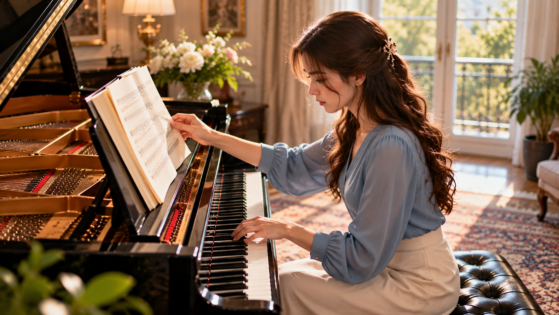
How to Structure Trinity Grade 8 Piano Practice
Effective practice does not necessarily mean spending hours playing the same pieces from beginning to end.
A structured practice session can be divided between technical work, repertoire, sight-reading, and supporting musicianship. This allows different skills to develop consistently without allowing one area to dominate the preparation.
For example, a student might begin with scales and arpeggios, move into focused work on difficult repertoire passages, spend time on interpretation and complete runs, and finish with sight-reading or aural/improvisation work.
The exact schedule can vary depending on the student’s strengths and weaknesses. Someone with strong technique but weaker sight-reading may need to devote more time to unfamiliar scores, while another student may need greater attention to musical expression and performance confidence.
The important factor is consistency.
Common Challenges with Trinity Grade 8 Piano Preparation
Grade 8 preparation can bring several challenges, particularly when students approach it with habits that worked well at earlier levels.
One common problem is over-focusing on technical accuracy. Students may spend weeks correcting wrong notes while neglecting phrasing, dynamics, articulation, and musical character.
Another challenge is leaving supporting skills until the final stages of preparation. Sight-reading, aural work, and improvisation require gradual development, so trying to learn them shortly before the exam can create unnecessary pressure.
Performance anxiety can also become more noticeable at this level. A student may play confidently during lessons but struggle to maintain concentration when performing under examination conditions.
That is why mock performances are valuable. Playing for a teacher, family member, or small audience can help students become comfortable with maintaining focus while being observed.

Preparing for the Final Weeks
As the examination approaches, preparation should gradually move from learning toward refining and performing.
Instead of constantly changing fingerings or attempting to relearn sections, students should work on consistency. Complete performances should become more frequent, while difficult passages can still receive targeted attention.
Recording practice performances can also be extremely useful. Listening back may reveal issues that are difficult to notice while playing, such as uneven tempo, excessive pedal use, unclear melody lines, or insufficient contrast between sections.
At this stage, the goal is not to make every performance identical. Rather, students should become comfortable enough with the music that they can recover calmly if a small mistake occurs.
Preparing for Trinity Grade 8 Piano Exam Day
Good preparation extends beyond the piano itself.
Students should be familiar with the required examination format, the order in which they intend to present their work, and any specific requirements associated with their chosen pathway. Trinity allows candidates to present their face-to-face exam in their preferred order, with the sequence indicated to the examiner.
A calm routine before the examination can also help. Arriving with enough time to settle down, checking the required materials, and avoiding excessive last-minute practice can help preserve concentration.
Most importantly, students should remember that an examination performance is not simply a test of whether every note is perfect. It is an opportunity to demonstrate the musical skills developed throughout the preparation process.
Face-to-Face or Digital Grade 8 Exam?
Trinity currently provides different assessment options, including face-to-face examinations and digital examinations. Digital candidates can choose between a Technical Work pathway, which combines three pieces with technical work and overall performance assessment, and a Repertoire-only pathway, which focuses on four repertoire pieces.
The choice depends on the student’s circumstances, strengths, and preferred method of assessment.
A digital examination may suit students who are comfortable preparing and recording a performance, while a face-to-face examination provides the experience of performing directly for an examiner. Neither route should be selected simply because it appears easier; the complete requirements of the chosen pathway should be understood before preparation begins.
The Role of a Piano Teacher in Grade 8 Preparation
At Grade 8, students need strong independent practice. However, expert guidance still plays an important role.
A teacher can spot technical weaknesses early. They can also help select suitable repertoire, improve interpretation, structure practice, and give clear performance feedback.
More importantly, a good teacher shows students how to practise effectively. They guide each session instead of simply assigning tasks.
This guidance matters even more with advanced repertoire. Small technical issues can become major challenges as the music grows faster, denser, and more expressive.

How Long Does Grade 8 Preparation Take?
There is no single preparation period that suits every pianist.
A student’s previous training, technical foundation, practice consistency, reading ability, repertoire choice, and musical maturity all influence the amount of time required.
Someone who has already developed strong Grade 7-level technique may progress through the syllabus more efficiently than a student who needs to strengthen fundamental skills first.
Rather than rushing toward an examination date, it is better to establish clear milestones. Pieces should be learned securely, technical requirements should become reliable, supporting skills should be practised consistently, and complete performances should gradually become more confident.
A Practical Grade 8 Preparation Strategy
A successful preparation plan can be thought of in stages.
Stage 1: Assessment and Repertoire Selection
Begin by evaluating the student’s current level and identifying suitable repertoire. At this point, technical gaps should also be noted so that they can be addressed early.
Stage 2: Learning the Repertoire
The next phase focuses on notes, rhythm, fingering, articulation, and basic interpretation. Difficult sections should be isolated rather than repeatedly practised only within complete runs.
Stage 3: Musical Development
Once the notes are secure, attention can shift toward phrasing, tone, dynamics, voicing, pedal control, stylistic character, and overall musical direction.
Stage 4: Supporting Skills
Sight-reading and the chosen supporting test should be incorporated regularly rather than treated as last-minute preparation.
Stage 5: Performance Preparation
Mock examinations, recorded performances, complete runs, and targeted corrections can then help bring everything together.
This gradual progression allows the student to move from learning the music to owning the performance.
Final Tips for Trinity Grade 8 Piano Candidates
Grade 8 is an advanced level, but a clear plan can make preparation easier.
Keep the current syllabus handy. Check the latest repertoire and technical requirements before planning the exam. Trinity recommends using the current syllabus as the main reference.
Practise difficult passages slowly first. Increase the speed only when you gain control. Focus equally on technique and musical expression. Practise sight-reading and supporting skills throughout your preparation.
Most importantly, look beyond the number of pieces you complete. Build confidence, independence, expression, and musical awareness as you prepare.
Conclusion
Trinity Grade 8 Piano marks an important stage in a pianist’s journey. It brings technique and musicianship together.
The repertoire develops style, expression, and confidence. Technical work builds control and precision. Supporting skills such as sight-reading, aural awareness, and improvisation help students become more versatile musicians.
With the right repertoire, regular practice, and expert guidance, students can approach Grade 8 with confidence. The Mystic Keys supports aspiring pianists with personalised learning and guidance throughout their musical journey.
For students looking for flexible Piano Lessons Online, structured one-on-one classes can provide focused practice, expert feedback, and steady progress toward their musical goals.
The goal goes beyond passing the exam. Students should learn to use technique to express ideas, shape musical phrases, and perform with confidence.
For more information and exciting resources about learning music, visit our website at The Mystic Keys. For more music content and exciting offers follow us on
Facebook, Instagram, YouTube, LinkedIn, Twitter, Pinterest, and Threads.